

Summary
A useful men’s preventive-health checklist is a conversation plan, not a shopping list of tests. Bring your health history, medicines, prior results and questions. Screening decisions depend on age, relevant organs, risk, earlier findings and local guidance. New symptoms need assessment; they should not wait for a routine screening visit.
This guide helps you prepare for a primary-care appointment, compare the purpose of common screening discussions, and understand why more testing is not always better. The examples use US guidance where identified. Your clinician should apply the recommendations appropriate to your circumstances and location.
What you’ll understand
- Separate screening from symptoms. A preventive test and an investigation of a symptom have different jobs.
- Bring the context. Family history, previous results and medicines can change the next step.
- Ask about benefit and harm. False alarms and follow-up procedures matter as well as possible benefit.
- Discuss everyday health. Sleep, mood, tobacco use, alcohol and sexual health belong in the conversation.
- Clarify the follow-up. Know who reviews a result and when to contact the practice.
- Use the planner carefully. Priority counts organize questions; they are not a disease-risk score.
Start with these steps
- Collect recent results and a current medicine list.
- Choose a few questions that matter most to you.
- Ask which screening recommendations apply and why.
- Leave with a result-review and follow-up plan.
General health education, not an individualized screening schedule. Seek timely or urgent assessment for new or severe symptoms rather than waiting for a planned checkup.
What belongs in a preventive-health visit?
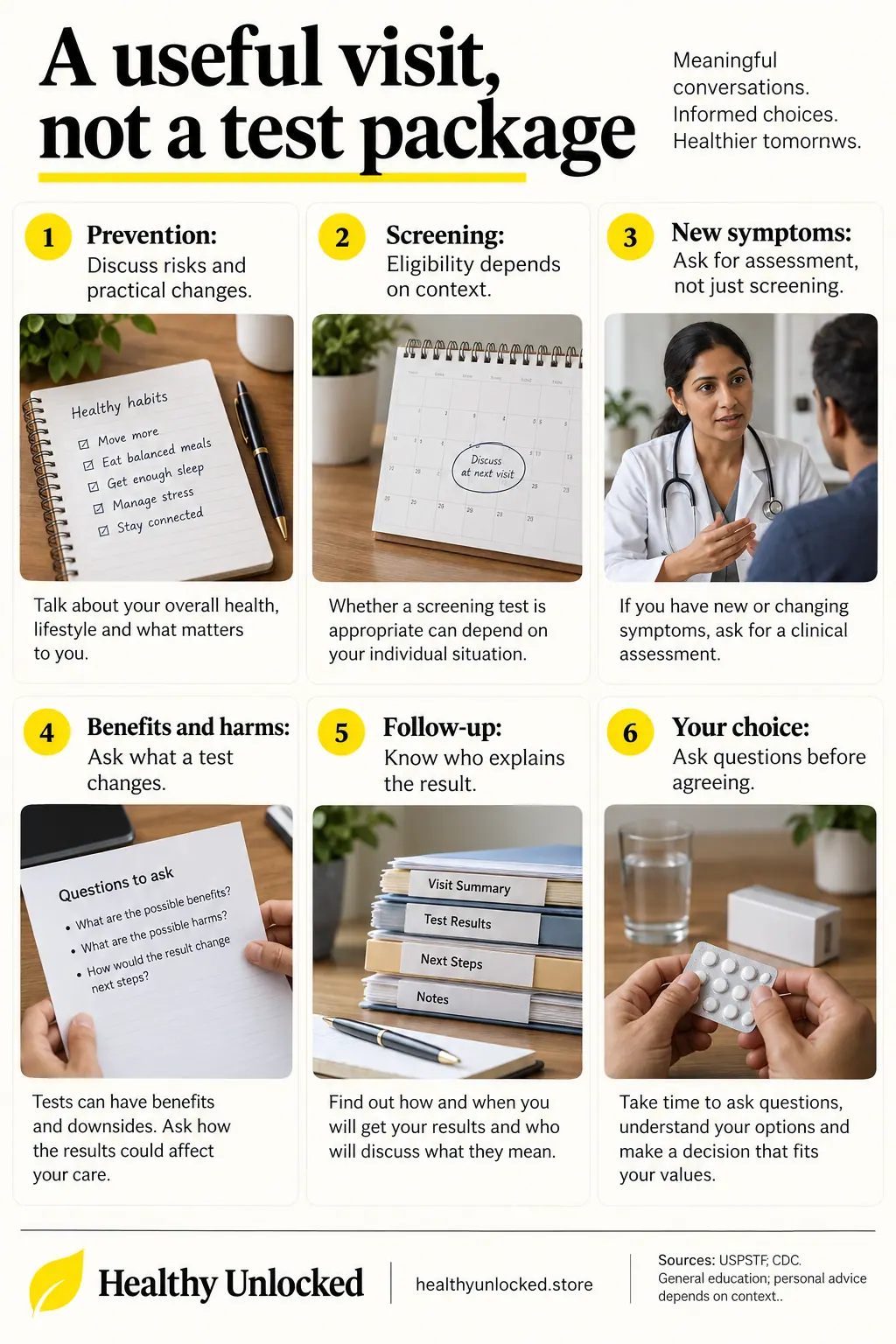
Preventive care looks for opportunities to reduce health risks and identify some conditions before they cause symptoms. A visit may include reviewing history, measuring something relevant, discussing vaccines, deciding whether a screening test applies, and agreeing on manageable changes. It need not include a large laboratory panel to be useful.
Screening generally concerns people without the symptom that a test is intended to investigate. If you have a new lump, persistent bleeding, chest discomfort or another new concern, say so when booking and at the start of the visit. The clinician may need a diagnostic assessment rather than a routine screening pathway. Do not describe a symptom as “just something for my annual tests.”
The US Preventive Services Task Force publishes recommendations for defined groups. Its guidance is a useful source, but a headline alone cannot supply your personal plan. Read who a recommendation applies to, its date, the relevant risk factors, and any limits before treating it as an instruction.
A preventive visit can also be useful when no new test is recommended. You may clarify a past result, update a vaccine record, discuss tobacco use, or decide which change feels possible this month. Those are concrete outcomes. A normal test result does not replace the rest of the conversation or guarantee that nothing can change later.
Use this checklist to prepare a discussion, not to mark yourself as healthy or unhealthy. There is no universal “men’s health package” in this article. A useful plan fits the person, including relevant organs and prior care, rather than assuming that everyone described as a man has the same anatomy or screening needs.
| Visit task | What it aims to do | A useful question |
|---|---|---|
| Prevention | Discuss risks and practical ways to reduce them | What is worth prioritizing for me now? |
| Screening | Look for a specified condition in an eligible person without related symptoms | Does this recommendation apply to my history and risk? |
| Diagnostic assessment | Investigate a symptom or a concerning finding | Does this new symptom change the plan? |
| Follow-up | Review findings and decide what happens next | Who will explain the result and when? |
Do not measure a visit by the number of tests
A test can produce a false-positive result, an uncertain finding or an unnecessary procedure. More testing may also cost time and money without adding useful information. Ask what decision the proposed test would change. If a test is not recommended, ask for the explanation rather than assuming that the concern was dismissed.
Conversely, do not reject an appropriate test simply because you feel well. Feeling well and meeting screening criteria are different issues. The decision is best made with an explanation of benefits, possible harms and alternatives, including the option of waiting when that fits the guidance and your situation.
Which personal details change screening decisions?
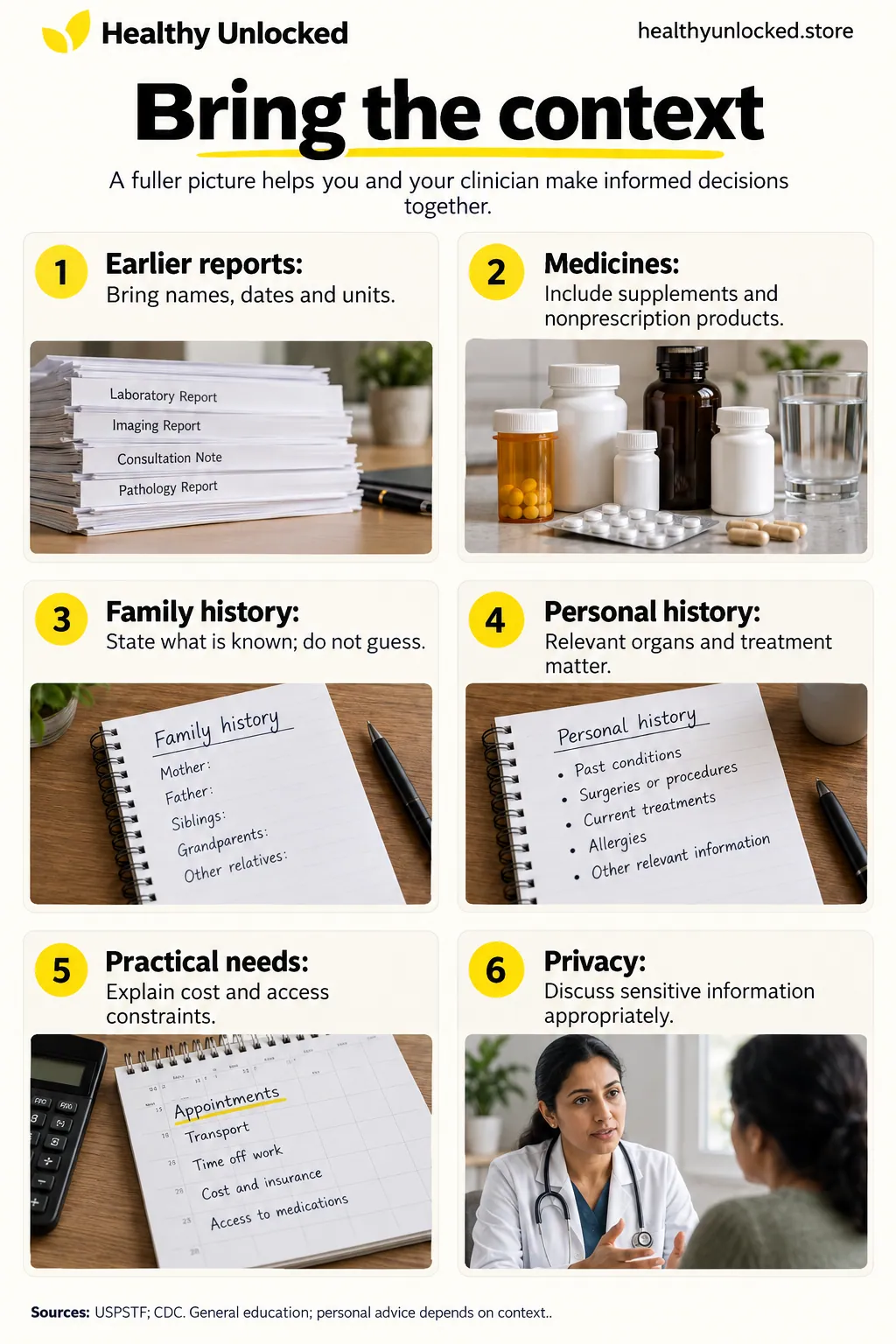
Your history helps a clinician decide which recommendations fit. Bring prior diagnoses, operations, relevant family history, previous screening results and current medicines. Include supplements and medicines bought without a prescription. A supplement can matter to the conversation even if its packaging describes it as natural.
Family history is more useful when it is specific. If you know a relative’s condition and roughly when it was diagnosed, record that. If you do not know, say so; do not guess an age to fill a form. The clinician can decide whether the available history changes care or whether further information would help.
Previous results can prevent a test from being repeated unnecessarily and can also identify a follow-up that was missed. Bring the report rather than only saying that a value was high or low. Units, dates, the laboratory reference range and the circumstances of testing may matter. A screenshot without the name of the test can be difficult to interpret.
Relevant anatomy and treatment history should be discussed respectfully and privately. Screening is not determined by gender labels alone. If a question about an organ or past treatment feels unexpected, ask why it is relevant. You should be able to understand how it affects the proposed care without being reduced to a checklist category.
Work patterns, access to appointments, costs and caregiving responsibilities may affect what is practical. Explain those constraints. A plan that requires a follow-up you cannot access needs discussion, not silent agreement. Prevention works better when the next step can actually be completed and the practice knows how to reach you.
| Bring or describe | Why it matters | If you do not have it |
|---|---|---|
| Previous test reports and dates | May change eligibility or follow-up | Ask the prior service for a copy when feasible |
| Current medicine and supplement list | May affect testing or other care | Bring packaging or a clear photo |
| Relevant family history | May change risk assessment | State what is known and what is uncertain |
| Personal diagnoses and relevant anatomy | Recommendations apply to particular circumstances | Discuss privately with the clinician |
| Practical constraints | Follow-up must be feasible | Ask about suitable alternatives and access |
A recommendation is not a prediction
Being in a group for which screening is recommended does not mean that you will develop the condition. Being outside a routine screening group does not mean that a new symptom should be ignored. Keep those distinctions in mind when reading age ranges or risk factors online.
Guidelines are updated as evidence changes. Check the current recommendation, including whether a document is final or only a draft. If you read two different recommendations, bring the sources to the appointment and ask how your clinician is applying the guidance rather than trying to resolve the disagreement from a headline.
What should you ask about heart and metabolic health?
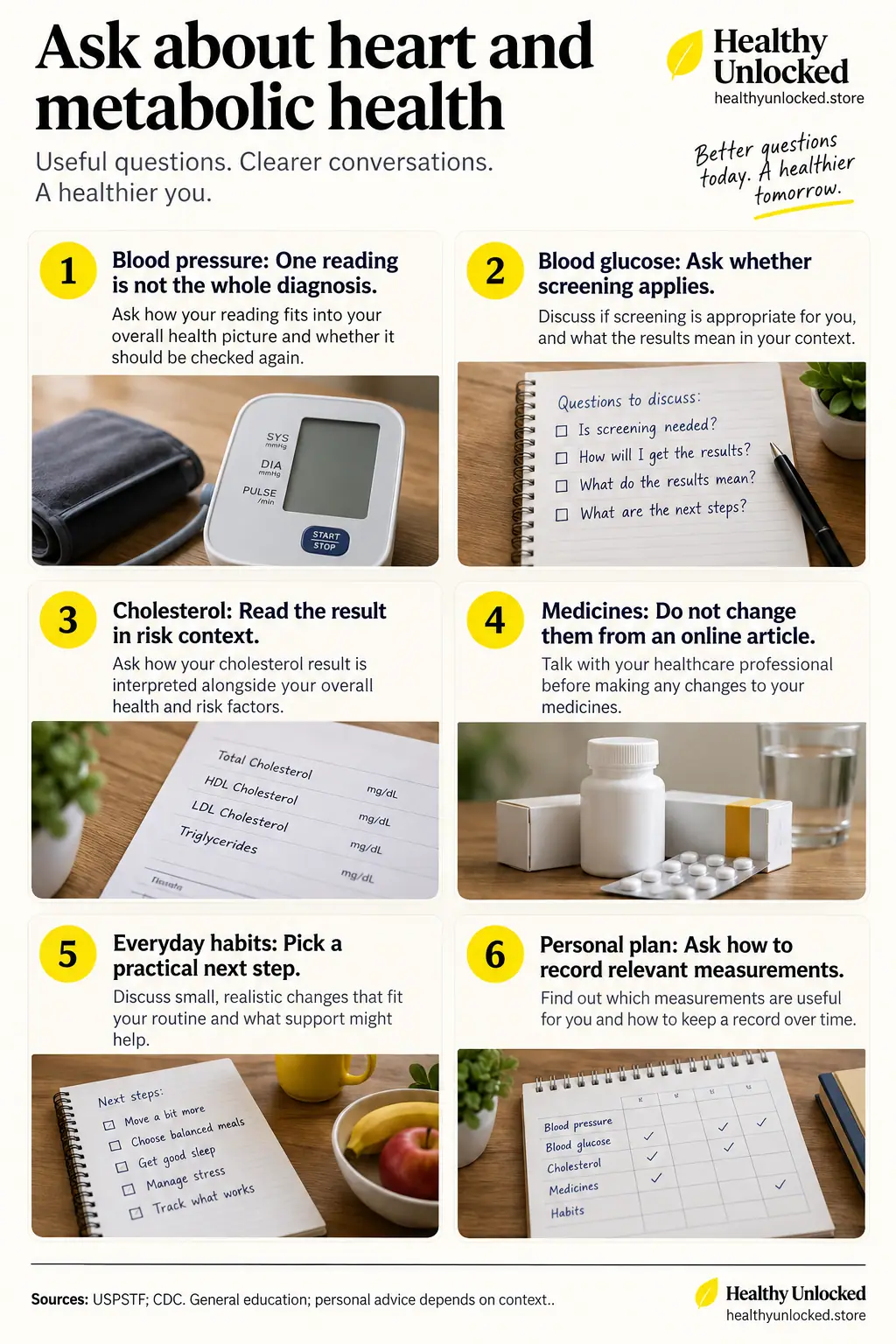
Blood pressure is an important preventive discussion because high blood pressure can be present without obvious symptoms. The USPSTF recommendation on adult blood-pressure screening distinguishes an initial measurement from confirmation of a diagnosis. A single reading taken in an unsuitable situation should not automatically become a lifelong label.
Ask how a measurement was taken and what follow-up is needed if it is above the expected range. If home measurements are advised, ask which device and method are suitable and how the practice wants the results recorded. Do not change medicines on the basis of this article or turn an unverified device reading into a treatment decision.
Discuss whether blood-glucose testing is appropriate. The USPSTF guidance on prediabetes and type 2 diabetes screening applies to specified populations rather than everybody buying a yearly panel. Age, weight-related risk, history and local guidance can affect the discussion. Symptoms that raise concern need their own assessment.
Cholesterol and cardiovascular risk also belong in a conversation about context. A laboratory number is not the entire decision. The USPSTF recommendation on statins for prevention explains a risk-based approach for a defined group. This article does not calculate your cardiovascular risk or recommend starting a medicine.
Everyday habits remain relevant whether a test is due or not. Describe activity, tobacco exposure, food routines and what would be realistic to change. Our beginner walking plan and protein and fiber food guide offer practical background; neither replaces a clinician’s advice for a medical condition.
| Topic | Ask this | Avoid this shortcut |
|---|---|---|
| Blood pressure | Do I need confirmation or a measurement plan? | Treating one reading as a complete diagnosis |
| Blood glucose | Does screening apply to my current circumstances? | Assuming every yearly panel is necessary |
| Cholesterol and risk | How does this result fit my overall risk? | Choosing treatment from one number alone |
| Medicines | What should I continue and what needs review? | Stopping or adding a medicine without advice |
| Everyday habits | Which change is practical and worth prioritizing? | Assuming a normal result replaces prevention |
Bring the context of a home measurement
If you already have a measurement record, bring the date, device information and method you were told to use. Describe any symptoms separately. Ask whether the record is useful or should be repeated using an agreed method. More entries are not necessarily better when the method is unclear.
The appointment-priority planner below does not use blood pressure, glucose, cholesterol, body measurements or family history to produce a risk score. That is intentional. It can organize your questions without pretending to interpret clinical information it cannot assess.
How should you discuss cancer screening?
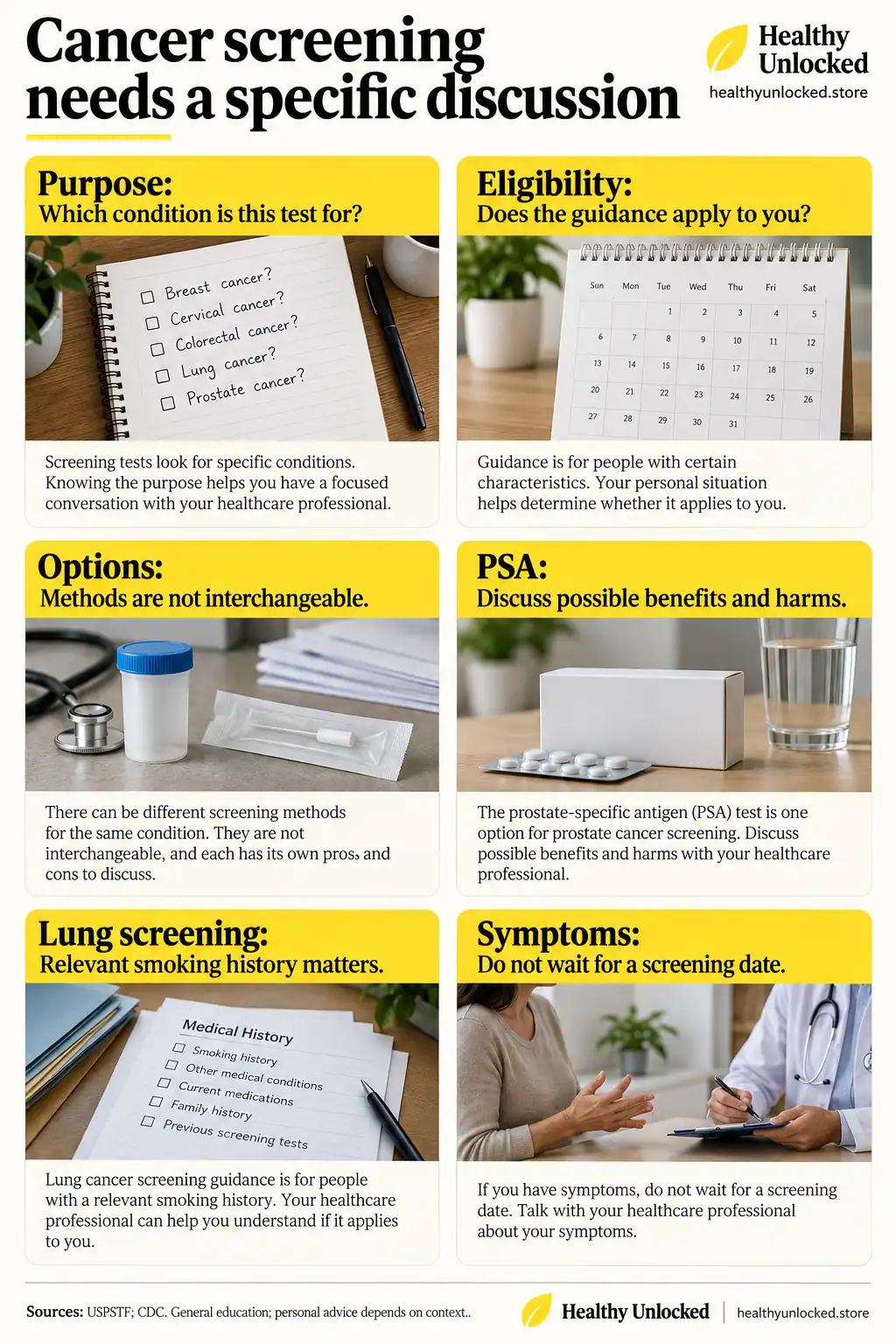
Cancer screening is not one test and does not have one schedule for all cancers. Eligibility, benefits, harms and follow-up differ. Begin with the condition a test is intended to detect, whether the recommendation applies to you, and what a positive or uncertain result would lead to. A useful discussion is more specific than asking for “all cancer tests.”
The USPSTF colorectal-cancer screening recommendation explains screening options for eligible adults. If screening is relevant, ask about the available methods, preparation, frequency and follow-up after an abnormal result. The option that fits your circumstances may depend on local services and your previous history.
Prostate-specific antigen testing, usually called PSA, is a separate decision. The USPSTF prostate-cancer screening guidance describes benefits and harms and the importance of an informed discussion for an eligible group. PSA is not a simple guarantee that cancer is absent or present. Discuss urinary symptoms separately rather than treating them as a routine screening request.
Lung-cancer screening is also intended for a defined group with relevant smoking history, not for every person who wants a chest image. The USPSTF lung-cancer screening recommendation explains this context. If smoking history is relevant, describe it accurately and ask how eligibility is assessed, without assuming that any scan is an equivalent screening test.
New bleeding, a changing lump, unexplained persistent symptoms or a concerning skin change should be raised as a symptom assessment. Do not wait for your next eligible screening date. A person may need investigation even when a routine screening test is not recommended for their age or risk.
| Discussion | What to clarify | Important limit |
|---|---|---|
| Colorectal screening | Eligibility, method and follow-up after an abnormal finding | Methods and intervals are not interchangeable |
| PSA screening | Individual benefits, possible harms and what happens after a result | A result alone does not confirm or exclude cancer |
| Lung screening | Whether smoking history and other criteria fit | Not a general chest scan for everyone |
| Family history | Whether it changes routine recommendations | A relative’s illness does not automatically set your schedule |
| New symptom | Whether diagnostic assessment is needed now | Do not wait for a routine screening date |
Ask what happens after the test
Before agreeing, ask who will review the result, how it will reach you, and what follow-up might be needed. Understand any preparation and the consequences of an incomplete or abnormal result. If you receive a result through an online portal, do not assume that seeing it means that the practice has explained it.
If you decide to defer a screening discussion, ask what the plan is for revisiting it. A documented choice after a conversation is different from a forgotten task. Keep a private note of the agreed action and contact the practice if the expected result or follow-up does not arrive.
What about vaccines and infection screening?
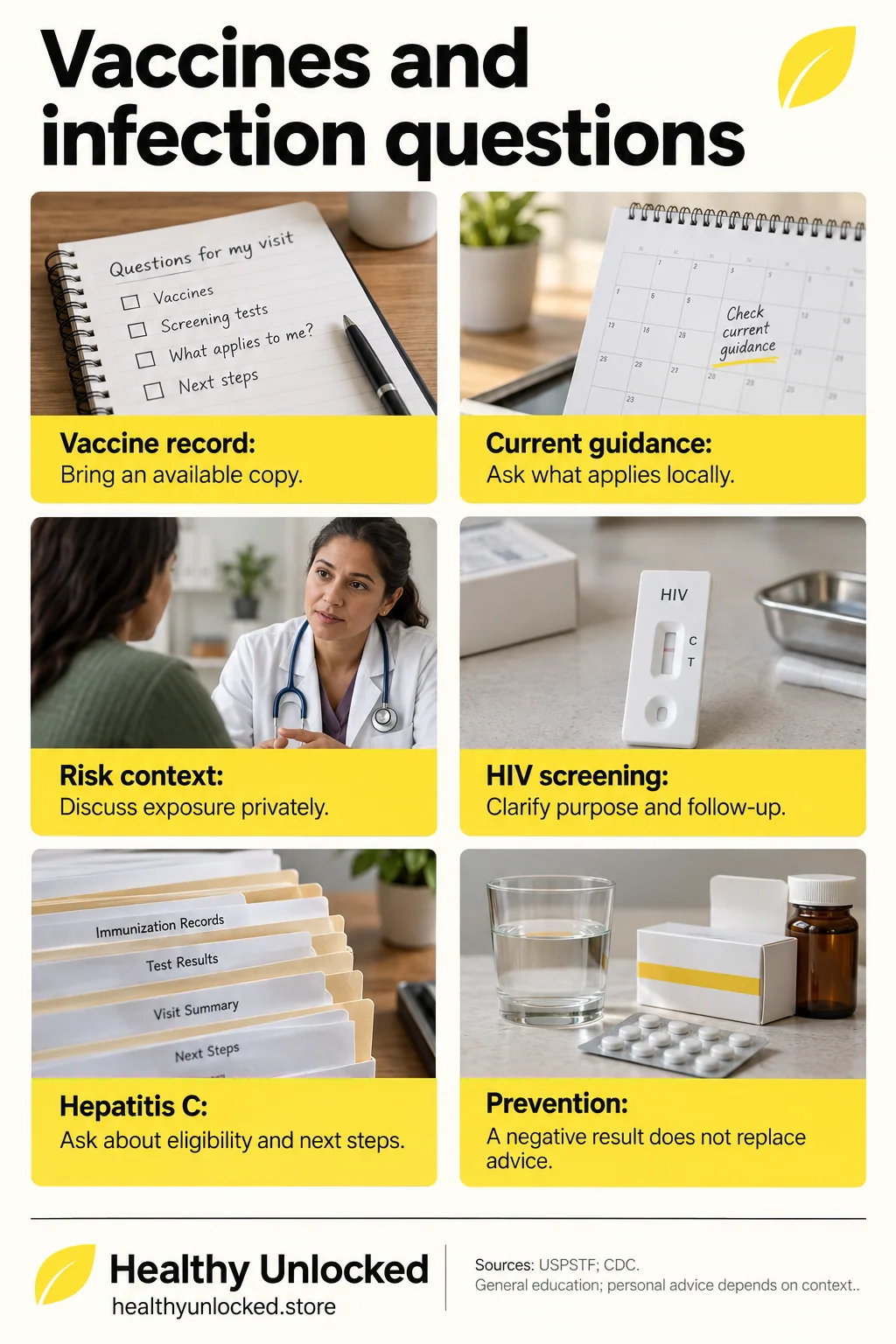
Vaccination review is part of prevention. Bring any available vaccine record and ask which current recommendations apply to your age, prior doses, health conditions, work, travel and other relevant circumstances. A vaccine list copied from an old article may be out of date. Use the current national guidance and the advice appropriate to your care.
The CDC adult immunization schedule is a US reference, not a global instruction. Some vaccines require more than one dose, and a missed dose may need an individualized catch-up discussion. This article does not decide which product or timing is right for you.
Infection screening can include a discussion of HIV, hepatitis or sexually transmitted infections when guidance or risk makes it appropriate. The USPSTF HIV-screening recommendation and hepatitis C screening recommendation explain distinct purposes. One negative test does not answer every infection question or replace relevant prevention advice.
Talk privately about exposure, symptoms and previous testing rather than choosing tests solely from a package name. The right test and timing can depend on the question being investigated. If you have a new symptom or a possible exposure that needs prompt advice, contact an appropriate service instead of waiting for a routine appointment.
Use respectful language and expect confidential care within the rules of the service. You can ask how information is stored, who can see results and whether a private conversation is possible. A partner’s needs and your own care may both matter, but public comments on a blog are not the right place for personal exposure details.
Keep records without sharing them publicly
Store a vaccine record or result where you can retrieve it securely. Bring a relevant copy to the appointment rather than uploading an entire history to an unfamiliar website. If you use a patient portal, check that it is the service’s real portal and understand how to contact the practice for questions.
If a record is missing, say that it is missing. Do not recreate vaccination dates from memory as if they were documented facts. Ask whether the service can retrieve prior records or how uncertainty should be handled. Accurate uncertainty is more useful than a confident but invented entry.
How do sleep, mental health and sexual health fit?
Preventive care is not limited to laboratory numbers. Sleep, mood, alcohol, tobacco, sexual concerns and the ability to manage everyday tasks can affect health and the care you need. Raise a concern in ordinary language: what changed, how long it has been happening, and what it makes harder to do.
For sleep, describe your schedule, daytime sleepiness, snoring or other concerns rather than only saying that your sleep score is low. Our adult sleep-hygiene guide explains practical habits and their limits. A routine cannot diagnose a sleep disorder or substitute for assessment of persistent symptoms.
Mental-health questions can be part of appropriate primary care. The USPSTF recommendation on depression and suicide-risk screening distinguishes specific screening questions and the systems needed for assessment and care. A positive questionnaire is not the same as a complete diagnosis, and a negative score does not mean that you should hide a concern.
Sexual-health changes may have several explanations. Describe the concern, relevant medicines and any important timeline. Do not assume that fatigue, erection changes or reduced interest automatically mean low testosterone. Hormone testing and treatment require an appropriate clinical discussion, not a general screening checklist or a supplement advertisement.
If you have thoughts of harming yourself, feel unable to stay safe, or have a severe acute symptom, seek immediate help through appropriate local emergency or crisis services. Do not use an appointment planner to decide whether you can wait. A routine preventive visit is different from urgent assessment.
Choose one manageable change
At the end of the conversation, a practical action might be making a follow-up appointment, asking for smoking-cessation support, collecting a missing report or trying a suitable activity routine. Choose something that fits your circumstances and has a clear next step. Prevention should not become a punishment for an imperfect week.
A family member or support person can help if you want them involved, but keep space for a private conversation. Ask for written instructions or an interpreter when useful. Understanding the plan is part of good care; pretending you understood an unfamiliar term can make follow-up harder.
How can you prepare for a useful appointment?
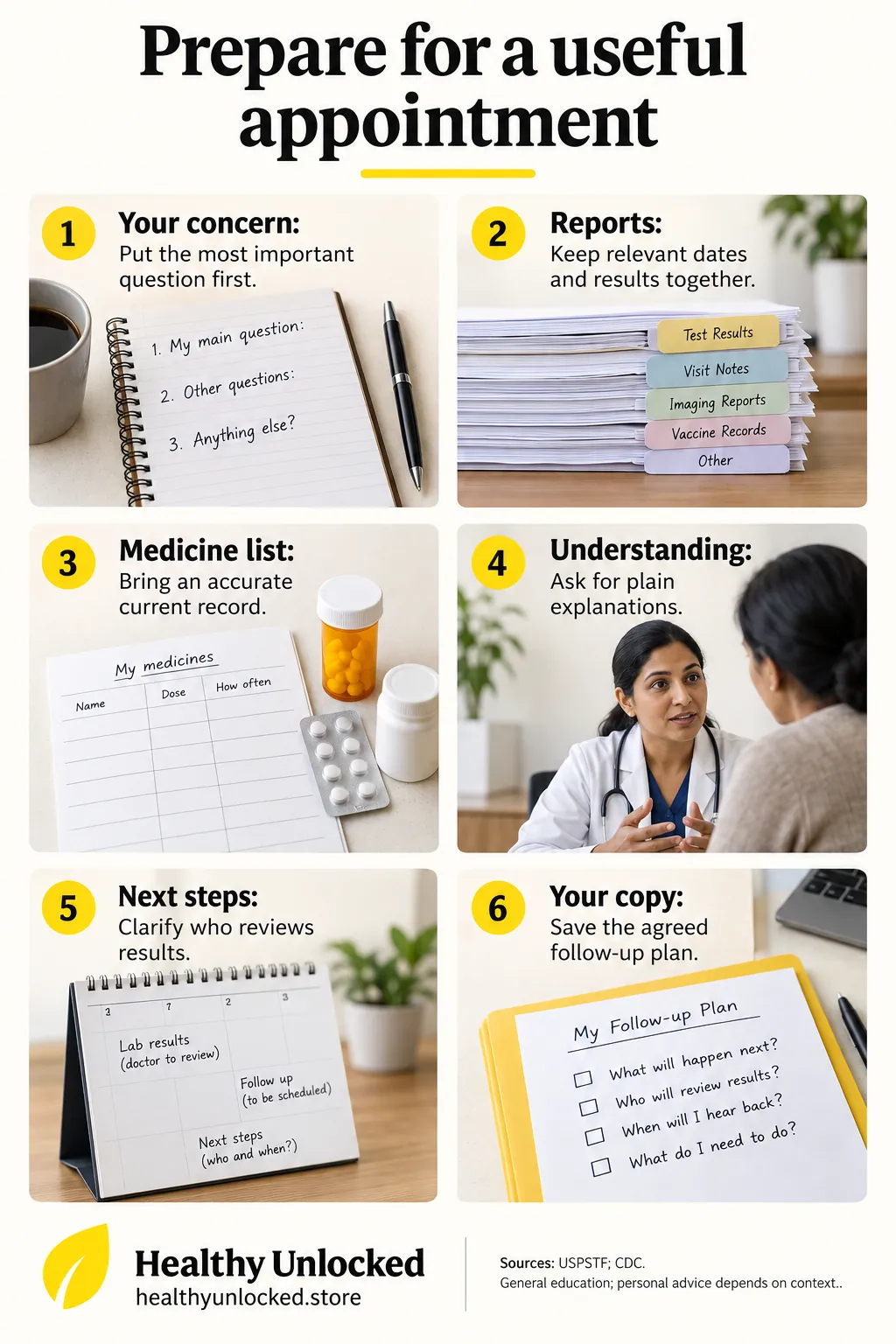
Prepare a short agenda before the visit. List your main concern first, then a few preventive questions and any result that needs clarification. Tell the practice about new symptoms when booking so it can advise on the appropriate appointment. A routine slot may not be the right place to introduce a severe concern at the last minute.
Bring a current medicine list, relevant reports, vaccine information and the family history you know. If documents are on your phone, make them easy to find without handing over unrelated private information. A single folder or printed summary can save time and reduce the chance of leaving out a relevant detail.
Ask about any preparation before arriving. Do not fast, stop a medicine or change a dose because a general checklist implies that tests might be ordered. The practice should tell you whether a particular preparation is needed. If instructions are unclear or conflict with existing advice, ask for clarification.
During the appointment, use questions that lead to a decision: “Does this recommendation apply to me?”, “What are the benefits and possible harms?”, “What would this result change?”, and “Who will follow it up?” You do not need to quote a guideline perfectly. It is enough to identify the decision you are trying to understand.
Before leaving, summarize the agreed actions. Note what is being done now, what is not needed, what needs further information, and when to follow up. If a result does not arrive as expected, contact the practice. “No news” should not be assumed to mean a normal result unless the service has explicitly explained its process.
| Item | A useful entry | Privacy or safety check |
|---|---|---|
| Main concern | One sentence describing what changed and when | New or severe symptoms may need a different appointment |
| Documents | Relevant results, medicine list and vaccine record | Keep unrelated personal information private |
| Preventive question | A named test or concern and what you want to understand | Do not assume eligibility from a package name |
| Agreed action | What happens next and who is responsible | Clarify preparation before changing medicines or fasting |
| Follow-up | How and when results will be explained | Contact the service if the expected review is missing |
A useful visit can leave some questions open
Sometimes a decision needs an earlier report, a more detailed family history or a separate consultation. Record the next step instead of treating uncertainty as a failed appointment. Ask what information is needed and whether the delay changes anything you should do now.
The goal is a usable care plan, not a completed online checklist. If the appointment identifies a new concern, the priorities may change. A plan can be revised when new information arrives. Keep the checklist flexible enough to support that conversation.
Try the appointment-priority planner
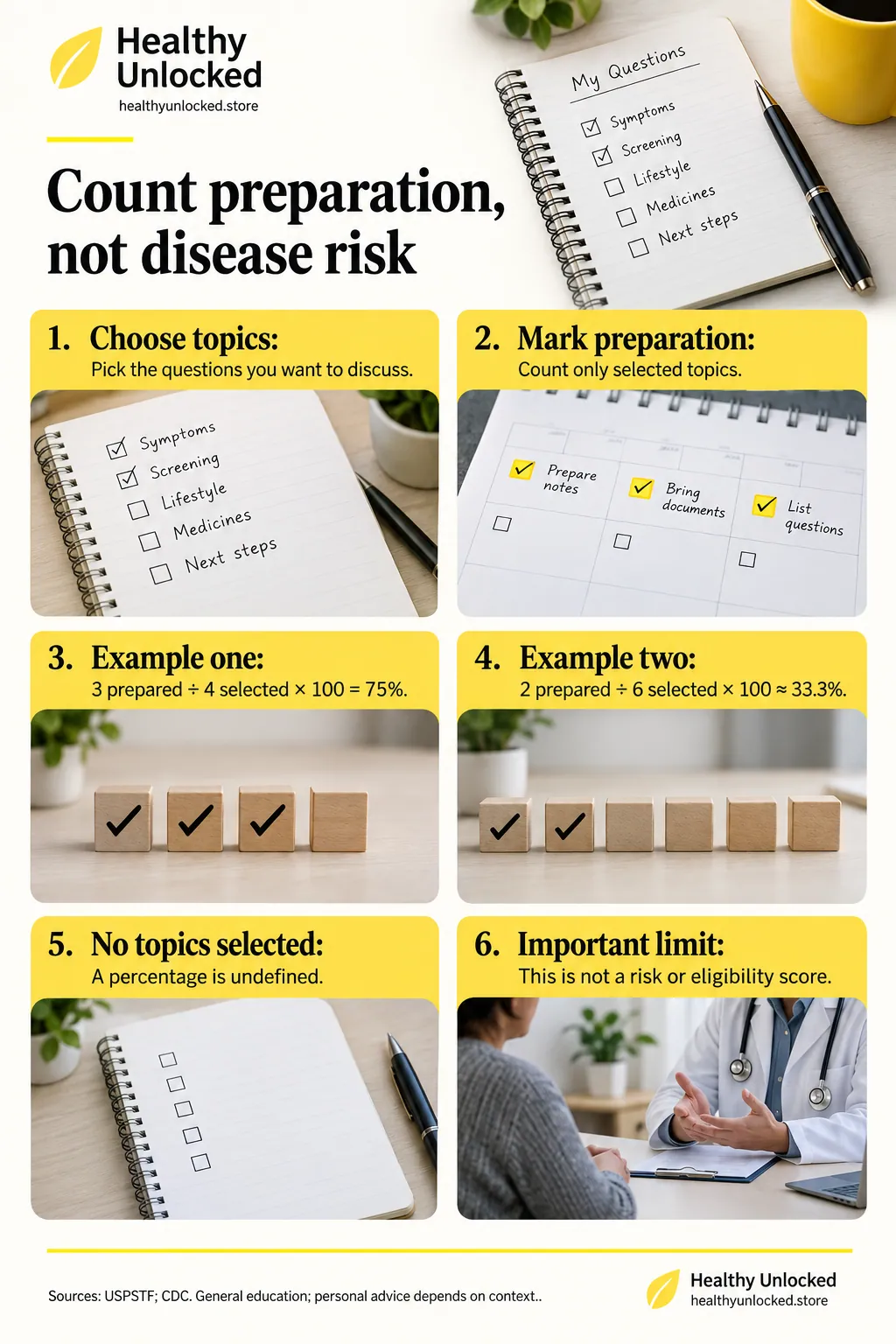
The appointment-priority planner counts the questions you choose to prepare and how many have a written note. It is an organizational aid. Selecting a topic does not mean that a screening test is recommended, and leaving one unselected does not establish that it is irrelevant to your health.
Choose the topics you want to discuss, then mark those for which you have prepared a question or relevant information. The percentage is prepared selected topics divided by selected topics, multiplied by 100. If no topics are selected, there is no meaningful completion percentage. A prepared mark on an unselected topic should not increase the count.
Example one: you select four topics and prepare notes for three. The calculation is 3 ÷ 4 × 100 = 75%. That describes preparation only. It is not a probability of disease, a measure of health, or evidence that the unprepared topic needs a test. You can still attend and ask for help with an incomplete checklist.
Example two: you select six topics and prepare two. The calculation is 2 ÷ 6 × 100, approximately 33.3%. The remaining four are opportunities to write questions, not four failed health checks. A shorter list with one important question may be more useful than a large list chosen only to increase the number.
The tool does not use your age, organs, results or medical history to assign screening eligibility. Resetting clears the form on this page. Use the offline worksheet if you prefer to write privately, and do not rely on the page to store a health record. Clinical decisions stay with an appropriate professional conversation.
Prepare appointment topics
3 prepared of 4 selected = 75%. No disease-risk or screening score.
3 prepared of 4 selected = 75%. No disease-risk or screening score.
Calculations use this page’s entries in your browser; they do not save or send them to a Healthy Unlocked server. Keep downloaded files private as needed.

Download a private question sheet
Use the preventive-health appointment worksheet to organize the topics and agreed actions offline. Keep the hypothetical examples separate from your own notes. Do not send personal test results through a public blog comment. The download does not create a consultation or send a record to the author.
For care of exposed skin, our beginner skin-care guide offers related everyday information. Keep routine self-care and medical screening distinct. Neither a tidy grooming routine nor a complete worksheet certifies that a person is free of disease.
Common questions about men’s preventive health
These short answers help you prepare a conversation. They do not replace a personal screening recommendation or an assessment of a symptom.
Does every man need the same yearly blood-test panel?
No. Testing should have a purpose and fit the person’s circumstances, previous findings and current guidance. A preventive visit can be useful without a large panel. Ask what decision a proposed test would change.
Is screening the same as checking a new symptom?
No. Screening generally applies to eligible people without the related symptom. A new or concerning symptom may need diagnostic assessment, even when a routine screening test is not recommended.
Should I request PSA testing automatically?
No. PSA screening involves a discussion of eligibility, possible benefits and harms under relevant guidance. Urinary or other symptoms should be described separately. A result alone does not confirm or exclude prostate cancer.
Can I use US recommendations as my personal schedule everywhere?
No. US guidance is identified as a reference in this article. Your clinician should use guidance appropriate to your location, history, risk and circumstances. Local programs and available services can differ.
Should I fast or stop medicines before the visit?
Only follow the specific preparation instructions given by the practice or appropriate clinician. Do not change medicines or fast because a general checklist mentions possible tests. Clarify instructions that are uncertain.
Does the planner tell me whether I am healthy?
No. It counts prepared questions among selected topics. It does not calculate disease risk, screening eligibility or urgency. You do not need a completed checklist before asking for care.
Your next step: gather one relevant report, write your main question, and ask the practice what preparation is needed. Leave the visit knowing how the result or agreed action will be followed up.
About this article
By Yashveer Bharani for Healthy Unlocked. This guide organizes preventive-health questions and identifies US guidance as US guidance. No institution is claimed to have reviewed or endorsed the article, and the author is not presented as having examined readers.
Planner examples are hypothetical preparation arithmetic. They are not screening algorithms, disease-risk scores or treatment recommendations. Current professional advice, relevant national guidance and product-specific or test-specific instructions take precedence over a general worksheet.
Sources and further reading
These original references support the guidance and its limits. A link does not mean that the institution reviewed or endorsed this article.
Main guidance
Practical reference
Context and definitions
Evidence and limitations
 Healthy Unlocked
Join the conversation
Share a practical idea or ask a question about this guide. Please keep personal medical details private.