
Summary
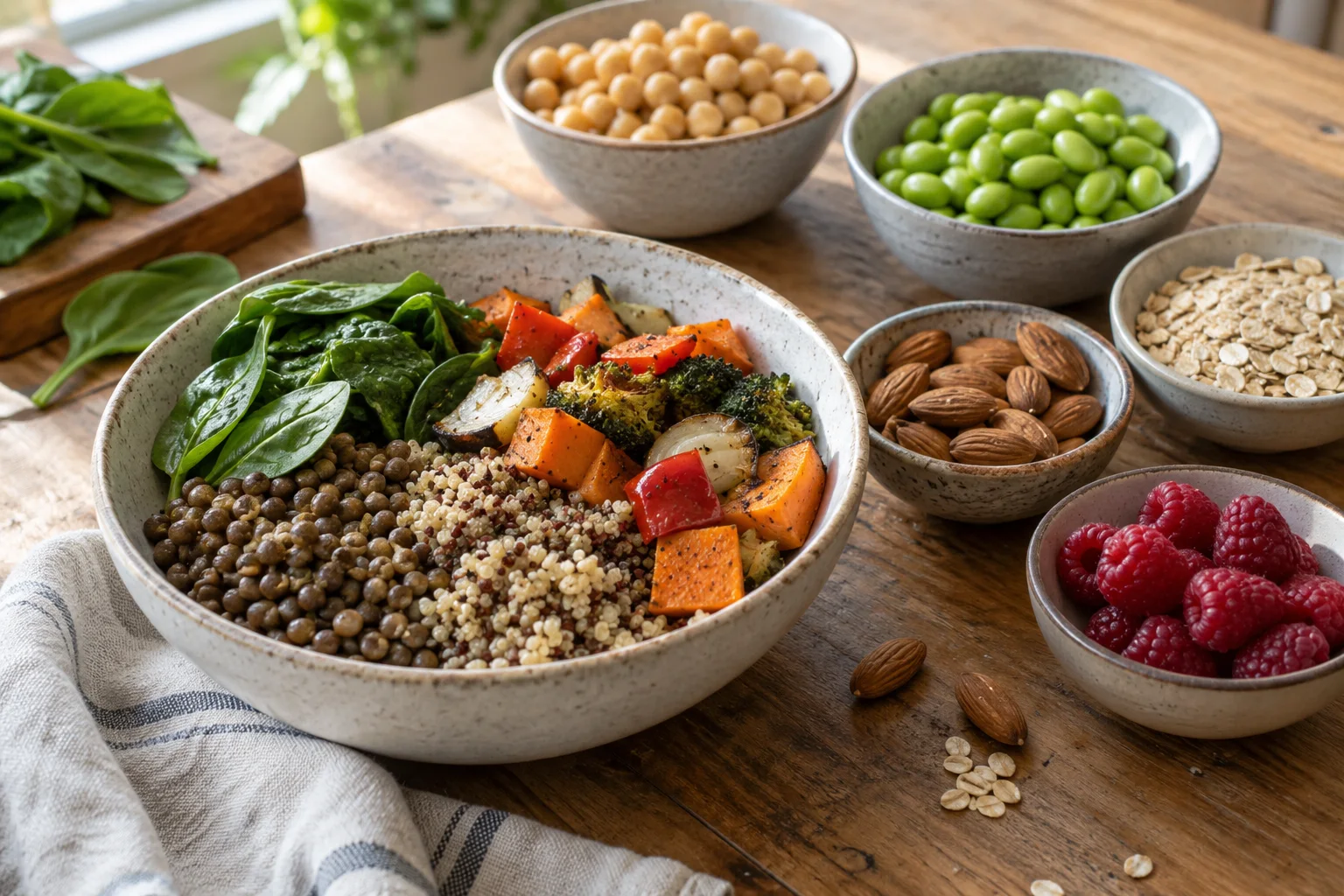
Protein and fiber foods include beans, lentils, chickpeas, edamame, nuts, seeds, oats and quinoa. Their nutrient amounts depend on the food, preparation and serving size. You can also combine a protein food, such as eggs, fish or plain yogurt, with fiber-rich vegetables, fruit or whole grains to build a meal.
This guide explains how those choices work in everyday eating. It brings together a serving chart, meal ideas, an adjustable two-food calculator, practical swaps and advice on reading labels. The aim is to help you understand your options and adapt familiar meals to your appetite, kitchen and circumstances.
What you’ll understand
- Protein and fiber. Eggs supply protein, not fiber; beans and lentils provide both.
- Compare portions. Check serving weights; keep cooked and dry weights separate.
- Read labels. Nutrient totals depend on how many servings you eat.
- Build a meal. Pair a protein food with fiber-rich plants, enough food and flavor.
- Keep it practical. Choose affordable foods you enjoy that suit your allergies and routine.
- Add fiber gradually. Make small changes, watch comfort and follow any prescribed diet.
How to use this guide today
- Start with a familiar meal. Notice its protein food and whether it includes a fiber-rich plant ingredient.
- Check the portion. Read the chart or product label, keeping cooked and dry weights separate.
- Try one practical pairing. Add a suitable vegetable, fruit, whole grain or legume that you enjoy.
- Adjust for your situation. Consider appetite, allergies, cost, preparation time and any guidance from your care team.
Keep individual needs in mind. This is general food education. Growth, pregnancy, breastfeeding, activity, medical conditions and prescribed diets can change your needs. Meal examples do not guarantee weight loss or a particular health outcome, and general guidance does not replace advice tailored to you.
What do protein and fiber actually do?
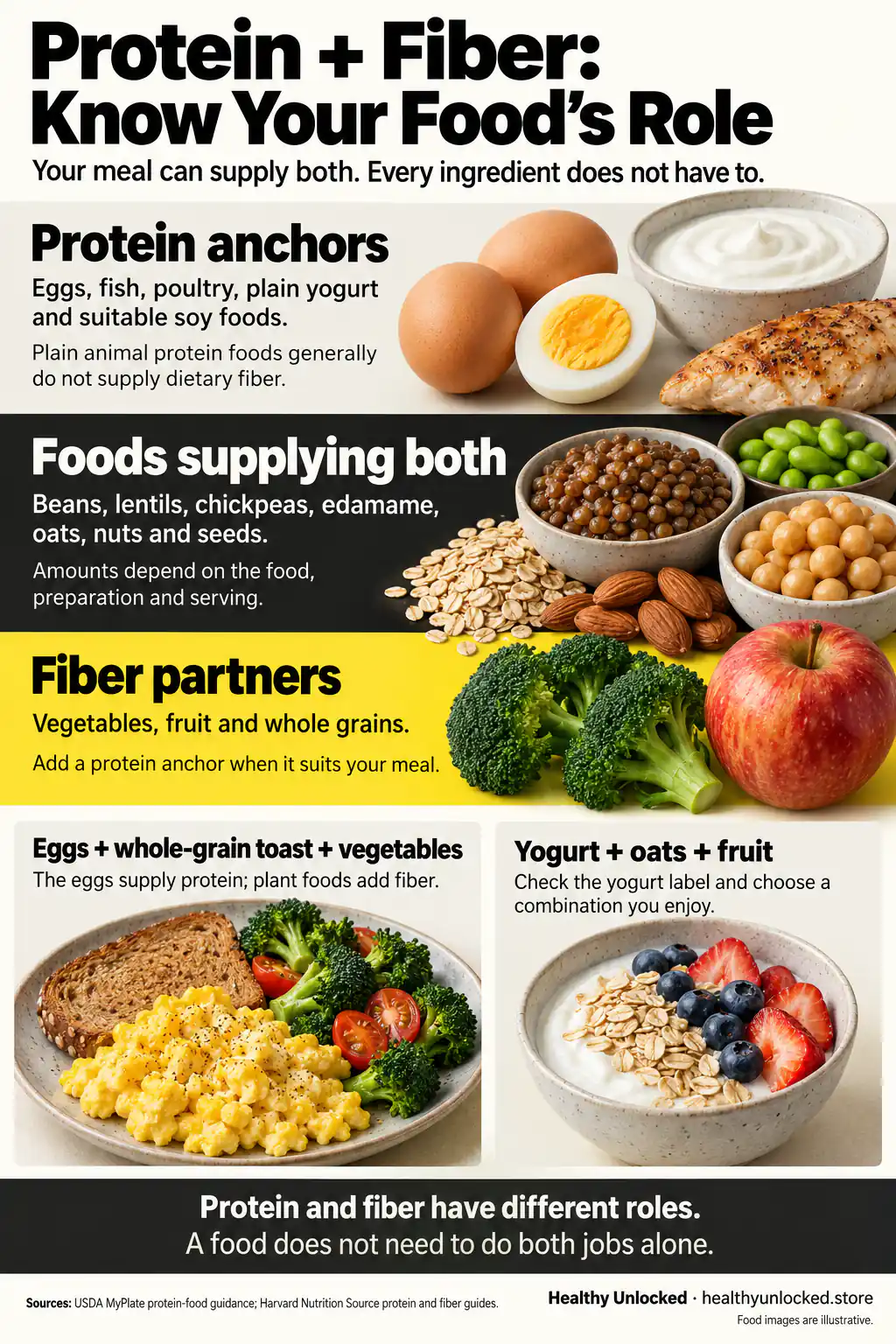
Protein helps your body build and maintain tissues. Fiber is a group of food components, mostly from plants, that your digestive enzymes do not fully break down. The nutrients have different jobs, so a meal with plenty of protein does not automatically provide enough fiber.
Think about scrambled eggs on white toast. Eggs contribute protein, but they do not bring dietary fiber. Adding whole-grain toast and fruit changes the meal’s overall mix. The eggs do not need to be replaced just because another ingredient supplies something different.
USDA’s protein-food guide explains the roles of protein in tissues and other body functions. Harvard’s overview of dietary fiber describes soluble, insoluble, and fermentable fibers. These categories overlap in real foods; there is no need to turn breakfast into a chemistry lesson.
| Nutrient | Main idea | Useful food examples |
|---|---|---|
| Protein | Supports tissues and other body functions | Legumes, soy foods, eggs, fish, poultry, dairy |
| Fiber | Different types support digestive function in different ways | Legumes, whole grains, vegetables, fruit, nuts, seeds |
| Together in a meal | Combine food roles across the plate | Beans with a grain; yogurt with oats and fruit |
Does this combination keep you full?
A meal containing protein, fiber-rich plants, enough food, and some fat may feel more satisfying than a small snack alone. But fullness varies with the person, the food’s texture, and the rest of the meal. Hunger is not a failure, and more grams are not always better.
Avoid promises that a specific food will stop cravings, flatten your stomach, or prevent disease. Nutrition research often describes patterns over time. It does not guarantee an outcome from one bowl. Harvard’s protein guide is useful for understanding why the whole food matters alongside its protein content.
Which protein and fiber foods are practical choices?
Legumes are useful starting points because one serving contributes both nutrients. Whole grains, nuts, and seeds can support the combination too. Compare a realistic serving, not just a food’s name: a spoonful of seeds and a bowl of beans are different amounts of food.
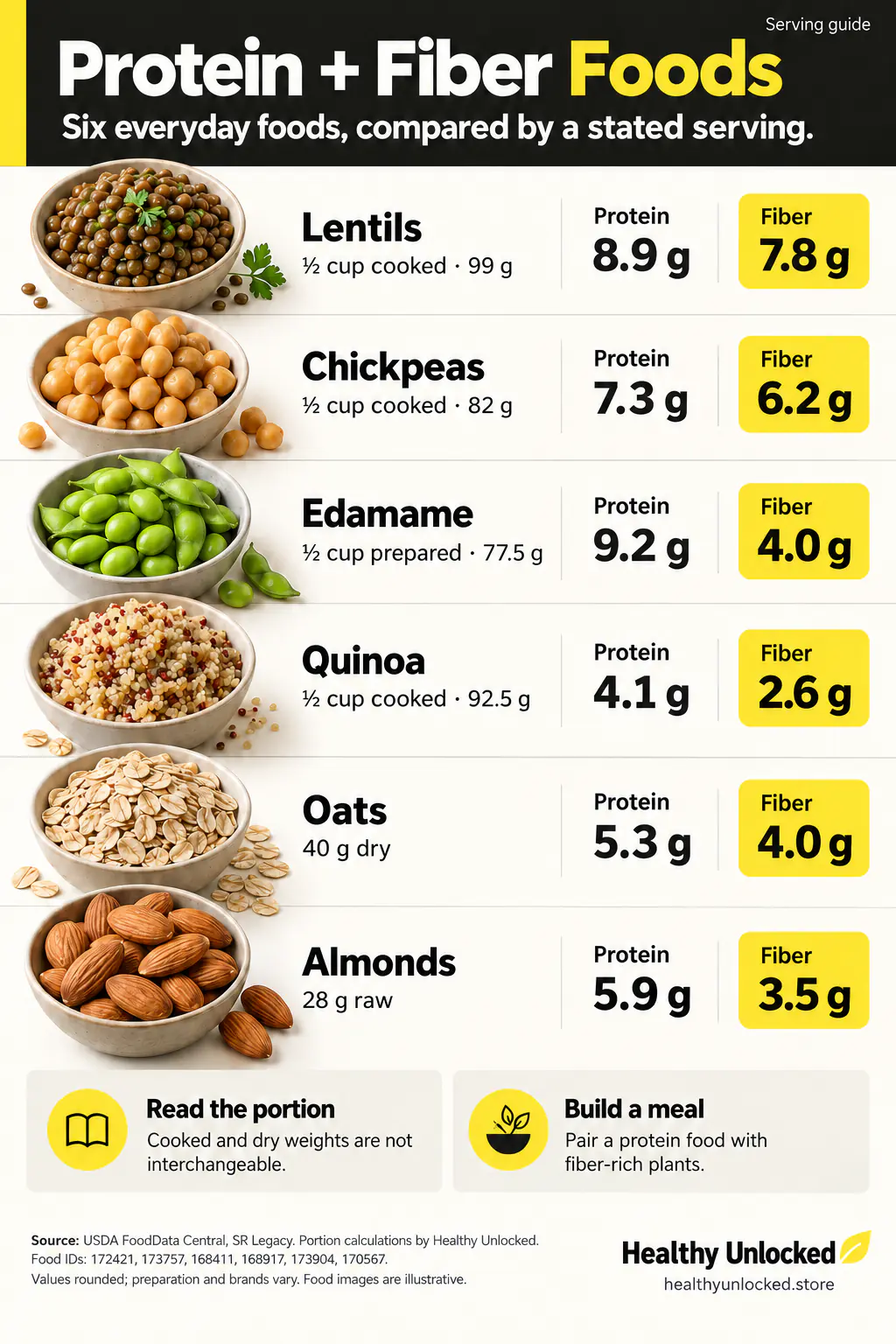
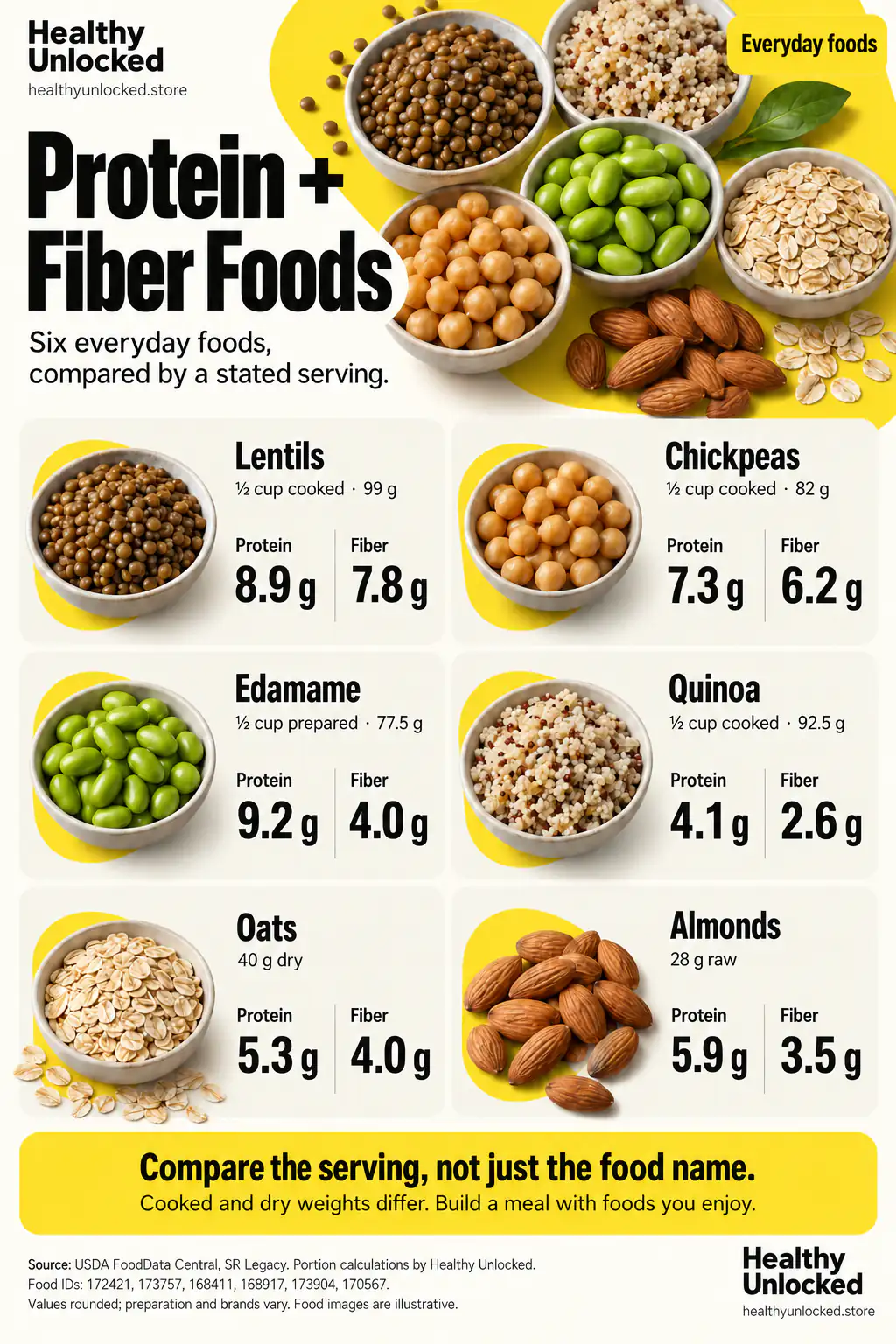
The following protein fiber food chart uses USDA FoodData Central SR Legacy records. Values are estimates calculated for the stated portions and checked on October 5, 2026. These are illustrative portions, not recommended amounts. Product labels may differ.
| Food and record | Preparation / portion | Weight | Protein | Fiber |
|---|---|---|---|---|
| Lentils (FDC 172421) | ½ cup cooked | 99 g | 8.9 g | 7.8 g |
| Chickpeas (FDC 173757) | ½ cup cooked | 82 g | 7.3 g | 6.2 g |
| Black beans (FDC 173735) | ½ cup cooked | 86 g | 7.6 g | 7.5 g |
| Pinto beans (FDC 175200) | ½ cup cooked | 85.5 g | 7.7 g | 7.7 g |
| Edamame (FDC 168411) | ½ cup prepared | 77.5 g | 9.2 g | 4.0 g |
| Quinoa (FDC 168917) | ½ cup cooked | 92.5 g | 4.1 g | 2.6 g |
| Oats (FDC 173904) | 40 g dry | 40 g | 5.3 g | 4.0 g |
| Almonds (FDC 170567) | 28 g raw | 28 g | 5.9 g | 3.5 g |
| Peanuts (FDC 172430) | 28 g raw | 28 g | 7.2 g | 2.4 g |
| Roasted soybeans (FDC 172441) | 28 g dry-roasted | 28 g | 12.1 g | 2.3 g |
All weights describe the edible food. Edamame means shelled beans, not pods. Lentils, chickpeas, black beans, and pinto beans are cooked without salt; quinoa is cooked. Oats are weighed dry. Nuts and dry-roasted soybeans use a stated 28 g portion. Food links open the matching USDA FoodData Central pages with nutrient tables. See the calculation method below.
Beans, lentils, and chickpeas
These foods work in soups, wraps, rice bowls, salads, and familiar family dishes. Lentils can become a stew or a sauce; chickpeas can be folded into a warm vegetable pan; black or pinto beans fit comfortably into tacos. Choose a flavor you like rather than a food you think looks impressive.
If you want preparation ideas, see Harvard’s lentil guide and its overview of legumes and pulses. The American Heart Association’s bean guide also explains how legumes fit into an overall eating pattern. Canned versions are convenient, though their sodium and nutrient values depend on the product.
Edamame and other soy foods
Frozen edamame can be a quick side or a bowl ingredient. Follow the package cooking directions and remove the pods before eating the beans. Dry-roasted soybeans are a different food with less water and a different serving weight; do not swap their numbers into an edamame entry.
Tofu and tempeh are useful protein options, but their fiber content varies with processing and brand. Pair them with vegetables or a whole grain rather than assuming every soy product supplies the same amount of fiber. Soy is also an allergen for some people.
Oats, quinoa, nuts, and seeds
Oats fit both sweet breakfasts and savory bowls. Quinoa can join a mixed grain bowl or salad. Neither needs to do the whole job alone: add another protein food when it suits your meal and appetite.
Almonds, peanuts, and seeds offer texture as well as nutrients. They are often toppings or snacks, so portion size matters when comparing them with a main dish. Chia seeds are another option, but they are optional; you do not need a fashionable ingredient to build a balanced plate.
Why cooked versus dry weight matters
Cooking changes how much water a food contains. A dry-food record cannot accurately describe the same gram weight of the cooked food. Match the preparation state before copying nutrition numbers into a meal tracker or comparing two foods.
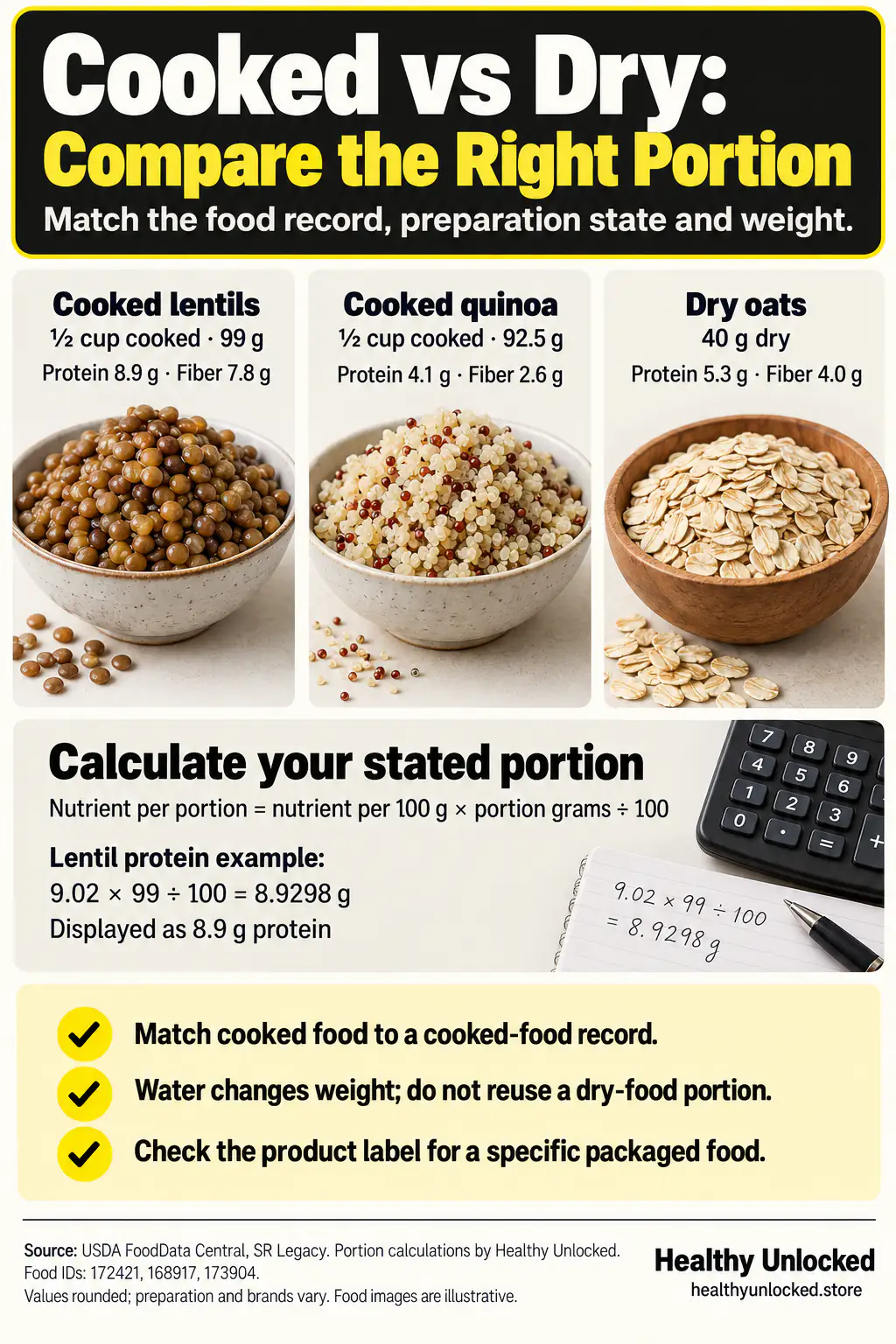
For example, the USDA record linked in the chart defines a cooked cup of lentils as 198 g. We use half that weight, 99 g, for the half-cup entry. A different food has a different cup weight. Use the gram column to reproduce the comparison.
How much protein and fiber do you need?
Protein and fiber needs vary with age, sex, life stage, activity and health. Dietary reference intakes are population benchmarks, while food-label Daily Values help you compare foods. Neither replaces an individual nutrition assessment. Understand the distinction before setting a daily target.
The National Academies’ Dietary Reference Intake tables, checked on October 5, 2026, list the following values for generally healthy people. Protein figures are Recommended Dietary Allowances based on reference body weights; fiber figures are Adequate Intakes. They are not performance goals or maximum limits.
| Source category | Age | Protein RDA | Fiber adequate intake |
|---|---|---|---|
| Female | 14–18 years | 46 g/day | 26 g/day |
| Male | 14–18 years | 52 g/day | 38 g/day |
| Female | 19–30 years | 46 g/day | 25 g/day |
| Male | 19–30 years | 56 g/day | 38 g/day |
| Female | 31–50 years | 46 g/day | 25 g/day |
| Male | 31–50 years | 56 g/day | 38 g/day |
The table shows selected adolescent and adult categories from the source. Other age groups, pregnancy and breastfeeding have separate values. If you need individual guidance, a registered dietitian can consider your body size, growth, activity, health, and eating pattern. USDA’s Food and Nutrition Information Center and dietary-guidance resources explain these reference systems.
How should you read a protein or fiber claim?
Read the serving information first, then the actual nutrient amounts. A front-of-package claim cannot tell you how much you will eat, whether the food suits an allergy, or whether it provides a balanced meal. Two similar-looking products can have quite different labels.
The FDA’s serving-size guidance, checked in 2026, explains that a labeled serving reflects amounts people typically consume. It is not a recommendation. The FDA’s percent Daily Value guide defines 5% DV or less as low and 20% DV or more as high for a nutrient per serving. Those are label-reading benchmarks.
The FDA’s Daily Value table uses 28 g of fiber for adults and children aged four and older. That standard helps compare labels; it does not replace the age-specific reference table above. You do not need to hit a printed percentage with every meal.
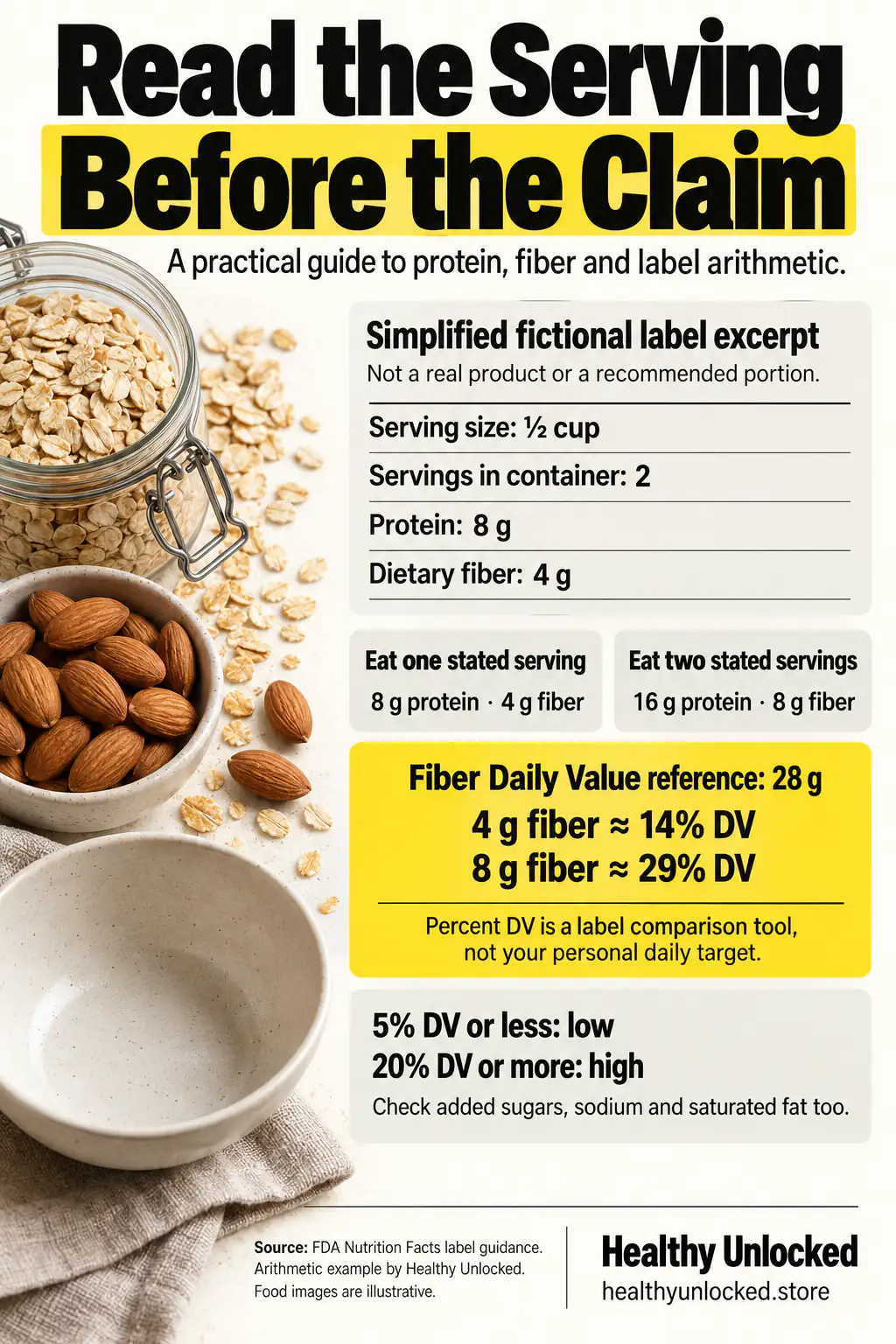
When comparing a cereal, yogurt, bread, or snack bar, check serving size, protein, fiber, added sugars, sodium, and saturated fat together. Read the added-sugars line separately from total sugars. A naturally sweet fruit and a sweetened bar are not interchangeable simply because a number looks similar.
The FDA’s complete Nutrition Facts explanation, label overview, and youth label-reading materials offer more examples. For younger readers, learning the label is more useful than chasing rigid macro goals.
How do you build a balanced meal with protein and fiber?
Start with a protein food, add fiber-rich plants, include a grain or other starch when it fits, and finish with flavor. Adjust the combination to your hunger, preferences, and circumstances. You can use a bowl, a sandwich, a soup, or a familiar mixed dish; a divided plate is only one format.
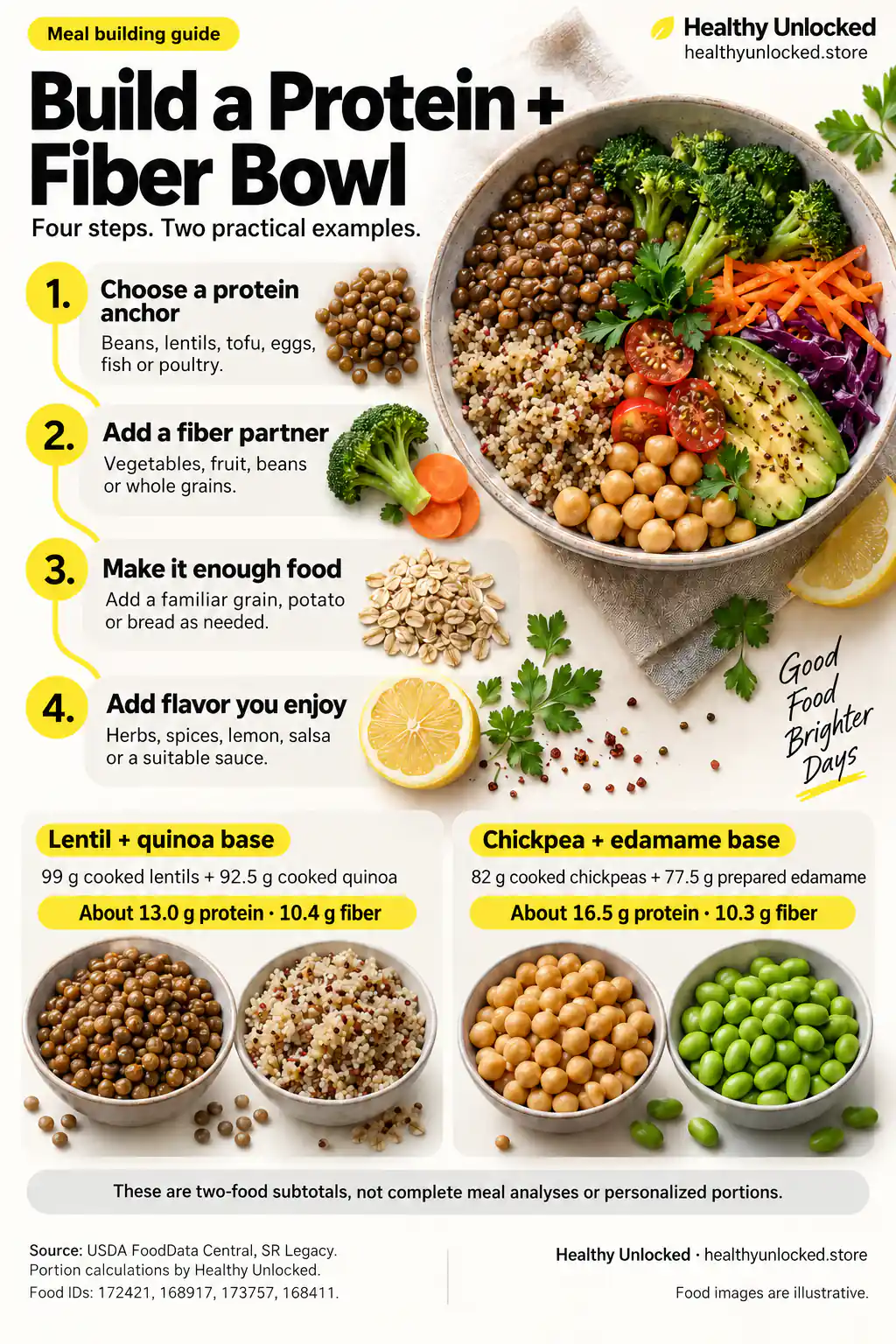
This flexible approach draws on food-group variety and Harvard’s Healthy Eating Plate. It does not set exact portion ratios for every person. Vegetables, fruit, whole grains, protein foods, and suitable fats have roles beyond the two nutrients highlighted here.
- Choose the anchor. Pick beans, lentils, tofu, eggs, fish, poultry, or another protein food you enjoy. A bean-based meal can already provide substantial fiber.
- Add a plant partner. Use vegetables, fruit, legumes, or whole grains. If your anchor is eggs or yogurt, this step supplies the fiber those plain foods lack.
- Make it enough food. Add a grain, potato, bread, or another familiar starch as appropriate. Protein and fiber numbers do not tell you whether a meal provides enough energy.
- Make it taste good. Use herbs, spices, lemon, salsa, a suitable sauce, or some oil. A nutritious combination you dislike is difficult to repeat.
Two worked examples with transparent numbers
These calculations illustrate how foods add together. They are subtotals for named ingredients, not complete meal nutrition panels. Vegetables, sauces, toppings, and extra food change the final amounts.
Lentil and quinoa bowl base
Combine the chart’s 99 g cooked lentils with 92.5 g cooked quinoa. Healthy Unlocked’s calculation from USDA records, checked October 5, 2026, gives about 13.0 g protein and 10.4 g fiber. Add vegetables, flavor, and other food as needed; no cooked-recipe testing is claimed.
Chickpea and edamame bowl base
Combine 82 g cooked chickpeas with 77.5 g prepared, shelled edamame. The same USDA-based method gives about 16.5 g protein and 10.3 g fiber for those ingredients. Add a grain, vegetables, and a sauce that suits you. Avoid this combination if soy is an allergen for you.
Try the two-food meal builder
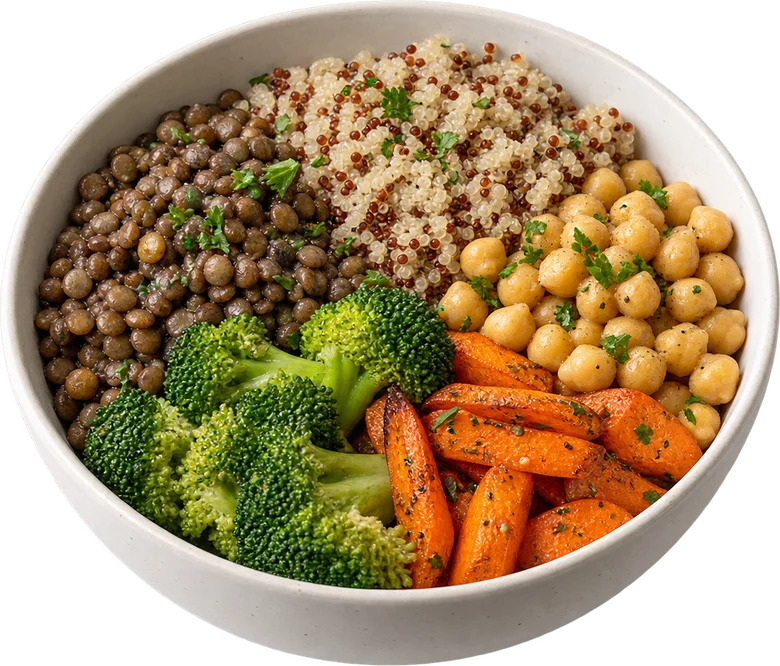
Choose two chart portions. The result is their combined protein and fiber, before any other ingredients.
Educational subtotal. Not a complete meal analysis or recommended portion.
If counting makes food feel stressful, skip the calculator. Use the food groups and meal ideas instead.
What are easy protein and fiber meal ideas?
Choose combinations that fit your kitchen, schedule, and appetite. A few reliable meals are often more useful than a long list of recipes you never make. The ideas below show how to pair foods; they are not a fixed daily menu or guaranteed nutrient totals.
| Meal | Protein anchor | Fiber partner | Practical finish |
|---|---|---|---|
| Breakfast bowl | Plain yogurt or suitable soy yogurt | Oats and fruit | Add nuts or seeds if safe for you |
| Savory breakfast | Eggs or tofu | Whole-grain toast and vegetables | Use herbs, pepper or a suitable sauce |
| Lunch wrap | Chickpeas, beans or poultry | Vegetables and suitable whole-grain wrap | Keep filling and dressing easy to pack |
| Grain bowl | Lentils or edamame | Quinoa and vegetables | Add a flavorful dressing |
| Quick dinner | Fish, tofu or beans | Vegetables and a whole grain | Adjust portions to your appetite |
| Soup night | Lentils, beans or suitable poultry | Vegetables and a whole-grain side | Use a broth that fits your sodium needs |
| Snack pairing | Plain yogurt, nuts or hummus | Fruit or vegetables | Check allergens and the actual product label |
When breakfast needs to be quick
Use a breakfast you already have: oats, toast, cereal, or yogurt. Then notice the gap. Oats can take milk or a suitable soy drink; plain yogurt can take fruit and oats; eggs can join whole-grain bread and vegetables. Check plant-drink labels because their protein contents differ.
When you need a packed lunch
Separate wetter ingredients from bread or greens when practical, and keep a suitable dressing in a small container. A grain-and-bean bowl can become a wrap the next day. If you add eggs, dairy, poultry, or other perishable food, think about transport temperature as well as convenience.
When you get home hungry
Keep a short assembly option: ready-to-eat beans, a suitable cooked grain, vegetables, and a sauce. Use properly stored leftovers or products that can be cooked according to their directions. A backup meal can be simple and still useful. You do not need a perfectly plated dinner to make a worthwhile choice.
For a manageable way to notice what worked, try our ten-minute weekly routine review. Write down a meal you enjoyed, something that was inconvenient, and one change you want to try. The aim is a routine that fits your life.
How can you eat this way on a budget?
Start with foods you can actually buy, store, and prepare. Beans, lentils, oats, frozen vegetables, and familiar grains can be useful building blocks. Compare local unit prices and waste, rather than assuming a specific food is always cheapest. Time, equipment, and safe storage are part of the cost.
A large bag of dried beans may have a lower price per serving but need soaking, cooking, and planning. A can can be more practical when you have little time or limited equipment. Frozen produce can be useful when fresh produce spoils before you use it. Choose the option that you are likely to eat.
| If this does not work | Consider | Check first |
|---|---|---|
| Fresh produce goes unused | Frozen vegetables or fruit | Added ingredients and storage directions |
| Dried beans take too much time | Canned or ready-to-eat beans | Sodium, drained serving and cost per serving |
| Quinoa costs too much locally | Oats, brown rice or another familiar grain | Serving values will change |
| Dairy does not suit you | Appropriate soy or other alternative | Protein, fortification and allergen label |
| Nuts are an allergen | A tolerated alternative chosen for your needs | Seeds can also be allergens; avoid cross-contact |
| A large bean portion feels uncomfortable | A smaller amount alongside familiar food | Persistent symptoms need assessment |
USDA’s healthy-eating-on-a-budget resources focus on planning, shopping, and preparation. There is no universal dollar estimate here because prices vary by location and date. A realistic saving starts with checking your own store’s shelf label and the portions you usually use.
What if you avoid meat, dairy, gluten, or nuts?
For vegetarian or vegan meals, use a variety of legumes, soy foods where suitable, grains, nuts, and seeds. Protein and fiber are only part of dietary adequacy; a fully vegan pattern also needs attention to nutrients such as vitamin B12. Get appropriate guidance rather than treating this short guide as a complete diet plan.
For celiac disease, choose foods that meet your required gluten-free standards. Do not assume every oat product is suitable because oats are naturally different from wheat. NIDDK’s celiac-disease food guidance explains contamination concerns and the need to work with a qualified professional.
For food allergies, swaps must account for the specific allergen and cross-contact, not just the obvious ingredient. FDA’s food-allergy guidance covers labeling for major allergens. Seeds are not automatically safe replacements for nuts, and dairy-free products are not automatically safe for every allergy.
How do you prepare food ahead safely?
Cook components you can reuse, rather than packing the same full meal for an entire week. Label storage containers, cool and refrigerate perishable food promptly, and freeze suitable portions when you will not use them soon. Safe handling matters more than an attractive meal-prep photo.
USDA FSIS guidance, checked in 2026, advises refrigerating perishable leftovers within two hours, or one hour above 90°F; keeping refrigerated leftovers for three to four days; and reheating leftovers to 165°F. Use a food thermometer and follow product-specific instructions. FDA’s safe-storage guide provides additional refrigerator and handling advice.
How can you increase fiber without a sudden big change?
Introduce fiber-rich foods gradually and pay attention to comfort. A large jump can cause gas or bloating for some people. Fluids also matter, but there is no single water amount suitable for everyone. Follow prescribed fluid limits and seek individual advice if you have a medical condition.
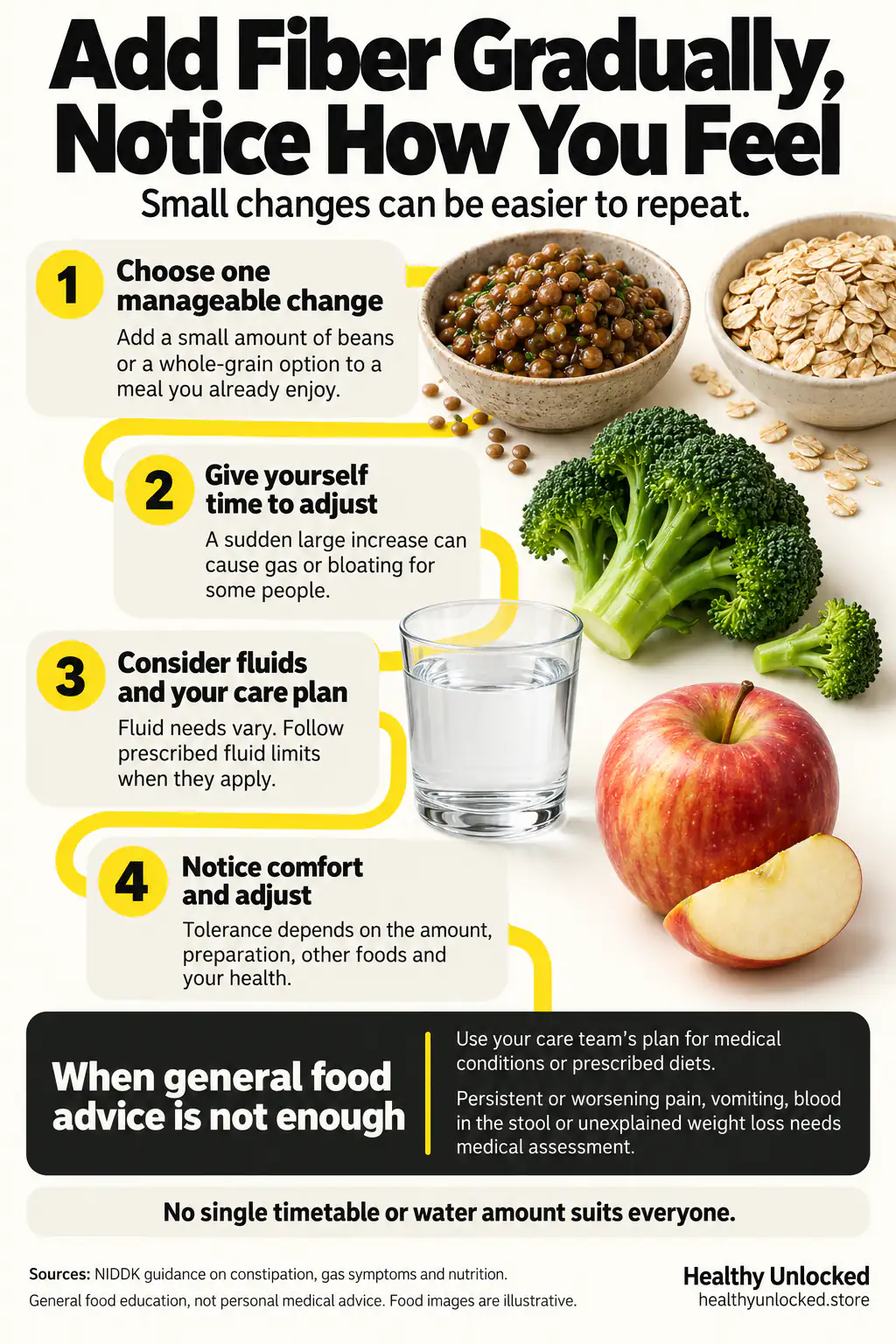
Choose one manageable adjustment, such as adding a small amount of beans to a familiar meal or using a whole-grain option you enjoy. See how that feels before adding several new foods at once. NIDDK recommends adding fiber a little at a time; it does not give one timetable that applies to every person.
Gas is not a reliable sign that a food is bad for everyone. The amount, the preparation, other foods, and your health all affect tolerance. NIDDK’s explanation of diet and gas symptoms describes why different carbohydrates can cause symptoms and when a dietitian may help.
When should a general food chart take a back seat?
If you have chronic kidney disease, a prescribed low-fiber diet, significant digestive symptoms, or another condition affecting eating, use your care team’s plan. NIDDK’s kidney-disease nutrition guide explains that protein and other nutrients may need to be individualized. A blanket “eat more protein” message can be inappropriate.
Persistent or worsening abdominal pain, vomiting, blood in the stool, or unexplained weight loss should be assessed rather than managed by adding more fiber. See NIDDK’s symptoms guidance. This article does not diagnose constipation, food intolerance, or any other condition.
How did Healthy Unlocked calculate the food chart?
Healthy Unlocked used the exact USDA FoodData Central records linked in each row, matched each food’s preparation state, and calculated protein and fiber for the displayed gram weight. The source data are historical SR Legacy values; checking them in 2026 does not mean they were newly measured in 2026.
Calculation: nutrient per stated portion = nutrient per 100 g × stated portion weight in grams ÷ 100.
Example: the cooked lentil record provides 9.02 g protein and 7.9 g fiber per 100 g. For 99 g, the results are 8.9298 g protein and 7.821 g fiber, displayed as 8.9 g and 7.8 g.
Values are rounded to one decimal. Meal subtotals use unrounded ingredient data. We did not cook or laboratory-test the foods. Brands, preparation and moisture can change their values. The chart is not a same-calorie comparison, a same-weight ranking, or a clinical meal plan. Use the product label for a specific packaged food. USDA’s data-type documentation explains how SR Legacy differs from newer Foundation and branded-food data.
Download the USDA serving chart as a CSV
The underlying data are public-domain USDA data, with reuse explained in the FoodData Central API guide. The SR Legacy nutrient archive and USDA macronutrient resources offer further background. The downloadable file includes food IDs, states, serving weights, and the two source nutrient values.
Common questions about protein and fiber foods
Do eggs, chicken, fish, and plain yogurt contain fiber?
Plain eggs, chicken, fish and yogurt provide protein but generally do not provide dietary fiber. Add a plant partner, such as vegetables, fruit, beans, or whole grains. A breaded, flavored, or mixed product may have a different label because of its added ingredients.
Do all plant foods contain a lot of protein?
Plant foods differ in their protein content. Many contain some protein, but amounts vary. Beans and soy foods can act as protein anchors; fruit is usually a fiber partner. Use the actual serving and product information instead of assuming all plants make equivalent protein substitutions.
Can I get protein and fiber without supplements?
Ordinary foods can provide both. Supplements may have a role for some people, but a powder or fortified bar does not replace a varied eating pattern. Read FDA’s supplement guidance before treating supplement marketing as evidence of necessity, safety, or effectiveness.
Is one food always the best choice?
No. The useful choice depends on taste, allergy needs, price, preparation time, access, and tolerance. The chart is a starting point for comparing stated portions. It cannot decide what is best for your circumstances.
Will eating protein and fiber guarantee weight loss?
No. A protein-and-fiber combination can be part of a satisfying meal, but it does not guarantee a change in body weight. This guide is designed for food literacy, not calorie restriction. Teenagers especially should not turn general adult diet content into a self-directed weight-loss plan.
How do I know whether an online nutrition guide is trustworthy?
Check who wrote it, whether claims link to relevant evidence, how numbers were calculated, and what the limitations are. A real author name helps, but credentials and clear reasoning still matter. Our guide to choosing a useful wellbeing resource gives you a practical checklist.
Your next meal: choose a food you enjoy as the protein anchor, add a fiber-rich partner, and make the meal large and varied enough for you. Keep the combination that works. You can adjust one meal without changing everything you eat.
About this article
By Yashveer Bharani for Healthy Unlocked. Published October 5, 2026. The food chart uses the USDA records linked beside each entry, with preparation states and portion calculations explained above. Food images illustrate meal combinations; they do not document recipe testing.
This guide provides general food education and does not replace individual nutrition or medical advice. No independent medical or registered-dietitian review has been recorded. No affiliate product links appear in this guide.
Updated October 5, 2026: Added structured information for the questions and embedded videos, verified video publishers and publication dates, and replaced raw food-data links with readable USDA nutrient pages. The serving chart is calculated from historical USDA SR Legacy records, not newly measured food samples.
For a practical example of checking a source, follow a food link in the serving chart and compare its preparation and gram weight before using the nutrient figures. We plan an editorial source check every six months, or sooner when relevant guidance changes. This editorial update is not an independent clinical review.
Read our editorial standards and health and advertising disclosure. To report a correction, contact Healthy Unlocked with the section and source.
Sources and further reading
Core references support the explanations and calculations above. The wider library helps you explore food preparation, label reading, and personal dietary needs. Links lead to the original institutions or video publishers; they do not imply that those organizations reviewed or endorsed this article.
Food literacy
- Fiber types and food sources
- Protein: food sources and the whole food package
- Harvard Healthy Eating Plate
- Whole grains: what makes a grain whole
- Legumes and pulses
- Oats: forms, preparation and food pairing
- Chia seeds: preparation and nutrition background
- Lentils: cooking and meal ideas
- Quinoa: preparation and serving ideas
- Almonds: nutrition and ways to use them
- American Heart Association: beans and legumes
Meal planning and data
- USDA MyPlate protein foods group
- USDA MyPlate healthy eating on a budget
- USDA Food and Nutrition Information Center
- USDA National Agricultural Library: macronutrients
- USDA SR Legacy nutrient-list archive
- USDA dietary guidance and reference-intake resources
- National Academies Dietary Reference Intakes: reference tables
- USDA FoodData Central
- FoodData Central: data types and limitations
- FoodData Central API and public-domain data policy
Labels and food safety
- FDA: understand and use the Nutrition Facts label
- FDA: serving size is not a recommended portion
- FDA: low and high percent Daily Values
- FDA: Daily Values and percent Daily Values
- FDA: added sugars on the label
- FDA: what is on the Nutrition Facts label
- FDA Read the Label: youth learning resources
- FDA: food allergies and allergen labeling
- FDA: storing food safely
- FDA: questions and answers on dietary supplements
- USDA FSIS: leftovers and food safety
Personal needs and digestion
Exact food records for the serving chart
- Lentils, mature seeds, cooked, boiled, without salt — FDC 172421
- Chickpeas (garbanzo beans, bengal gram), mature seeds, cooked, boiled, without salt — FDC 173757
- Beans, black, mature seeds, cooked, boiled, without salt — FDC 173735
- Beans, pinto, mature seeds, cooked, boiled, without salt — FDC 175200
- Edamame, frozen, prepared — FDC 168411
- Quinoa, cooked — FDC 168917
- Cereals, oats, regular and quick, not fortified, dry — FDC 173904
- Nuts, almonds — FDC 170567
- Peanuts, all types, raw — FDC 172430
- Soybeans, mature seeds, dry roasted — FDC 172441
Video publishers
- Guidelines for Nutrition & Fitting Healthy Eating into the Day: Part 7 — Harvard Medical School Continuing Education
- Mayo Clinic Minute: How dietary fiber makes you healthier — Mayo Clinic
- Understanding the Nutrition Facts Label, the Updated “Healthy” Claim, and Other Nutrition Claims — U.S. Food and Drug Administration
- What’s On MyPlate? (Eat Healthy on a Budget) Public — USDA Food and Nutrition Administration
 Healthy Unlocked
Join the conversation
Share a food combination you enjoy or ask a question about this guide. Please keep personal medical details private.