

Summary
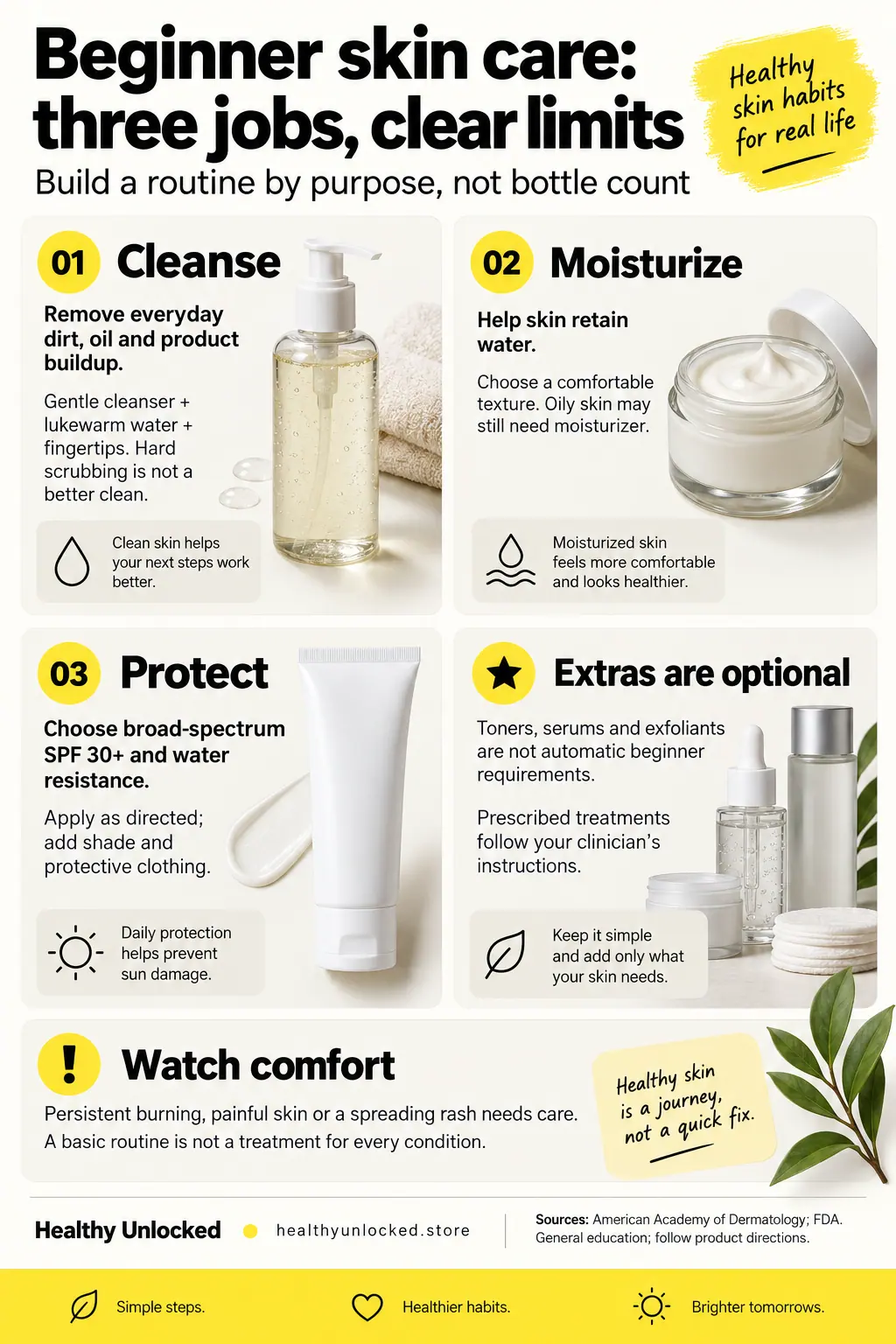
A skin care routine for beginners starts with three jobs: gently clean your skin, help it hold moisture, and protect it from the sun. A gentle cleanser, a suitable moisturizer and a broad-spectrum sunscreen can cover those jobs. You do not need a long list of serums, an expensive brand or a promise of “perfect” skin to begin.
Use the morning/evening chart to see the order, then use the routine planner to organize products you already own. This guide explains labels, skin comfort, cautious product introduction and practical costs. The examples are planning aids, not personalized treatments or tested product rankings.
What you’ll understand
- Three purposes. Cleansing, moisturizing and sun protection do different jobs.
- Simple order. Cleanse, moisturize, then use sunscreen in the morning.
- Gentle cleansing. Lukewarm water and fingertips beat harsh scrubbing.
- Skin comfort. Choose texture and labels that suit your needs.
- Sun protection. Check broad spectrum, SPF and water resistance; use shade and clothing too.
- One change at a time. Test new products; stop using a product that causes a reaction.
Start with these four checks
- Look at your shelf. Identify a gentle cleanser, moisturizer and sunscreen before buying more.
- Read the labels. Check directions, expiry, sun-protection claims and ingredients you must avoid.
- Keep changes small. Introduce one product at a time so a reaction is easier to trace.
- Watch comfort. Persistent burning, a spreading rash or painful skin needs care, not more products.
Keep the scope clear. This is general skin-care education. Acne, eczema, rosacea, allergies and prescription routines may need individual advice. Pregnancy can change which treatments are appropriate. A simple routine does not guarantee a particular appearance or replace medical care.
What does a beginner skin care routine actually need?
The starting point is a routine you can use comfortably and consistently: a cleanser to remove everyday buildup, a moisturizer to support hydration, and sunscreen alongside other sun-protection measures. Those purposes matter more than the number of bottles. The American Academy of Dermatology’s budget guide supports keeping the basics simple.
It helps to separate routine care from treatment. Washing off a day’s sunscreen is routine care. Trying to treat persistent acne, a painful rash or dark marks is a different task. A bottle advertised for a particular concern does not automatically belong in every beginner’s routine. If you already have a prescribed treatment, keep following the instructions from your clinician rather than replacing them with a general internet sequence.
Give every product one clear job
Think of a bathroom shelf as a small working kit. Before keeping a product, ask: What does this do? When do I use it? Does my skin tolerate it? What would happen if I left it out? If you cannot answer those questions, adding another product is unlikely to make the routine clearer. Our guide to making a grooming routine usable follows the same purpose-first approach.
| Step | Main purpose | Beginner decision | Important limit |
|---|---|---|---|
| Gentle cleanser | Remove dirt, oil, makeup and product buildup | Choose a product you can rinse off comfortably | A tight, burning feeling is not a sign of a better clean |
| Moisturizer | Help skin retain water and feel comfortable | Choose a texture you will use | Oily skin can still need moisture |
| Sunscreen | Help protect exposed skin from ultraviolet radiation | Check broad spectrum, SPF and water-resistance labeling | Does not replace shade, clothing or reapplication |
| Toner or serum | Depends on the formula | Optional; identify a reason before adding | Extra active ingredients can add irritation |
| Exfoliant or treatment | A specific concern, depending on the product | Not an automatic starting requirement | May need professional advice, especially with a skin condition |
Skin care is not a contest for flawless skin
Normal skin has texture, pores and occasional changes. The aim of this guide is manageable care, not a promise to erase every line or mark. Photographs in this article show routine settings and objects; they are not before-and-after evidence or records of product testing. Useful comparison starts with what a product is meant to do, not whether its packaging looks impressive.
What should you do in the morning and evening?
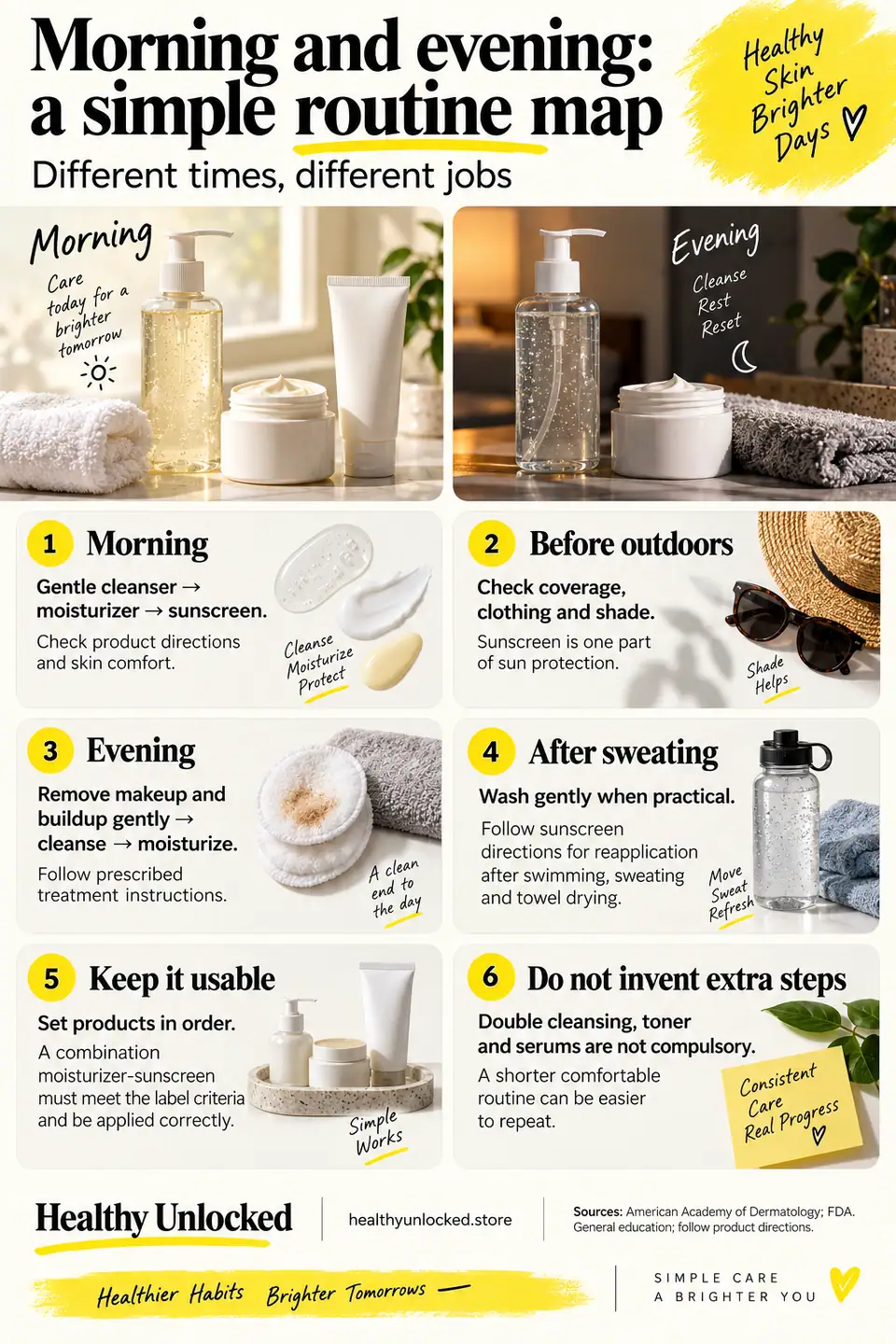
A straightforward morning order is gentle cleansing, moisturizer, then sunscreen. Evening care focuses on removing the day’s buildup and moisturizing; sunscreen is for sun exposure, not an extra bedtime treatment. The AAD’s product-order guidance also explains where prescribed treatments belong when you use them.
Keep the sequence short enough to remember. Products need directions, not a complicated ritual. A moisturizer with sunscreen can simplify the shelf if it meets the sun-protection criteria and you apply it in the amount and frequency required. A tiny dab of a combination product does not automatically provide the protection claimed on its label. Follow the actual package instructions.
| Time | Sequence | What to notice | Adaptation |
|---|---|---|---|
| Morning | Gentle cleanser → moisturizer → sunscreen | Comfort, even coverage and product directions | If cleansing aggravates dryness, ask about adjusting the routine |
| Before going outdoors | Check sunscreen directions, clothing and shade | Exposed ears, neck, hands and other missed areas | Plan reapplication for continued exposure |
| After heavy sweating | Gentle washing and appropriate sun-protection renewal | No hard rubbing or repeated harsh cleansing | Follow the water-resistance and towel-drying instructions |
| Evening | Remove makeup/buildup gently → cleanse → moisturize | Whether skin feels comfortable afterward | Follow clinician instructions for any prescribed treatment |
Makeup, shaving and busy mornings
Makeup goes after the underlying care steps; makeup with SPF is not a reason to ignore the directions for adequate sun protection. If you shave, use a gentle technique and watch for irritation. The AAD’s men’s skin-care guide discusses product labels and shaving comfort. These basic purposes are useful regardless of gender.
For a busy morning, prepare the routine the night before: place the products in order, check whether your sunscreen is running low, and set out a clean towel. You do not need to promise yourself a long routine and then feel you failed when time runs out. If an essential step gets missed regularly, simplify the setup rather than adding motivational pressure.
How can you wash your face without overdoing it?
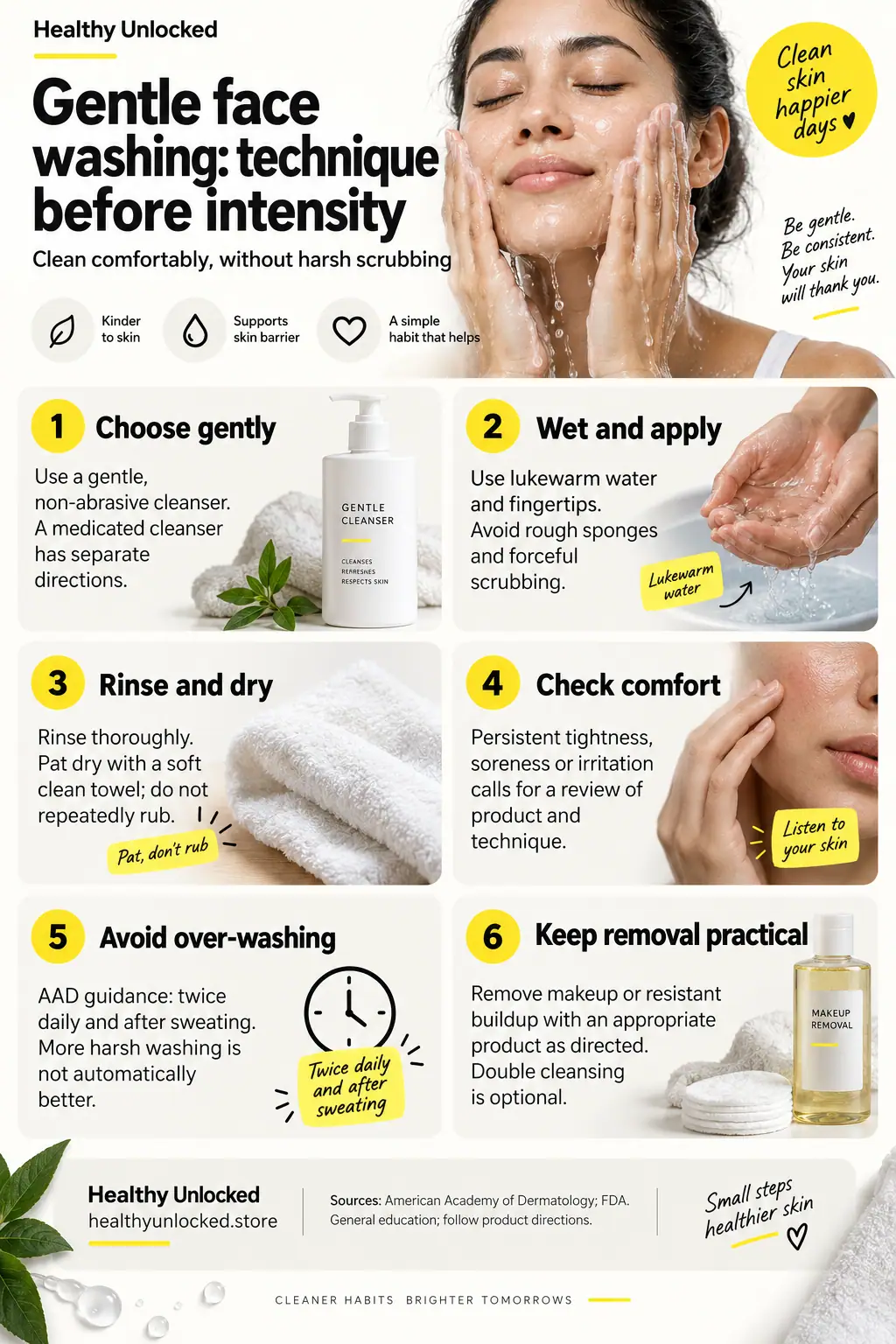
Use a gentle cleanser, lukewarm water and your fingertips, then rinse and pat dry. Scrubbing harder does not make washing more useful. The AAD’s face-washing guidance recommends avoiding abrasive cleansing and limiting washing to twice daily and after sweating.
Notice the feeling after rinsing
A cleanser should help remove buildup without turning every wash into an uncomfortable experience. If your face feels persistently tight, sore or irritated, review the product, water temperature and rubbing technique. Do not assume the problem means your skin needs stronger exfoliation. Several changes at once make the cause harder to identify.
Use a towel gently rather than repeatedly rubbing the same area. Sharing towels or using a visibly dirty washcloth is not a useful shortcut. If makeup or a resistant product remains, use an appropriate remover according to its directions. Double cleansing is a method some people use, not a compulsory beginner achievement. The routine should solve the removal task without unnecessary irritation.
Avoid turning cleansing into treatment
A medicated cleanser may have a specific role, but it also has its own warnings and directions. It should not be treated as interchangeable with every plain cleanser. People with acne can read the AAD’s skin-care tips for acne-prone skin; persistent or scarring acne needs an appropriate assessment, not endless product switching.
Cleanse after heavy sweating when practical, especially if a helmet or hat has trapped sweat against your skin. Avoid making that advice into a rule to wash after every small movement. Skin comfort, your actual activities and any condition-specific instructions matter. An ordinary walk and a very sweaty workout may create different practical needs.
How do you choose moisturizer for your skin?
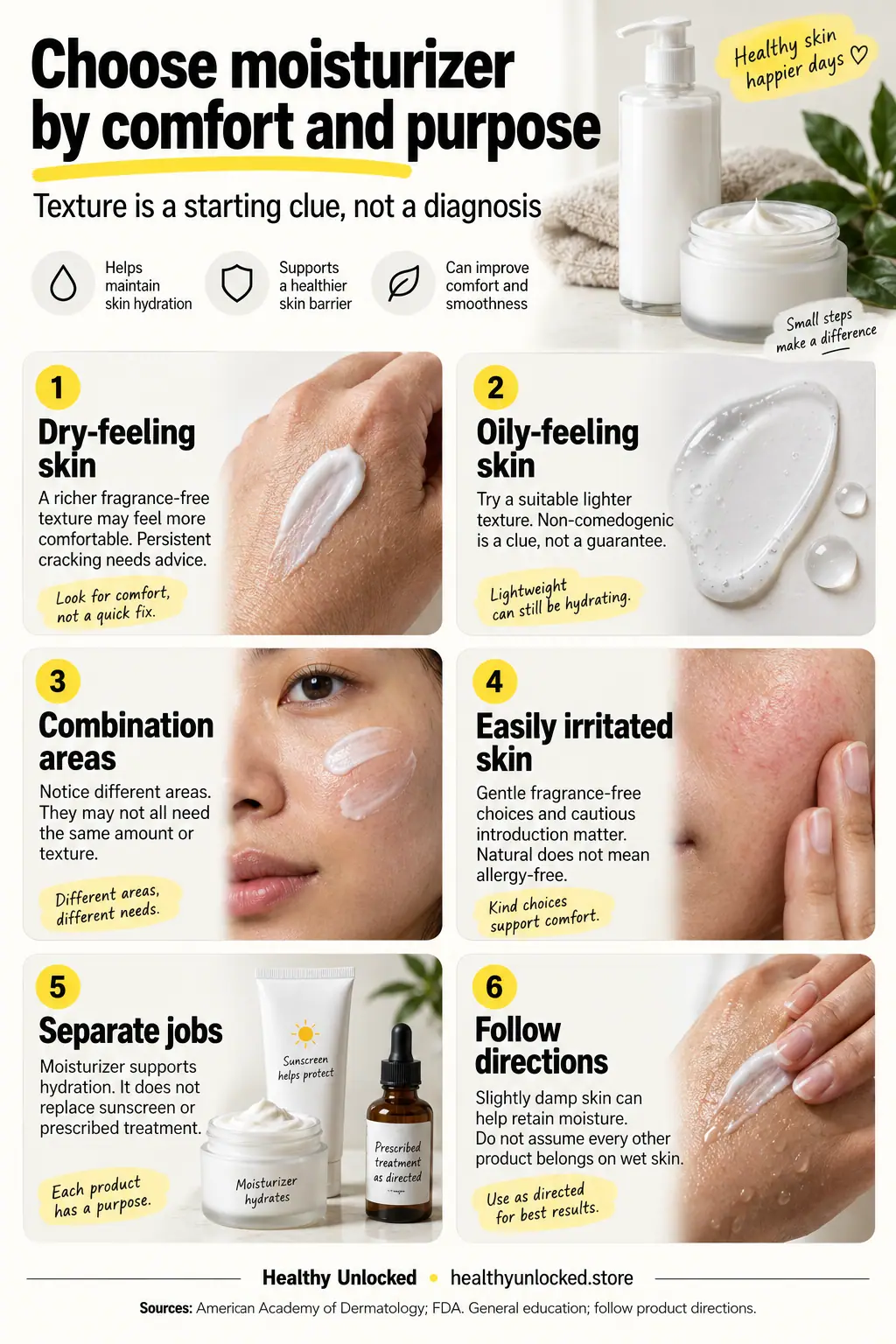
Choose a moisturizer that feels comfortable, suits your needs and has understandable directions. Dry, oily and easily irritated skin can need different textures. A product’s price or trendy ingredient is not proof that it will suit you. The AAD’s dry-skin guide explains why gentle care and suitable moisturizing matter.
| What you notice | Useful starting consideration | Avoid assuming | When to ask for help |
|---|---|---|---|
| Dry or rough feeling | A richer, fragrance-free texture may be more comfortable | That stinging means the product is working | Persistent cracking, inflammation or pain |
| Oily or shiny areas | A lighter texture; non-comedogenic label where relevant | That oily skin never needs moisturizer | Persistent acne or an unclear diagnosis |
| Different areas behave differently | Observe which areas need more or less product | That your entire face needs the heaviest texture | Ongoing irritation despite simple care |
| Products often sting or cause itching | Gentle, fragrance-free products and cautious introduction | That “natural” or “hypoallergenic” guarantees safety | Repeated reactions or a spreading rash |
Read texture and tolerance separately
A gel, lotion or cream describes a product’s form, not a universal quality score. A light lotion may be convenient in hot weather; a cream may feel more comfortable when skin is dry. The correct choice is not whichever form is fashionable. Consider how the product feels after use, how it layers with sunscreen and whether you can afford to replace it.
Applying moisturizer to slightly damp skin can help retain moisture, as the budget and dry-skin guidance explains. Follow a specific product’s instructions if they differ. Do not carry that detail into a claim that every other product must go onto wet skin. Sunscreen, prescribed treatments and other formulas can have different directions.
Oily skin still deserves gentle care
Removing every trace of oil with repeated harsh washing is not the same as caring for oily skin. The AAD’s oily-skin guidance covers gentle cleansing, suitable products and sun protection. A “won’t clog pores” label can be a useful shopping clue, but it is not a promise that no person will ever break out.
For acne-prone skin, the AAD explains the role of moisturizer. If a treatment dries your skin, ask how moisturizer fits around that treatment rather than independently changing doses or stopping prescribed care. Moisturizer supports routine comfort; it does not replace treatment for an underlying condition.
Which sunscreen details matter most?
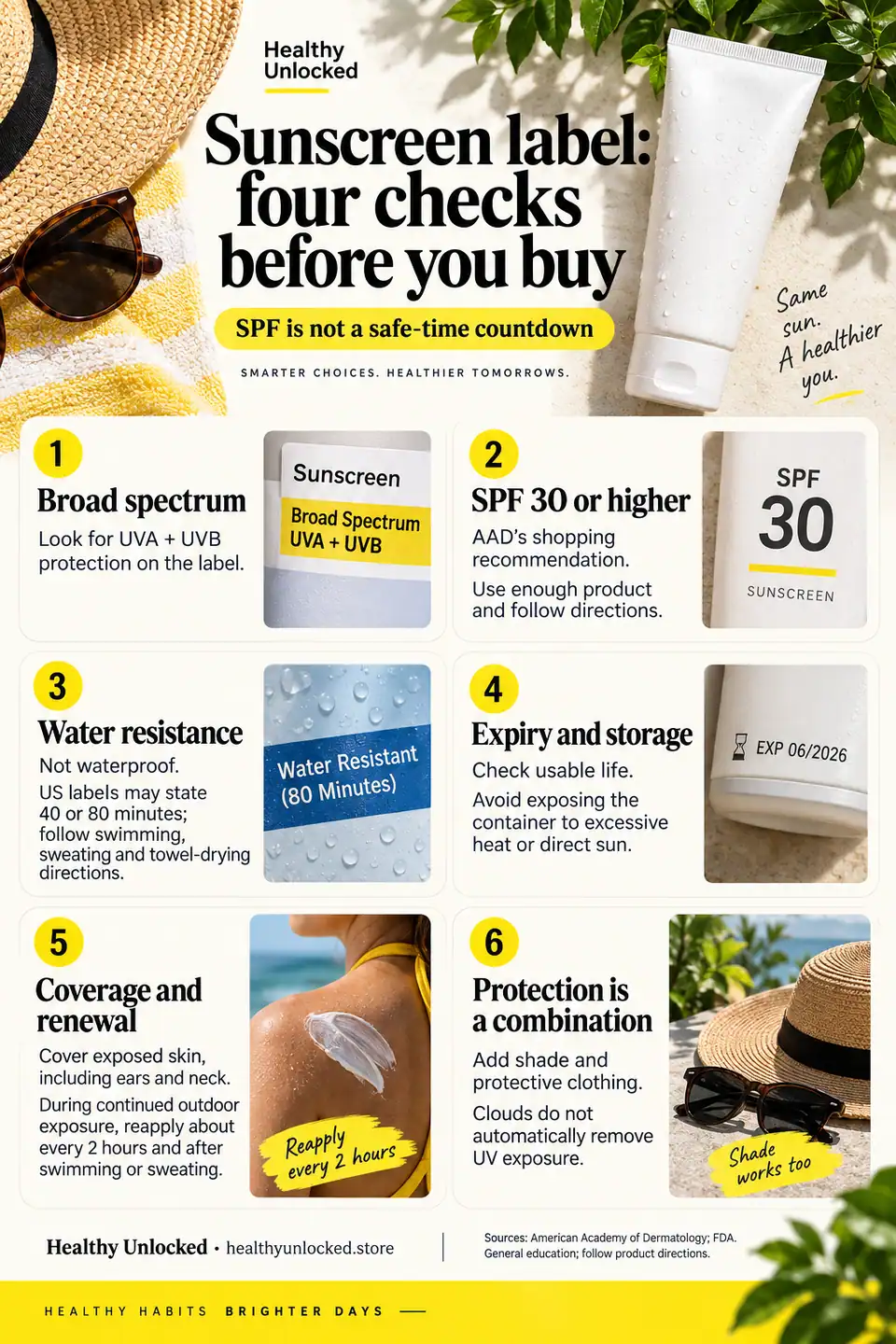
Look for broad-spectrum protection, SPF 30 or higher, and water resistance, following AAD selection guidance. Use the label directions and combine sunscreen with shade and protective clothing. SPF describes protection under testing conditions; it is not a timer that makes extra hours in strong sun safe.
Know what the label does and does not say
Broad spectrum refers to protection against UVA and UVB radiation. Water resistant is different from waterproof: products still need reapplication. The FDA’s sunscreen explanation describes US water-resistance labeling of 40 or 80 minutes and the directions for use. That labeling detail is not a promise of all-day protection.
There is a distinction between regulatory labeling and a professional recommendation. The FDA’s general sun-safety page mentions broad-spectrum SPF 15 or higher, while the AAD recommends choosing SPF 30 or higher. This guide uses the AAD’s SPF 30-or-higher shopping recommendation. Reading the actual source prevents those two statements from looking like an unexplained contradiction.
| Label detail | What it means | What to do | What it does not mean |
|---|---|---|---|
| Broad spectrum | UVA and UVB protection | Look for the actual claim on the package | Permission to skip shade and clothing |
| SPF 30 or higher | AAD’s recommended starting selection criterion | Use enough and follow directions | A number of safe minutes or hours outdoors |
| Water resistant | Tested water resistance for the stated interval | Follow swimming, sweating and towel-drying instructions | Waterproof or sweatproof all day |
| Expiry/storage directions | Limits on usable life and storage | Check before use; protect the container from excess heat | That an old bottle is reliable indefinitely |
Use enough, and remember missed areas
The AAD’s application guide describes covering exposed skin and applying before going outdoors. Your face is only one part of the task. Ears, neck, exposed scalp, hands and other uncovered areas are easy to miss. Body size and clothing coverage affect how much product is needed; a tiny facial dab is not whole-body coverage.
During continued outdoor exposure, reapply about every two hours and after swimming or sweating, following the package directions, including towel drying. Plan supplies before a long outing. Protective clothing and a shaded route reduce reliance on remembering a bottle alone. Cloudy weather does not automatically remove ultraviolet exposure.
Comfort helps you use the product
If sunscreen stings, leaves an unwanted cast or feels greasy, look for a suitable alternative rather than assuming all sunscreen is impossible for you. The AAD’s skin-needs guide discusses options, including tinted products. Ongoing reactions deserve professional advice. Do not mix sunscreen with another cream to change the texture; follow the product’s application instructions.
How should you introduce a new product and handle a reaction?
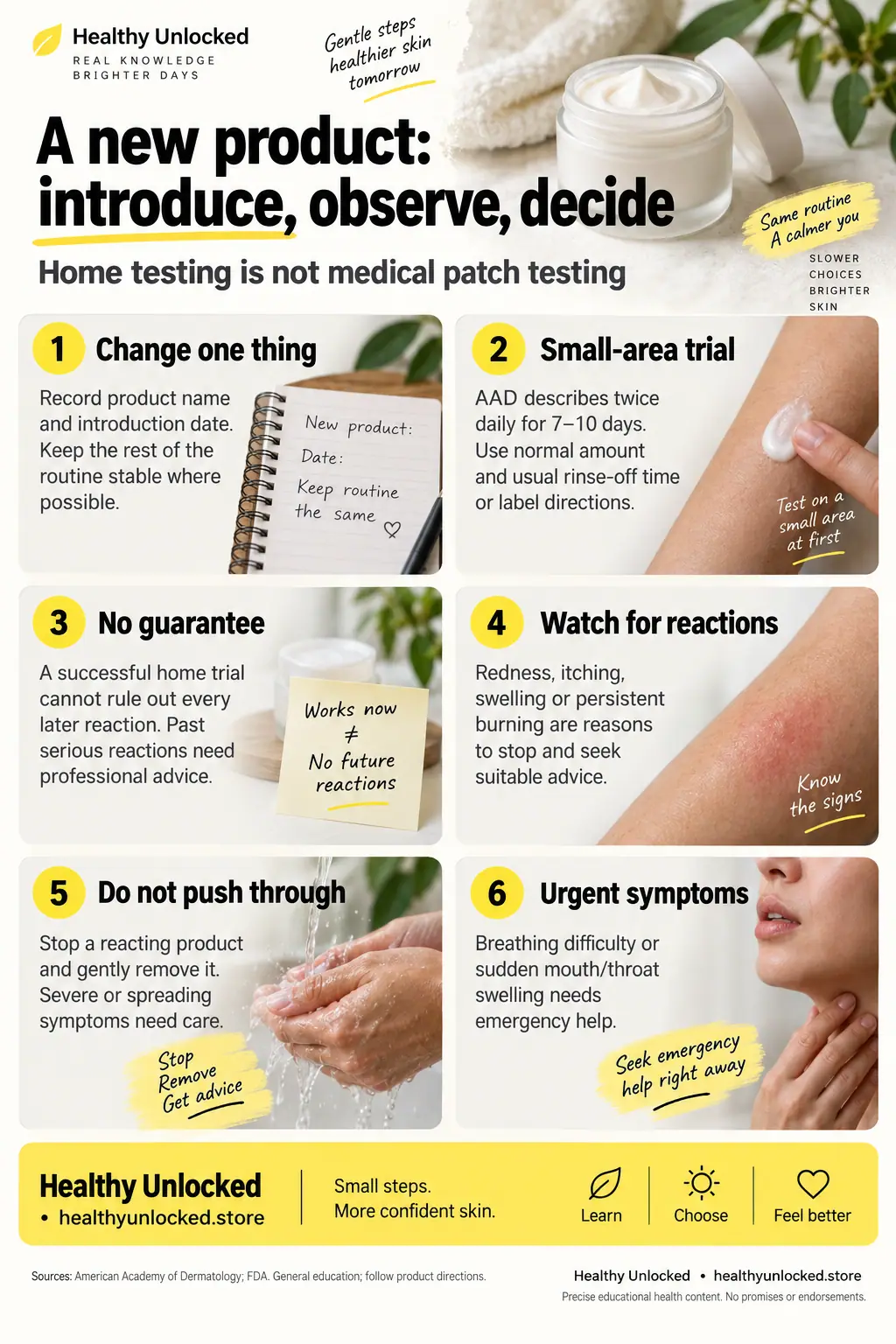
Introduce products cautiously and make one change at a time. The AAD’s home-testing guide describes trying a product on a small area twice daily for seven to ten days, following its usual exposure time. That is a screening step, not a guarantee or a substitute for medical allergy testing.
Keep a small, useful product log
Record the product name, introduction date and what you notice. “New moisturizer on Monday; itching by Wednesday” is more useful than a collection of impressions with no dates. Note changes such as weather, shaving or a prescribed treatment too. The record helps a clinician understand the sequence; it does not let a website diagnose an allergy.
For rinse-off products, use the contact time described in the testing guidance or package directions; do not leave cleanser on all day just to make the test seem stronger. Do not test a product that previously caused a serious reaction without professional advice. An ingredient list also matters if you have an established allergy.
“Natural” does not guarantee a comfortable result
Plant-derived ingredients and pleasant scents can still cause irritation or an allergy. “Unscented” and “fragrance free” are not always interchangeable. The FDA’s fragrance information and hypoallergenic-label explanation help put marketing language in context. A reassuring word on the front of a bottle is not independent proof that it is safe for your particular skin.
If a product causes a reaction, stop using it and gently remove it. Do not keep applying it to “push through” a rash. Persistent or severe symptoms, swelling or a spreading reaction need care; breathing trouble or sudden swelling of the mouth or throat needs emergency help. NHS contact-dermatitis guidance explains why finding the cause matters.
Repeated unexplained reactions may need clinician-directed patch testing. That medical process is different from a home product trial. Conditions such as eczema or rosacea may also change what feels comfortable. Avoid using a general routine builder as a way to select treatment for those conditions.
How can you keep the routine affordable and easy to follow?
Start with products that serve the core purposes and are comfortable enough to use. Before buying an extra, check whether it duplicates a job already covered. A small, reliable routine can be easier to repeat than an expensive shelf of competing products. Our weekly routine review offers a practical way to simplify.
Compare useful costs, not packaging prestige
Compare equal quantities when looking at prices. A larger container may cost more upfront but less per unit; it may also be wasteful if you cannot use it within its suitable life. Separate those questions. A low price does not prove effectiveness, and a high price does not prove better skin compatibility. Avoid buying a large pack of an unfamiliar product before you know whether it suits you.
Keep containers clean and use products as directed. Check shelf-life and expiry information, and do not share products in ways that contaminate them. Sunscreen storage deserves particular attention when a bag or car becomes hot. If a product’s smell, texture or appearance changes unexpectedly, check the manufacturer’s directions instead of treating the date alone as reassurance.
Try the morning/evening routine planner
Select the time of day and whether you have a sunscreen product that meets the stated criteria. The planner organizes the basic sequence and flags a missing sun-protection step. It does not recommend a brand, diagnose skin type, choose acne treatment or judge an allergic reaction. Products you enter are not stored or sent anywhere by this tool.
Build a simple routine from what you own
Choose a time and the basics you have. This organizes purpose and order; it does not approve ingredients or prescription combinations.
Morning example: gentle cleanser → suitable moisturizer → sunscreen. Prescription instructions can change the sequence.
Your selections stay in this page. No personal health data is stored or sent by this tool.
Download the skin-care routine planner. The file contains the same basic sequence, label checks and a blank product log. You can use it without the interactive tool.
How do the planning examples work?
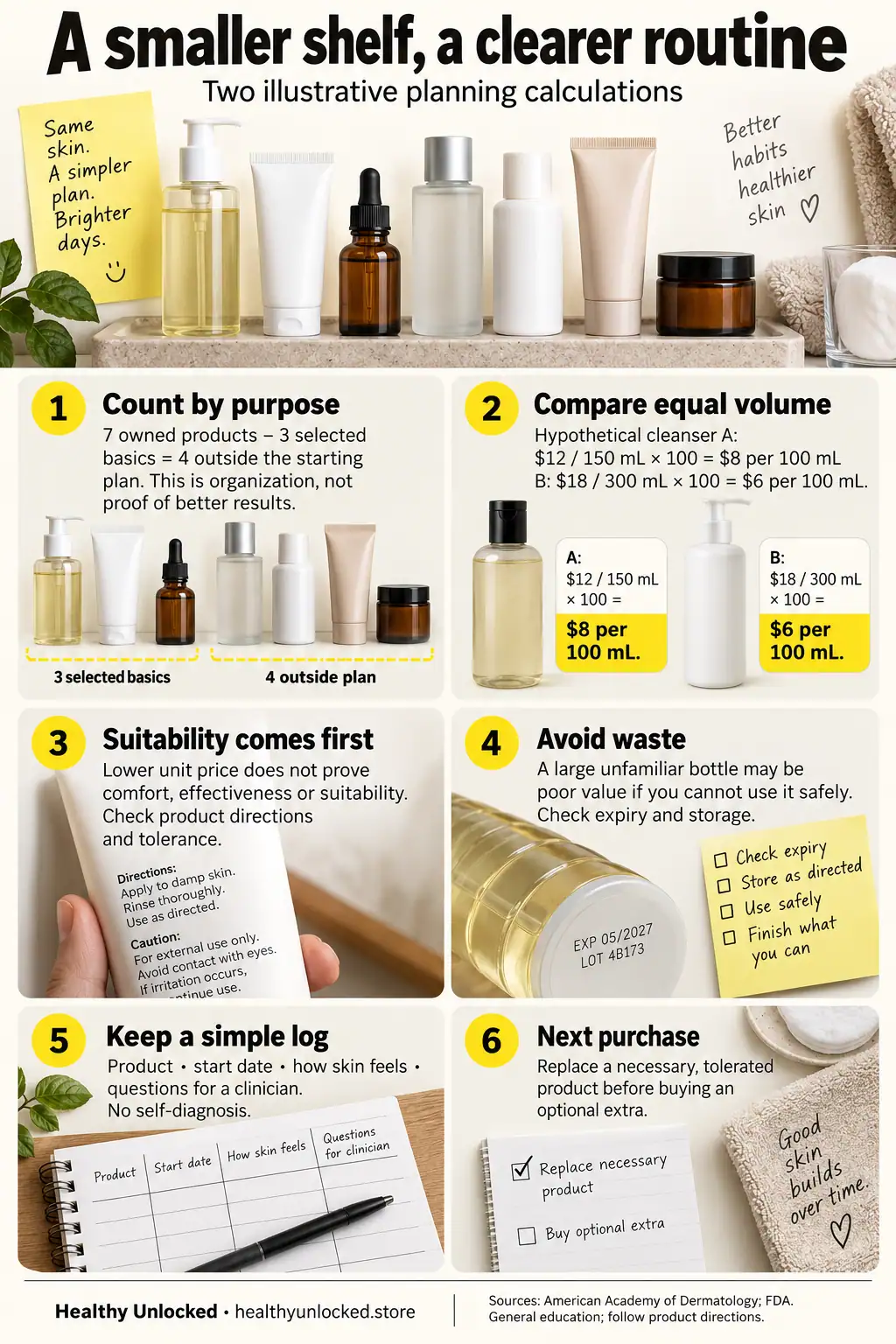
The examples below show arithmetic and organization, not measured skin outcomes. Product counts do not predict results. Costs are hypothetical and are not current offers. Healthy Unlocked’s contribution is a purpose-based routine worksheet that makes the choices and limits visible, alongside linked professional and regulatory guidance.
| Example | Inputs | Calculation | What the result means |
|---|---|---|---|
| Shelf simplification | 7 owned products; 3 selected for the basic purposes | 7 − 3 = 4 products left out of the basic plan | A simpler plan, not proof that 3 products suit every person |
| Unit-price comparison | Hypothetical cleanser A: $12/150 mL; B: $18/300 mL | A: $8 per 100 mL; B: $6 per 100 mL | B costs less per volume; suitability and waste still matter |
Example one: a crowded shelf
Imagine seven products on your shelf: cleanser, moisturizer, sunscreen, toner, two serums and a scrub. You choose the first three for the basic plan. Seven minus three leaves four products outside that plan. The calculation does not prove those extras are harmful or that three separate bottles are compulsory. It simply makes the starting routine easier to understand. A prescribed treatment remains a separate instruction to follow.
Example two: price per equal volume
For the hypothetical cleansers in the table, calculate price divided by volume, multiplied by 100. Twelve dollars divided by 150 mL, multiplied by 100, is $8 per 100 mL. Eighteen dollars divided by 300 mL, multiplied by 100, is $6 per 100 mL. This compares cost only. It says nothing about irritation, performance, ethical claims or how long the bottle will last in your home.
Evidence, uncertainty and your next step
The source library below separates everyday technique, sun protection, label interpretation and conditions needing care. Professional recommendations are not product rankings. Regulatory information explains its own jurisdiction. If two sources use different wording, check their purpose before treating the difference as a disagreement about your skin.
Before following any guide, check who wrote it, whether its claims have relevant sources and what it cannot answer. Our wellbeing-resource checklist helps with that decision. For an uncertain skin condition, your next step is an appropriate clinician, not a longer routine or a stronger claim on a bottle.
Common questions about beginner skin care
Do beginners need toner and several serums?
No. Toner and serums are optional additions whose usefulness depends on their ingredients and your needs. Start by understanding cleansing, moisturizing and sun protection. If a product does not have a clear purpose in your routine, leave it out of the starting plan. Prescription treatments and diagnosed skin conditions require their own instructions.
Can oily skin skip moisturizer?
Oily skin can still benefit from a suitable moisturizer, especially when a treatment causes dryness. A lighter texture and a non-comedogenic label may be useful shopping clues. Repeated harsh washing is not a substitute for comfortable care. Persistent acne or irritation needs appropriate advice rather than an assumption that every oily face needs the same product.
Is sunscreen in makeup enough?
Do not assume that the amount of makeup you normally apply provides the protection shown on its label. Follow sunscreen directions for coverage, amount and reapplication. A moisturizer-sunscreen combination can be useful if it meets the protection criteria and is used correctly. Shade and protective clothing still belong in the plan.
Should I continue a product that burns?
Do not keep using a product to push through an apparent reaction. Stop using it and gently remove it. Ongoing or severe irritation, swelling or a spreading rash needs care. Breathing difficulty or sudden mouth or throat swelling needs emergency help. A home product trial cannot identify every allergy or replace medical patch testing.
How quickly should I add new products?
Add products one at a time rather than changing the whole shelf at once. The AAD describes a small-area home trial twice daily for seven to ten days, using the product as directed. That trial helps screen for a reaction, but does not guarantee tolerance. Previously serious reactions and condition-specific treatments need professional guidance.
Does an expensive routine work better?
Price alone does not establish whether a product is suitable, comfortable or effective for your needs. Compare purpose, directions, ingredients you must avoid and equal-volume costs. Choose a routine you can afford to maintain. This guide does not rank brands, report product testing or promise a particular cosmetic result.
Your next routine: identify the three core purposes, read the labels and make one manageable change. Keep what feels comfortable and works with your day. If symptoms persist, use the product log to explain the situation to a clinician instead of adding more products.
About this article
By Yashveer Bharani for Healthy Unlocked. This guide brings together linked skin-care guidance and an original routine-planning worksheet. The calculations are illustrative, and the photographs show routine settings rather than documented product tests. General education does not replace care for a diagnosed condition.
Sources and further reading
These original sources support the guidance and clarify its limits. Calculators use the stated assumptions, not personal health measurements. Some references are in English. A link does not mean that the institution reviewed or endorsed this article.
Core guidance
Practical reading
Preparation and labels
Safety and care
Related evidence
Reference resources
 Healthy Unlocked
Join the conversation
Share a practical idea or ask a question about this guide. Please keep personal medical details private.