
Summary
A walking plan for beginners starts with a short, comfortable walk on a safe route, then changes gradually according to comfort and recovery. You do not need to reach 10,000 steps, buy a tracker or complete a long workout on your first day. Minutes, effort and how you feel are more useful starting observations than a universal speed.
This guide provides a flexible four-week example, a weekly-minute planner, practical safety checks and a printable log. The example is not a prescription or a promise of weight loss. Adult activity guidance is a longer-term reference, separate from the amount someone can comfortably start with.
What you’ll understand
- Start small. A manageable short walk is a valid beginning.
- Adapt the example. Repeat, shorten or rest instead of forcing progress.
- Separate time and effort. Moderate effort generally lets you talk, but not sing comfortably.
- Prepare practically. Comfortable shoes, a safe route and weather awareness come first.
- Respect symptoms. Persistent pain needs attention; urgent symptoms need urgent help.
- Keep it repeatable. Missed days are planning information, not a reason for punishment.
Four checks before your next walk
- Choose a manageable duration. Five minutes is an example, not a minimum.
- Check the route. Consider crossings, surface, weather and an easy return.
- Keep your own pace. You do not have to match a companion.
- Review afterward. Notice comfort and recovery before changing the plan.
Know the limits. Health conditions, pregnancy, recovery after illness or surgery and mobility concerns may need individual advice. This tool counts planned minutes; it does not diagnose symptoms, calculate personal calories or certify exercise intensity.
How should a beginner start walking?
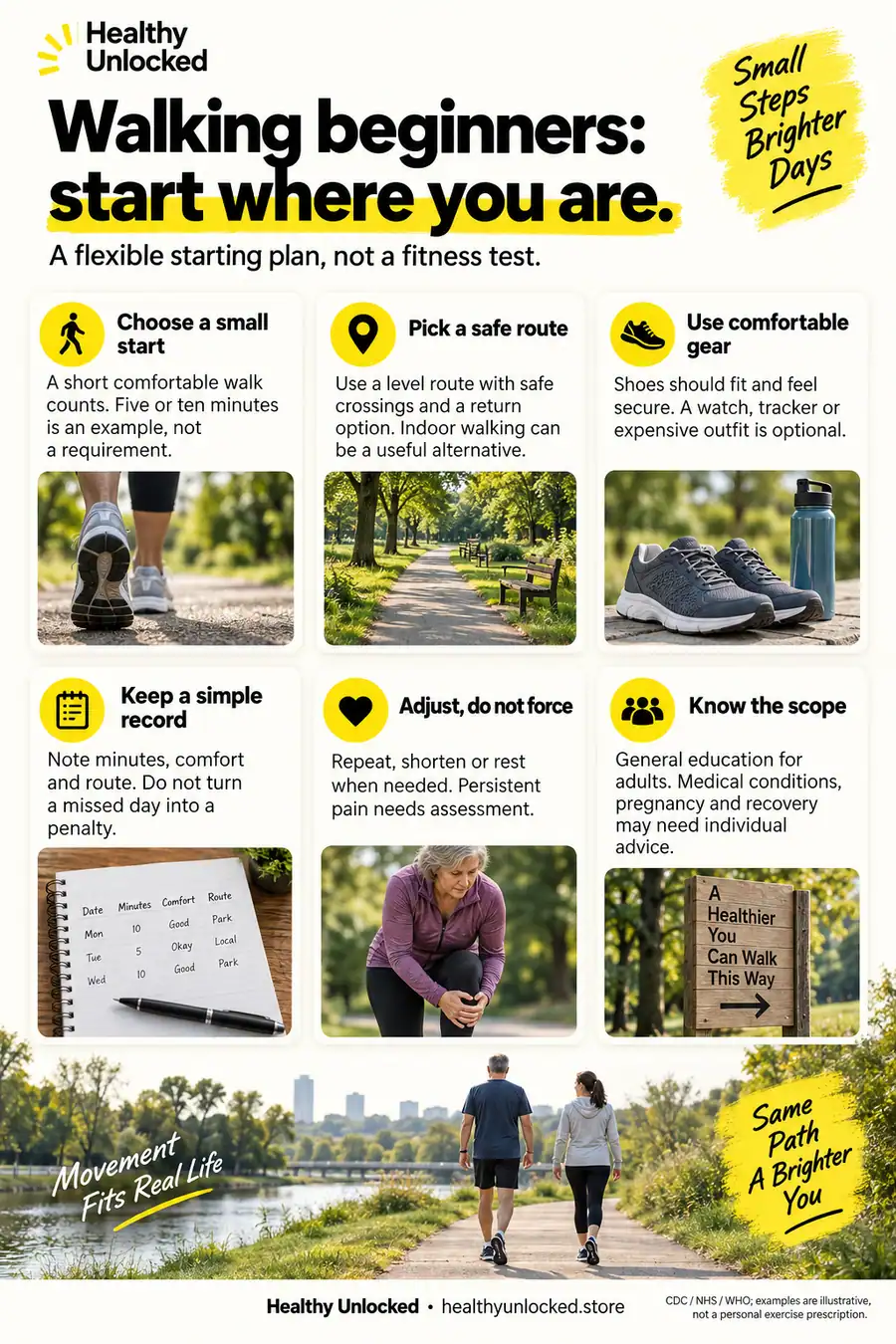
Start with a route and duration that feel manageable, even if that means a few minutes. Choose comfortable shoes and a place where you can turn back without difficulty. The first useful question is “Can I repeat this comfortably?” rather than “How far can I force myself today?” The NHS walking guide supports building walking into everyday life.
If you have been inactive, a small start can help you learn what fits your day. A walk around a level block, a short indoor route or part of an ordinary errand can all be practical options. Short bouts can add up. You do not have to make every outing look like a formal workout, and easy movement should not be dismissed simply because it does not reach a particular pace.
Begin with an observation, not a test
Notice how the route feels, whether your shoes rub, how traffic crossings work and how you feel later. A new routine creates several decisions at once. Reducing those decisions can be more useful than choosing an ambitious target. Our weekly routine review helps turn those observations into a practical adjustment.
Before starting, consider whether a health condition, recent illness, surgery, pregnancy or a mobility issue changes what is suitable. General guidance is not a clearance certificate. If you have been told to limit exertion or follow a rehabilitation plan, keep those instructions. Ask your care team how walking fits instead of replacing an individual plan with a schedule from an article.
| Decision | Useful starting option | What to observe | Avoid assuming |
|---|---|---|---|
| Duration | A short, comfortable outing | Comfort during and after | That five or ten minutes is a mandatory minimum |
| Route | Level, familiar and easy to leave | Surface, crossings and return options | That a longer route is automatically better |
| Pace | Your manageable pace | Breathing, effort and symptoms | That another person’s speed fits you |
| Equipment | Comfortable shoes and suitable clothing | Fit, rubbing and visibility | That a tracker is required |
| Record | Actual minutes and a brief comfort note | What makes the routine repeatable | That missed days need punishment |
What walking can and cannot promise
Regular physical activity has important health benefits, as the World Health Organization explains. That does not let an article predict your weight change, blood pressure or fitness improvement from a particular four-week plan. Results depend on many factors. The practical value here is learning a manageable routine, not promising an outcome that the examples cannot establish.
What could a flexible four-week walking plan look like?
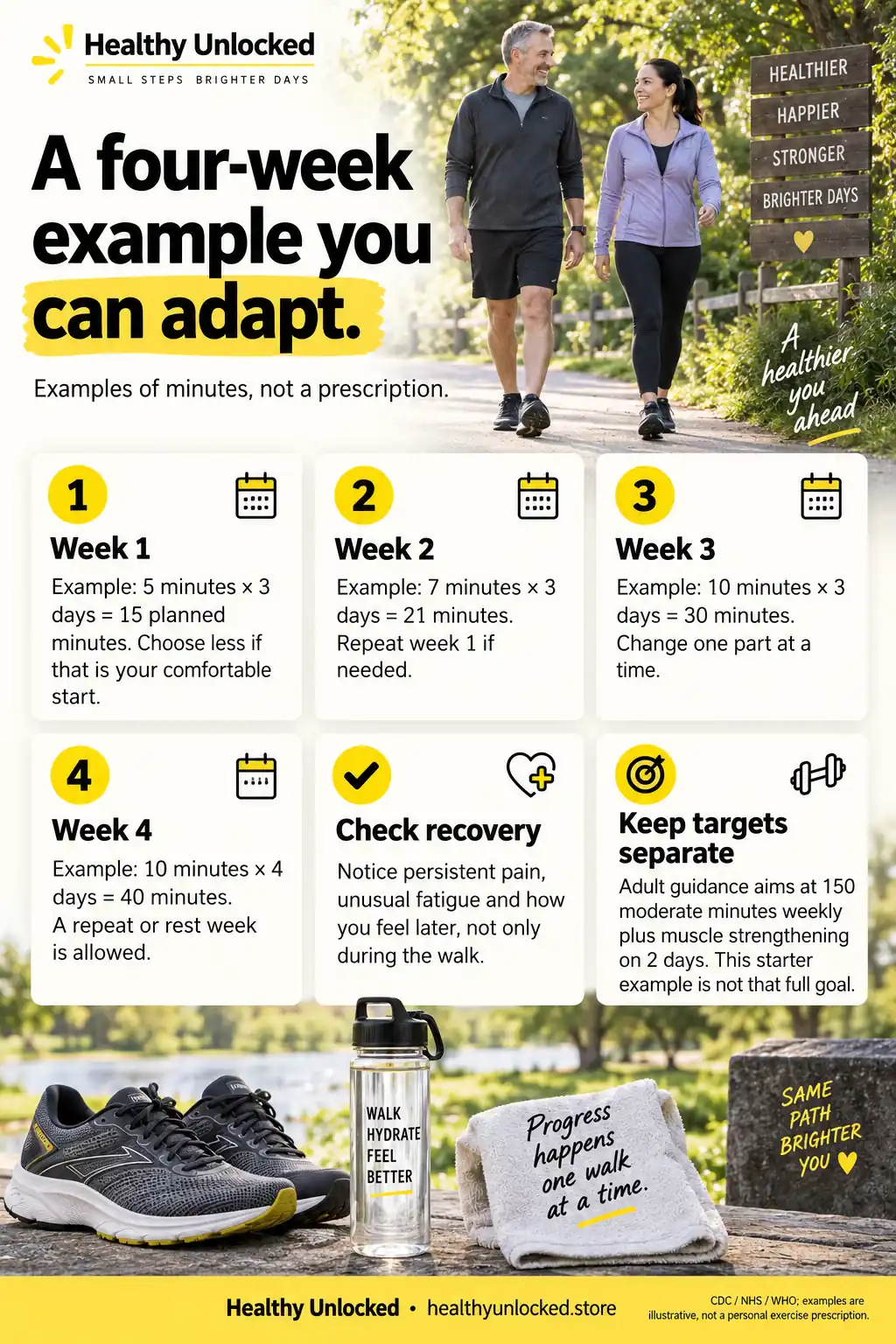
The example below starts with five minutes on three days and changes only one part at a time. It is an illustration of planning, not a required progression. You can start with less, repeat a week, reduce the duration or choose another suitable activity. The plan should respond to your comfort and circumstances rather than demand that you keep up with its row number.
| Example week | Minutes per walk | Days | Planned total | Adjustment option |
|---|---|---|---|---|
| 1 | 5 | 3 | 15 minutes | Choose less or pause if unsuitable |
| 2 | 7 | 3 | 21 minutes | Repeat week 1 if needed |
| 3 | 10 | 3 | 30 minutes | Keep the same duration if recovery is not comfortable |
| 4 | 10 | 4 | 40 minutes | Repeat, shorten or rest rather than forcing an increase |
Change one part, then review
Duration, number of days, terrain and pace all change the demand of a walk. Increasing all of them at once makes it harder to understand what caused discomfort. A longer walk on a hill is not the same change as adding a few minutes on the same level route. Keep the plan simple enough that you can connect an adjustment with how it feels.
A repeat week is useful information, not a failure. If work, weather or tiredness makes a planned week difficult, decide what can be simplified. Do not compensate for a missed walk by automatically doubling the next one. Persistent pain or unusual symptoms need attention rather than a more determined attempt to finish the schedule.
Keep the adult guideline separate from the starter example
General adult guidance aims for at least 150 minutes of moderate activity per week, alongside muscle-strengthening activity on two days. The WHO guidance also describes broader activity recommendations and the importance of reducing sedentary time. The example’s 15–40 planned minutes is a small starting illustration, not the complete guideline.
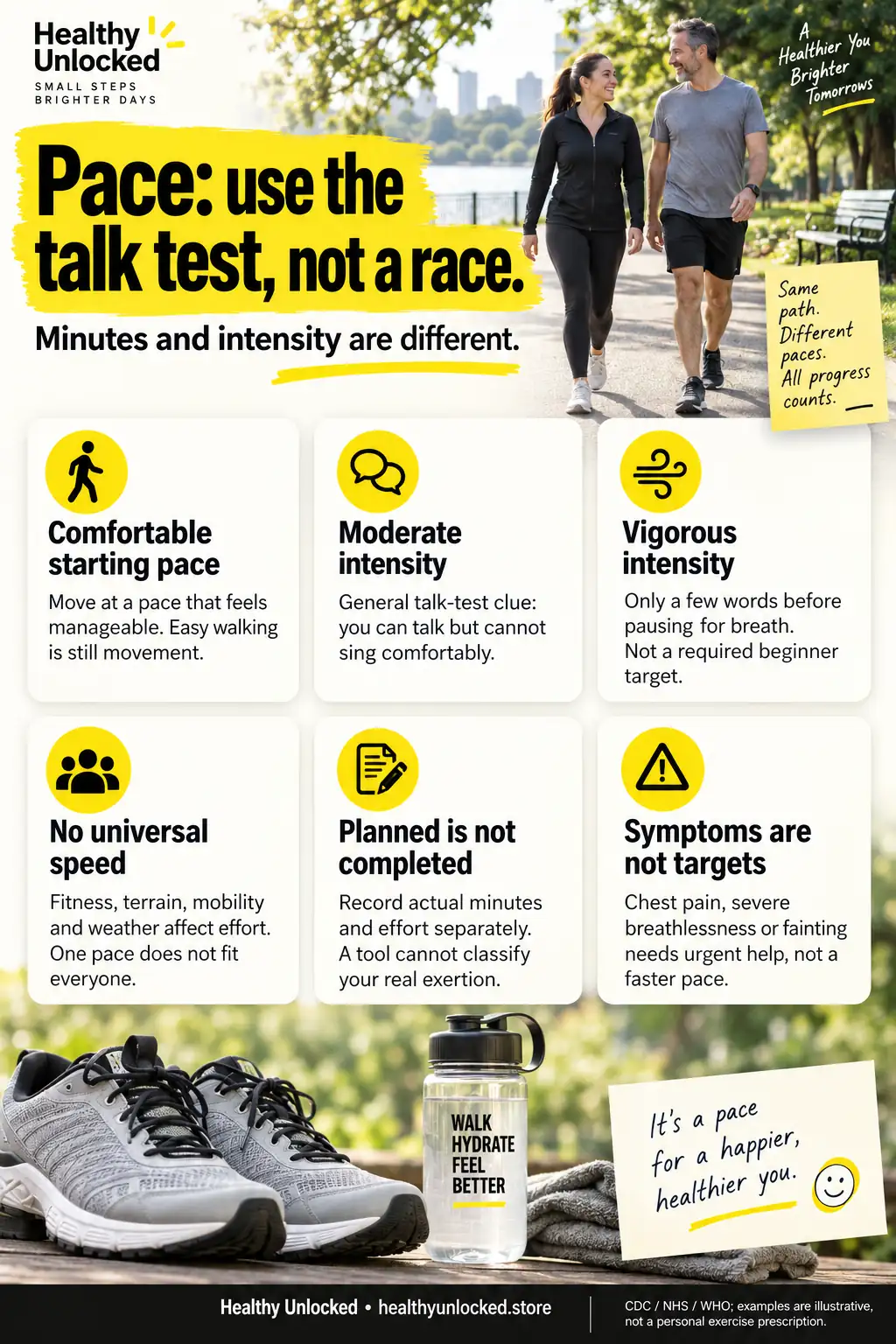
Also, a minute of walking is not automatically a minute of moderate activity. Effort matters. A starter walk at an easy pace may still be worthwhile movement without fitting that intensity category. Keep these ideas separate so a planner does not label every entry as a completed moderate workout or imply that walking alone covers strength and balance needs.
How fast should you walk, and what is the talk test?
Use a pace you can manage. For moderate activity, a common talk-test clue is being able to talk but not sing comfortably. At vigorous intensity, you may manage only a few words before pausing for breath. This is a practical general clue, not a diagnosis, and vigorous activity is not a required beginner target.
Why one speed does not fit everyone
Fitness, walking ability, hills, heat and the surface affect effort. A pace that feels easy to one person may feel demanding to another. A speed shown on a watch or an online chart therefore cannot replace noticing your own exertion and symptoms. The NHS adult activity guidance explains the difference between activity intensities.
| Observation | What it tells you | Useful action | What it cannot establish |
|---|---|---|---|
| Minutes | Time spent moving | Record actual duration | Intensity or personal calorie use by itself |
| Talk test | A general clue about effort | Adjust pace thoughtfully | Medical clearance or a precise fitness measurement |
| Distance | How far the route goes | Choose a manageable return | Equal effort on different terrain |
| Step count | A device’s estimate of steps | Use consistently if helpful | A universal requirement or a diagnosis |
Start and finish gently
Ease into the walk rather than making the first minute the hardest part. Finish at a gentler pace instead of abruptly turning the outing into a sprint. The American Heart Association’s walking resources include preparation and warm-up guidance. This article does not prescribe stretches for a specific injury or ask you to push through pain.
Walking with a companion can make an outing pleasant, but companionship does not require matching their pace. Agree on a route and a way to shorten the walk. If conversation becomes difficult or you feel unwell, slow down or stop as appropriate. A social plan should make the routine easier to manage rather than make it embarrassing to notice your limits.
For practical pacing, the NHS walking guide explains the brisk-walking talk test. The WHO activity guidance puts walking within a broader activity pattern, while the NHS heat-safety guidance explains why weather can change an outdoor plan.
What shoes and preparation do you actually need?
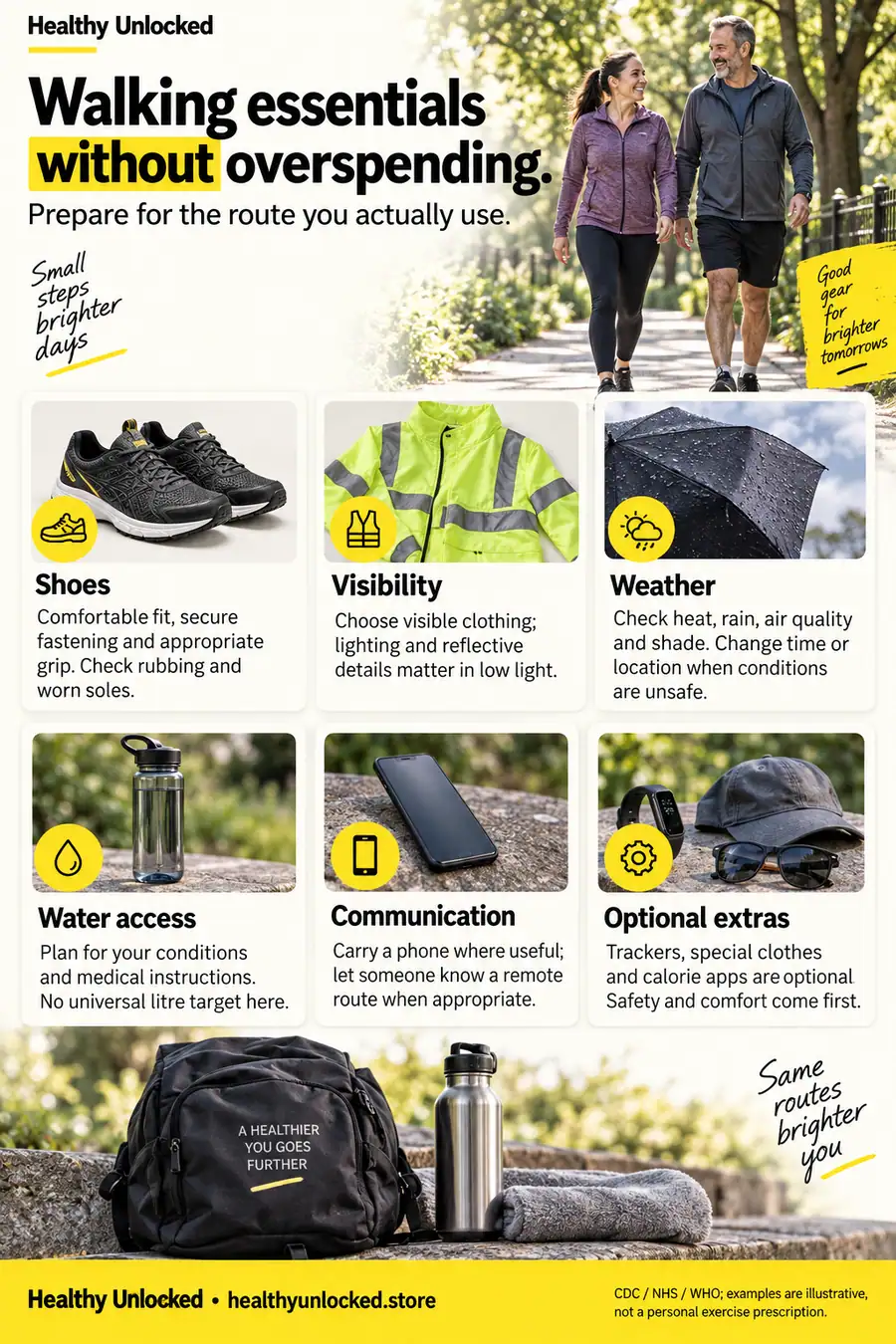
Comfortable, secure shoes and clothing suited to the conditions are the starting essentials. Check whether shoes rub, slide or have worn soles. You do not need a particular brand or an expensive outfit to begin. A phone, light or water access may matter depending on the route, weather and your individual needs.
Check fit before a longer outing
Try a short familiar route before assuming a new pair is comfortable over a longer walk. Notice rubbing, pressure and whether fastening feels secure. An ongoing foot problem may need advice rather than a different shopping claim. A shoe described as supportive is not automatically suitable for every person or a treatment for pain.
Choose clothing that lets you move comfortably. In low light, visibility is a safety issue; reflective details and adequate lighting can matter more than appearance. Carrying too many unnecessary items can make a small walk awkward. Prepare for the real route rather than an imagined perfect fitness outing.
Make preparation quick
Set shoes where you can find them, identify the route and check the conditions before leaving. If you use a phone, charge it and keep attention on your surroundings near traffic. If a route is remote, letting someone know your plan may be sensible. Preparation should reduce avoidable problems, not become a long routine that delays every walk.
Hydration needs depend on weather, duration, activity and medical instructions. This guide does not set one litre target for everyone. Plan access to water where useful, and follow any fluid restrictions or care advice you have. A generic walking article should not override instructions for a heart, kidney or other medical condition.
How do route, weather and symptoms change the plan?
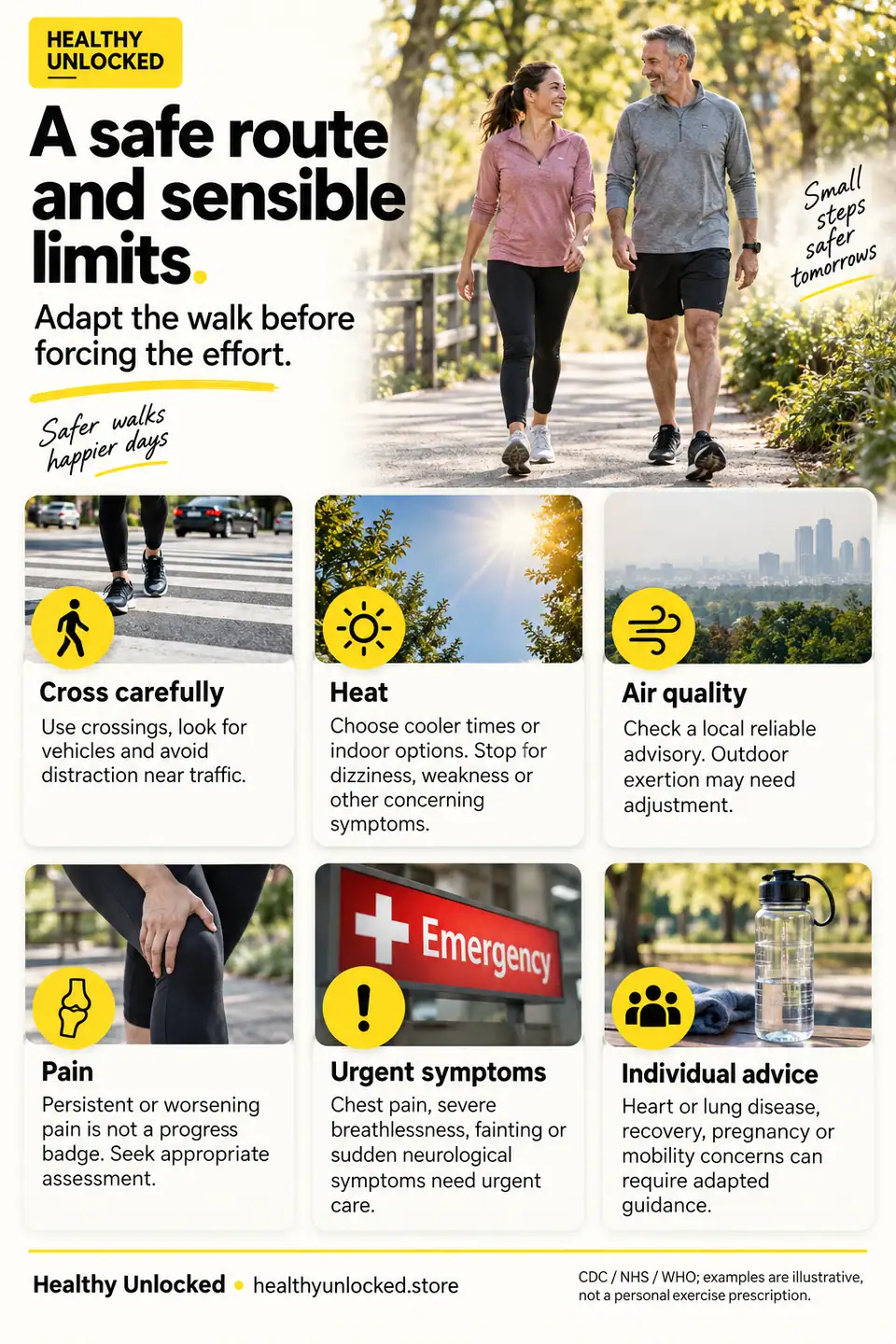
A suitable route has a surface you can manage, safe crossings and an easy way to return. Look at lighting, traffic, uneven ground and whether you can stop or sit when needed. A route can be unsuitable even when the planned minutes look small. Safety is about the setting as well as the effort.
| Condition | What to check | Possible adaptation | Limit |
|---|---|---|---|
| Heat | Temperature, shade and symptoms | Cooler time or indoor route | Do not make heat tolerance a challenge |
| Poor air quality | Reliable local advisory | Change time, place or activity | Individual health advice may require more caution |
| Rain or slippery ground | Grip, visibility and flooding | A safe indoor alternative | Do not enter unsafe surfaces to finish a total |
| Traffic or darkness | Crossings and visibility | Better-lit, quieter route | A device should not distract you from vehicles |
| Pain or unusual fatigue | Severity, persistence and recovery | Stop, reduce or seek advice as appropriate | No automatic rule to push through |
Heat and air-quality decisions
Use a reliable local forecast or advisory. The AirNow air-quality explanation helps US readers understand the AQI; readers elsewhere should use their local reporting system. A cooler time or indoor route can be more practical than insisting on an outdoor walk. A plan is allowed to change when conditions change.
Dizziness, weakness or other concerning symptoms in heat are reasons to stop and respond appropriately. The NHS guidance on heat exhaustion and heatstroke explains important warning signs and urgent situations. Do not use a minute target as a reason to stay in unsafe conditions.
Know when symptoms need help
Persistent or worsening pain is not evidence that a routine is working. Seek an appropriate assessment instead of repeatedly changing shoes or forcing longer distances. Chest pain, severe breathlessness, fainting or sudden neurological symptoms need urgent attention. The NHS chest-pain page and breathlessness guidance explain why symptoms cannot be judged from a generic walking plan.
If you need a walking aid or have balance concerns, use suitable individual guidance. This article does not tell you to remove an aid, change medication or independently perform rehabilitation exercises. Indoor walking is an alternative setting, not a guarantee that every surface or activity is safe for every person.
How can you make walking easier to repeat?
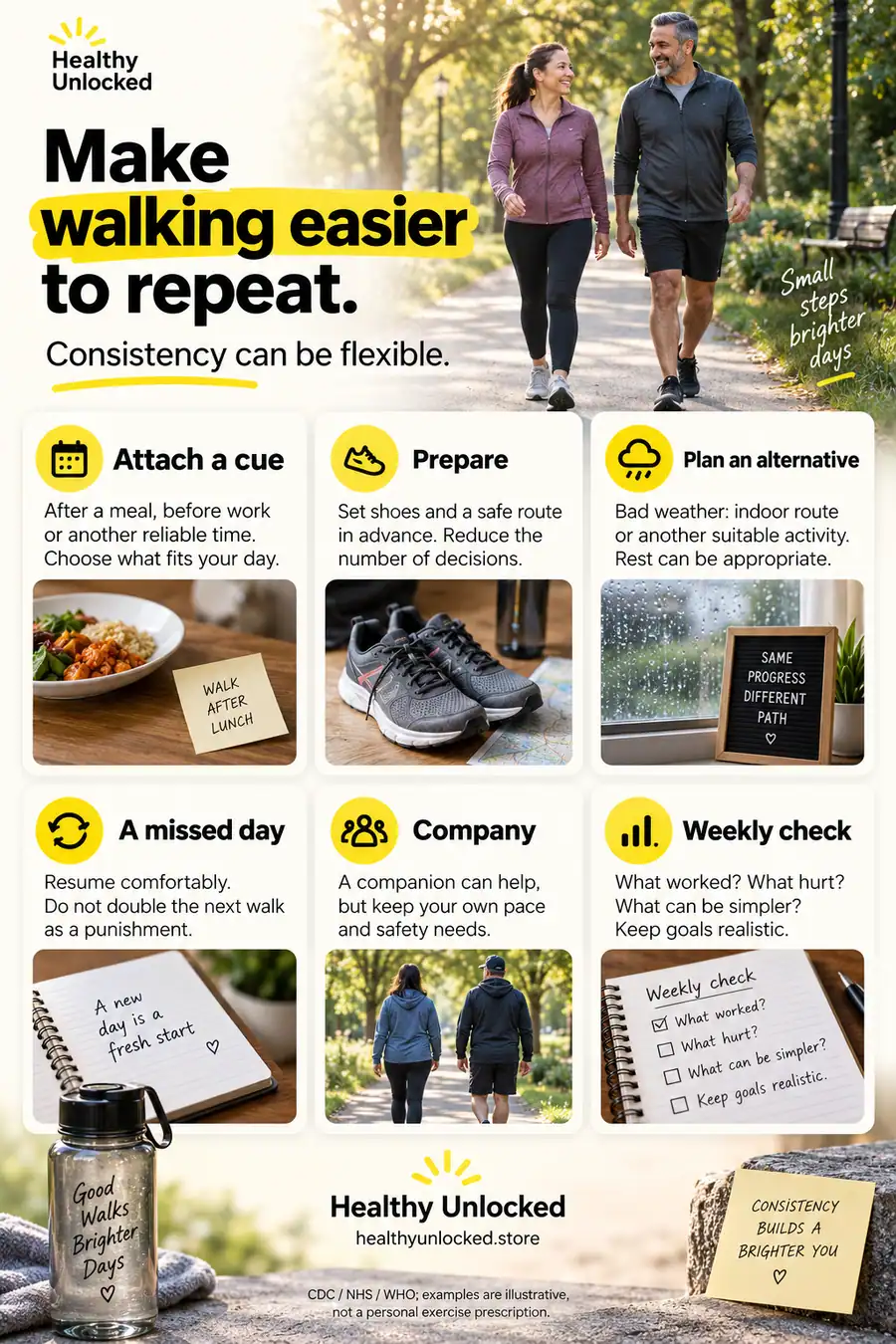
Connect a manageable walk with a reliable part of your day: after a meal, before work or another time that fits. The best time is not a universal clock hour. It is a time you can use safely and reasonably consistently. Keep an alternative for days when weather, work or family needs change the plan.
Reduce decisions, not flexibility
A familiar route and ready shoes remove small obstacles. A short backup route can help when the original outing is too demanding or too long for the available time. An indoor option, another suitable activity or rest may be appropriate. A flexible plan can remain consistent in purpose without repeating exactly the same minutes every day.
Missed days tell you something about the setup. Was the time unrealistic? Was the route inconvenient? Did pain or fatigue make the plan unsuitable? Answering those questions is more useful than deciding you lack willpower. Restart comfortably. Do not make the next outing a punishment for what you missed.
Review what actually happened
At the end of the week, look at completed minutes, comfort and the main barriers. A total without context can hide a route that repeatedly causes problems. A small routine that fits may be more useful than an ambitious schedule that exists only on paper. Our purpose-first routine guide uses the same idea of making everyday steps understandable.
A companion or reminder can help, but neither should turn ordinary movement into pressure to ignore symptoms. Choose a way to record activity that feels useful rather than demanding. You can use a notebook instead of an app. The article does not require a streak, competitive leaderboard or public health data.
Try the weekly walking-minute planner
Enter minutes per outing, outings per day and days per week. The result is planned time, before any missed or shortened outing. It does not determine whether that walking is moderate activity. Use the result to understand your plan, then record what actually happened separately.
Try the weekly walking planner
Add up planned minutes. A duration total does not measure exercise intensity, calories or medical suitability.
Example: 5 minutes × 1 walk × 3 days = 15 minutes per week. Start with a manageable amount; this is not a prescribed target.
Your selections stay in this page. No personal health data is stored or sent by this tool.
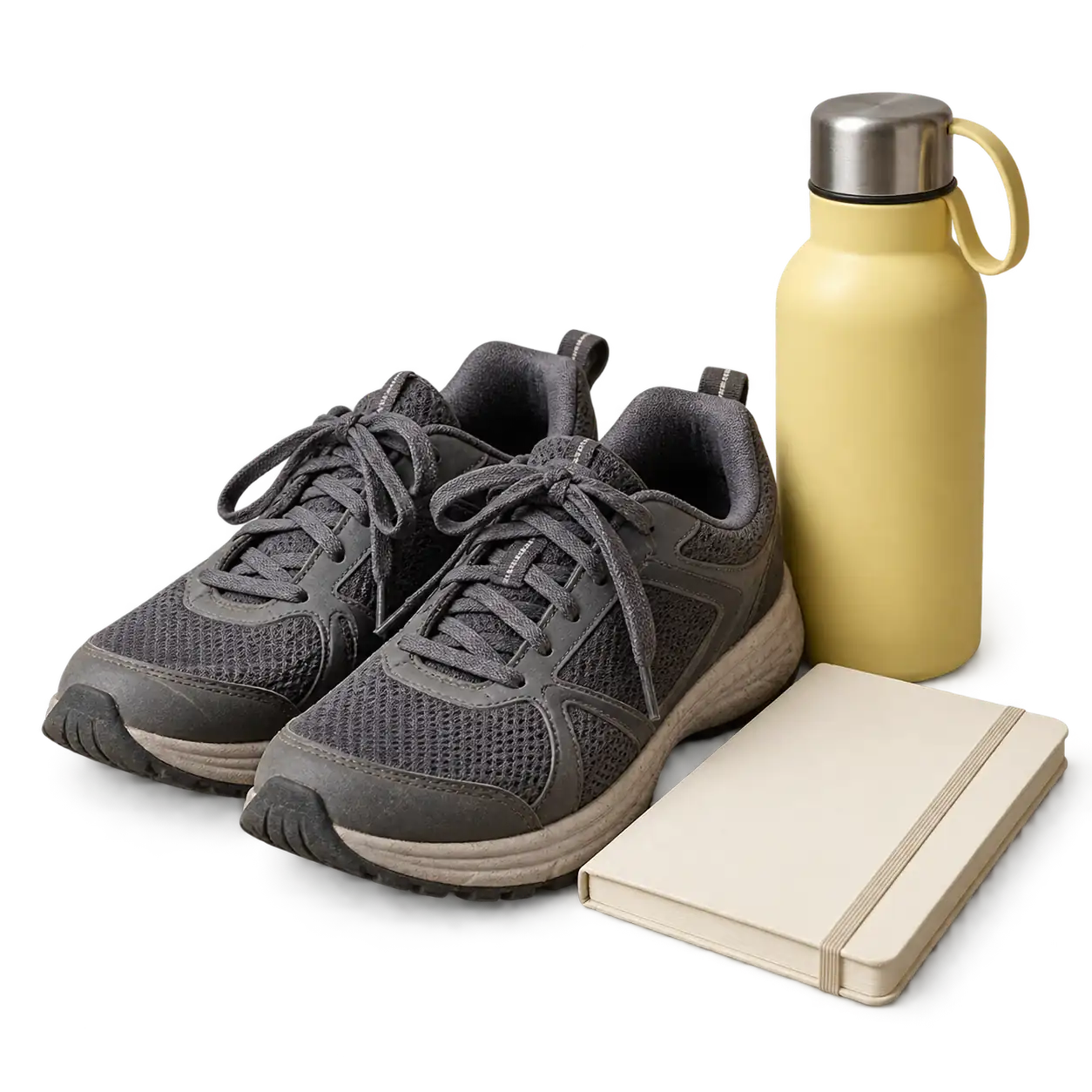
Download the walking plan and comfort log. The sheet separates planned and actual minutes and has room for route and comfort notes. Keep it privately or print it. Nothing about your health needs to be sent to this website to use the planner.
Use a small total well
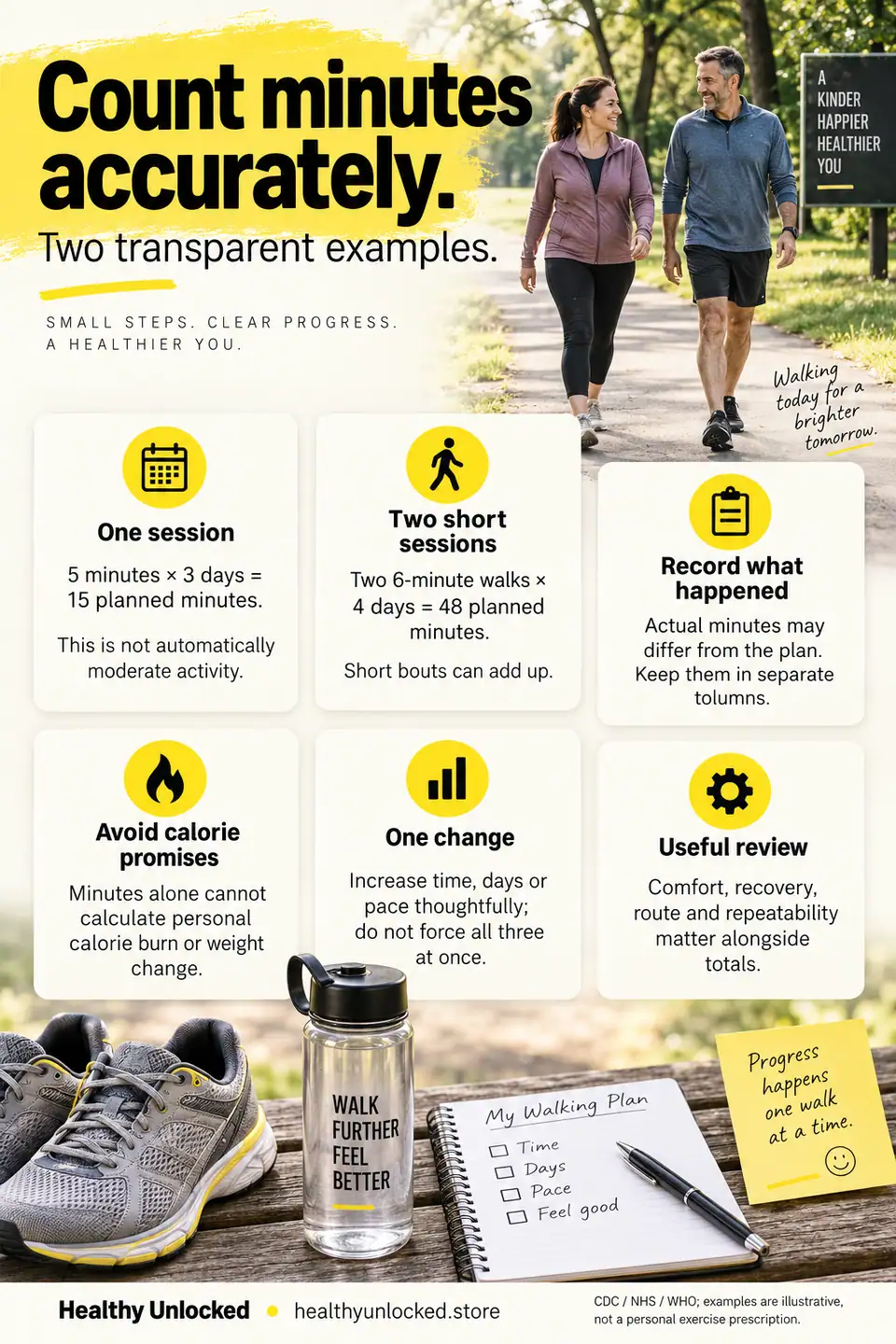
Five minutes once a day on three days produces 15 planned minutes. Two six-minute outings on four days produce 48. Neither result is a score for your health. The value is making assumptions visible: if the number of outings changes, the total changes. A calculator cannot observe your breathing, terrain, recovery or medical situation.
Keep the planner realistic. Entering a large number does not make it an appropriate plan. A blank, negative or implausible entry should be corrected, not converted into a dramatic result. The static examples below remain readable if interactive features are unavailable. You can perform the same arithmetic with a notebook.
How are the examples calculated, and what are their limits?
The arithmetic uses minutes per outing × outings per day × days per week. The first example assumes one five-minute walk on three days. The second assumes two six-minute walks on four days. These are illustrative schedules, not tested exercise interventions or personal prescriptions.
| Example | Inputs | Calculation | Meaning |
|---|---|---|---|
| One short outing | 5 minutes; 1 outing; 3 days | 5 × 1 × 3 = 15 minutes | Planned time; effort remains a separate observation |
| Two short outings | 6 minutes; 2 outings; 4 days | 6 × 2 × 4 = 48 minutes | Planned time; not an automatic calorie or weight prediction |
Why there is no calorie or weight-loss calculator here
Personal energy use depends on more than time. Body size, pace, terrain and other factors affect it. An article can provide general education without inventing a precise result from insufficient inputs. Adding a confident calorie figure would make the tool look more detailed while making its meaning less reliable.
Similarly, a weekly total does not establish that you have achieved every activity recommendation. Strength work, intensity and other individual needs remain separate. The planner is an organizational aid. It is intentionally limited to the information that its inputs can actually calculate.
How to evaluate the guidance
Primary public-health guidance supports the general activity principles; walking resources explain practical preparation. Worked examples are original planning illustrations. Follow the linked source when checking a numerical recommendation. Photographs show ordinary walking settings and equipment, not a documented exercise trial or an outcome guarantee.
Our guide to choosing a useful wellbeing resource explains how to check authorship, claims and limitations. If a condition-specific instruction conflicts with a general article, use the advice from your care team. More words, links or attractive images do not change that boundary.
Common questions about starting to walk
Do beginners need 10,000 steps every day?
No universal 10,000-step starting requirement is used here. Start with manageable movement and review comfort. Adult recommendations are expressed in activity time and intensity alongside other activity needs. A step counter can be useful, but its number is not a personal clearance certificate or a reason to ignore symptoms.
Does a five-minute walk count?
A short walk is movement and can contribute to a more active day. Five minutes is an example, not a minimum. Whether it is moderate activity depends on effort. Keep time and intensity separate, and choose a starting amount you can manage comfortably.
How fast should a beginner walk?
There is no single speed that suits everyone. Begin at a manageable pace. The talk test gives a general clue: moderate effort usually allows talking but not singing comfortably. Terrain, weather and individual ability affect effort. Symptoms need attention rather than a faster target.
Should you make up a missed walk by doubling the next one?
Not automatically. Resume comfortably and review why the outing was missed. A shorter plan, different time or safer route may fit better. Doubling as punishment can ignore comfort and recovery. Persistent pain or unusual symptoms need appropriate advice.
Can walking indoors be useful?
Yes, an appropriate indoor route can be a practical alternative when weather, air quality or outdoor safety is unsuitable. Check surface, space and your own needs. Indoor does not automatically mean every exercise is safe, and a follow-along video is optional rather than a required beginner workout.
When should a walking beginner seek help?
Persistent or worsening pain, unusual symptoms or uncertainty related to a medical condition deserves appropriate advice. Chest pain, severe breathlessness, fainting or sudden neurological symptoms need urgent attention. A general plan cannot diagnose the cause or replace an individual rehabilitation or treatment plan.
Your next walk: choose a short safe route, keep a manageable pace and notice how you feel afterward. Record what happened, then make one useful adjustment. A routine can develop without a race, a perfect streak or an expensive tracker.
About this article
By Yashveer Bharani for Healthy Unlocked. This guide combines linked public-health guidance with original planning examples and a weekly-minute tool. Calculations illustrate planned time; photographs are not evidence of exercise testing. It provides general education, not a medical assessment, individualized prescription or guaranteed result.
Sources and further reading
These original sources support the guidance and clarify its limits. Calculators use the stated assumptions, not personal health measurements. Some references are in English. A link does not mean that the institution reviewed or endorsed this article.
Core guidance
Practical reading
Preparation and labels
Safety and care
Related evidence
Reference resources
 Healthy Unlocked
Join the conversation
Share a practical idea or ask a question about this guide. Please keep personal medical details private.