

Summary
A useful bedtime routine makes the transition from a busy day to sleep easier to manage. Keep it short, protect enough opportunity for sleep and choose a few activities that suit your circumstances. A longer checklist is not automatically better, and completing one does not guarantee that you will fall asleep.
This guide separates wind-down activities from the time available for sleep. It includes choices for a shared home, late work and caring responsibilities, plus a time-budget planner. The planner adds the minutes you choose; it does not set a treatment schedule, assess sleep quality or tell you to restrict time in bed.
What you’ll understand
- Keep the purpose clear. Preparing for sleep and treating insomnia are different tasks.
- Protect sleep opportunity. An elaborate routine should not consume the time needed to sleep.
- Choose a manageable sequence. A few familiar tasks can be easier to repeat than a long list.
- Fit the circumstances. Shifts, care and shared rooms need practical adjustments.
- Use arithmetic carefully. Activity minutes are a planning estimate, not a sleep prescription.
- Seek help for ongoing problems. Persistent difficulty or concerning sleepiness deserves assessment.
Start with these steps
- Identify the time available for preparation.
- Choose two or three tasks that matter.
- Leave room for interruptions instead of squeezing sleep.
- Discuss continuing problems with a clinician.
General education, not insomnia treatment or a guarantee of alertness. Do not change medicines, restrict sleep or drive when sleepy because a routine has been completed.
What should a bedtime routine actually do?
A bedtime routine is a sequence of ordinary actions that helps close the day and prepare for sleep. It might include putting work away, doing personal care, preparing an item for the morning and choosing a quiet activity. The useful sequence depends on the life around it.
The NHLBI healthy-sleep-habits guide explains why making time for sleep matters alongside habits. Preparation is useful when it supports the sleep opportunity, rather than becoming another demanding task that takes it away.
A routine is not a promise that sleep will arrive at a particular minute. Treating sleep as a deadline can add pressure. You can complete sensible preparations and still have a difficult night, especially when symptoms, stress, medicines or a sleep disorder need attention.
Do not judge the routine by its products or resemblance to a video. A familiar book, a simple wash and a place for tomorrow’s belongings may meet the planning need. The purpose is an easier transition, not another shopping requirement.
Our adult sleep-hygiene checklist provides broader background. Use the present guide to organize a few evening tasks. Neither article replaces assessment of an ongoing sleep problem.
| Question | Useful planning role | Important limit |
|---|---|---|
| What remains before bed? | Identify preparation tasks | Not the cause of a sleep disorder |
| How long do tasks take? | Estimate a manageable sequence | Not a prescribed amount of sleep |
| What interrupts the evening? | Account for work and care | Not personal failure |
| Did I complete the tasks? | A factual planning record | Not an alertness grade |
| Why is sleep repeatedly difficult? | Notes can support a clinical conversation | Not a diagnosis from a checklist |
| Is driving safe? | No safety clearance is provided | Routine completion cannot certify alertness |
Make the sequence serve you
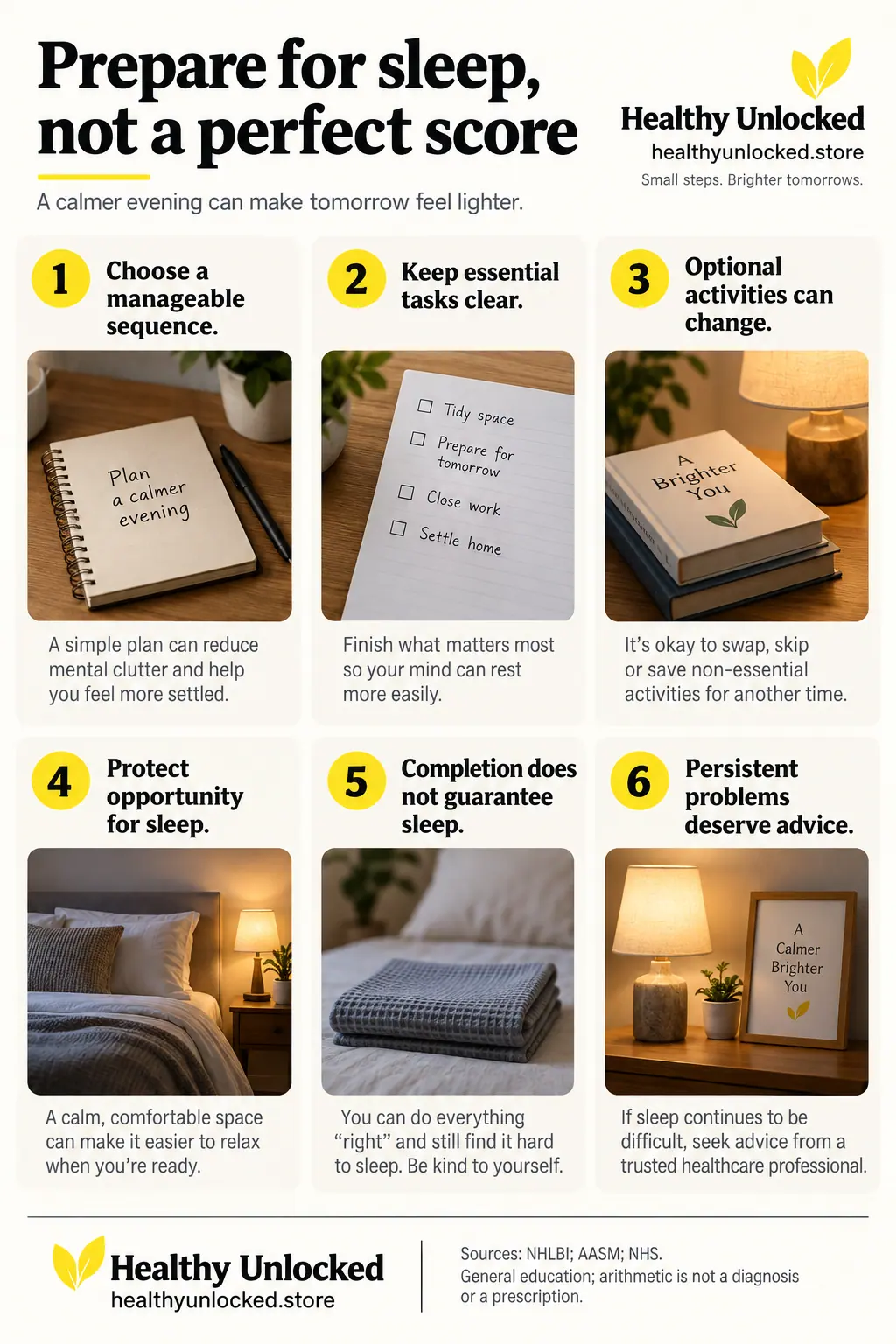
Write what you currently do before adding anything. If the necessary tasks are manageable, you may not need a new routine. If one task regularly runs late, address it before adding several activities around it.
Choose a version that fits an ordinary day. A plan needing a private room, spare money and uninterrupted time may not fit your circumstances. Simplify the steps rather than treating the mismatch as a lack of willpower.
A change can be small: prepare a bag earlier, put a work notebook away after the last task or discuss shared lighting. These are practical choices, not tested treatments or obligations for every reader.
Protect sleep opportunity before adding activities
Start with the opportunity available for sleep. Preparation time, time in bed and time actually asleep are different measures. A calculator that adds evening tasks cannot know how much sleep you will get. A planned bedtime is not a measured sleep-start time.
Consider morning obligations and which evening tasks can happen earlier. Avoid letting a long routine crowd out sleep. This guide does not prescribe an exact bedtime or calculate a treatment window from a sleep diary.
If the day repeatedly leaves too little opportunity, adding another product or a longer relaxation sequence does not solve the time problem. Simplify preparation or discuss task-sharing where possible. Some constraints need help from other people rather than another personal checklist.
Professional insomnia care can involve specific interventions. Do not copy a time-in-bed restriction from an example, subtract your diary’s awake time from tonight’s sleep window or use this planner to make such a decision.
The NHLBI guidance on sleep amounts describes general needs. Those references are background, not an individualized answer for illness, unusual schedules or treatment. Ask for advice when your situation differs or sleep remains difficult despite adequate opportunity.
| Measure | What it describes | Misleading substitution |
|---|---|---|
| Wind-down budget | Time for chosen preparations | Calling preparation minutes sleep |
| Sleep opportunity | Time available within real obligations | Assuming opportunity equals sleep achieved |
| Time in bed | A recorded period in bed | Assuming all of it was sleep |
| Estimated sleep | A diary estimate of sleep that occurred | Diagnosing a condition from that number |
| Required wake time | An obligation in the schedule | Assuming preceding sleep was sufficient |
| Interruption | Care or an event that occurred | Erasing it to make the plan look complete |
A late evening needs a shorter plan
On a late day, keep essential personal care and necessary preparation. Optional tasks can be shortened or moved. Do not stay awake to make up every missed routine item.
A truthful note such as “short version after late work” is useful. Avoid calling the night a failure or imposing a stricter schedule as punishment the following evening.
If you must be available for care or emergencies, retain the necessary communication channel. Putting a phone away is flexible; it should not prevent an important call or create a safety problem.
Choose a short, flexible wind-down sequence
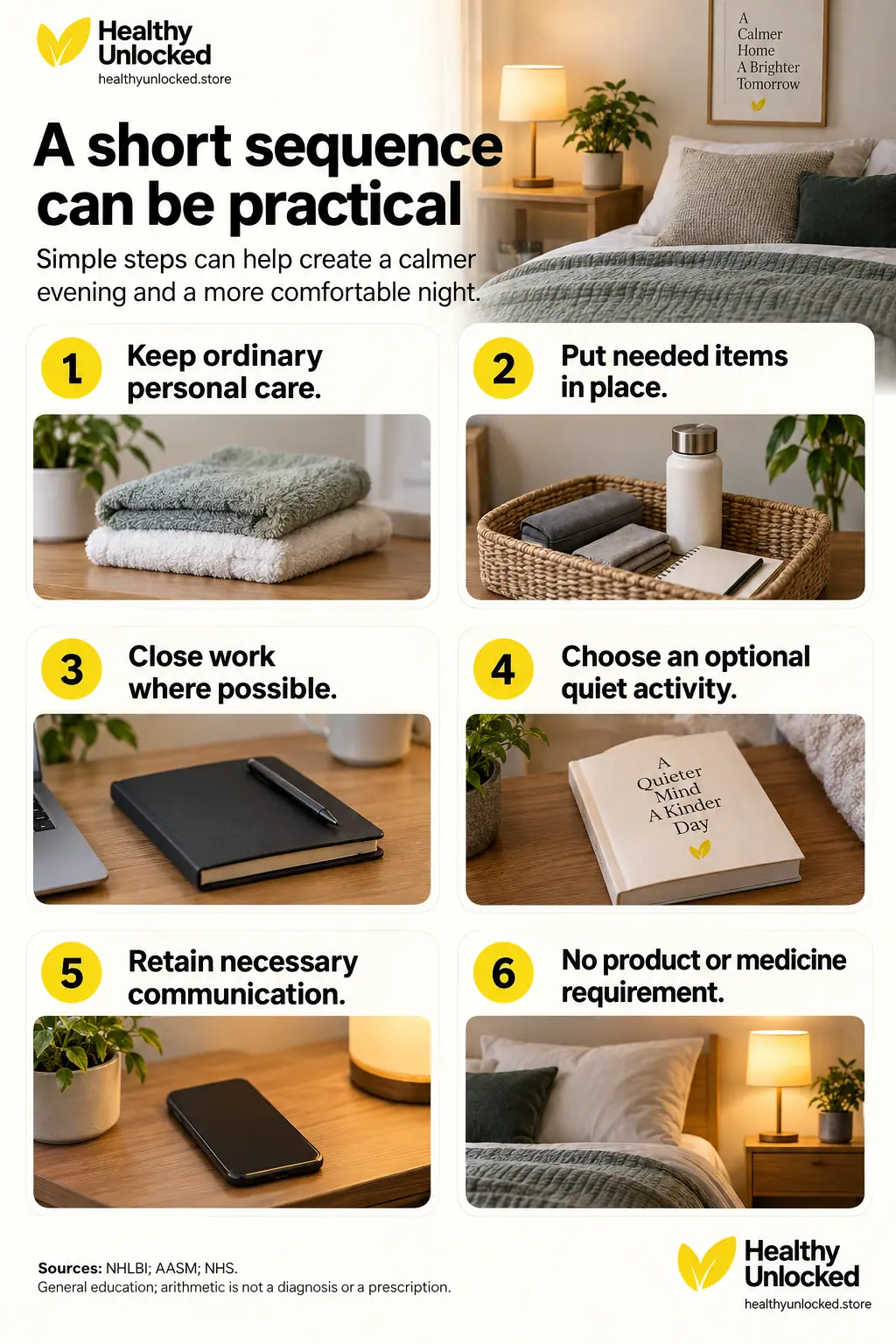
Choose tasks by purpose. Essential personal care, preparation that prevents morning rushing and a quiet transition can form a small sequence. You do not need an item from every category, and the order can change.
A first version might contain only ordinary personal care and putting tomorrow’s essentials in one place. If you want a quiet activity, choose something accessible and easy to stop. A familiar book or quiet listening are examples, not sleep guarantees.
A routine does not need photographing, matching products or minute-by-minute recording. A rough estimate can show whether tasks fit. The planner deliberately avoids awarding a score for the number of activities.
Do not add supplements, sedatives or alcohol assuming they are harmless shortcuts. Medicine decisions depend on the product, person and other treatments. Ask a qualified clinician or pharmacist instead of treating a checklist as authorization.
Our beginner skin-care guide keeps personal care understandable. Skin care is not sleep treatment. Follow product instructions without adding applications simply because it is bedtime.
| Category | Possible choice | Flexible boundary |
|---|---|---|
| Personal care | Your ordinary wash or tooth-care preparation | Use instructions relevant to you |
| Tomorrow’s essentials | Put a needed item in place | Move earlier when the evening is crowded |
| Closing work | Write the next task and put materials away | Account for on-call duties |
| Quiet transition | A short comfortable activity | No guaranteed sleep outcome |
| Shared arrangements | Agree on light or noise where possible | Retain safety and respect others |
| Necessary care | Prepare what a dependent person needs | Do not remove essential care to finish a list |
Keep a minimum and an optional version
The minimum version contains necessary tasks. An optional version can add a quiet activity when circumstances allow. Optional steps should not become conditions you believe must be satisfied before sleep is possible.
Estimate task lengths from experience. The examples below use chosen minutes to demonstrate arithmetic, not ideal durations from a trial. Leave unallocated time when a task varies.
Changing one thing at a time can make the plan easier to understand. This is an organizational suggestion, not a clinical rule. Symptoms needing care do not have to wait while you finish several experiments.
Make the room and evening tasks easier to manage
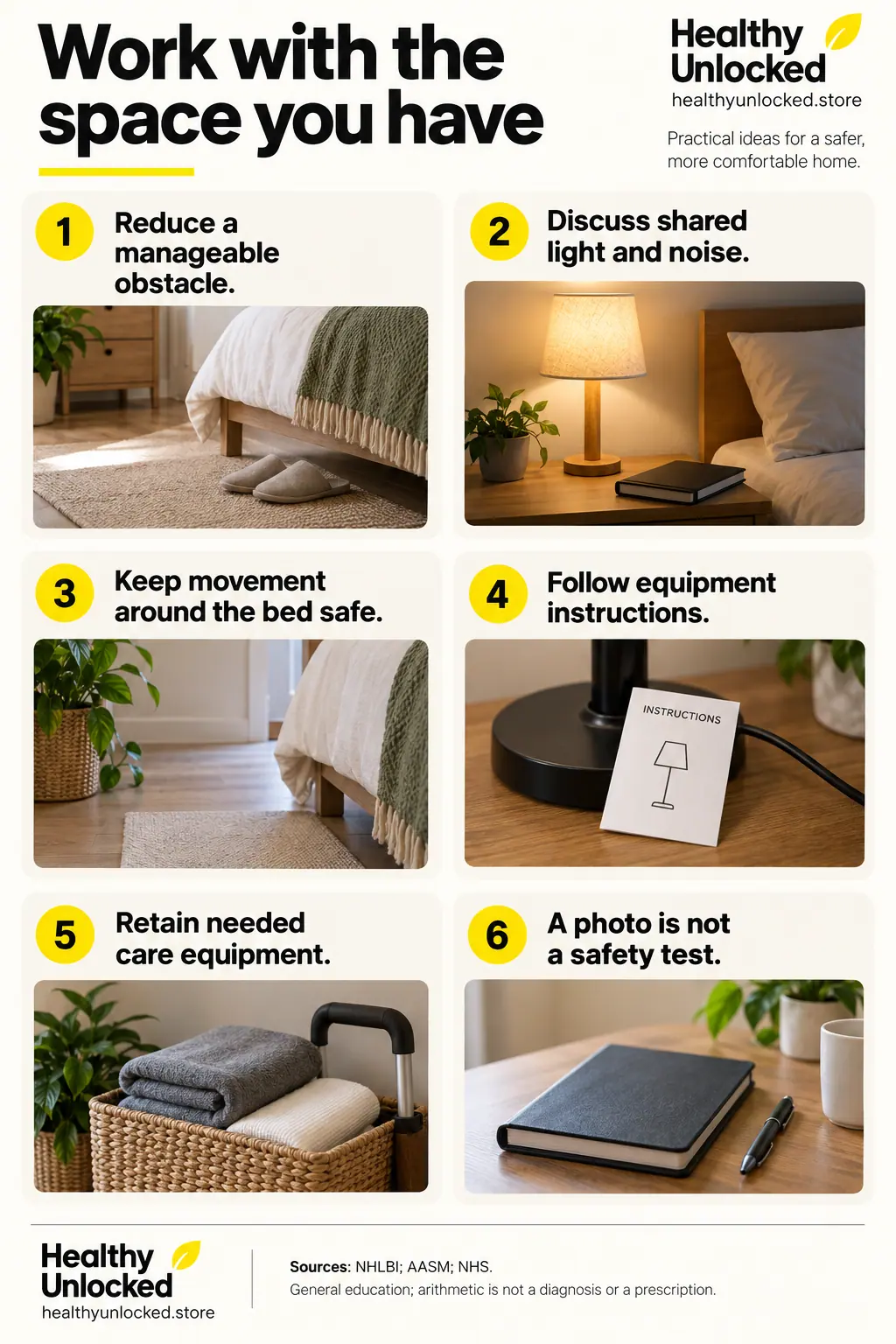
Look for practical obstacles: work left active, tomorrow’s item hard to find, noise that can reasonably be reduced or lighting that can be adjusted safely. Address what is within reach without assuming you need a redesigned bedroom.
The NHS sleep preparation advice offers general ideas about routine and surroundings. Use them as options. Retain safe lighting, medicines as directed and equipment required for care.
A shared room needs cooperation. A small accommodation may be more realistic than demanding complete darkness and silence at the same hour every night. Another person’s work or care needs belong in the discussion.
Keep the bed and route around it safe. Do not put cables, charging devices, heaters or objects in hazardous positions because an image looks peaceful. Follow equipment instructions; an editorial photo is not a tested room layout.
If housing, heat or noise remains an obstacle, acknowledge it. A routine cannot remove every environmental problem. An honest note can support practical help instead of suggesting that the reader needs more discipline.
Use a workable device boundary
Separate necessary communication from optional scrolling. An alarm, an emergency call or a care message may need to remain available. Retain those functions while making optional use easier to stop.
One display setting is not proof that device use has no effect. Content, work demands and time spent can matter to the routine. A boundary is a planning aid, not a claim that a feature eliminates sleep problems.
If a device holds your diary, make the record after waking or at another suitable time. Repeated clock checks during the night are not needed to create exact-looking entries.
Consider daytime habits without rigid countdown rules
The bedtime sequence is part of a larger day. Work timing, caffeine, activity, meals, stress and medicines may be relevant to a sleep discussion. Record context without declaring that one habit caused a difficult night.
The NHLBI sleep-wake-cycle explanation describes biological timing. A routine can support a consistent pattern where possible, but cannot override symptoms or shifts simply because the checklist is complete.
Caffeine can be present in products other than coffee. Note the product and approximate time if relevant. Do not apply an online countdown as a universal safe cutoff; ask about your circumstances when treatment or another condition affects the advice.
Alcohol is not a reliable sleep solution. Do not combine it with medicines or use it to force sleep based on a lifestyle article. Interaction, use or dependence concerns deserve appropriate support.
Our walking guide for beginners explains gradual activity choices. Do not add a strenuous session to compensate for a missed routine or assume one walk guarantees sleep.
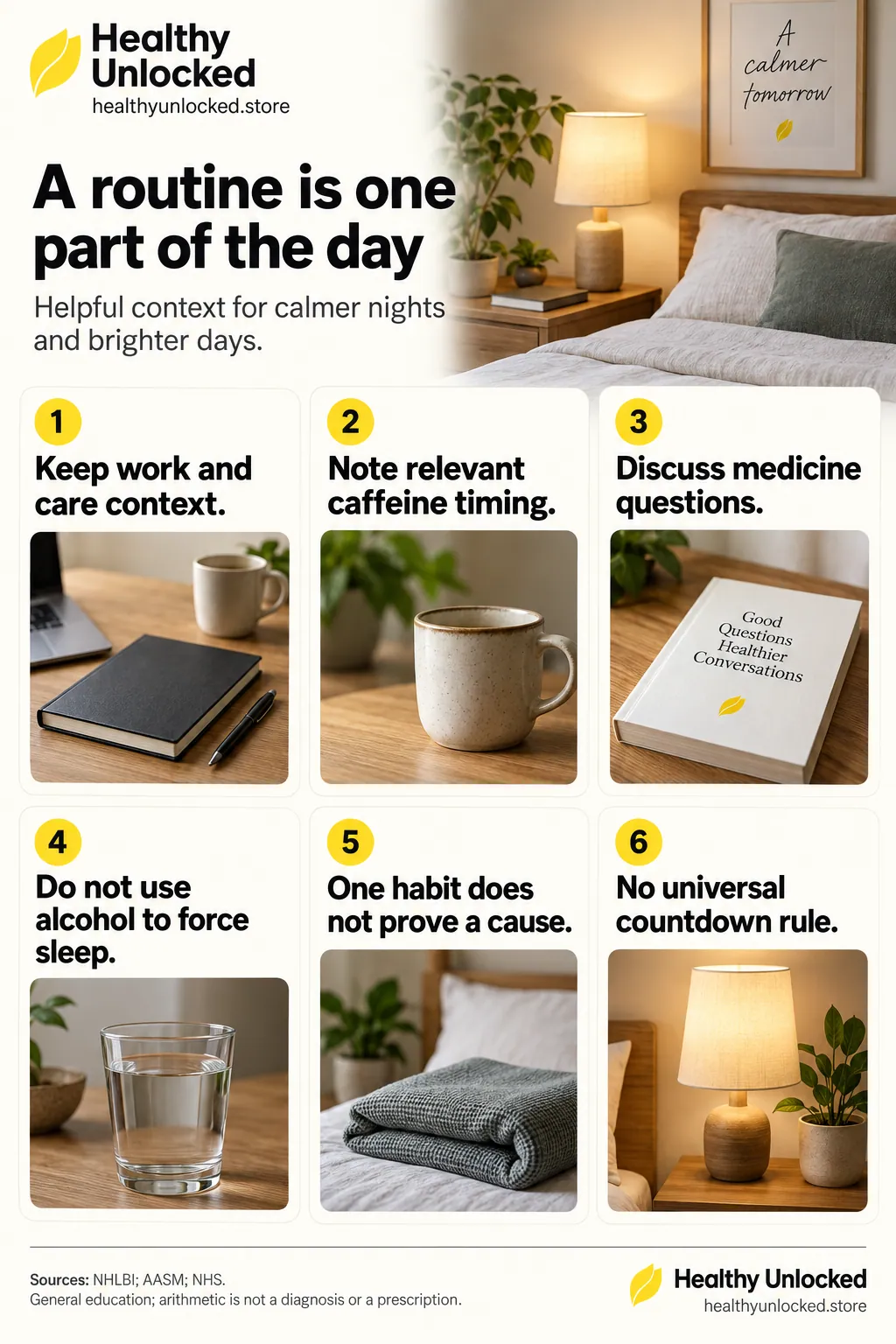
A simple-looking countdown is not personalized care
Headlines assigning fixed hours to meals, drinks, screens and work can look easy to follow. This article does not present one countdown as treatment or a requirement for all readers.
A reminder can help with a particular task such as putting work away. Missing it does not establish that the night has been medically compromised.
Keep relevant prescribed medicines and supplements on a list for your clinician. Discuss timing and side-effect questions rather than stopping treatment independently.
Adapt the routine to shifts, care and shared homes
Account for work and care that actually happen. Someone returning from a night shift cannot simply copy a daytime worker’s evening. Consider preparation before the main sleep period even when it happens in daylight.
The American Academy of Sleep Medicine shift-work resource explains background concerns. A time-budget tool cannot assess fitness for duty, prescribe a rotating schedule or certify safe driving after a shift.
Caring responsibilities can interrupt a plan. Keep essential care visible and discuss sharing where support exists. An interrupted night is not proof that a person failed to follow a routine.
In a shared home, washing or preparing tomorrow’s lunch may compete for space. Move what can move and retain a short version for crowded evenings. An affordable plan works with the circumstances.
If the routine increases anxiety, simplify it and discuss the difficulty. Preparation should not become a ritual repeated until perfect. A practical transition can coexist with help when organization is not enough.
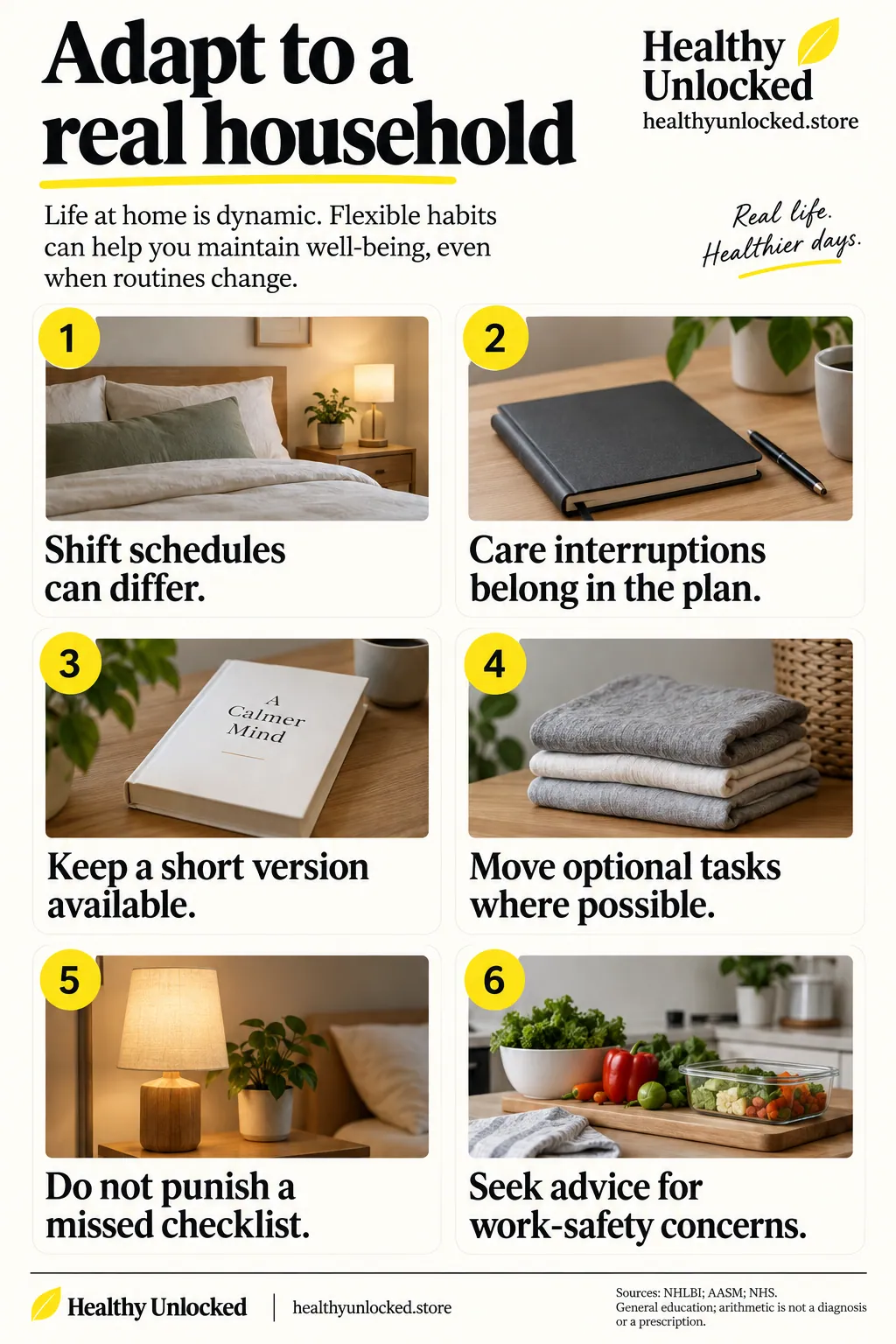
Worked example: a flexible shared-household plan
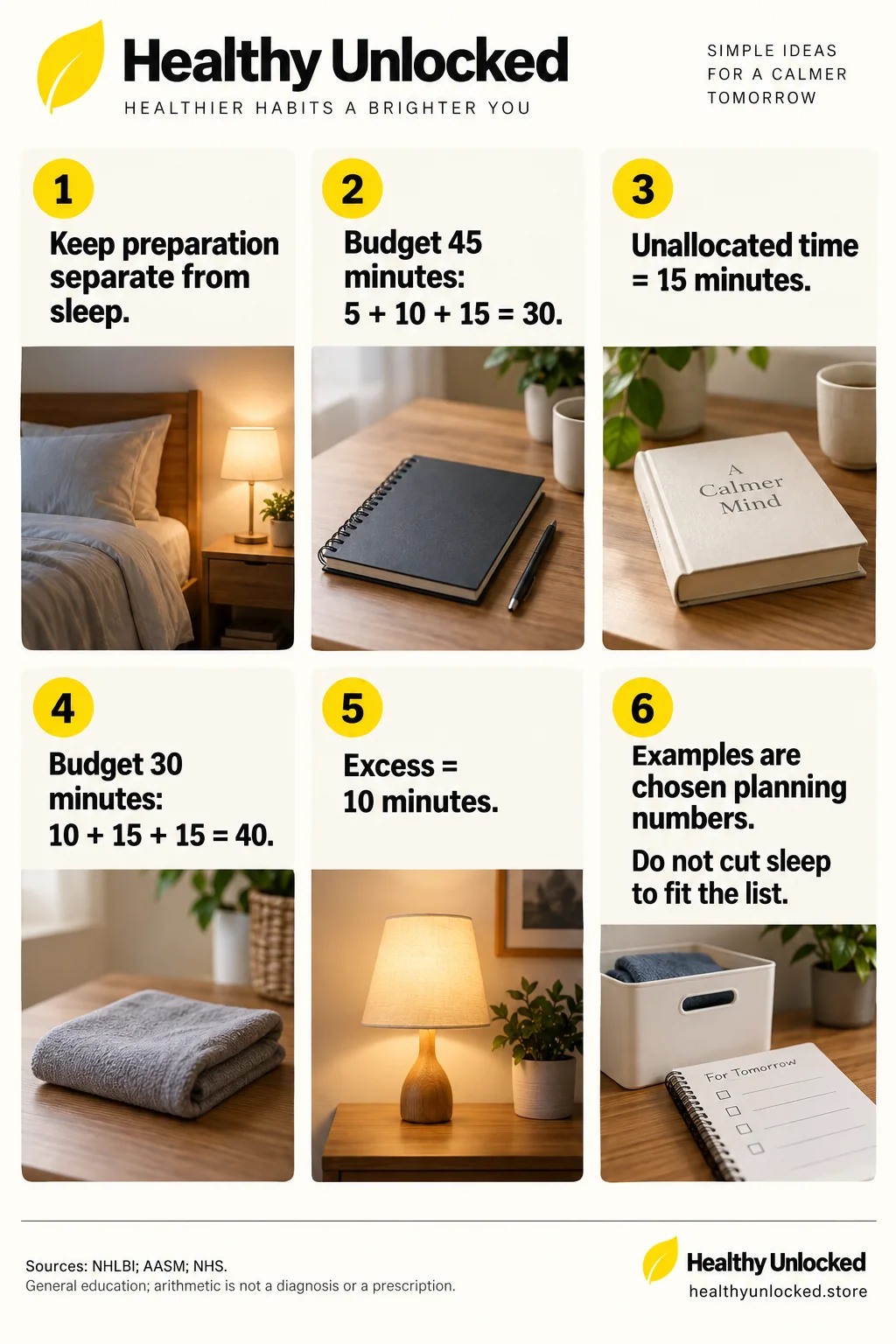
Someone has 45 minutes for preparation after necessary household work. They choose 5 minutes for essentials, 10 for ordinary personal care and 15 for a quiet activity. The chosen tasks total 30 and leave 15 unallocated. That remainder is a buffer, not measured sleep.
If care interrupts the optional activity, a short version can replace the plan. The example demonstrates arithmetic and flexibility, not a particular sleep outcome.
The next week may require another arrangement. Updating the plan is allowed; a fixed printable list should not outweigh changing responsibilities or professional advice.
When does a sleep problem need more than a routine?
Persistent difficulty falling asleep, staying asleep or functioning during the day can need more than a routine. Discuss ongoing problems with a healthcare professional. You do not need a perfect diary or a month of experiments before asking.
The NHLBI insomnia treatment overview describes cognitive behavioral therapy for insomnia and other clinical care. This article does not reproduce a treatment protocol, prescribe sleep restriction or recommend medicine.
Loud snoring with witnessed breathing pauses, gasping or another concern can need assessment. The NHLBI sleep-apnea diagnosis resource explains the process. A regular bedtime does not rule a disorder out.
Do not drive when sleepy. Address an immediate safety problem at work or on the road and seek advice. Coffee, a checkbox and a planned bedtime cannot certify safe alertness.
Urgent chest pain, serious breathing difficulty, collapse or immediate self-harm risk need appropriate urgent help. Do not respond to severe symptoms by trying a new bedtime checklist.
| Concern | Useful information | Avoid |
|---|---|---|
| Repeated difficulty | Pattern, daytime effect and main question | Waiting for a perfect routine |
| Breathing concerns | What was observed and by whom | Ruling it out from regular bedtime |
| Sleepiness | Timing and safety effects | Treating the planner as driving clearance |
| Medicines | Names and timing questions | Stopping treatment independently |
| Work or care | Actual schedule and interruptions | Hiding constraints for a tidy record |
| Anxiety about the routine | What feels compulsory or stressful | Adding steps as punishment |
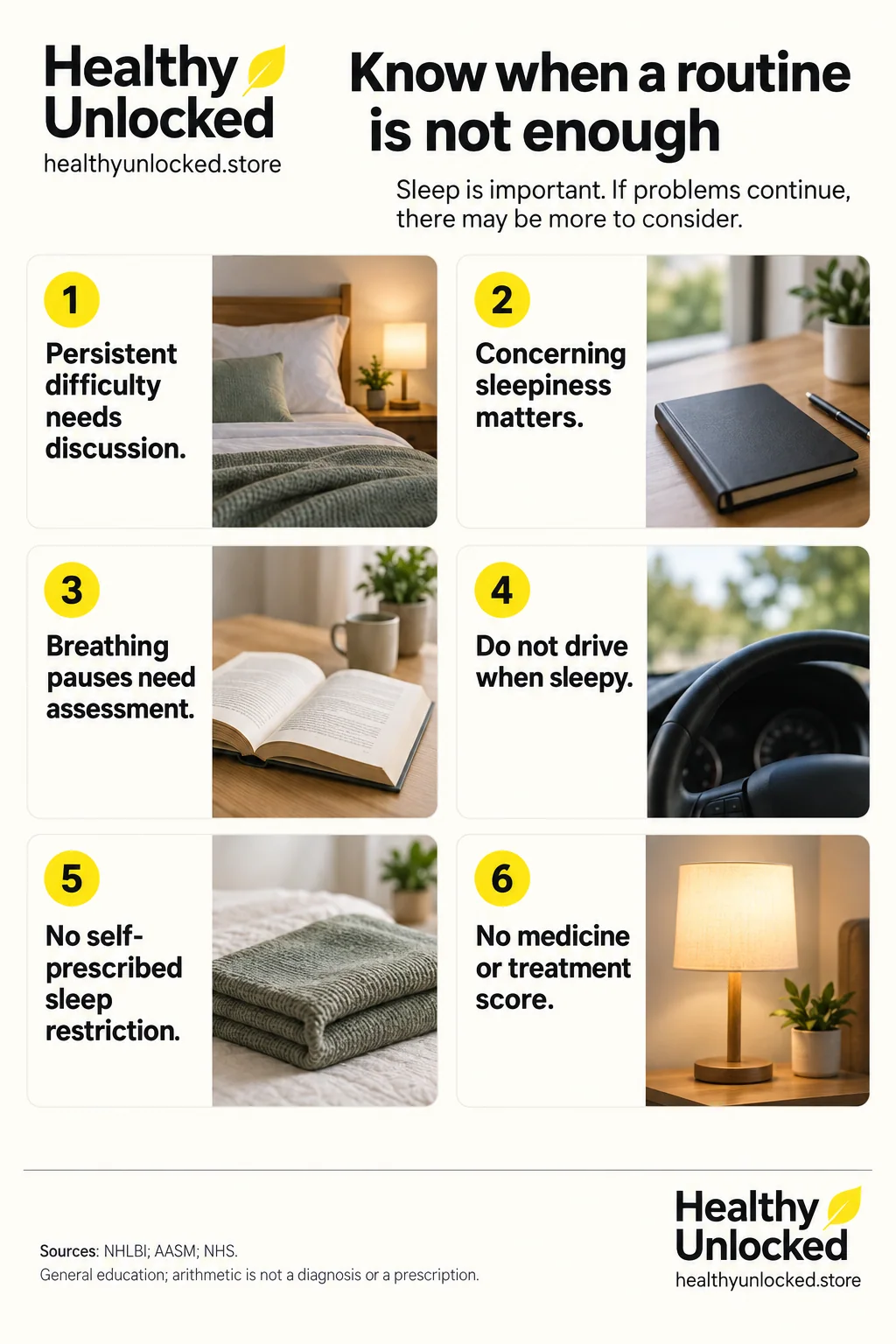
Agree on a useful next step
Keep estimates and planned times separate in a diary. A short record can support a conversation without becoming a diagnostic test. Leave uncertainty visible.
Ask what happens next, how follow-up works and which changes require earlier contact. Do not leave assuming every sleep problem must improve through habits alone.
If you already have a treatment plan, discuss how ordinary preparation fits it. The advice responsible for your care takes priority over this general guide.
Try the wind-down time-budget planner
The planner adds three chosen task durations and compares their total with a preparation budget. It shows unallocated minutes or an excess. It does not measure sleep, predict sleep onset, prescribe time in bed or grade health.
Enter a positive whole-number budget up to 1,440 minutes. This upper bound is validation, not a recommended length. Each task requires a whole number from zero to 1,440. Zero omits a task; a blank is not silently changed to zero.
Worked example one: a budget of 45 with tasks of 5, 10 and 15 gives a total of 30 and 15 unallocated. All values are hypothetical planning choices, not ideal durations.
Worked example two: a budget of 30 with tasks of 10, 15 and 15 gives a total of 40 and exceeds the budget by 10. Consider moving or shortening optional preparation where possible. Do not cut the sleep opportunity to make the list fit.
Total = task one + task two + task three. Unallocated = max(0, budget − total). Excess = max(0, total − budget). Equality makes both differences zero. Invalid entries remove the old result so it cannot be mistaken for a current answer.
Try the wind-down time-budget planner
5 + 10 + 15 = 30, leaving 15 of a chosen 45. Planning only, not sleep achieved; do not cut sleep to fit tasks.
5 + 10 + 15 = 30, leaving 15 of a chosen 45. Planning only, not sleep achieved; do not cut sleep to fit tasks.
Calculations use this page’s entries in your browser; they do not save or send them to a Healthy Unlocked server. Keep downloaded files private as needed.

| Field | Valid entry | Limit |
|---|---|---|
| Preparation budget | Positive whole minutes, at most 1,440 | Not a prescribed sleep window |
| Task one | Whole minutes, zero allowed | Not sleep achieved |
| Task two | Whole minutes, zero allowed | Optional task may be omitted |
| Task three | Whole minutes, zero allowed | Blank remains invalid |
| Total and difference | Arithmetic on estimates | No treatment or alertness grade |
| Invalid value | Clear message and no stale answer | Negative, fractional and non-finite entries rejected |
Keep the worksheet’s purpose clear
The download separates a chosen budget, optional tasks and actual interruptions. It is an editorial planning aid, not a validated insomnia questionnaire or clinical dataset. The example was not a tested treatment outcome.
The calculation can run locally in the browser without sending entered minutes to a Healthy Unlocked server. Downloaded files remain subject to device and storage privacy. Do not put sensitive details in a shared folder unless you want them shared.
Reset clears entries and results. When scripting is unavailable, the formula and worked examples remain readable. The interactive tool is not required to understand preparation time.
Choose a manageable adjustment and consider whether it fits life. If symptoms continue, ask for care instead of repeatedly changing numbers in search of a perfect schedule.
Common questions about bedtime routines
How long should a routine be?
Choose a manageable sequence that fits your circumstances and protects enough sleep opportunity. This guide supplies no universal duration. Example minutes are hypothetical, not treatment.
Can a routine cure insomnia?
Persistent insomnia can need assessment and specific treatment. General habits are not a complete care plan. Do not use the planner to prescribe sleep restriction or medicines.
Must every activity be completed?
No. Keep essential tasks and an optional version. On a late or interrupted day, optional steps can move rather than consume time available for sleep.
What if I work at night?
Think about preparation before the main sleep period. Shift-work concerns can need individual advice. The tool does not assess fitness for duty or driving.
Does the planner collect sleep data?
Its calculation uses chosen minutes in the browser, not a personal sleep history. Downloads remain subject to the privacy of your device and storage service.
When should I seek help?
Ask about persistent difficulty, concerning sleepiness or breathing disturbances. Do not drive when sleepy or wait for a completed routine before addressing urgent concerns.
About this article
By Yashveer Bharani for Healthy Unlocked. This guide explains practical planning alongside public sleep resources. It does not claim independent specialist review, tested treatment outcomes or personal medical advice.
The calculator performs the formula shown above on chosen minutes. Examples and images are editorial aids, not clinical observations. Personal care advice takes priority over general planning.
Sources and further reading
These original references support the guidance and its limits. A link does not mean that the institution reviewed or endorsed this article.
Main guidance
Practical reference
Context and definitions
Safety and care
Evidence and limitations
 Healthy Unlocked
Join the conversation
Share a practical idea or ask a question about this guide. Please keep personal medical details private.