

Summary
A sleep diary is a short record of sleep timing, estimated awakenings and how you feel during the day. It can make a healthcare conversation clearer, especially when “I do not sleep well” is difficult to describe. Write useful estimates after waking, include relevant daytime context, and bring the record to an appointment. The diary does not diagnose a sleep disorder.
This guide explains what to record, how to separate time in bed from estimated sleep, and how to summarize a few entries without turning them into a sleep-quality grade. The arithmetic helper checks minutes you enter; it cannot measure sleep stages, certify driving safety or prescribe a shorter sleep window.
What you’ll understand
- Keep the record simple. Dates, sleep timing, estimates and daytime effects are the essentials.
- Separate different times. Getting into bed, trying to sleep and falling asleep are not identical.
- Use honest estimates. You do not need to watch a clock all night.
- Add useful context. Naps, caffeine, work schedules and symptoms can help explain a day.
- Bring questions, not a diagnosis. The pattern supports a conversation rather than proving a cause.
- Know when to seek help. Do not delay assessment or drive while sleepy to complete a record.
Start with these steps
- Choose a simple paper or private digital record.
- Fill it in after waking using reasonable estimates.
- Add the daytime effects and context that matter.
- Bring the record and your main questions to the appointment.
General education, not sleep-disorder diagnosis or treatment. The calculated percentage is descriptive arithmetic, not a target for restricting time in bed or a certificate of alertness.
What is a sleep diary useful for?
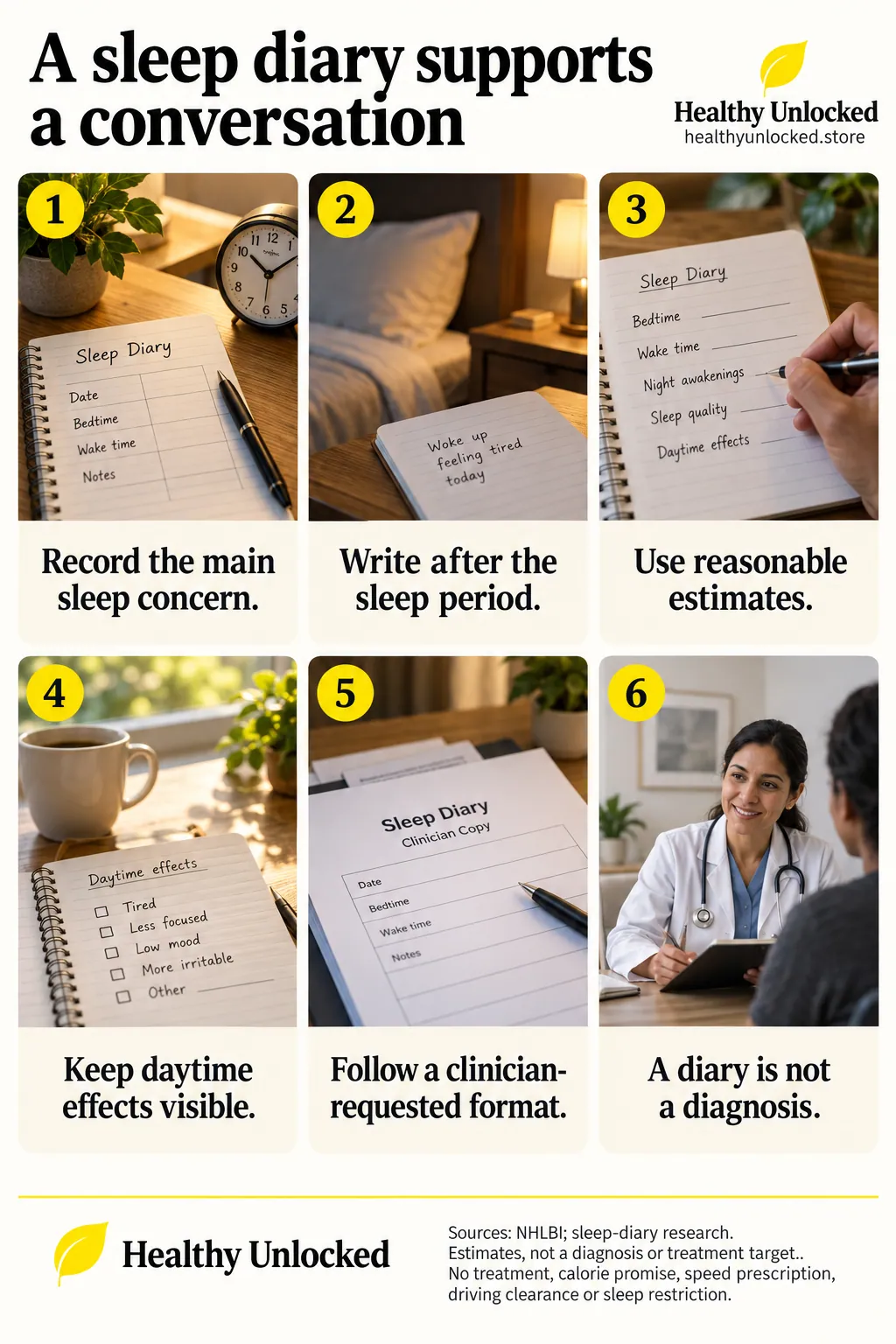
A sleep diary gives a conversation some concrete details. Instead of trying to remember an entire week at an appointment, you can show when you tried to sleep, roughly how long you were awake, and how the following day felt. A short note made close to the event can be more useful than an elaborate reconstruction weeks later.
The NHLBI explanation of insomnia assessment says a diary may be helpful for one to two weeks before a visit. That is background guidance, not a requirement to wait two weeks before seeking help. If a clinician has asked for a particular duration or form, use that request and ask what to do when an entry is uncertain.
The record is not a test you must pass. It does not prove that you have insomnia, explain why you woke up, or show that you are safe to drive. Its job is to organize observations so that a healthcare professional can consider symptoms, history, examination and other information together.
A diary can also be useful when the schedule is irregular. Shift work, caregiving and changes between workdays and days off can make a single “usual bedtime” misleading. Record the actual sleep period and its date rather than forcing every day into a conventional night-time template.
Our sleep-hygiene guide covers practical background habits. This article focuses on the record itself. Keeping a diary and using general sleep habits are not equivalent to receiving treatment for persistent insomnia or another sleep condition.
| Purpose | Useful information | Important limit |
|---|---|---|
| Prepare for a visit | Dates, timing and daytime effects | Not a diagnosis by itself |
| Describe an irregular schedule | Actual sleep periods and work context | Not proof that the schedule is safe |
| Record an estimate | Approximate awake and asleep time | Not an objective sleep-stage measurement |
| Support follow-up | Changes alongside an agreed care plan | Not a reason to change treatment independently |
| Keep a personal note | A private record of relevant observations | Not a clinical record service or emergency assessment |
Start with the question you want help answering
Your question may concern difficulty falling asleep, frequent waking, an early final waking time or daytime sleepiness. Write that question at the top of the record. It helps you choose useful details and keeps the diary from becoming a collection of unrelated numbers.
If recording makes you more anxious about sleep, simplify it and tell your clinician. There is no benefit in making a diary so demanding that you spend the night checking the clock. The purpose is to improve the conversation, not to supervise every minute of sleep.
What should you write each morning?
Complete the main entry after your sleep period, using your best reasonable estimates. For many people that means in the morning, but for someone sleeping after a night shift it may mean later in the day. Label the dates clearly so that an overnight period is not assigned to the wrong day.
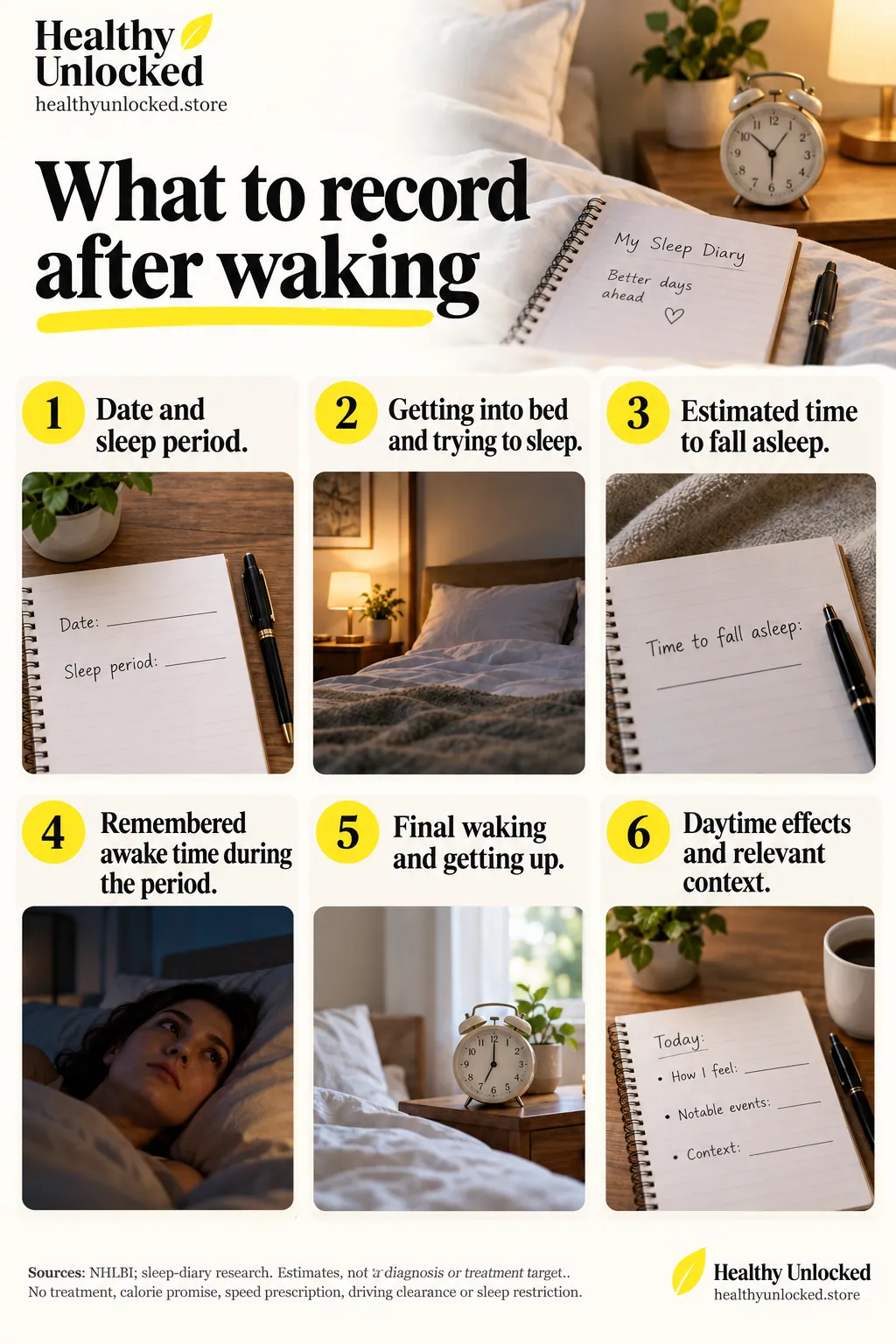
Record when you got into bed, when you tried to sleep, an estimate of how long falling asleep took, and any remembered awake time during the sleep period. Also note the final waking time and when you got out of bed. These are different events; keeping them separate makes the estimate easier to understand.
You do not need to know the exact minute when you fell asleep. “About twenty minutes” is a reasonable kind of estimate when that is what you remember. If you genuinely do not know, say so rather than choosing a precise number because a form has an empty box. Uncertainty is useful information for the reader of the record.
Include a brief description of sleep quality and how you felt after waking in your own words. A simple note such as “unrefreshed” or “more rested than yesterday” is enough for this worksheet. Do not invent a clinical score or borrow a diagnosis from an app label to make the note sound more formal.
The Consensus Sleep Diary research paper describes standardized items used in sleep self-monitoring. Our worksheet is an editorial aid and does not claim to be a validated reproduction of that instrument. If your clinician supplies the original form or another clinical questionnaire, complete that instead of assuming the forms are interchangeable.
| Field | How to record it | Keep the distinction clear |
|---|---|---|
| Date and sleep period | Write start and end dates when needed | An overnight period crosses a calendar date |
| Getting into bed | Actual or estimated clock time | This may be before trying to sleep |
| Trying to sleep | Clock time or a clear note | Reading in bed is not automatically attempted sleep |
| Time to fall asleep | Your approximate minutes | Do not stay awake to measure it precisely |
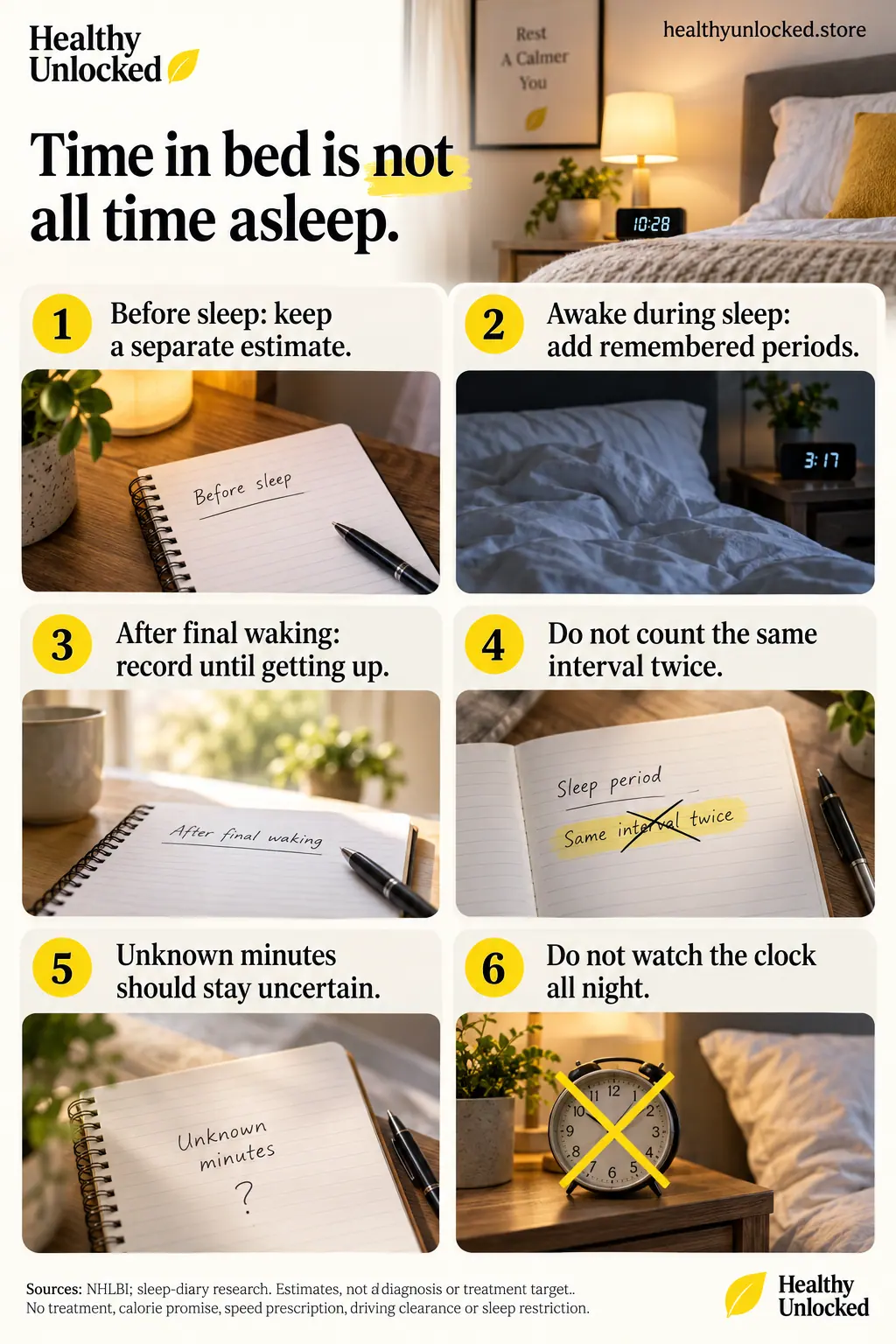
| Awake during the period | Approximate total remembered minutes | Do not count the same interval twice |
| Final waking and getting up | Record both when they differ | Awake time before rising is not sleep |
| Daytime effect | Brief words about sleepiness and functioning | A description is not a driving-safety certificate |
Keep the wording consistent
If you use “waking time” for the time your eyes opened on one day and the time you left bed on another, comparisons become difficult. Choose simple labels and keep them the same. A clinician can interpret an approximate but consistent record more easily than a precise-looking record whose labels keep changing.
A paper diary, a private spreadsheet or a suitable clinical form can all hold the same basic information. The most useful format is the one you can complete without disruption and bring to the visit. An expensive wearable or a detailed app is not a prerequisite.
How do time in bed and time asleep differ?
Time in bed and time asleep are not the same measure. A person may spend part of the period reading, trying to fall asleep, awake after an awakening or awake before getting up. A record that labels all time in bed as sleep can hide the very difficulty you wanted to explain.
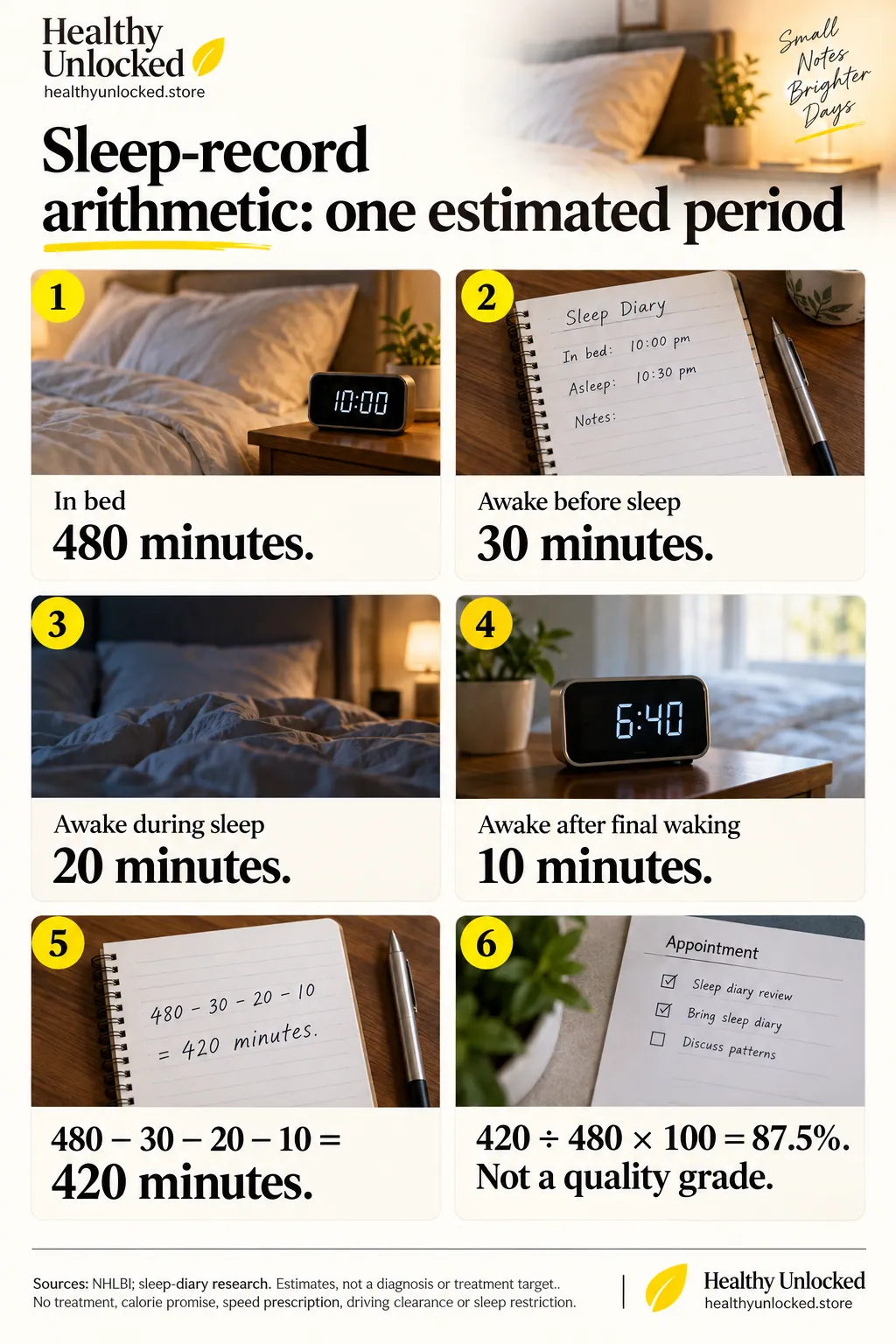
For the simple arithmetic below, define one complete in-bed period. Subtract the awake minutes before sleep, during the period and after the final awakening before rising. Include any other awake-in-bed time in the appropriate part and avoid overlap. The result is an estimate based on your entries, not a measurement of what your brain was doing.
An overnight clock interval needs the date change. From 23:00 to 07:00 on the following day is eight hours, or 480 minutes. It is not a negative sixteen-hour interval. If your sleep period is during the day, keep that label rather than assuming every record must cross midnight.
If you left bed during the period or had separate sleep periods, make that clear in the written record. The simple tool uses one defined period and cannot reconstruct a complicated schedule from missing details. Your clinician may prefer a different calculation or form when the situation requires it.
Sleep efficiency is a descriptive ratio sometimes used in clinical work: estimated sleep time divided by time in bed, expressed as a percentage. In this article it is not graded as good, bad or diagnostic. A high percentage can still accompany inadequate sleep opportunity or daytime problems. Do not use the percentage to shorten time in bed on your own.
| Part of the period | Illustrative entry | Arithmetic role |
|---|---|---|
| In-bed interval | 23:00 to 07:00 next day | 8 hours = 480 minutes |
| Awake before sleeping | 30 minutes | Subtract once |
| Remembered awake time during the period | 20 minutes | Subtract once |
| Awake after final waking before rising | 10 minutes | Subtract once |
| Estimated sleep | 480 − 30 − 20 − 10 | 420 minutes = 7 hours |
| Descriptive percentage | 420 ÷ 480 × 100 | 87.5%; not a quality grade |
Precision is not the same as accuracy
A result displayed to one decimal place is still based on approximate inputs. If your remembered awake time might have been twenty or forty minutes, a decimal percentage does not remove that uncertainty. Keep the note as an estimate and discuss how much detail is useful for your appointment.
Do not convert a wearable’s sleep-stage graphic into a medical conclusion. Devices and methods differ. The study comparing diary estimates with other sleep measures illustrates why a self-reported record and a measured signal are different approaches. This worksheet cannot confirm a device’s stages or explain a disagreement.
Which daytime details belong in the diary?
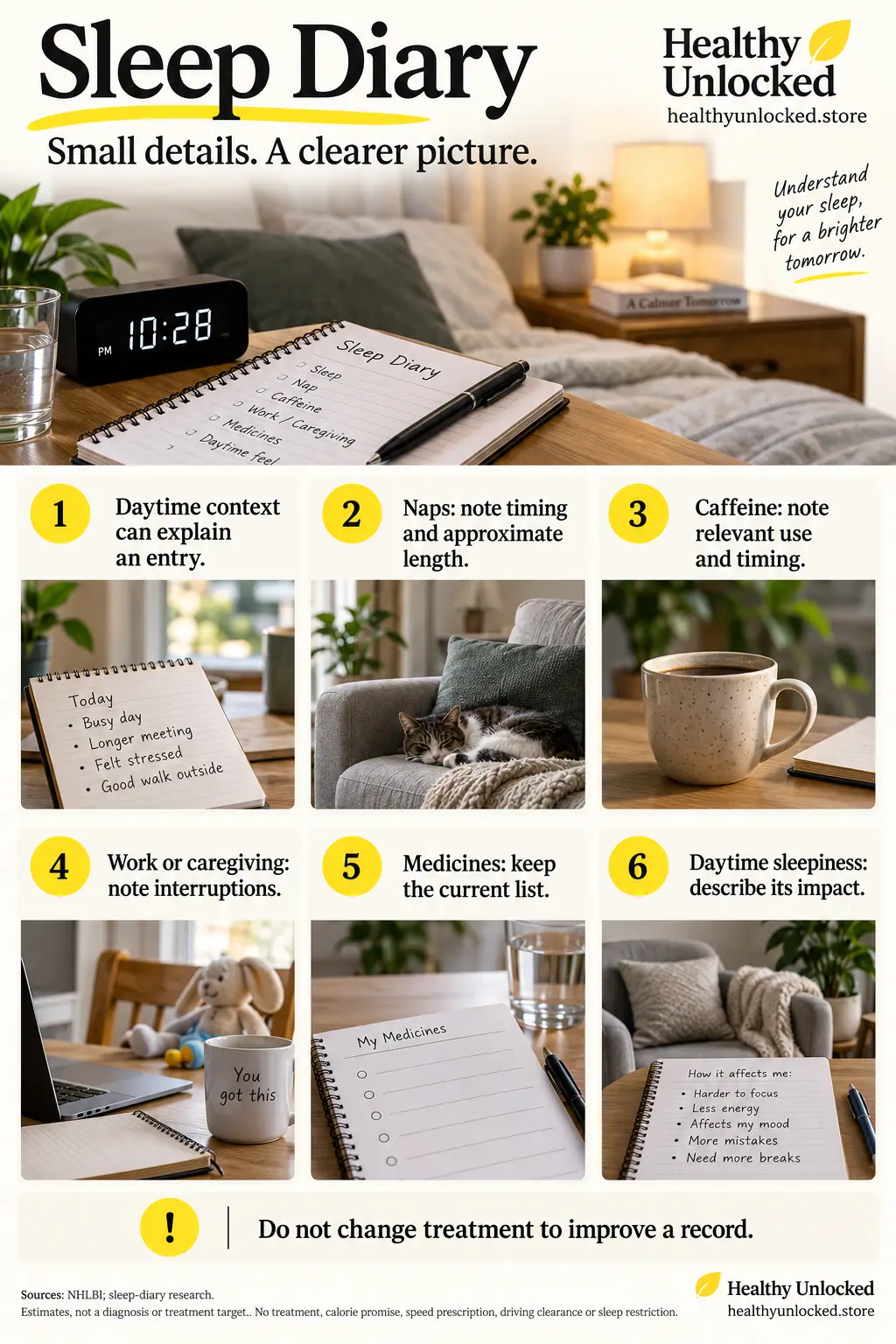
Sleep is not only the hours written in the night-time row. Add the daytime effects that brought you to the article: sleepiness, concentration difficulties, unrefreshing sleep or problems doing ordinary tasks. Use short descriptions rather than a score the worksheet has not been designed to interpret.
Record naps when relevant, including approximate timing and duration. A nap and an overnight sleep period are separate entries. Do not silently add the nap to the tool’s in-bed period. If your clinician wants a full twenty-four-hour total, ask how the different periods should be recorded.
Note caffeine and alcohol with timing and an approximate description when useful. Do not change prescribed medicines to make the diary look cleaner. Include medicines and supplements that may be relevant, and ask a clinician or pharmacist about them. A product being sold without a prescription does not make it irrelevant to sleep.
Work, caregiving, travel and changes in schedule can help explain an entry. A night shift, an early start or repeated interruptions may matter more than a single bedtime number. Record the circumstances without blaming yourself for a schedule you do not control.
The NHLBI description of insomnia symptoms includes daytime effects as well as sleep difficulty. Bring those effects to the appointment even if the recorded duration looks ordinary. Conversely, a difficult entry should not be turned into a diagnosis from one night alone.
| Context | A concise note | Avoid this shortcut |
|---|---|---|
| Nap | About 20 minutes in the afternoon | Adding it invisibly to an overnight period |
| Caffeine | Type, approximate amount and time | Assuming an exact effect from one entry |
| Alcohol | Approximate use and timing if relevant | Treating it as a sleep remedy |
| Medicine or supplement | Name and current use for discussion | Stopping or changing it without advice |
| Work or caregiving | Shift or interruptions that changed the schedule | Treating a constraint as a personal failure |
| Daytime effect | Sleepiness or difficulty with ordinary tasks | Using a diary number to certify safe driving |
Use a note to explain an unusual day
A brief note such as “travel day” or “woke to care for someone” can prevent a misleading comparison. You do not need to describe another person’s private health information. Record only the context needed to understand your sleep period.
Our beginner walking article offers general movement background. If you note activity in the diary, write what happened rather than assuming that a particular session caused the next night’s sleep. Timing and association alone do not prove a cause.
How can you review patterns without self-diagnosing?
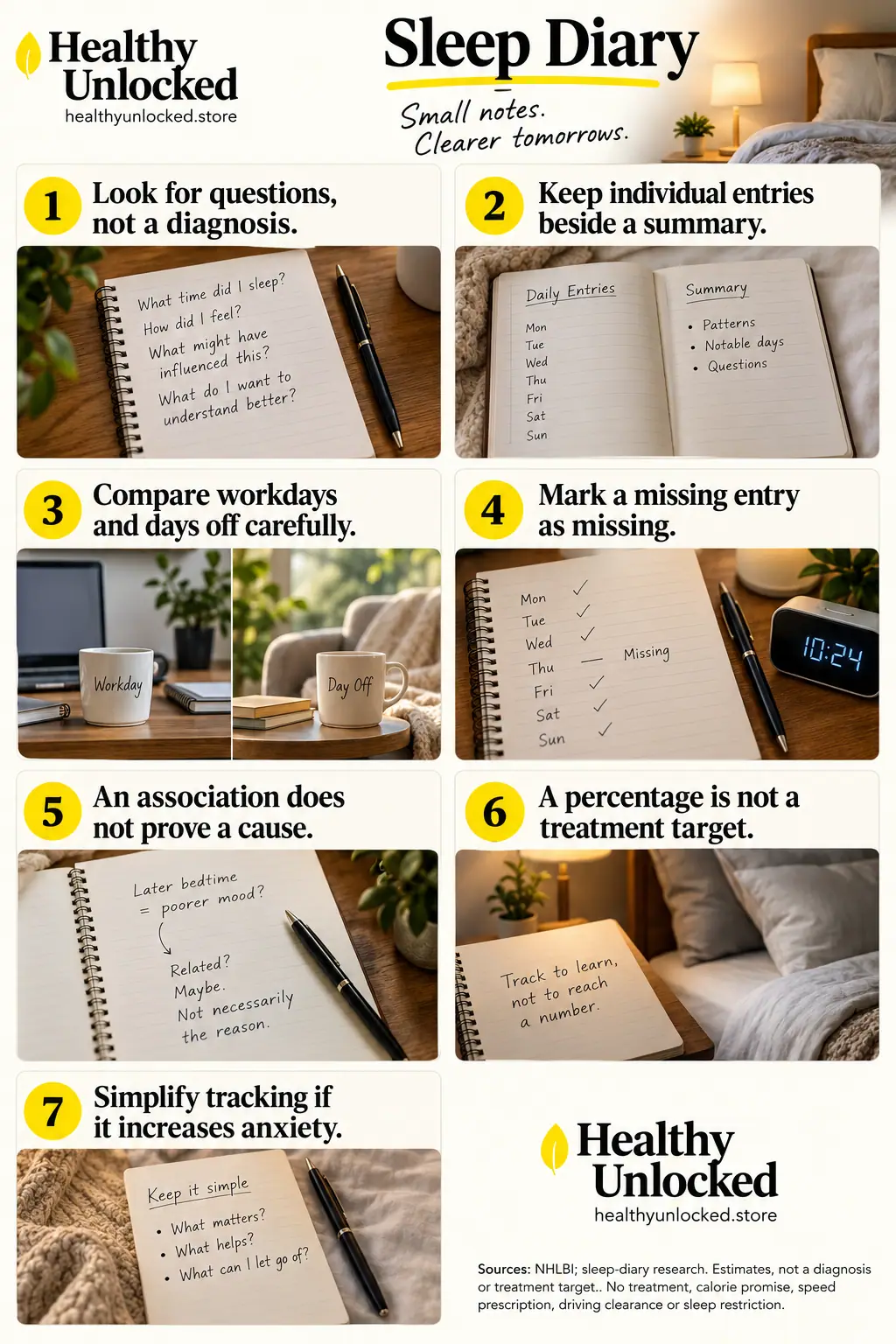
After a few entries, look for questions rather than verdicts. Are workdays and days off different? Do you have enough opportunity for sleep? Is the difficulty falling asleep, repeated waking, or feeling sleepy during the day? These questions can help organize the visit without deciding the diagnosis in advance.
Keep individual entries alongside any average. A weekly mean can hide a very irregular schedule or a day with a concerning symptom. If one period is missing, mark it as missing; do not invent a usual night to make the table complete. Tell the reader which entries were included in a summary.
Averages also depend on the question. An average of nightly percentages is not necessarily the same as total estimated sleep minutes divided by total in-bed minutes. This tool handles a single period and does not silently choose a weekly method. Ask your clinician which summary they want before building a more complicated spreadsheet.
An association is not proof of a cause. A difficult night after a late coffee may prompt a useful question, but stress, work and many other circumstances may have changed too. Avoid making a strong claim from one paired observation or treating a diary as a personal experiment with controlled conditions.
If tracking increases anxiety or encourages repeated clock checking, bring that difficulty to the appointment as well. The record should serve you. A shorter format or a clinician-led approach may be more useful than continually adding columns in an attempt to achieve certainty.
Do not turn a percentage into treatment
Clinical care may use a diary as one part of assessment or treatment planning. That does not make the worksheet a self-treatment protocol. There is no sleep-restriction schedule, medicine advice or “healthy sleep score” in the calculator. Do not reduce your sleep opportunity because a percentage appears low.
The NHLBI insomnia treatment overview distinguishes treatment options from general habits. Persistent insomnia may need appropriate care beyond a bedtime checklist. A diary can support that conversation; it should not delay it or imply that the reader failed to follow enough tips.
How should you bring the record to an appointment?
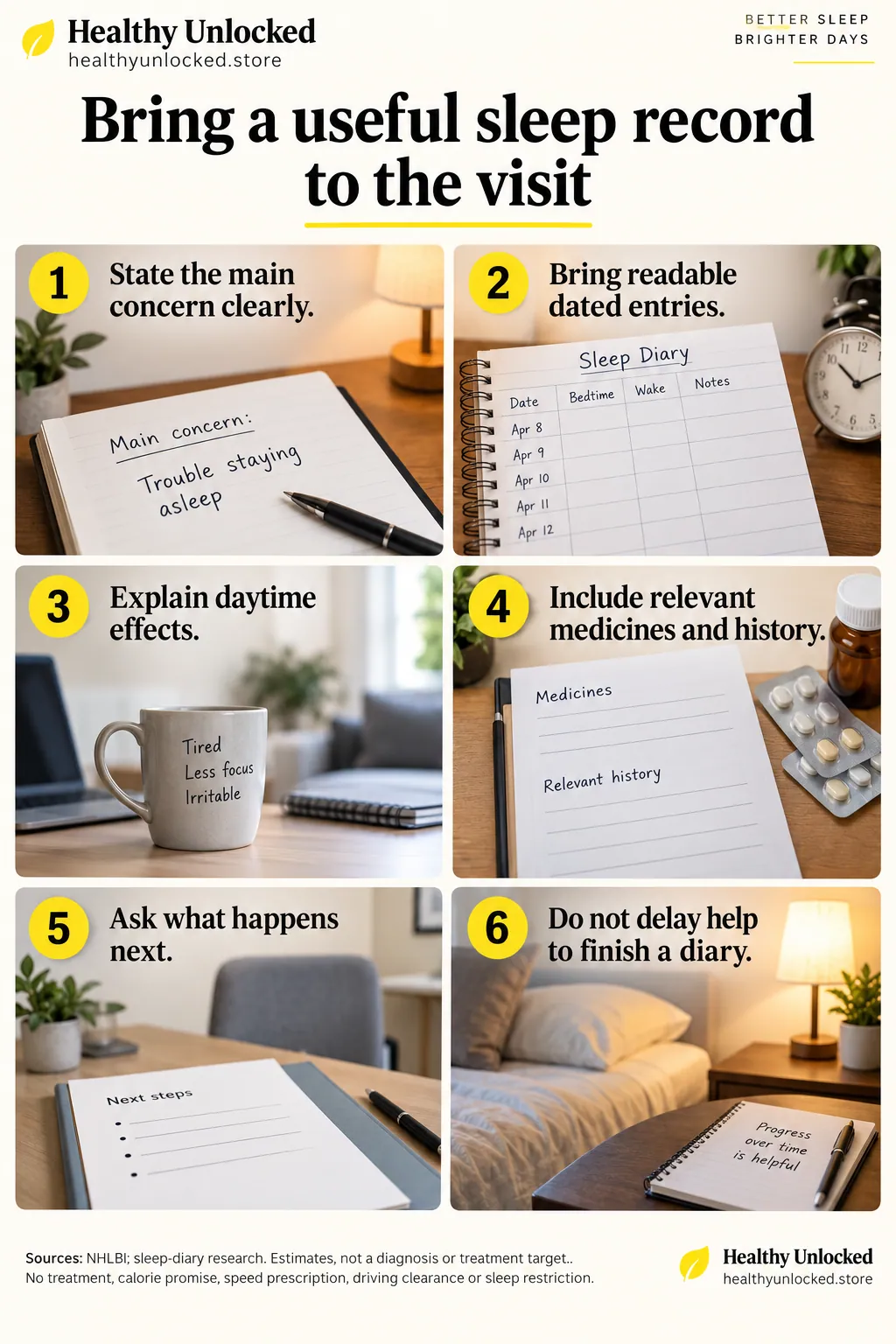
Bring the record in a form the clinician can read, along with your main concern and current medicine information. A printed sheet or a clear file can be easier to review than many screenshots in different apps. Label estimates and missing entries so that the discussion begins with the actual information available.
Explain what the problem means in daily life. You might have difficulty staying awake at work, trouble concentrating, or worry about repeated awakenings. Describe symptoms without assuming a cause. If somebody has noticed loud snoring or pauses in breathing, mention that observation and its source.
Ask whether further assessment is needed and what the next step is. The NHLBI explanation of sleep-apnea assessment describes how history and appropriate tests may be considered. A diary alone cannot confirm or exclude sleep apnea, and a normal-looking duration does not rule out a breathing problem.
If you have an existing treatment plan, bring it and ask how the record should be used. Do not change medicines or equipment settings from a diary percentage or an online explanation. Your healthcare team can consider the record together with the reason for treatment and any other relevant findings.
Leave with an understandable follow-up plan: who reviews the record, whether to continue it, and what symptoms should prompt earlier contact. Ask for clarification when a term is unfamiliar. The aim is a usable next step, not simply a thicker folder of sleep data.
| Bring or ask | Why it matters | Keep it brief |
|---|---|---|
| Main sleep concern | Shows why you sought help | One or two clear sentences |
| Labeled diary entries | Provides timing and context | Include uncertainty and missing days |
| Daytime effects | Shows the practical impact | Specific observations rather than a diagnosis |
| Medicine and relevant history | Supports appropriate assessment | Current list and existing advice |
| Questions about next steps | Makes follow-up understandable | Who, when and how to contact the service |
Share the record privately
Do not paste a full health record, address or identity document into public comments. If a clinician needs a digital copy, ask which secure route the service uses. This website does not need the personal record in order for you to use the educational worksheet.
The arithmetic runs in the browser and asks for durations rather than a name or diagnosis. Site services are covered by the privacy policy; the tool is not a healthcare messaging system. Save your own file if you want a lasting copy, and remove details you do not need to keep.
When should you get help instead of tracking longer?
Do not drive or operate hazardous equipment when sleepy. A long recorded sleep period, a high percentage or a completed diary cannot certify alertness. If sleepiness affects safety, address the immediate situation and seek appropriate advice rather than using the tool to reassure yourself.
Persistent sleep difficulty or daytime impairment is a reason to discuss care. You do not need a perfect diary first. Severe or urgent symptoms require appropriate local help, not an extended tracking exercise. If another condition or a medicine may be involved, ask a clinician about it rather than making changes independently.
Loud snoring, witnessed pauses in breathing, waking gasping or significant daytime sleepiness should be raised in a healthcare conversation. They do not establish a diagnosis from this article. They also should not be dismissed because the worksheet shows seven hours of estimated sleep.
If a personal mental-health concern includes immediate danger or thoughts of harming yourself, seek urgent support through appropriate local emergency or crisis services. A sleep record is not a crisis assessment. Do not delay getting help to complete a row or calculate a percentage.
The NHS insomnia resource offers general background on when to seek advice. Use the services and guidance appropriate to your location. A general international source does not replace your own care team or provide a local emergency pathway.
Avoid making the diary another sleep task
Put the record aside once the entry is complete. Repeatedly recalculating a difficult night is unlikely to make the entry more accurate. If the process becomes stressful, simplify the record and tell the clinician why it was hard to complete.
You can attend an appointment with a few honest entries or even a written description of the concern. A missing spreadsheet does not make your symptoms less important. The diary is a support for care, not a gate you must pass through before asking for it.
Try the sleep-record arithmetic helper
The helper uses one in-bed period measured in minutes, with three non-overlapping awake estimates: before sleep, during the period and after final waking before getting up. Estimated sleep equals in-bed minutes minus those awake minutes. The descriptive percentage equals estimated sleep divided by in-bed time, multiplied by 100.
Worked example one: an eight-hour period is 8 × 60 = 480 minutes. Subtract 30 minutes awake before sleep, 20 during the period and 10 after final waking. The result is 480 − 30 − 20 − 10 = 420 minutes, or seven hours. The percentage is 420 ÷ 480 × 100 = 87.5%. It is not a quality grade.
Worked example two: a daytime six-hour period is 360 minutes. With 30 minutes awake before sleep, 30 during the period and zero after final waking, estimated sleep is 300 minutes, or five hours. The percentage is 300 ÷ 360 × 100 ≈ 83.3%. A different ratio does not by itself explain why the day felt different.
In-bed time must be greater than zero and no more than a complete twenty-four-hour period for this simple single-period model. Awake values can be zero but cannot be negative or sum to more than the in-bed duration. Blank or impossible entries should clear the old answer and show what needs correction. The maximum is an input boundary, not a suggested sleep duration.
Clear removes your entries and the previous result. The calculation rounds only the displayed percentage; it does not make approximate input times exact. The sleep-record worksheet includes meaningful fields, example arithmetic and source notes. The written examples remain available without JavaScript.
Calculate one diary estimate
480 − 30 − 20 − 10 = 420 estimated minutes; 87.5% of time in bed. No quality grade or treatment window.
480 − 30 − 20 − 10 = 420 estimated minutes; 87.5% of time in bed. No quality grade or treatment window.
Calculations use this page’s entries in your browser; they do not save or send them to a Healthy Unlocked server. Keep downloaded files private as needed.
Read the result with its assumptions
If awake intervals overlap, subtracting them separately will underestimate sleep. If time outside bed is mixed into the in-bed value without explanation, the label becomes unclear. Revise the record or ask which form to use rather than trusting a result from inconsistent inputs.
This editorial worksheet is not a participant research dataset, a validated clinical scale or a sleep-restriction algorithm. It has no diagnostic thresholds. Do not interpret any output as permission to drive, adjust a medicine, reduce sleep opportunity or decide that a persistent symptom needs no assessment.
Common questions about sleep diaries
How long should I keep a sleep diary?
NHLBI says one to two weeks may be helpful before a visit, but follow your clinician’s request. Do not wait to seek help for symptoms or safety concerns just to complete a particular number of days.
Do I need exact times or a wearable?
No. Reasonable estimates and clear labels are useful. You do not need to watch a clock all night or buy a device. If you are uncertain, mark the estimate rather than inventing precision.
Is time in bed the same as time asleep?
No. Awake time before sleep, during the period and after final waking can be part of the in-bed period. Keep the labels separate and avoid subtracting the same awake interval twice.
Does a low percentage mean I have insomnia?
No. The percentage is descriptive arithmetic from estimated inputs, without a diagnostic threshold in this tool. A clinician considers symptoms, history and other information to assess a sleep problem.
Should I shorten time in bed to improve the number?
Do not use this worksheet to restrict your sleep opportunity. It is not a treatment protocol. If a clinician provides a personal plan, follow that advice and discuss any concerns with the service.
Can a good-looking record prove I am safe to drive?
No. Duration and percentages cannot certify alertness. Do not drive when sleepy, and seek appropriate help when sleepiness or other symptoms affect safety.
About this article
By Yashveer Bharani for Healthy Unlocked. This article describes an editorial sleep-record worksheet and transparent arithmetic. It does not claim a clinical diagnosis, validated assessment instrument, sleep study or independent medical review.
Examples are hypothetical and estimates remain estimates. Original institutional guidance and research are cited separately from the worksheet. Visuals explain the record; they are not images of measured reader sleep or clinical testing.
Sources and further reading
These original references support the guidance and its limits. A link does not mean that the institution reviewed or endorsed this article.
Main guidance
Practical reference
Context and definitions
Safety and care
Evidence and limitations
Further reference
 Healthy Unlocked
Join the conversation
Share a practical idea or ask a question about this guide. Please keep personal medical details private.