

Summary
Low testosterone cannot be diagnosed from tiredness, a symptom checklist or one isolated laboratory number. A clinician considers relevant signs and symptoms alongside appropriately collected, consistently low results and the possible cause. Report timing, units, medicines, illness and fertility plans can all matter to the conversation.
This guide explains how to describe changes, prepare questions and keep a laboratory report in context. Five tables and a preparation tool support an appointment; the tool counts selected information that you have prepared. It does not interpret testosterone values, estimate disease risk, choose treatment or recommend a supplement.
What you’ll understand
- Symptoms overlap. Tiredness and mood or sexual changes can have different causes.
- Testing needs context. One result alone is not a diagnosis.
- Keep the original report. Timing, units and laboratory reference information matter.
- Discuss medicines and illness. Do not stop treatment to change a result yourself.
- Mention fertility plans. They can affect treatment decisions.
- Avoid a booster shortcut. Marketing and a symptom score do not replace assessment.
Start with these steps
- Describe the change and its effect in your own words.
- Bring complete reports and relevant timing details.
- List medicines, supplements and fertility questions.
- Ask what testing or follow-up is appropriate.
General education, not diagnosis or a hormone prescription. A new or severe symptom needs assessment in its own right; do not postpone care while completing a checklist.
What do low-testosterone symptoms actually mean?
Testosterone is a hormone involved in several body functions. A concern about deficiency needs more than a vague feeling of low energy or a number seen online. The useful question is whether a person’s symptoms, examination and properly interpreted tests support a diagnosis and what may explain it.
The Endocrine Society patient guide to hypogonadism describes the combination of symptoms and repeated early-morning testing. This article does not turn that information into an online diagnostic rule or suggest that every reader should order a hormone panel.
A checklist can help remember a concern, but cannot establish its cause. The same complaint may occur in different conditions or circumstances. Treating a nonspecific symptom as proof of low testosterone risks overlooking another explanation.
The Endocrine Society testosterone guideline recommends against routine screening of the general male population. Symptom assessment and population screening are different decisions. Ask what is appropriate for your situation rather than purchasing testing solely because an advertisement suggests everyone needs it.
Use this guide to prepare a clear conversation. It does not promise more energy, fertility, muscle gain or improved sexual function. It is not a masculinity test, and a medical concern should not be framed as a failure of identity or character.
| Question | Useful information | What is insufficient |
|---|---|---|
| What has changed? | A symptom history and its effect | A promotional symptom score |
| Is testosterone consistently low? | Appropriate repeated tests interpreted clinically | One isolated number |
| What does a report mean? | Original units, timing and laboratory context | A number copied without its unit |
| What might explain it? | History, examination and appropriate investigations | An online cause checklist |
| Would treatment suit me? | A discussion of diagnosis, benefits and risks | A product advertisement |
| Should everybody be tested? | Individual clinical indication | Assuming symptoms or age alone require a panel |
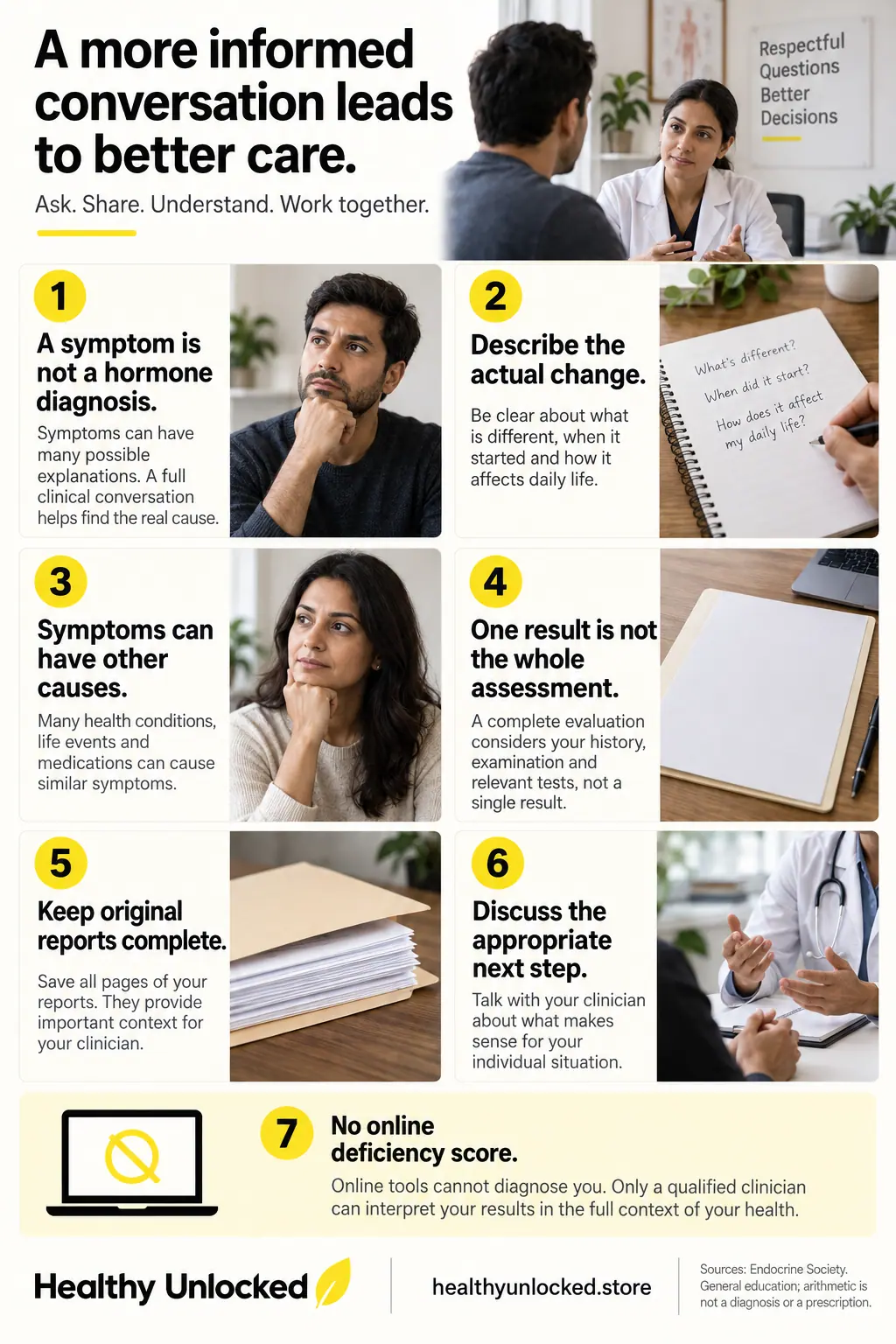
A concern deserves ordinary, respectful language
You can say that your energy, sexual interest or another function has changed without assigning a hormone diagnosis. Describe the difference from your own usual experience and how it affects daily life. You do not need to compare yourself with someone in a fitness video.
A result should not become a judgment about masculinity or worth. Medical decisions concern health, context and the person’s goals. Avoid forums or sales messages that use shame to push a product before the cause is understood.
If the concern is difficult to explain, write a short question before the visit. You can ask to discuss it privately. A clear account can be useful without publishing intimate details or submitting them to a commercial symptom quiz.
Describe changes without diagnosing from a checklist
Relevant changes can include sexual symptoms or other signs considered by a clinician. Fatigue, low mood and reduced physical performance are nonspecific: they do not identify one hormone problem on their own. Keep the concern visible without labeling its cause in advance.
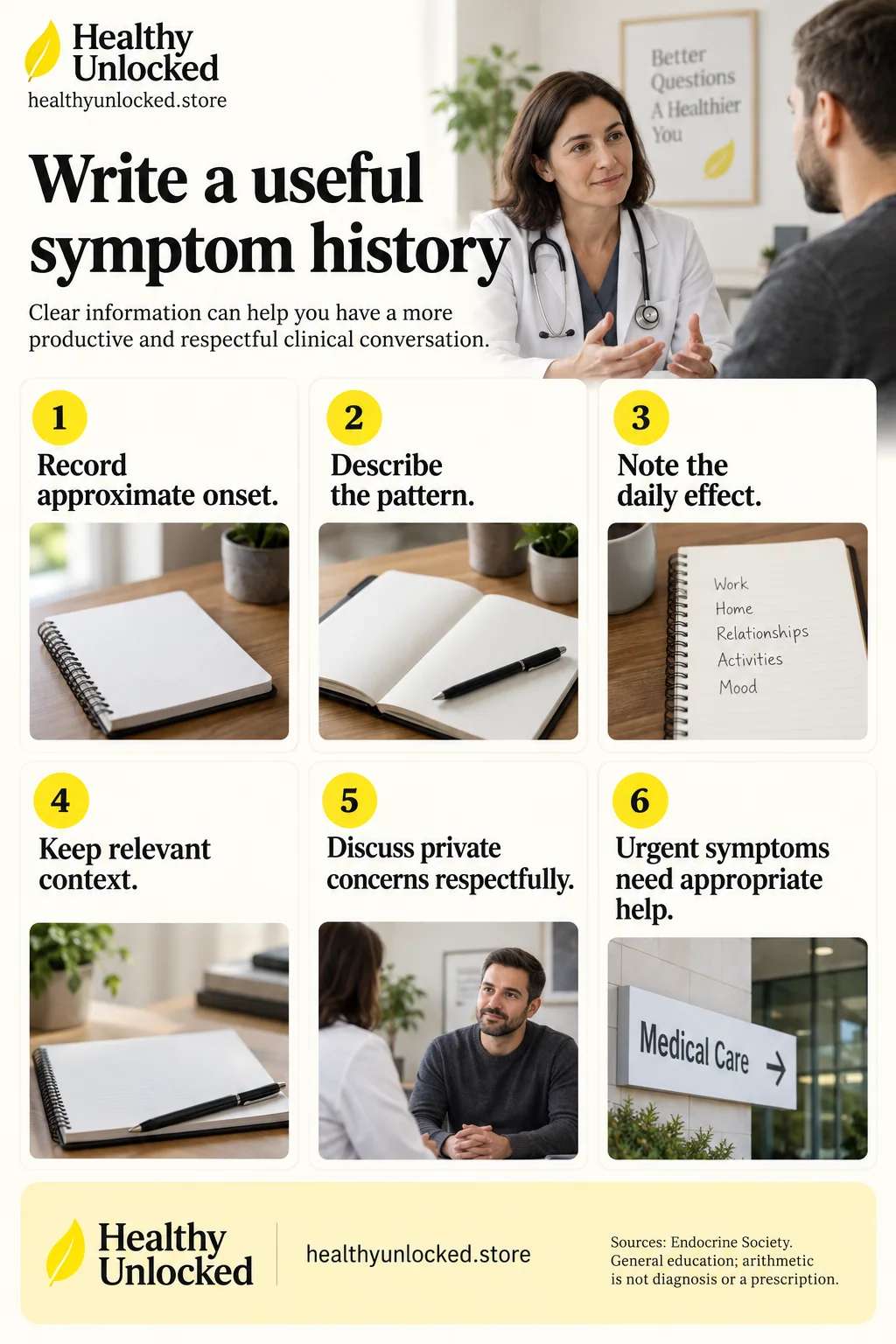
Write when you first noticed a change, whether it persisted and what else was happening. This is a history, not a test result. A precise-looking date is not required if you only remember an approximate period; label the uncertainty.
Consider the effect on daily life rather than simply the number of boxes ticked. A symptom that matters to you deserves discussion even if a checklist has few items. A high count is not automatically a more severe hormone deficiency.
Our sleep-hygiene article can explain general sleep context, and our protein-and-fiber food guide explains everyday meals. Neither article proves the cause of fatigue or supplies a hormone-treatment diet.
New symptoms need their own assessment. Do not attribute sudden severe headache, a new visual problem, serious chest pain or another urgent change to low testosterone without appropriate help. The present article is not an emergency triage calculator.
| Detail | Useful wording | Avoid |
|---|---|---|
| Onset | An approximate date or period | Inventing exact timing |
| Pattern | Persistent, intermittent or changed recently | Treating one day as proof |
| Daily effect | What has become difficult | A score copied from an advertisement |
| Sexual concern | Your change and relevant question | Publicly sharing private details unnecessarily |
| Associated context | Illness, sleep, medicines or another change | Assuming one cause without assessment |
| Urgent symptom | Seek appropriate help for its seriousness | Waiting for hormone testing first |
A hypothetical appointment note
A person might write: “I have felt more tired over the past several weeks and it affects my work. I would like to discuss possible causes and whether any testing is appropriate.” This is a useful starting question without claiming a testosterone diagnosis.
If there is a sexual concern, it can be stated separately with the change and approximate duration. Relevant medicine use and another symptom remain separate fields. A clinician can ask the additional questions needed for assessment.
This example is editorial. It is not a patient case, a validated questionnaire or evidence that a particular symptom leads to a particular result.
Why repeat testing and clinical context matter
Test timing and repeat confirmation matter because a hormone result is not a fixed label that never varies. The Endocrine Society describes at least two early-morning blood tests showing low testosterone alongside relevant symptoms and signs. Clinical guidance includes fasting confirmation and consideration of an appropriate assay.
The Endocrine Society’s 2026 statement on testosterone replacement restates the need for appropriate diagnosis. It is not authorization to arrange or interpret testing without a clinician, and this article deliberately avoids a universal numerical cutoff.
Ask when and how the test should be collected for your circumstances. A night worker or someone with an unusual sleep schedule should discuss that context rather than mechanically copying a clock time from an article. Do not assume a generic example settles the collection plan.
Acute illness, relevant medicines and other circumstances can affect interpretation. Tell the clinician what was happening around the collection. Do not stop a medicine, fast differently from instructions or change sleep to try to produce a preferred result.
A repeat test is not a challenge to pass. Its purpose is better evidence when clinically appropriate. Ask what the next step will be for different results and which concerns need earlier assessment rather than waiting for every planned appointment.
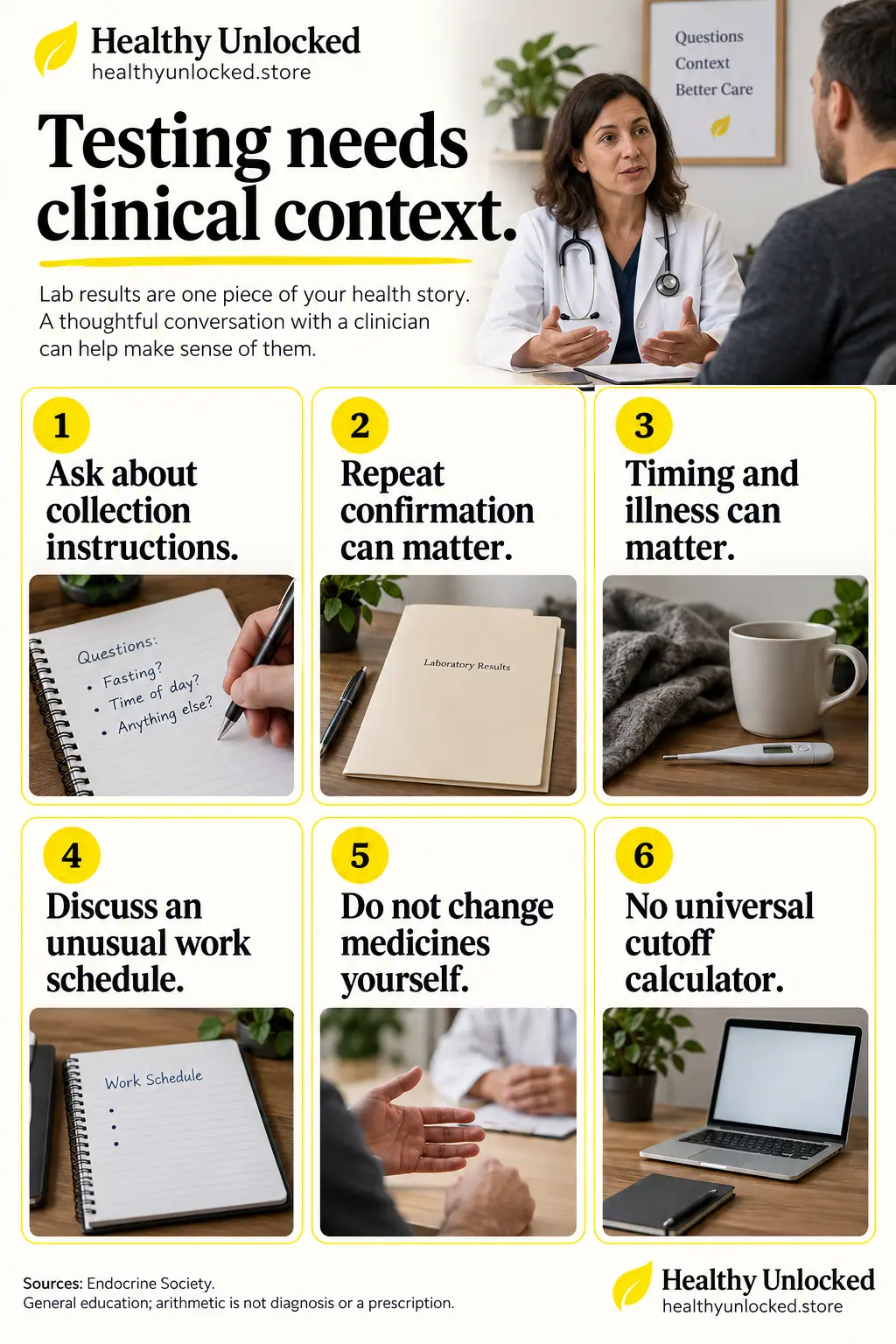
Keep a measured result separate from a diagnosis
A report describes what was measured in a sample using a particular method. A diagnosis combines appropriate evidence with the clinical situation. The two should not be treated as interchangeable.
If a result differs from a previous one, keep both complete reports. Differences in timing, units or laboratory context can matter. Do not delete a result because it does not match the conclusion you expected.
Ask whether another measurement is needed and why. This guide cannot decide which additional hormone tests, imaging or specialist assessment would be appropriate. More testing is not automatically more useful.
Read a report with its units, timing and reference range
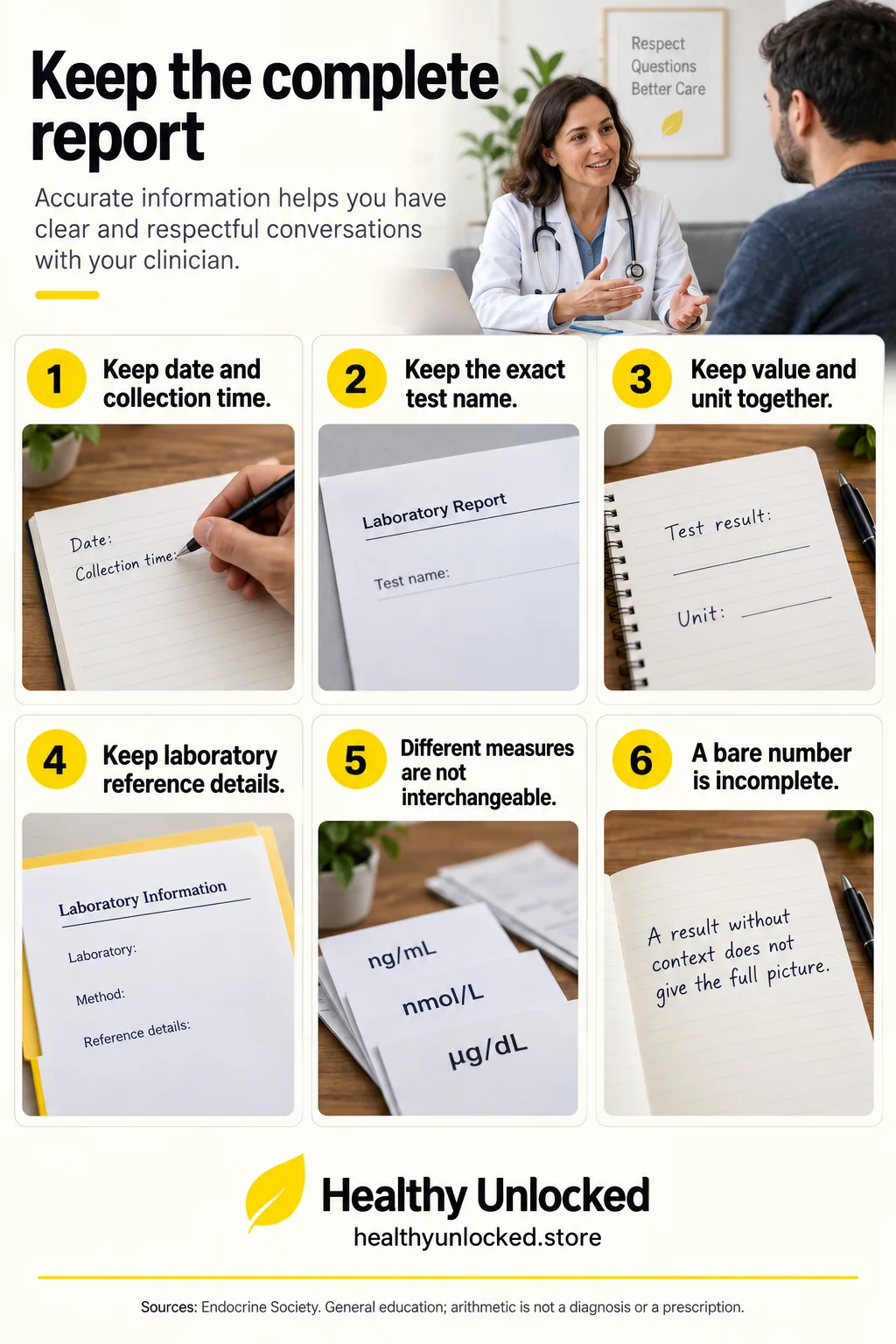
Bring the original report or a complete readable copy. Keep the collection date and time, test name, value, unit, laboratory reference information and any relevant notes. A single cropped number can remove information needed for interpretation.
Units are part of the result. A value reported in nanograms per deciliter and one in nanomoles per liter cannot be compared as though their printed numbers use the same scale. This article does not provide a conversion-based diagnosis or a treatment threshold calculator.
Total testosterone and a free-testosterone assessment are not simply two names for the same measure. The clinician decides which tests and methods are needed in context. Do not compare different measures using one internet chart.
Laboratory reference information is not automatically a personalized treatment decision. A flag can prompt a discussion, but the symptoms, collection conditions, confirmation and possible cause still matter. An unflagged result should not make a significant symptom disappear from the conversation.
If a report is unclear, ask the laboratory or clinician for a readable explanation of the field. Do not rewrite the unit or range yourself to make it match a website. Preserve the source report and label any personal note as a note.
| Field | Why keep it? | Boundary |
|---|---|---|
| Collection date and time | Shows when the sample was taken | Not enough for diagnosis alone |
| Test name | Identifies the measured quantity | Different tests are not interchangeable |
| Value and unit | Keeps the scale clear | A bare number is incomplete |
| Laboratory reference information | Shows the report’s own context | Not a universal treatment cutoff |
| Medicine and illness context | Supports interpretation | Do not change treatment independently |
| Previous complete report | Allows an appropriate comparison | Do not selectively retain only expected results |
Privacy applies to laboratory documents
A report can contain a name, contact details and identifying numbers. You can bring it securely to care without posting it publicly. Consider what a third-party app or forum will retain before uploading a document.
The tool below does not ask for a testosterone value or a report upload. It counts prepared information only. The existence of a private checklist does not establish the privacy policy of any other website or storage service.
If someone helps you prepare, decide what you want shared. A brief question may be enough for administrative help; detailed sexual or laboratory information need not be disclosed to everyone assisting with the appointment.
Discuss possible causes and relevant medicines
A confirmed deficiency can have different causes. The clinician may consider the testes, hormone-regulating systems and other health context. The distinction affects further assessment and care, so a low result should not immediately be reduced to “just age” or “just lifestyle.”
The Endocrine Society reproductive-hormone resource provides background. A general explanation of hormone systems is not a way to identify the cause in a particular reader.
Bring prescribed medicines, nonprescription products, supplements and relevant prior treatment to the discussion. Include products marketed for performance or hormone enhancement. Honest information can help care; it should not be hidden because an advertisement described a product as natural.
Do not independently stop a prescribed medicine or add a supplement to alter the next result. Ask who should review a possible interaction, what changes are appropriate and how follow-up will be arranged.
Health behaviors can be discussed without assuming they establish the diagnosis. Food, sleep and activity articles serve their stated general purpose. A routine or dietary change does not replace investigation when symptoms or appropriate results need assessment.
Prepare the context without preparing a diagnosis
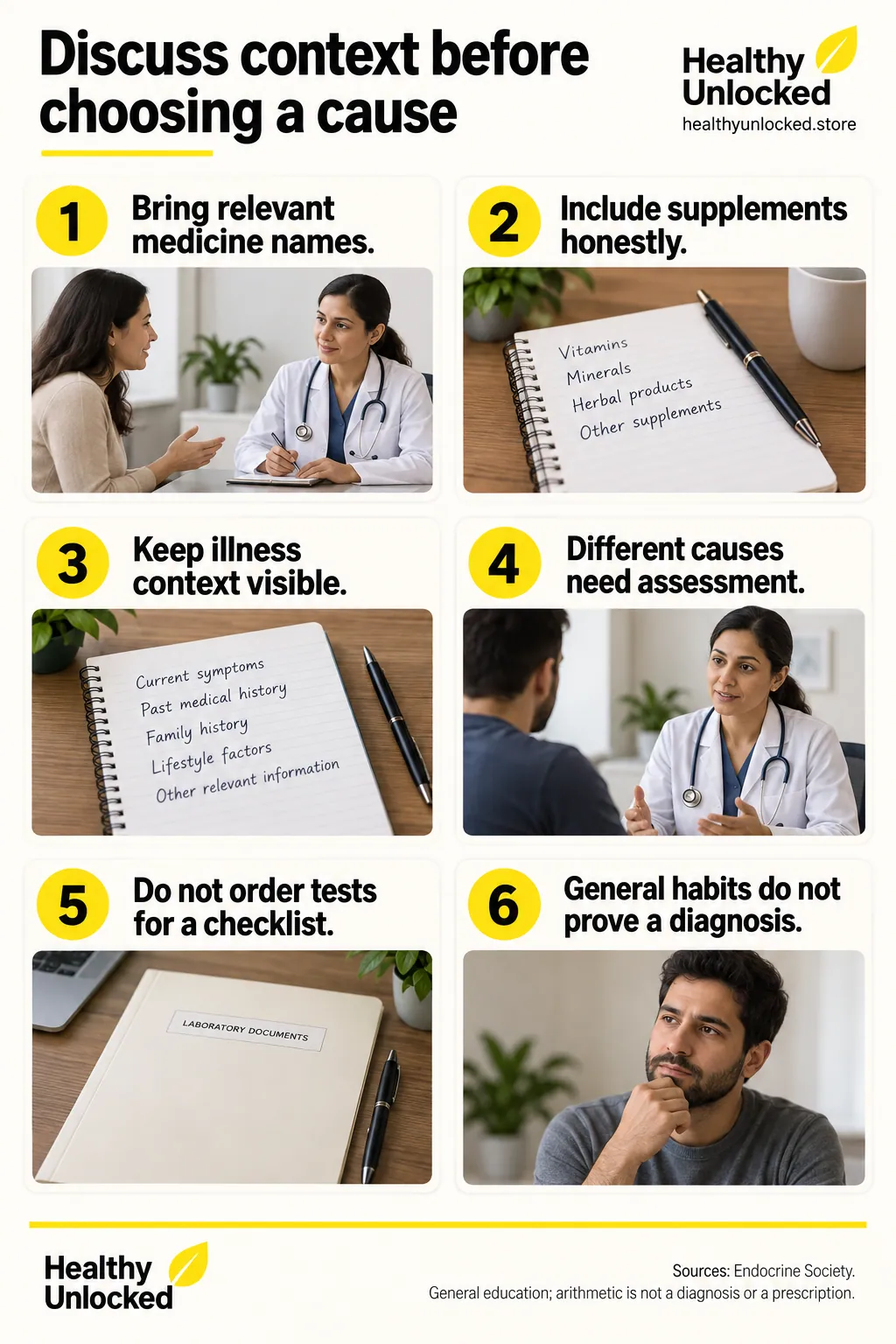
Keep a short medicine list with names you can verify from packaging or prescriptions. Mark an uncertain name instead of guessing. Bring a relevant past report when available, but do not order a large panel to make the folder look complete.
Write the question you most want answered. For example, ask whether the concern needs testing, how a previous result should be interpreted or what follow-up is appropriate. Different questions can require different next steps.
If another symptom is serious or changing quickly, ask about it directly. A prepared hormone folder should not distract from the immediate concern.
Bring fertility plans before discussing treatment
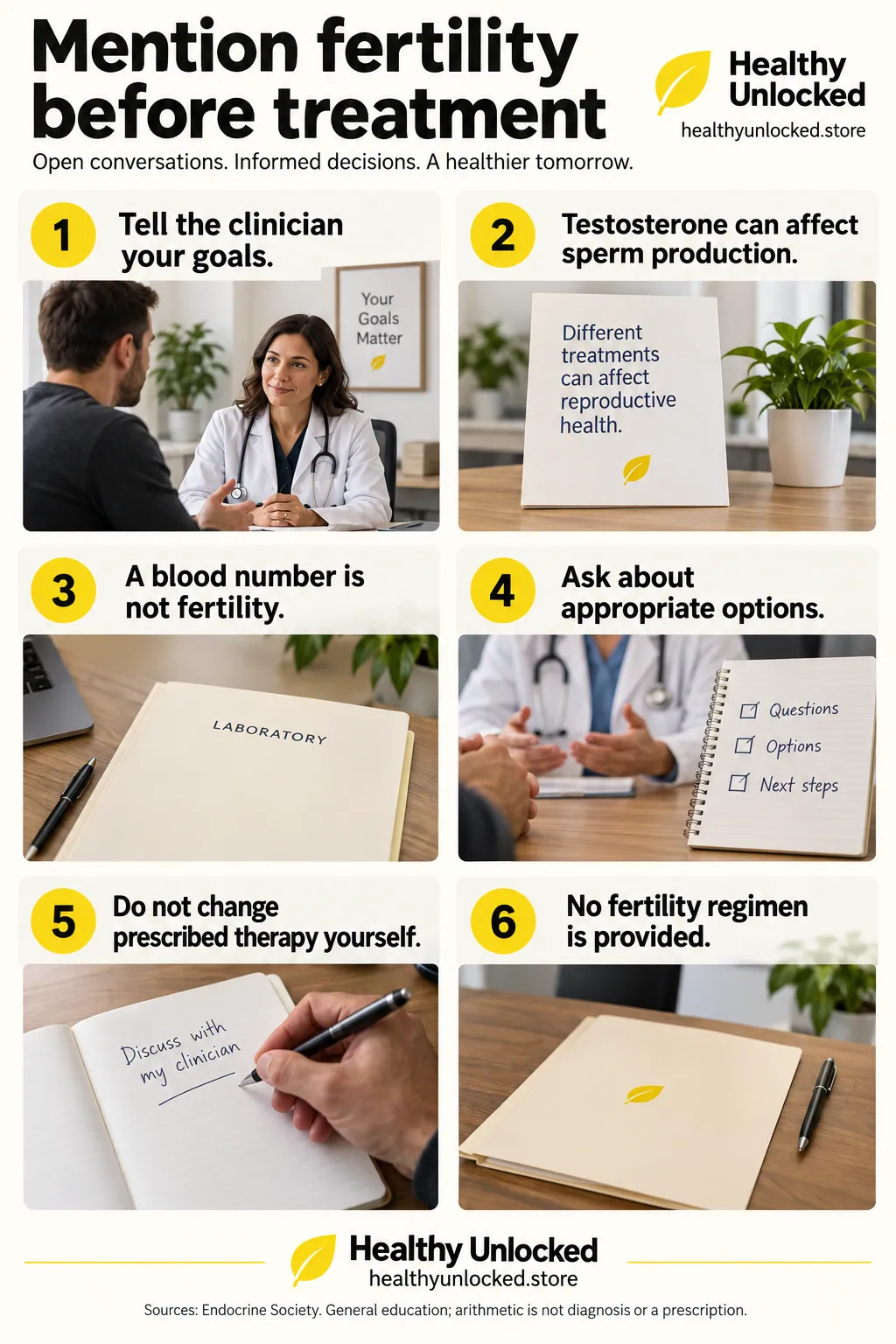
Fertility plans should be discussed before choosing treatment. Testosterone therapy can affect sperm production, and the Endocrine Society guideline recommends against starting it for men planning fertility in the near term. A clinician needs to understand the person’s goals before deciding on an approach.
Do not assume that improving a blood number means improving fertility. A testosterone result and a fertility assessment answer different questions. A symptom checklist cannot show sperm production, pregnancy probability or the appropriate treatment for a couple.
If you want to conceive, might want to in the future or are unsure, say so. A private question is enough to begin the discussion. There is no need to make a firm life decision simply to use the preparation tool.
If treatment is already prescribed and fertility becomes a concern, contact the clinician responsible for it. Do not stop or replace a hormone treatment based on this article. Ask which assessment or referral is appropriate.
This guide does not provide hormone doses, fertility-drug regimens or instructions for bodybuilding products. It also does not replace specialist advice for puberty, gender-affirming care or a different clinical indication.
Separate the goal from the marketing promise
A product promising energy, muscle and fertility in one message may combine several different outcomes. Ask which diagnosis and goal a proposed treatment addresses, what the evidence is and which outcomes it cannot promise.
You can ask about options, risks, monitoring and the cost of follow-up without committing immediately. A useful discussion leaves the next step clear rather than relying on a before-and-after image.
Personal preferences matter alongside clinical evidence. The correct conversation is about an appropriate plan, not about matching another person’s treatment or laboratory number.
Understand treatment limits and marketing claims
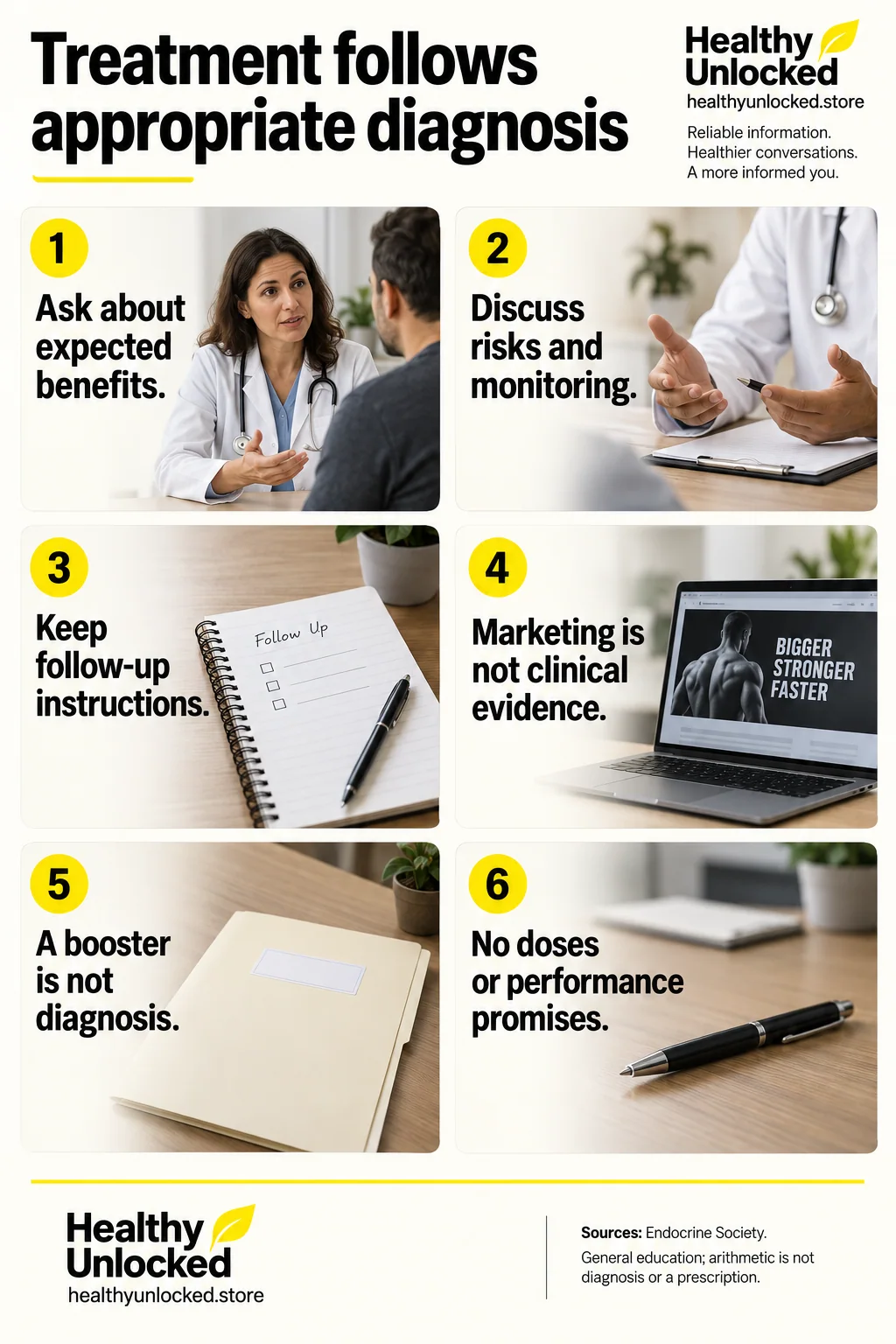
Treatment decisions follow appropriate diagnosis and cause assessment. They include potential benefits, harms, contraindications, fertility goals and monitoring. This article does not decide whether therapy is right for a reader or claim it is a general anti-ageing or performance solution.
A supplement advertised as a testosterone booster is not equivalent to a clinician-confirmed diagnosis or an appropriate prescription. Natural wording, testimonials and an attractive symptom quiz do not establish safety or effectiveness for your situation.
Ask what needs monitoring, who will review results and which changes require contact. Follow-up is part of treatment rather than a separate optional purchase. Keep instructions from the clinician responsible for your care.
Age-related change is not by itself a reason to start hormones. The professional guideline’s treatment recommendations discuss clinical indications and limits. A news headline or promotional cutoff cannot replace that assessment.
Use urgent care for urgent symptoms. Serious chest pain, sudden neurological change or another immediate concern should not wait while you seek a hormone explanation. No preparation percentage in this article is an urgency or health-risk score.
| Question | Information to clarify | Boundary |
|---|---|---|
| What has been diagnosed? | Symptoms, appropriate confirmation and remaining uncertainty | Not a symptom-quiz conclusion |
| What goal does treatment address? | The relevant concern and expected benefit | Not every promise in an advertisement |
| How do fertility plans fit? | Discuss the goal before choosing therapy | Do not treat a blood number as fertility |
| What monitoring is needed? | Who reviews results and how follow-up works | Not a one-time purchase |
| What if the plan does not help? | Agreed reassessment and earlier-contact instructions | Do not independently change treatment |
Questions worth asking before a treatment decision
Ask what diagnosis has been established, which cause is suspected and what uncertainty remains. Then ask what benefits are reasonably expected for your symptoms, what risks matter and how the plan fits fertility goals.
Ask what happens if symptoms do not improve or a result changes. Understanding follow-up avoids treating one prescription or test as the whole course of care.
You can decline an unnecessary public upload or commercial quiz and still seek assessment. A readable private account and complete reports are a sensible preparation method; they do not guarantee a particular clinical conclusion.
Try the appointment-preparation checklist
The preparation tool lets you select six possible information topics and mark the selected ones prepared. It counts prepared-and-selected items divided by selected items. It does not assess hormone deficiency, prescribe testing or decide how urgent care is.
Possible topics include the symptom history, its daily effect, current medicines, previous complete reports if available, collection-context questions and fertility or treatment questions. Select what is relevant. A report you do not have is not a reason to order a test just to complete a checkbox.
Worked example one: four topics selected and three of those prepared gives 3 ÷ 4 × 100 = 75%. That is note preparation only. It does not mean a 75% chance of low testosterone, 75% health or that an appointment should be delayed.
Worked example two: six topics selected and two prepared gives approximately 33.3%. The difference is arithmetic, not a worse diagnosis. An urgent or important concern can need care even when no preparation is complete.
A prepared checkbox on an unselected topic does not count. With no selected topics, no percentage is defined. Selecting all six and preparing none gives a valid 0% preparation result. Reset clears the selections and removes the result.
Prepare your hormone-appointment questions
3 prepared of 4 selected = 75%; 2 of 6 ≈ 33.3%. Preparation only, not hormone interpretation or urgency.
3 prepared of 4 selected = 75%; 2 of 6 ≈ 33.3%. Preparation only, not hormone interpretation or urgency.
Calculations use this page’s entries in your browser; they do not save or send them to a Healthy Unlocked server. Keep downloaded files private as needed.

| Input or result | Meaning | What it is not |
|---|---|---|
| Selected topic | An information item relevant to the visit | A mandatory test |
| Prepared topic | Information you have actually gathered | Proof that the information establishes diagnosis |
| Selected and prepared | The only items included in the numerator | A symptom count |
| No selected topics | Percentage undefined | A zero disease-risk result |
| Preparation percentage | Prepared selected items ÷ selected items × 100 | A health, hormone or urgency score |
| Reset or change | Result updates or clears | No stale answer retained as current |
Use the worksheet privately and honestly
The worksheet has space for the main question, changes, medicine names, report details and follow-up questions. It is an editorial aid, not a validated diagnostic questionnaire or a patient dataset. Hypothetical examples are not clinical observations.
The checklist calculation can run in the browser without sending its entries to a Healthy Unlocked server. A download and any other service you use have their own device and storage privacy. The tool does not request a laboratory value, an intimate history or a report upload.
If scripting is unavailable, the formula, two examples and worksheet remain usable. You can prepare a simple paper note without using the tool at all.
The useful outcome is a clearer conversation and an appropriate next step. Do not postpone assessment until a percentage reaches 100, and do not add tests, products or treatment simply to make the list complete.
Common questions about low testosterone
Does tiredness mean low testosterone?
No. Fatigue is nonspecific and can have different causes. Describe the change and its effect, then ask what assessment is appropriate rather than assigning a hormone diagnosis.
Is one low laboratory result enough?
Diagnosis requires clinical context and appropriate confirmation, not one isolated number. The Endocrine Society describes relevant symptoms with repeated early-morning low results. Discuss collection instructions and your circumstances with a clinician.
Should every adult man get tested?
The Endocrine Society guideline recommends against routine general-population screening. Testing should follow an appropriate clinical indication, not an advertisement or a need to complete this checklist.
Can I compare values from different laboratories?
Keep the original units, test names, collection details and laboratory reference information. A bare number or a shared internet cutoff is not a safe basis for personal treatment decisions.
Why mention fertility before treatment?
Testosterone therapy can affect sperm production. Fertility goals can change the treatment conversation, so discuss them before starting or changing therapy with a qualified clinician.
What does the preparation percentage mean?
Only the proportion of selected information topics marked prepared. It is not a chance of disease, a hormone interpretation, a health grade or a reason to delay needed care.
About this article
By Yashveer Bharani for Healthy Unlocked. This article explains how to prepare a clinical conversation using public endocrine-health information. It does not claim independent endocrinologist review or provide personal hormone advice.
The tool counts selected preparation items, not clinical findings. Examples and images are editorial aids, not patient records or tested treatment outcomes. Clinical testing, diagnosis and treatment remain professional decisions.
Sources and further reading
These original references support the guidance and its limits. A link does not mean that the institution reviewed or endorsed this article.
Main guidance
Practical reference
Context and definitions
Safety and care
Evidence and limitations
 Healthy Unlocked
Join the conversation
Share a practical idea or ask a question about this guide. Please keep personal medical details private.