

Summary
For exercise walking, use how the effort feels rather than one speed that everyone must reach. A useful rule of thumb is the talk test: at moderate effort you can talk but not sing comfortably. Start with a manageable walk, adapt to the route and your circumstances, and build gradually. Faster is not automatically better.
This guide explains the difference between pace and effort, offers flexible ways to arrange walking through the week, and shows how to add time accurately. The planner totals minutes you label as moderate; it cannot measure your fitness, decide whether exercise is safe for you, or promise a particular health result.
What you’ll understand
- Judge effort, not someone else’s pace. The same route can feel different to two people.
- Use the talk test as a guide. Speaking comfortably is different from breathlessness or a concerning symptom.
- Build a practical week. Short walks and travel on foot can contribute when the effort fits.
- Record useful details. Minutes, route, effort and comfort are more informative than speed alone.
- Keep the environment in mind. Heat, air quality, traffic and uneven ground can change the safer choice.
- Understand the arithmetic. Planned minutes are an estimate, not a medical assessment.
Start with these steps
- Choose a safe route and a duration that feels manageable.
- Notice whether talking is comfortable as you walk.
- Write down the actual minutes and how you felt.
- Adjust gradually and seek advice for symptoms or uncertainty.
General activity education, not a personal exercise prescription. Some activity can be useful even below a general guideline; pain or severe symptoms should not be pushed through to finish a target.
How fast should you walk for exercise?
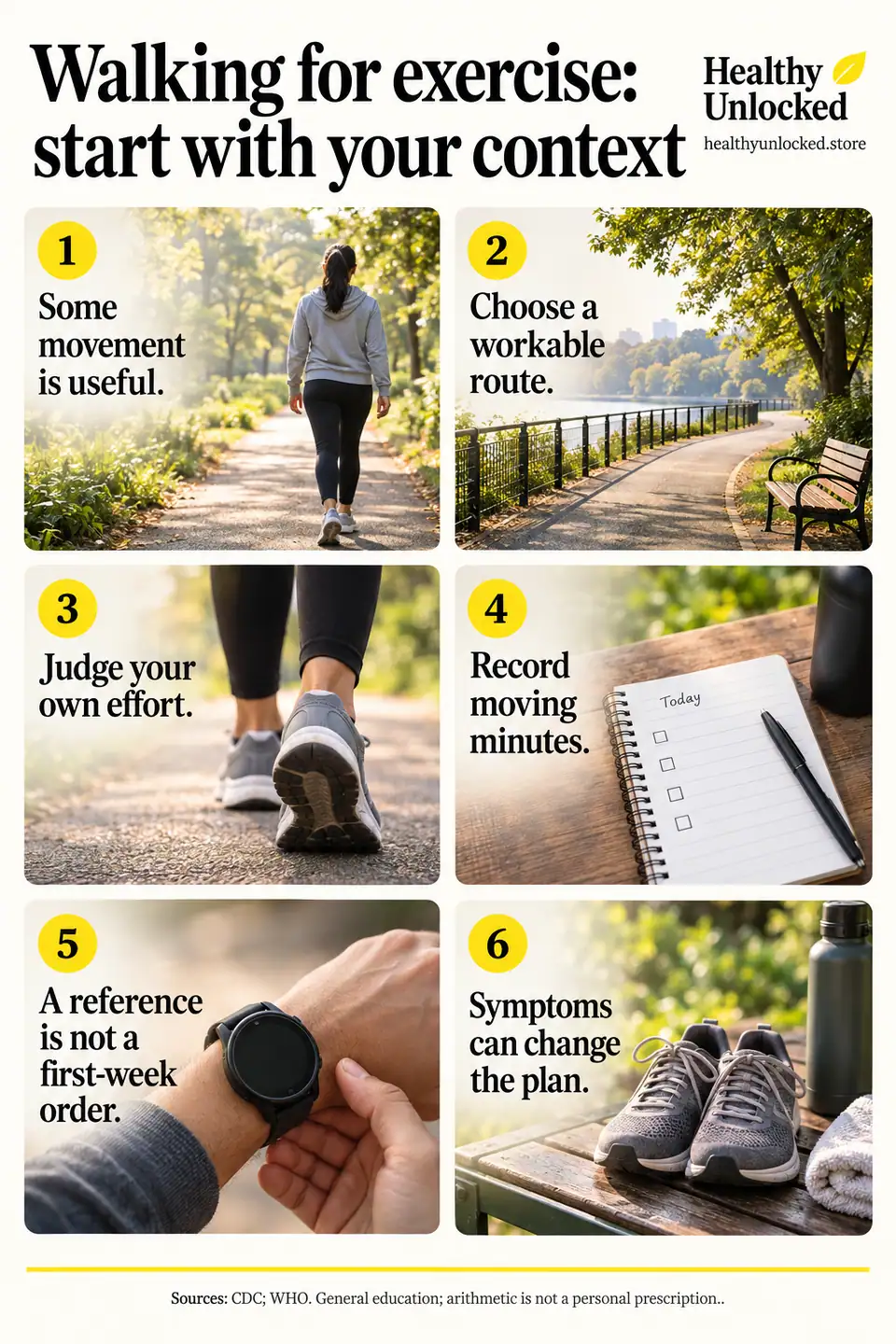
There is no single walking speed that works as the right exercise pace for everyone. A pace that feels easy to one person may feel demanding to someone who is starting out, recovering, using a mobility aid or walking uphill. Begin with the effort you experience and the conditions around you, rather than trying to match a number on somebody else’s fitness screenshot.
Walking pace describes distance covered in a given time. Exercise intensity describes the effort involved. Those ideas overlap, but they are not interchangeable. Two walks at the same average speed can feel different when one includes hills, heat, crowded crossings or a carried bag. A slower walk may still require substantial effort in a particular situation.
The CDC guide to measuring physical activity intensity distinguishes relative effort from the demands of an activity measured without regard to an individual’s fitness. Its talk-test rule is useful because you do not need to own a watch or calculate a heart-rate zone to notice how speaking feels. It remains a practical estimate, not a diagnosis or a laboratory measurement.
If you are beginning, a comfortable walk is a legitimate starting point. You do not have to turn every outing into a brisk session. An ordinary walk can help replace time spent sitting and make a routine easier to sustain. The important question is what you can do safely and repeat, followed by a gradual change if that is appropriate.
Our beginner walking guide focuses on establishing the habit. This article adds a way to think about effort once you are walking. Read the two together if the first difficulty is getting out of the door rather than choosing a pace. Neither guide can assess an unexplained symptom or set rehabilitation targets.
| Measure | What it tells you | What it cannot decide |
|---|---|---|
| Speed | Distance divided by time | Whether the pace is safe or moderate for you |
| Duration | How long you were walking | Whether every minute had the same effort |
| Relative effort | How demanding the walk felt | The cause of unusual breathlessness or pain |
| Route and conditions | The setting in which you walked | A guaranteed amount of benefit |
| Repeatability | Whether the routine fits your circumstances | Whether a medical condition needs assessment |
Choose a purpose before comparing numbers
A walk to reach a bus stop, a quiet recovery walk and a planned exercise session do not have to look identical. Name the purpose of the outing. If you want a manageable exercise walk, focus on a repeatable duration and your response to effort. If you need to travel safely through traffic, speed may be a poor priority.
For a person who cannot comfortably walk, another suitable form of movement may be a better option. Walking is one activity, not a moral test or the only way to be active. Ask a clinician or qualified rehabilitation professional about options if pain, balance, disability or recovery makes the usual advice unsuitable.
How does the talk test work?
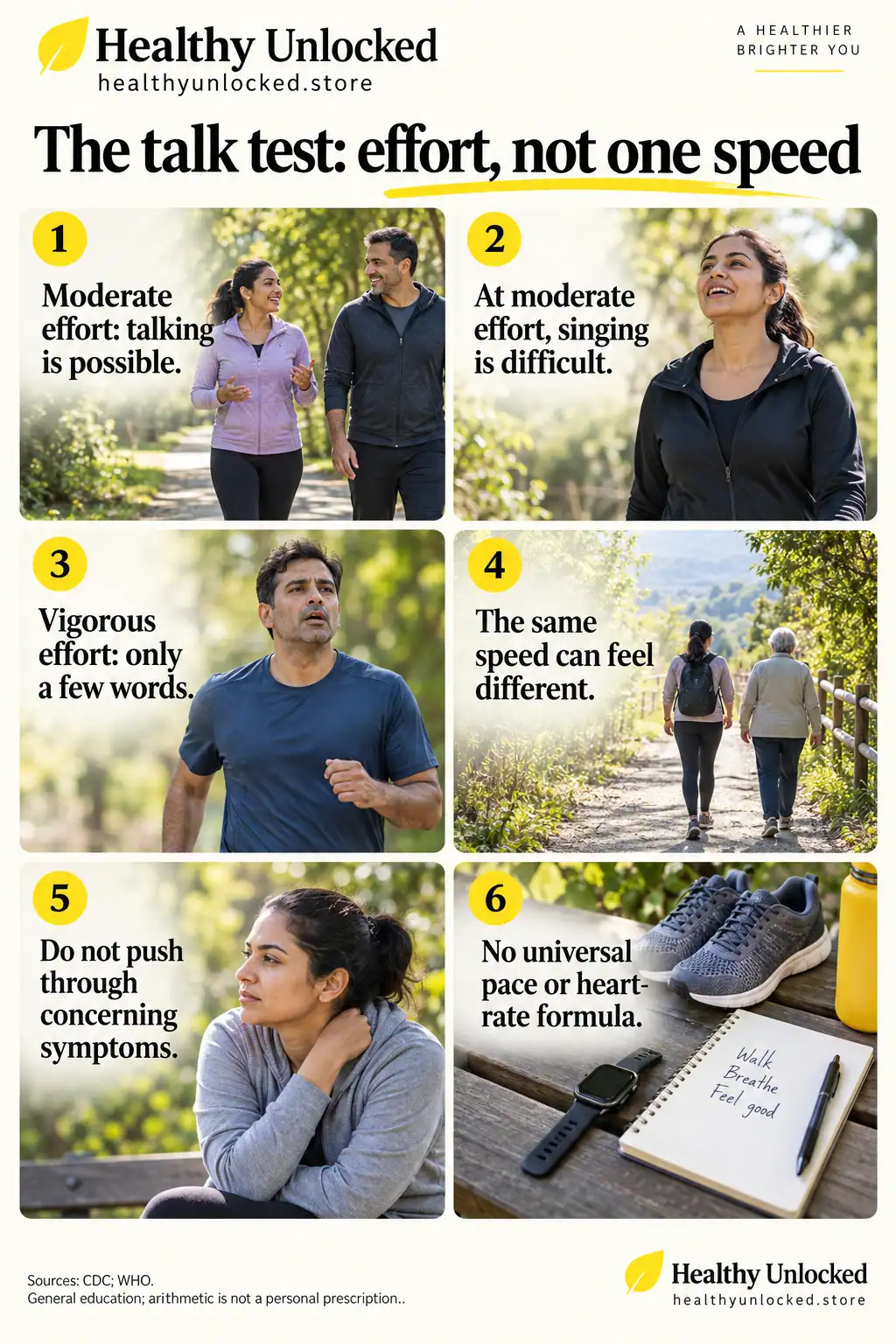
The talk test uses your ability to speak during activity as a rough guide to relative intensity. At moderate effort, a person can generally talk but would find singing difficult. At vigorous effort, only a few words may be possible before a pause for breath. This is the CDC explanation of adult activity intensity, expressed as a rule of thumb rather than a precise boundary.
Try an ordinary sentence at a suitable moment on a safe part of the route. You do not need to perform a song, talk continuously or make a difficult crossing while concentrating on the test. Notice the overall effort. If speech becomes unexpectedly difficult, slow down or stop as appropriate, and consider whether you need advice rather than treating the change as a successful workout.
A comfortable conversation during a gentle walk does not make the walk worthless. Light activity can be a useful alternative to sitting, and it may be the right starting effort. The talk test helps label what happened; it should not become a reason to dismiss movement that fits your current ability.
If you are walking with somebody, allow each person to use their own effort rather than the faster walker’s pace. A group can choose a route with a shorter option, regroup at a safe place, or agree that staying together matters more than maintaining a particular speed. Nobody should have to hide discomfort to avoid delaying the group.
Breathlessness has causes beyond exercise intensity. Asthma, heart or lung conditions, illness and other circumstances may need assessment. The test cannot identify the cause, and being able to say a sentence does not prove that exercise is medically safe. Follow a personal plan if your care team has given one.
| What you notice | Possible effort description | Practical response |
|---|---|---|
| Talking feels easy and singing would be comfortable | Often light relative effort | Useful movement; increase only if suitable |
| You can talk but singing is difficult | Often moderate relative effort | Keep a manageable pace and monitor comfort |
| Only a few words before pausing for breath | Often vigorous relative effort | Do not assume this is the necessary goal |
| Unexpected breathlessness, pain or dizziness | Not a safe intensity label | Stop and seek appropriate help |
| Unclear result because of speech or breathing limitations | The test may be unsuitable | Ask about an appropriate alternative measure |
The test does not require a heart-rate target
A wearable may estimate pace or heart rate, but its reading is not a substitute for symptoms and personal advice. There is no age-based heart-rate formula or target zone in this planner. Medicines and health conditions can change how useful a heart-rate number is. Ask your care team how to monitor effort if you have been given exercise restrictions.
You can keep a simple note such as “conversation comfortable” or “needed to slow on the hill.” Use the same plain wording across several walks so that the record is understandable. Avoid describing every harder walk as an improvement; sometimes the setting was simply more demanding.
How can you find a manageable starting pace?
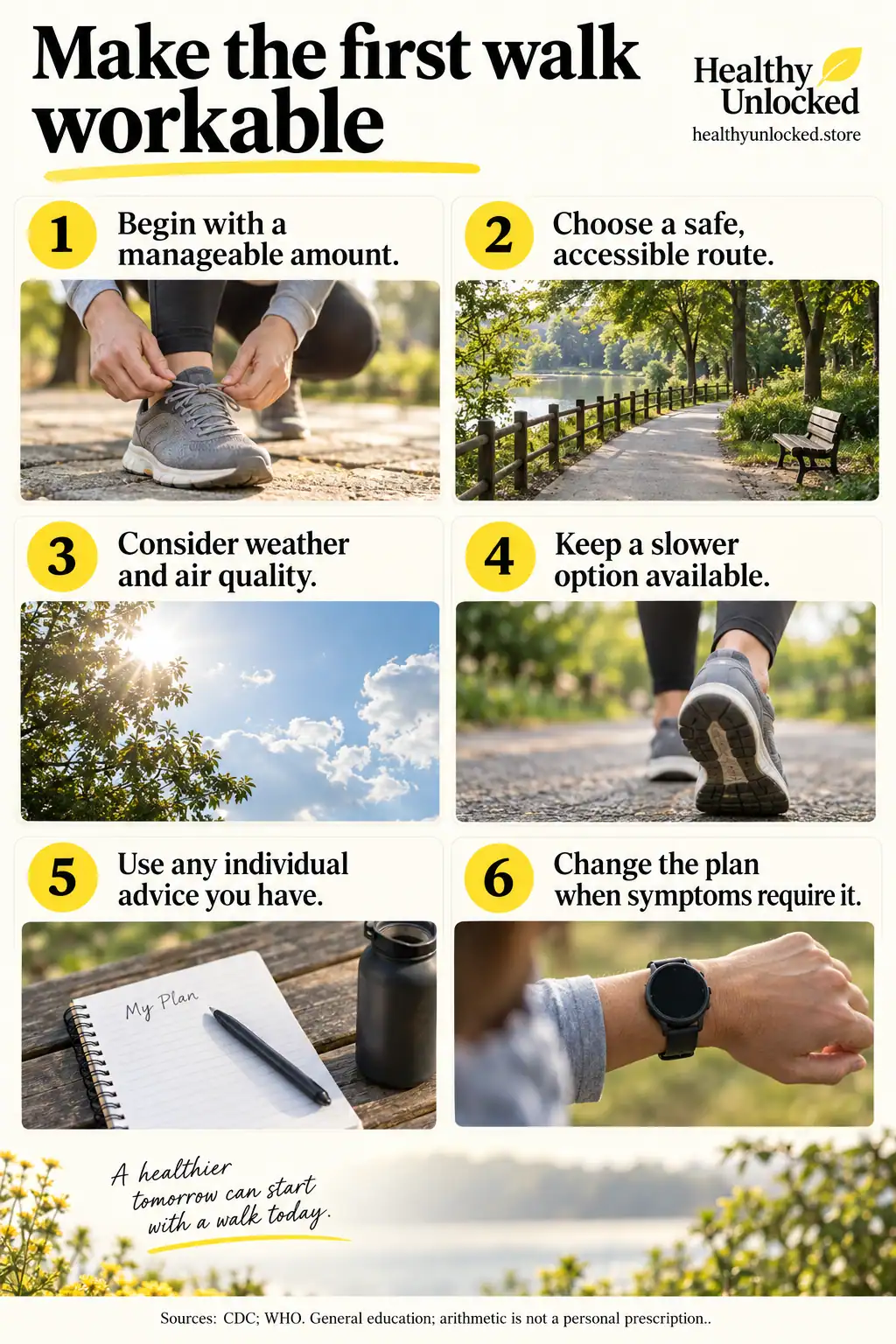
Begin from what you currently do. If walking around the block feels manageable, that can be your starting route. If it does not, choose a shorter or more accessible option or ask for advice about suitable activity. A printed weekly guideline does not mean that you should jump straight from inactivity to a long brisk walk.
Choose a route with a clear way to shorten or stop the outing. A nearby loop, an accessible indoor corridor or a familiar path can make the first attempts easier to adjust. Distance from home is not a badge of success. A route that lets you respond to fatigue or discomfort is often more practical than an ambitious destination.
Allow an easier start and finish rather than immediately setting off at the hardest pace you can maintain. Notice how your body responds as the walk continues. This article does not prescribe a universal warm-up time, speed increase or recovery schedule; those details depend on the person and any advice they have received.
Change one practical feature at a time. You might add a little time on a familiar flat route before choosing hills, or add another manageable day before making each walk faster. A change should leave room for recovery and ordinary life. If a new plan is difficult to repeat, revise it rather than treating the difficulty as a character flaw.
The WHO guidelines on physical activity and sedentary behaviour support starting with small amounts and building gradually. They provide population guidance, not a compulsory pace for a beginner. Your clinician’s restrictions or rehabilitation advice take priority over a general example online.
Returning after a break is a fresh starting point
An old personal best is not a requirement for your first week back. Illness, caring responsibilities, work and a change in routine may have altered what feels manageable. Use current comfort and capacity to set the next outing. If the reason for the break was a medical problem, ask about returning to activity before using a generic schedule.
Plan a smaller alternative for a difficult day. That could be a gentle walk closer to home or another suitable movement option. Rest may also be appropriate. Keeping flexibility in the plan is different from ignoring symptoms or pushing through exhaustion to preserve a streak.
How can walking fit into a busy week?
A weekly plan can start with the opportunities you already have: a safe part of the commute, a lunch break, a short outing after a meal, or time with a friend. Write the available windows first. It is easier to assess a real ten-minute opportunity than a vague intention to “exercise more” when the rest of the day is full.
For general adult guidance, CDC adult activity recommendations describe at least 150 minutes of moderate aerobic activity per week, together with muscle-strengthening activity on at least two days. WHO describes a wider recommended aerobic range. These are general reference points, not a pass-or-fail grade or an instruction to force an unsuitable amount.
Walking can contribute to the aerobic part when its effort is appropriate. It does not automatically cover every part of an activity recommendation. Keep muscle-strengthening, balance work when relevant, and individual advice separate from the walking-minute total. A completed walking plan cannot certify a complete exercise program.
Short periods can contribute; you do not need to discard a walk simply because it was shorter than a traditional workout. Record the minutes accurately and avoid counting the same session twice because two apps recorded it. If a walk included stops or long gentle stretches, do not automatically label the entire elapsed time as moderate effort.
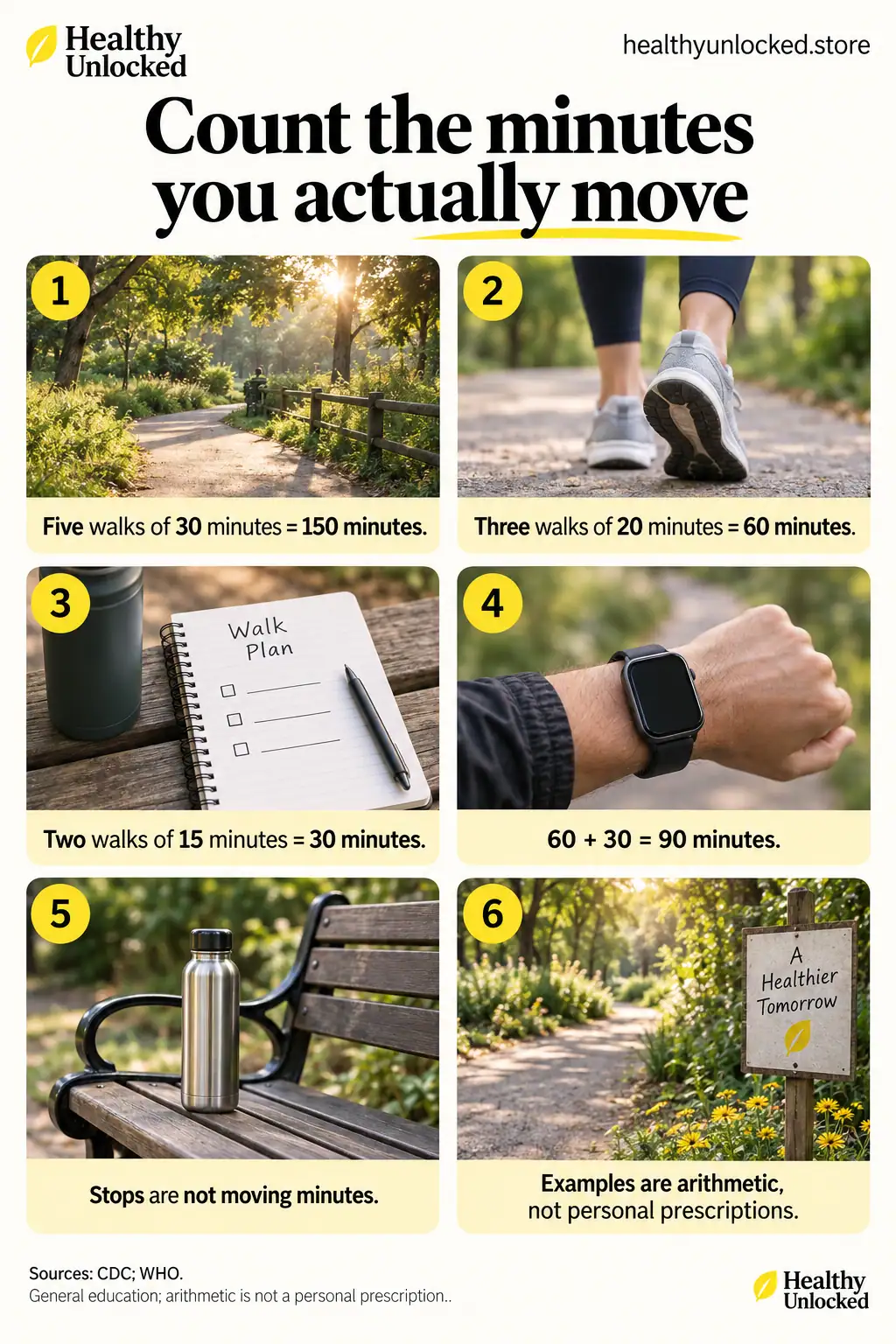
Five hypothetical thirty-minute moderate walks total 150 minutes. That arithmetic is straightforward, but five such sessions may not fit your starting ability or calendar. Three twenty-minute sessions plus two fifteen-minute sessions total 90 minutes. That is a different plan with useful activity, not a failed version of the first one.
| Example | Calculation | What to remember |
|---|---|---|
| Five moderate walks of 30 minutes | 5 × 30 = 150 minutes | Only suitable if the duration and effort fit you |
| Three 20-minute and two 15-minute moderate walks | 3 × 20 + 2 × 15 = 90 minutes | A smaller total can still include useful activity |
| Two moderate segments of 10 minutes on four days | 2 × 10 × 4 = 80 minutes | Do not also count the whole outing again |
| An easy walk with stops | Record its actual duration separately | Do not assume every minute was moderate |
| An individualized activity plan | Use the targets agreed with your care team | A general online target does not replace it |
Protect the plan from all-or-nothing thinking
A missed day does not require doubling the next session. Review why the plan did not fit: time, weather, discomfort, transport or an unrealistic duration. Change the arrangement where needed. The weekly total is a planning aid, and there is no extra benefit in turning it into a punishment.
Keep travel and household activity honest. Some tasks involve suitable aerobic effort and others do not. Standing at a crossing, waiting for a bus and moving slowly around a shop are not the same as a continuous moderate walk. They may still be part of a more active day without belonging in the same total.
What should you record instead of chasing speed?
Progress can mean that a familiar walk feels more manageable, that you have found a safer route, or that the routine now fits around work. Speed is only one possible record. It should not be the only definition of success, especially when the aim is a sustainable habit rather than a race.
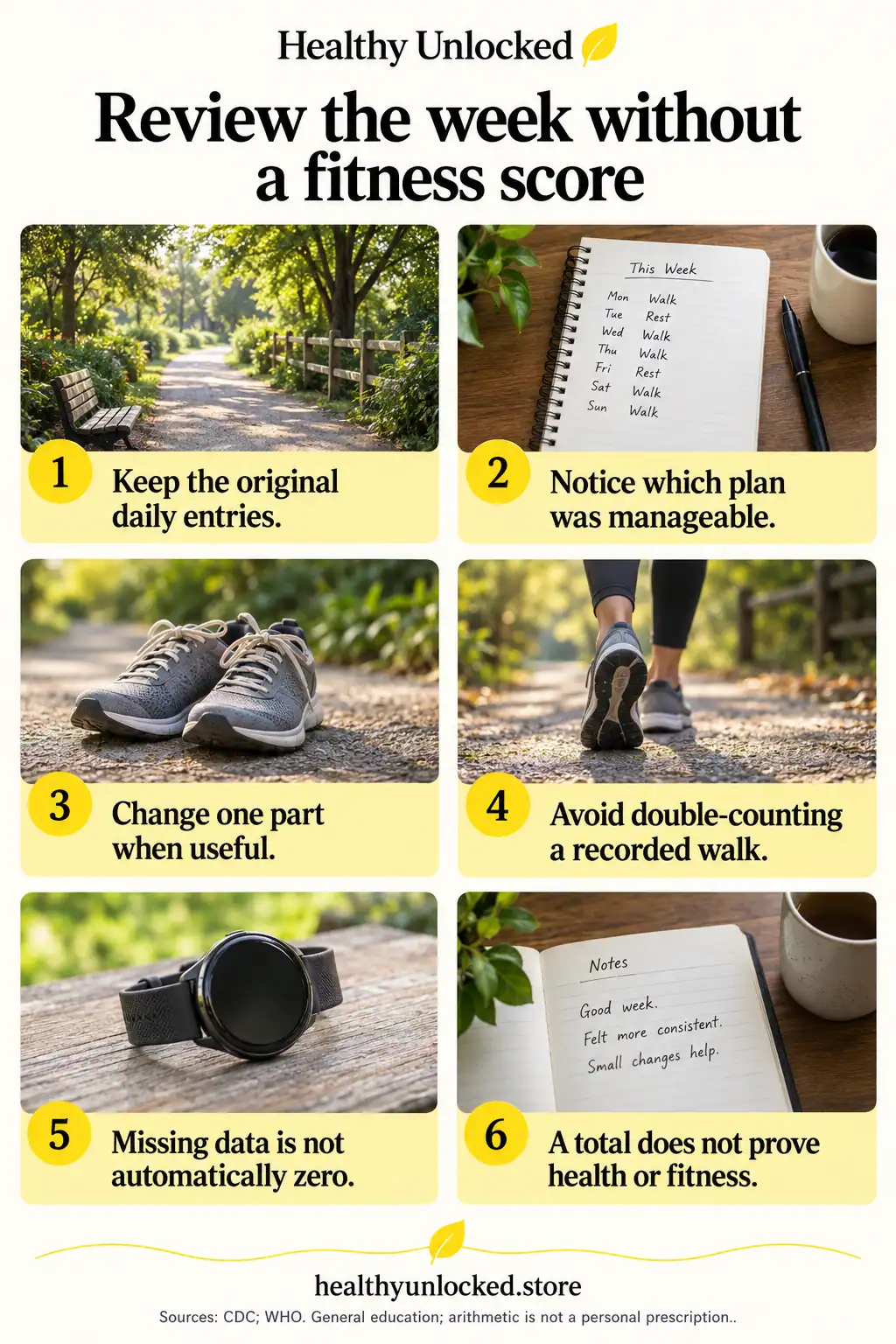
Write the date, actual walking minutes, route and a brief effort note. Add discomfort, unusual symptoms or the reason for a change when useful. A short entry can be enough. You do not need to publish your location, share a health detail with an app, or keep an elaborate spreadsheet to understand your own routine.
Compare similar conditions when you look at pace. A flat route in mild weather and a hilly route on a hot day are different comparisons. GPS can also be inaccurate, especially indoors or around buildings. An apparent speed change may reflect measurement or conditions rather than a change in fitness.
If a record will be used at an appointment, make its purpose clear. Your clinician may want symptoms or a response to a prescribed plan rather than a week of average speeds. Bring the personal exercise instructions alongside the record, and ask which details would be most useful to collect next.
Avoid using an estimated calorie figure to decide what you have earned the right to eat. Wearable estimates vary, and this article does not calculate energy expenditure or a weight-loss result. Ordinary food, hydration, rest and a sustainable routine remain relevant without a daily calorie contest.
| Record item | Example entry | Why it helps |
|---|---|---|
| Actual minutes | 12 minutes, with a pause recorded separately | Distinguishes walking from total outing time |
| Route | Familiar flat loop | Makes comparisons more meaningful |
| Effort | Could talk comfortably; singing would have been difficult | Adds context beyond speed |
| Comfort or symptoms | New knee discomfort; shortened route | Supports an appropriate review rather than a score |
| Practical adjustment | Earlier outing because of heat | Explains why the next plan changed |
Keep health information private
The downloadable record can stay on your own device or be printed. Write only the details you want to keep. Do not put a full address, identity document number or sensitive diagnosis into a public comment. If you share a route with friends, consider whether it reveals your home, workplace or regular timings.
The walking-time calculator processes its fields in your browser and does not ask for a name, age, diagnosis or location. Analytics and site services are described in the site’s privacy policy; the tool is not a clinical record system. Save your own copy if you need a lasting personal record.
How do routes, weather and footwear change the plan?
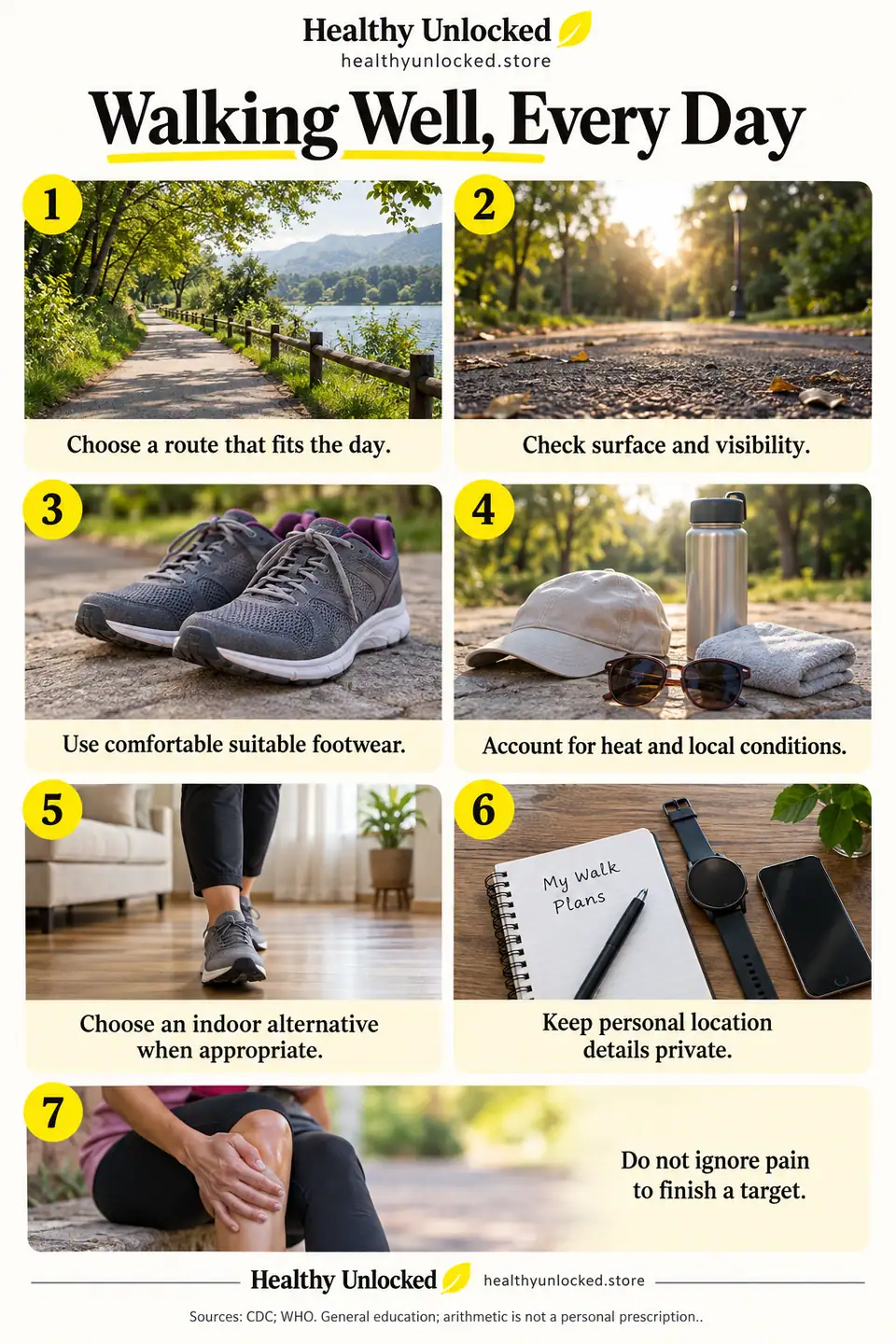
A route should fit your balance, mobility and surroundings. Look for a suitable surface, safe crossings and enough light to see hazards. A busy road, an uneven footpath or a poorly lit shortcut can make an otherwise short walk impractical. Choosing an accessible route is part of planning, not an excuse for moving more slowly.
Footwear should feel comfortable and appropriate to the surface. There is no compulsory brand or expensive purchase in this guide. If shoes repeatedly cause rubbing, pain or instability, address the problem rather than trying to compensate by walking faster. Persistent foot problems or medical foot-care needs warrant personal advice.
Heat can change the sensible timing and duration of activity. Follow local weather advice, choose a cooler or sheltered option when appropriate, and have access to drinking water. The CDC heat-health resource explains why heat exposure deserves attention. The walking tool cannot assess temperature, humidity or dehydration.
Air quality and traffic exposure also matter. Follow current local advisories and consider an indoor or less exposed option when conditions are poor. The WHO air-pollution overview provides background; it is not a live reading for your street. Check an appropriate local service for current conditions rather than relying on an old screenshot.
A carried bag, hills and a crowded route can increase effort or introduce other challenges. If the outing must carry shopping or children’s belongings, account for that purpose. Do not force the pace that felt manageable on a different unladen walk. The setting belongs in your record when it changes the plan.
Adapt the outing to the person, not the other way around
An indoor route, a walking aid or support from another person may make activity more accessible. Follow advice about the correct use of equipment when relevant. A generic speed target cannot tell you how to manage a balance problem or adapt after surgery.
If you walk with a group, agree on a safe meeting point and a way to opt for the shorter route. Avoid headphones or distractions that make it difficult to notice traffic or other hazards. Comfort includes being able to change the outing without pressure from a group, a streak counter or an ambitious plan.
When should you stop or get advice?
Do not treat pain, faintness or unusual breathlessness as proof that the session is working. Stop activity when a symptom makes it unsafe to continue. New or severe chest discomfort, fainting, severe breathing difficulty or other serious symptoms need urgent assessment through appropriate local emergency services. A timer or talk-test result should never delay that response.
For recurring discomfort, unexplained changes in exercise tolerance or uncertainty after illness, ask a clinician about the next step. Describe when the symptom occurs, what you were doing and whether it resolves with rest. Do not use a walking record to diagnose the cause or decide that a symptom is harmless because the pace was slow.
People managing chronic conditions, pregnancy, recovery or an injury may need adaptations and individualized advice. That does not mean that every person needs permission for every ordinary walk; it means that a general article cannot resolve a specific concern or replace an existing personal care plan.
If you have been told to monitor a particular symptom or follow an activity limit, use that instruction. The general weekly reference in this article is not a reason to exceed the limit. Ask the care team what to do if the plan becomes difficult or if your circumstances change.
Safety is also immediate and practical: weather, traffic, visibility, a suitable route and the ability to get help if necessary. The NHS walking-for-health guide offers general walking background. Use local services and personal advice for a situation that the guide cannot assess.
When the talk test is not the right tool
Speech differences, breathing conditions or a specific rehabilitation program may make the talk test less suitable. Ask a qualified professional about an alternative. There is no requirement to pass a spoken test in order for adapted movement to be worthwhile.
Never use the calculator while crossing a road or moving in a setting that needs your attention. Make the note after the walk in a safe place. Planning is useful when it supports the outing, not when it adds a distraction or prevents you from responding to how you feel.
Try the walking-time planner
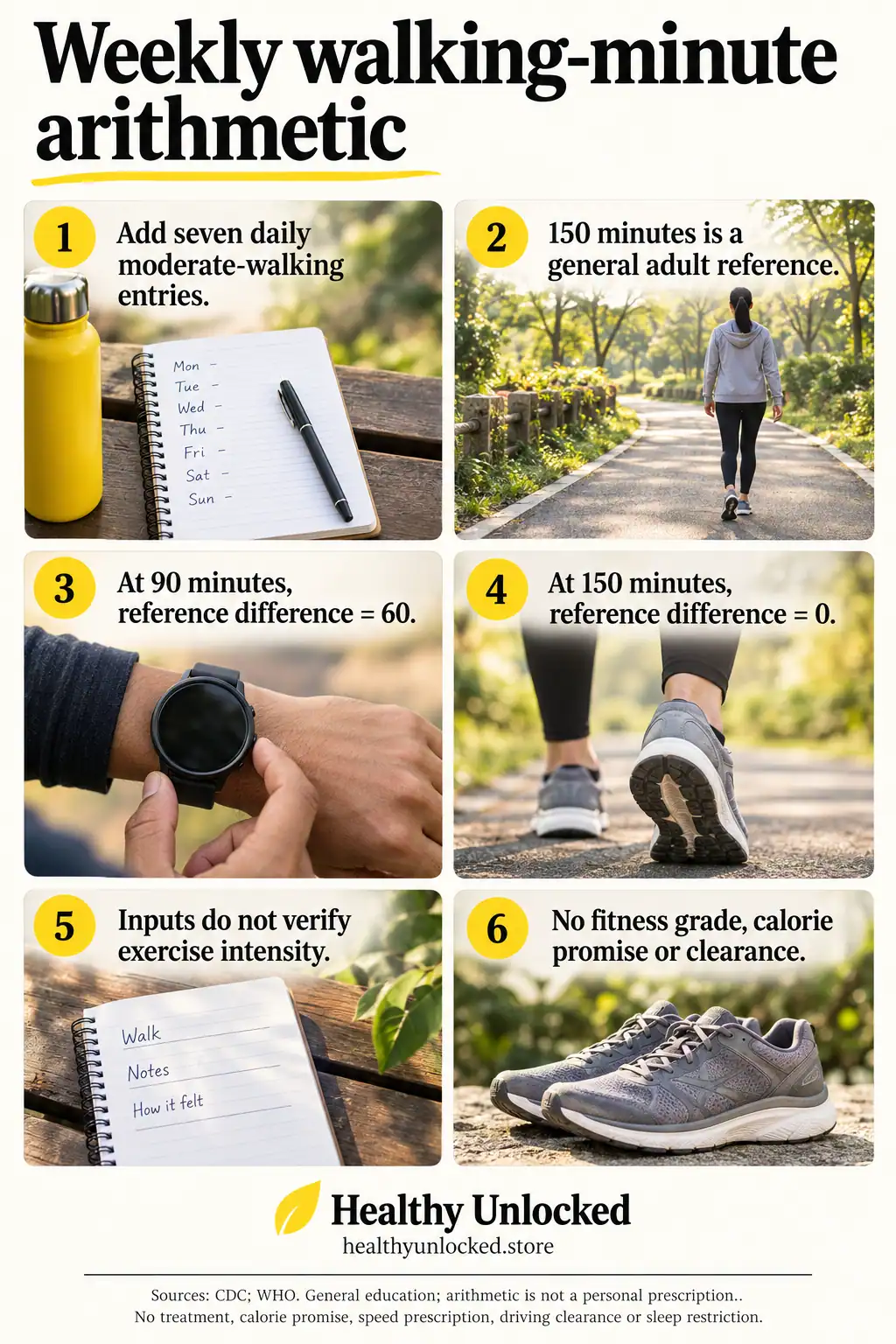
The planner adds the moderate walking minutes you enter for each day. Enter actual or hypothetical planned minutes consistently; do not mix the two without labeling the record. It does not determine whether a session was moderate, calculate calorie burn, predict weight change or certify that a target is appropriate for you.
The weekly total is the sum of the seven daily entries. A comparison with 150 minutes uses a general adult aerobic reference, not a personalized prescription. The remaining amount is the greater of zero and 150 minus your total. Reaching that figure does not assess strength activity, symptoms, medical restrictions or the quality of the whole plan.
Worked example one: five days at 30 minutes and two days at zero give 30 + 30 + 30 + 30 + 30 + 0 + 0 = 150 minutes. The reference difference is zero. This is arithmetic for a hypothetical week, not evidence that five thirty-minute walks are right for every beginner.
Worked example two: three days at 20 minutes and two days at 15 minutes, with two days at zero, give 20 + 20 + 20 + 15 + 15 = 90 minutes. The difference from the reference is 60 minutes. Do not interpret that difference as an instruction to make up all sixty minutes in one session.
Zero is a valid daily entry. Blank, negative, non-finite or impossible daily durations should produce a correction message rather than an old result. Clear removes your entries and the previous result. The static examples above remain usable without JavaScript, and the walking-plan worksheet lets you save a labeled record with the formula and reference source.
| Entry or result | Calculation rule | Keep this limit |
|---|---|---|
| Each day | Finite minutes from 0 to 1440 | This is an input boundary, not a recommended duration |
| Weekly total | Sum of all seven daily entries | The tool cannot verify your intensity label |
| Reference difference | Greater of 0 and 150 minus the total | A planning comparison, not a make-up session instruction |
| Reset | Clear all entries and remove the result | The example is not a personal exercise plan |
| Missing or invalid entry | Clear the previous answer and ask for correction | Do not retain a stale total |
Add actual moderate-walking minutes
5 × 30 = 150 minutes; 90 is 60 below the general adult reference. Not a personal prescription or fitness grade.
5 × 30 = 150 minutes; 90 is 60 below the general adult reference. Not a personal prescription or fitness grade.
Calculations use this page’s entries in your browser; they do not save or send them to a Healthy Unlocked server. Keep downloaded files private as needed.
What the numbers cannot show
A minute total cannot identify a disease, show whether a symptom needs urgent care, or decide that a faster pace is safe. It also cannot tell whether your daily entries include duplicated app recordings. Review the inputs before using the output to rearrange a week.
The worksheet is an editorial planning aid with hypothetical worked examples. It is not a research dataset collected from participants or a validated clinical assessment. Source dates and access notes appear below so that the origin of the general guidance is separate from the simple arithmetic used by the tool.
Common questions about walking intensity
Is there a walking speed everyone should aim for?
No. Fitness, mobility, terrain and conditions change how demanding a pace feels. Use a manageable effort and personal advice when relevant, rather than assuming that one speed is suitable for everybody.
How do I know whether my walk is moderate?
The talk test is a rough guide: at moderate effort you can generally talk but not sing comfortably. It does not diagnose breathlessness or prove that exercise is safe for a particular medical condition.
Do short walks count?
Short periods of suitable activity can contribute. Record the actual minutes and effort honestly, and avoid counting the same outing twice. Gentle movement can also help replace sitting even when it is not labeled moderate.
Must I reach 150 minutes in my first week?
No. That is a general adult aerobic reference, not a required starting plan. Start with manageable activity and build gradually when suitable. Your care team’s advice takes priority over a generic target.
Should I walk faster if my watch says the workout was easy?
Do not let one device label decide the plan. Consider your effort, comfort, symptoms and the setting. A wearable cannot assess every condition or replace personal exercise advice.
Can this calculator assess my fitness or weight loss?
No. It totals the moderate walking minutes you enter and shows arithmetic against a general reference. It does not measure fitness, calculate a personal calorie requirement or predict a health outcome.
About this article
By Yashveer Bharani for Healthy Unlocked. This article explains general walking intensity and an editorial minute-total planner. It does not claim supervised exercise testing, medical clearance or independent clinical review.
The worked schedules are hypothetical. Primary guidance, publication context and the formula are separated from personal recommendations. Visuals explain the ideas and do not document a reader’s exercise performance.
Sources and further reading
These original references support the guidance and its limits. A link does not mean that the institution reviewed or endorsed this article.
Main guidance
Practical reference
Context and definitions
Safety and care
Evidence and limitations
Further reference
 Healthy Unlocked
Join the conversation
Share a practical idea or ask a question about this guide. Please keep personal medical details private.