
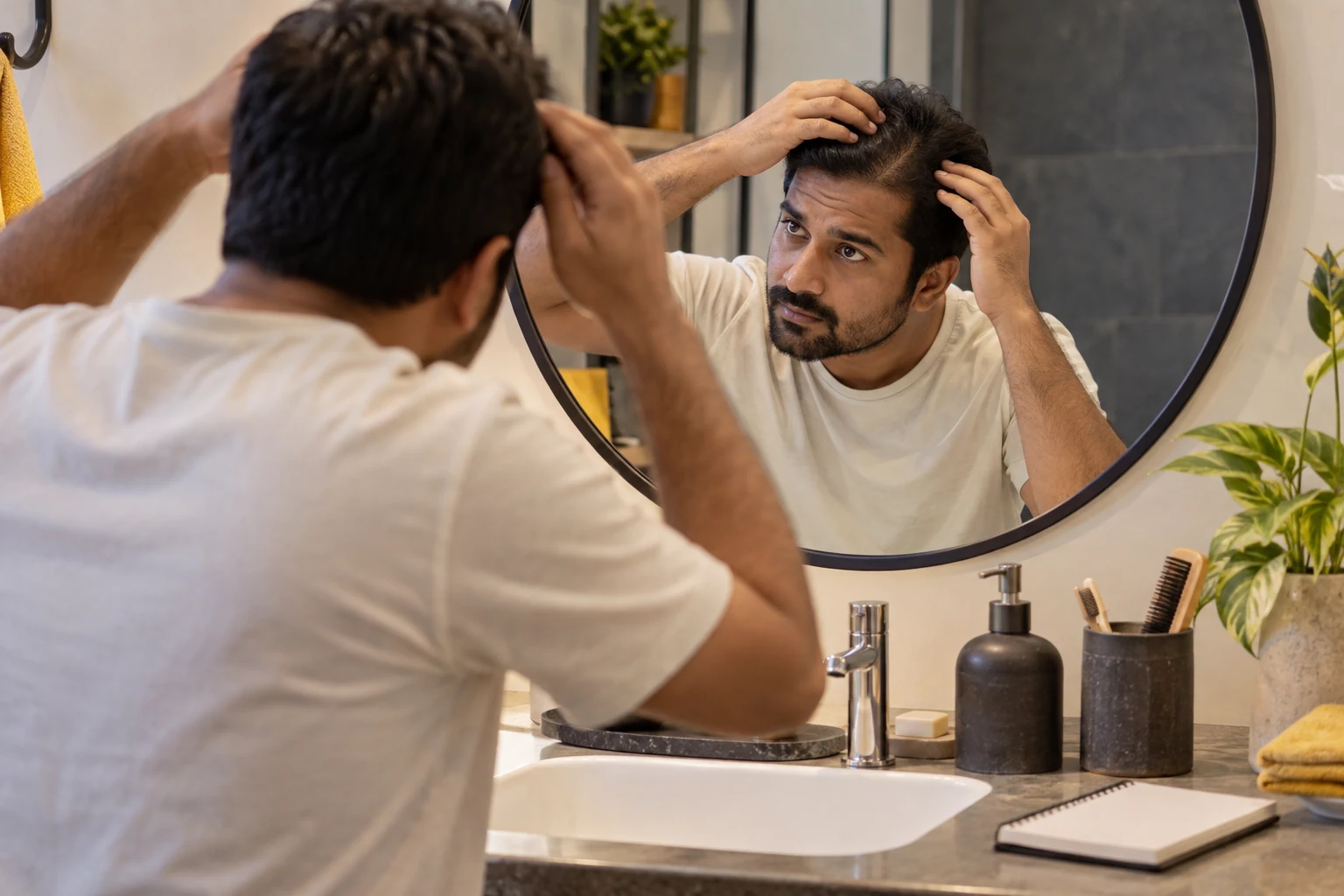
Summary
Dry scalp and dandruff can both cause flakes and itching. Dry skin involves reduced moisture, while dandruff is a common scalp condition that may need a different approach. The color, size or oiliness of flakes cannot confirm the cause. Persistent irritation, sores or patchy hair loss deserve professional assessment.
Use this guide to make daily care easier, understand product directions, and prepare useful questions. It explains what observations can tell you, where home comparisons stop, and how to keep a short record without turning it into a diagnosis.
What you’ll understand
- Flakes overlap. A dry-looking scalp does not automatically mean simple dryness.
- Keep care gentle. Avoid scratching, harsh scrubbing and layering unfamiliar products.
- Read the actual label. Directions and precautions differ between dandruff shampoos.
- Notice the whole pattern. Recent products, discomfort and changes outside the scalp matter.
- Get help for concerns. Pain, sores, patchy hair loss or persistent symptoms need assessment.
- Record observations. The planner organizes notes; it cannot identify a skin condition.
Start with these steps
- Write down when the flakes or discomfort started.
- Check recent changes in shampoo, dye, styling products and washing technique.
- Read directions before trying a suitable product, and avoid combining treatments blindly.
- Bring a short record and product labels to an appropriate professional if symptoms persist.
General scalp-care education. Seek urgent medical help for trouble breathing or severe swelling after a product reaction.
What is the difference between dry scalp and dandruff?
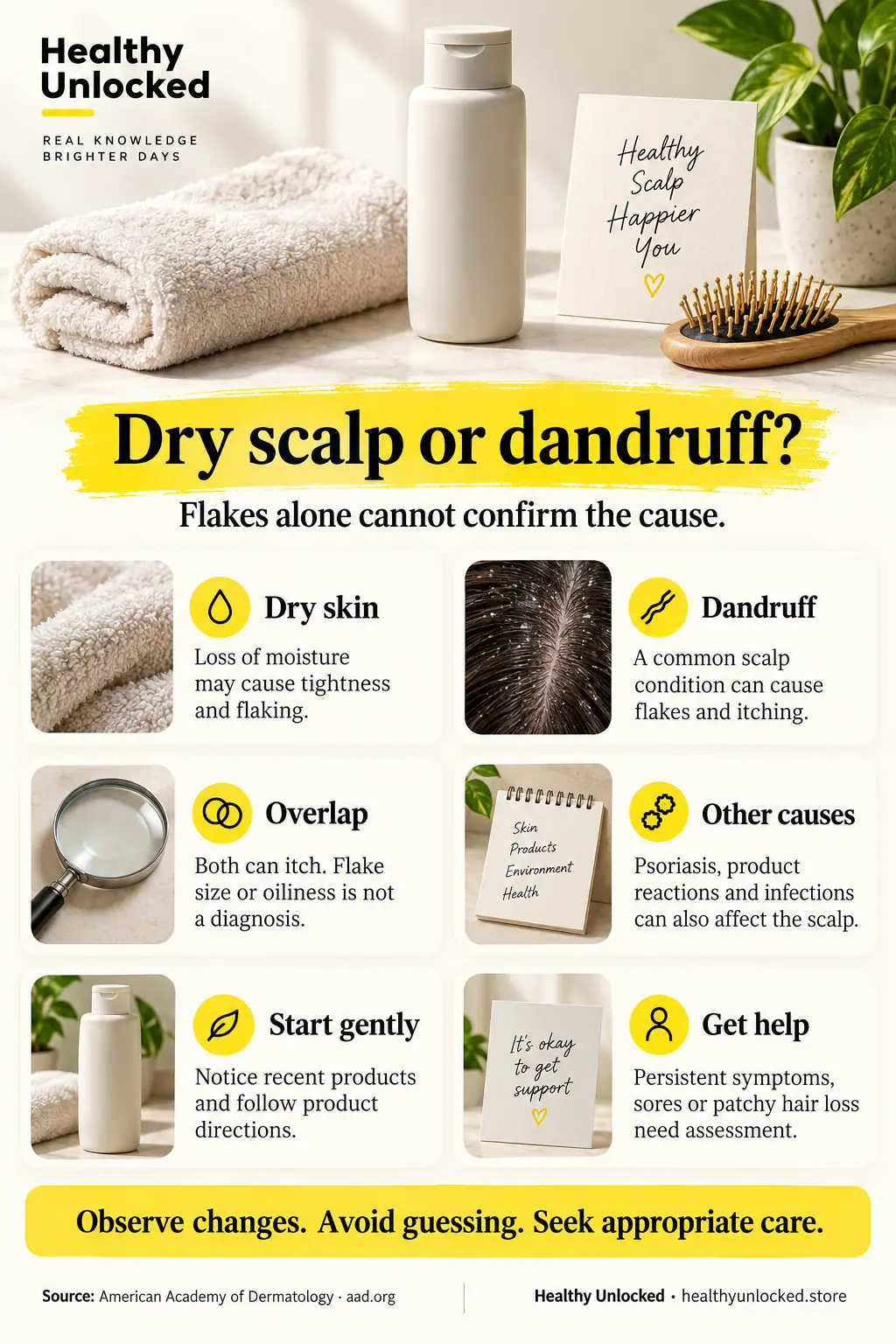
Dry scalp describes a scalp that feels or appears dry; it is not a diagnosis on its own. When skin loses moisture, it may feel tight or develop flakes. Dandruff describes a common scalp condition with shedding flakes, sometimes accompanied by itching. These descriptions can overlap, which is why a photograph or a shoulder full of flakes is an unreliable shortcut to the cause.
The American Academy of Dermatology’s explanation of dry-scalp conditions points out that several problems can look like ordinary dryness. The practical lesson is to separate what you notice from what you conclude. “My scalp feels tight after washing” is an observation. “I definitely have dry scalp and nothing else” goes further than that observation supports.
Dandruff does not mean that someone is dirty. It can recur even when hair is washed regularly. The relationship with oil, naturally occurring yeast and conditions such as seborrheic dermatitis is more complicated than a simple clean-versus-unclean explanation. Avoid making someone feel ashamed of flakes or assuming that stronger cleaning will solve them.
A useful first question is what changed: the product, how you used it, the weather, your styling routine, or the symptoms themselves. Keep the question open. A new shampoo may be relevant, but noticing a change after using it does not establish an allergy. A clinician may need history and examination to decide what is happening.
If you have already received a diagnosis and a care plan, use that plan rather than replacing it with an internet comparison. This guide is most useful for understanding the words used in that conversation and organizing the information you bring. It cannot decide whether you need a prescription or whether a previous diagnosis still fits new symptoms.
| Description | What you may notice | Limit of the observation |
|---|---|---|
| Dry-feeling scalp | Tightness, discomfort or flaking | Other scalp conditions may also feel dry |
| Dandruff | Flakes on the scalp or clothing, sometimes itching | Appearance alone does not establish every underlying cause |
| Recent product change | Symptoms noticed after a new product or different use | Timing does not prove an allergic reaction |
| Concern beyond flakes | Pain, sores or patchy hair loss | Requires assessment rather than a cosmetic comparison |
Keep the skin and the hair separate
Hair can feel dry while the scalp is oily, or the reverse. A conditioner that helps the lengths of your hair does not necessarily address an itchy scalp. Describe each separately: where does the discomfort occur, and what feels different about the hair? That makes a conversation more useful than saying that everything is “bad.”
Our beginner skin-care guide explains a similar principle for the face: choose care for the job it needs to do. The scalp deserves that same attention, without assuming that facial products or beard products automatically suit it.
Which observations are useful—and which are misleading?
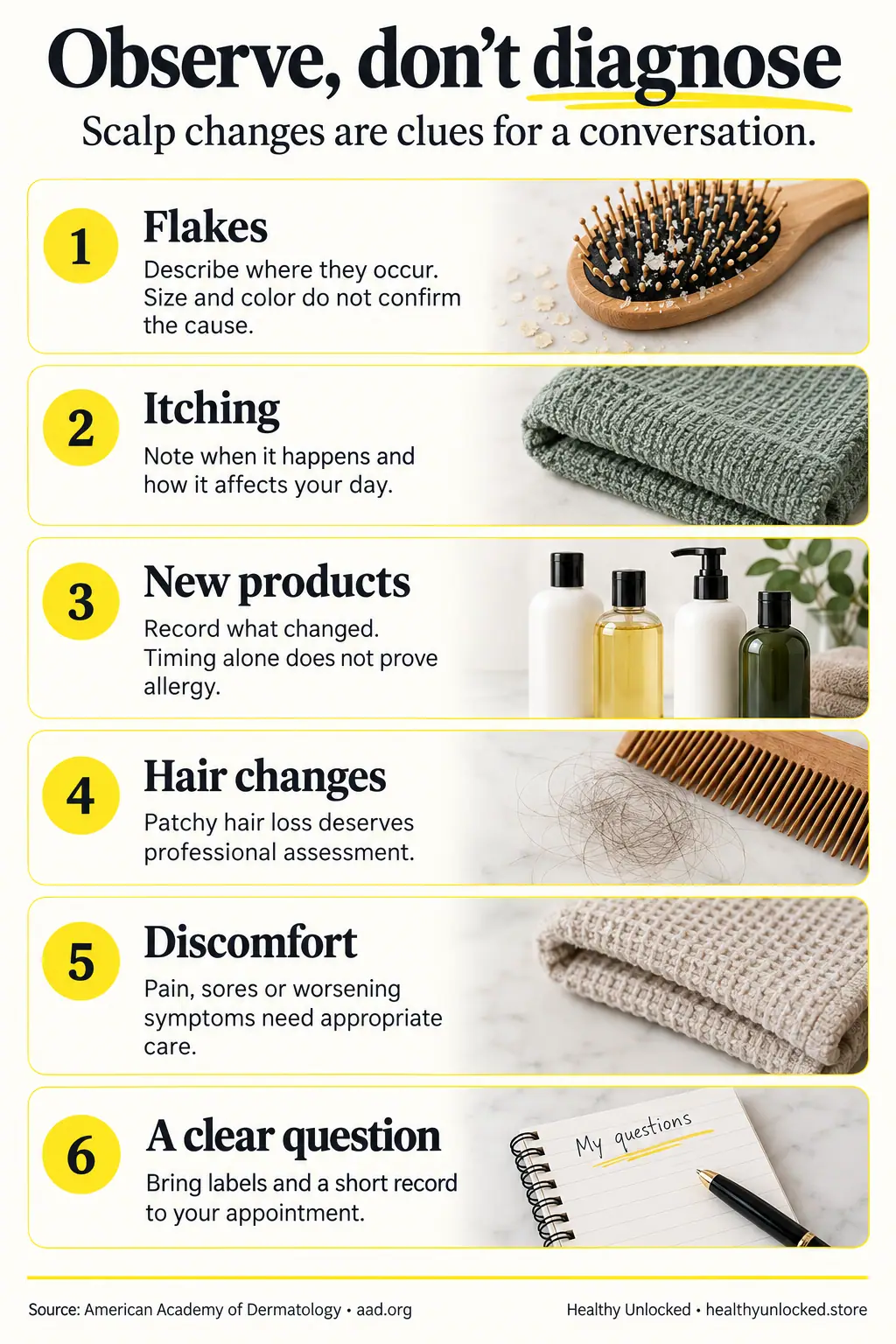
Compare patterns over time rather than treating one flake as evidence. Useful observations include where the flakes occur, whether washing is uncomfortable, how long symptoms have been present, and whether you have changed a product. None of those observations works as a stand-alone test. Their value comes from helping a professional understand your experience.
Many online comparisons describe small white flakes as dryness and larger greasy flakes as dandruff. Real symptoms do not always follow those neat columns. People can have overlapping conditions or a different cause altogether. Use appearance as a description, not as permission to start several medicated products or rule out the need for care.
Itching also has more than one explanation. The AAD guide to causes of scalp itching includes conditions beyond dandruff. A note such as “itching near the hairline after styling” helps identify the location and context. It does not tell you whether the cause is irritation, allergy or another condition.
If skin changes are visible, describe them in your own words. Color can look different across skin tones and lighting. Raised areas, soreness or a change that spreads may be easier to describe consistently than trying to match a medical photograph online. If you take a photograph for your own records, use similar lighting and keep it private.
A change outside the scalp may also be worth mentioning. For example, note discomfort around the ears or a new rash elsewhere, without assuming that all symptoms share one cause. The person examining you can decide whether those details belong together. A good record leaves room for more than one explanation.
| Record this | Do not conclude this | A better question |
|---|---|---|
| Flakes appeared after a product change | The product definitely caused an allergy | Could the timing or ingredients matter? |
| The scalp feels tight after washing | There cannot be dandruff | Could the washing method or another condition contribute? |
| The flakes look oily | A particular medicine is certainly required | What assessment or product advice fits this pattern? |
| Symptoms improved for a few days | The condition is permanently cured | How should I manage recurrence or new symptoms? |
| A patch has less hair | It is only cosmetic dryness | Does this change need prompt examination? |
Avoid the mirror checklist trap
Checking repeatedly under different lights can make small changes look more dramatic without producing better information. Choose a brief, consistent time for a note if you find it helpful. Stop the record if it increases worry. The goal is a clearer appointment, not constant surveillance of your scalp.
Do not ask an image-search result or an unvalidated symptom quiz to decide your diagnosis. Images may represent severe cases, different skin tones or entirely different conditions. Keep the ordinary facts you can describe and leave diagnostic interpretation to someone qualified to assess them.
How can you make everyday scalp care gentler?
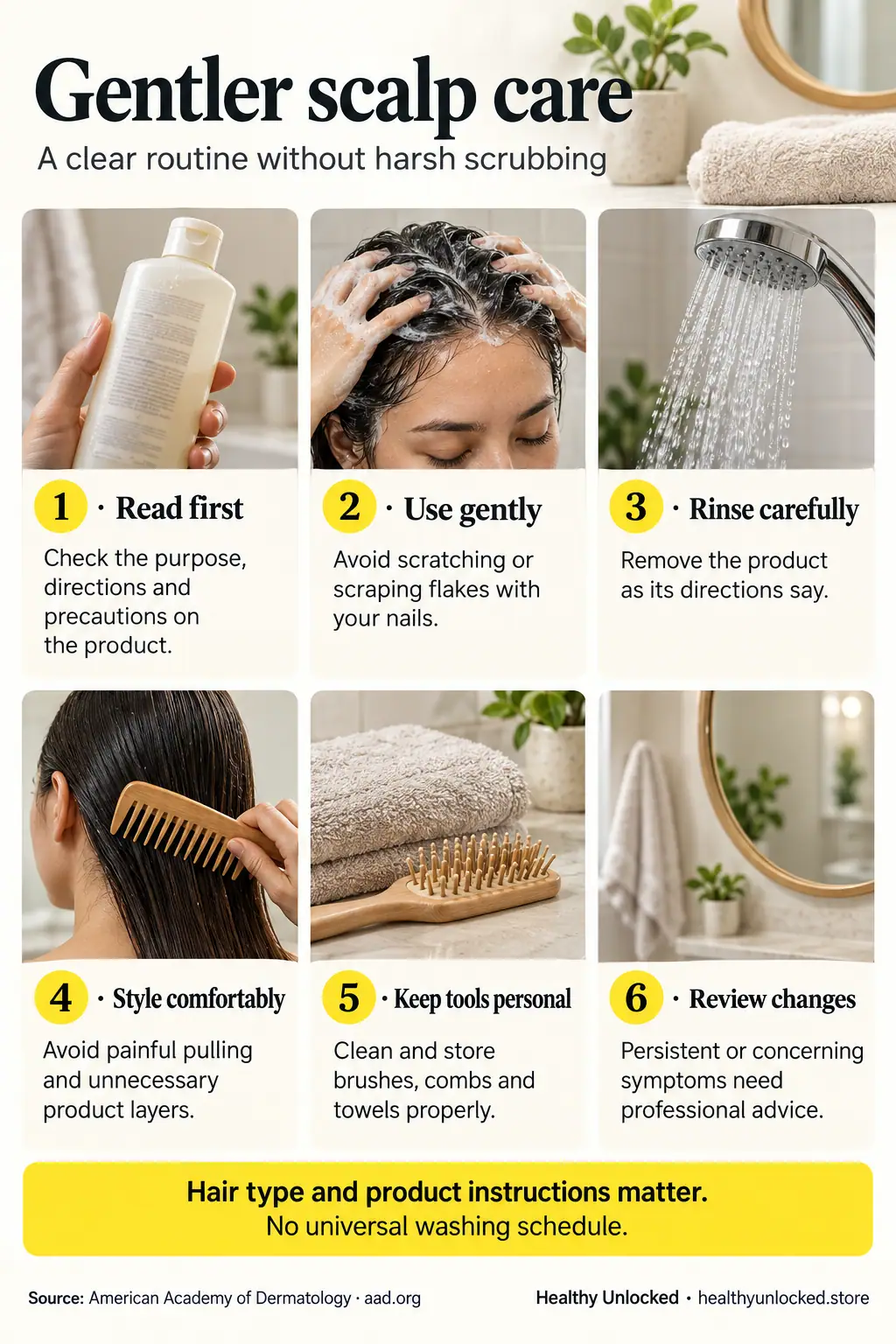
A gentler routine starts with how you handle the scalp. Use the product as directed, avoid very hot water, rinse carefully, and resist scraping flakes off with nails or a rough brush. If washing repeatedly causes discomfort, that is information to bring to a pharmacist or clinician rather than a reason to scrub harder.
The AAD tips for healthy hair provide wider guidance on washing and conditioning for your hair type. There is no single schedule in this article for every scalp, hairstyle or texture. Product instructions, your existing care plan and how your scalp responds matter more than copying someone else’s exact number of washes.
Before adding anything, look at what is already used: shampoo, conditioner, dye, oils, sprays, dry shampoo and styling products. The list may explain why a routine is difficult to follow. Write the actual product names privately, but do not interpret a long ingredient list as proof that a product is dangerous or that a shorter list is automatically safe.
Consider where a product belongs. A conditioner intended for hair lengths may have different instructions from a scalp treatment. Apply products only where their labels advise, and avoid the eyes or damaged skin when directed. More product is not necessarily more effective; an extra layer can make it harder to know which change helped or irritated.
Keep combs, brushes and towels clean and personal. Cleaning does not cure every scalp condition, but it is an ordinary part of tool care. Follow the manufacturer’s cleaning instructions rather than improvising a mixture that could damage the tool or leave a residue. If infection is suspected, ask what additional precautions are appropriate.
| Stage | Practical check | Reason to pause |
|---|---|---|
| Before washing | Know which product you are using and read its directions | Unclear label, unexpected damage to the seal or a product you cannot identify |
| During washing | Use gentle contact and the instructed technique | Burning, pain or a reaction |
| Rinsing | Remove product as directed without harsh scraping | Discomfort continues or becomes worse |
| Styling | Avoid pulling and unnecessary new layers | A style causes pain or increasing irritation |
| Review | Notice comfort and relevant changes | Symptoms persist, worsen or include concerning signs |
Make changes that you can understand
Changing shampoo, oil, dye and washing frequency at the same time makes a before-and-after comparison difficult. When a professional advises an ordinary routine adjustment, record what changed and follow the agreed plan. Do not deliberately re-expose yourself to a product that caused a concerning reaction just to prove a connection.
A personal example can be simple: you realize you were not rinsing the back of the scalp thoroughly, improve the rinse, and note whether washing feels more comfortable. That is a practical observation, not a claim that incomplete rinsing caused every flake or that a rinse replaces treatment.
How should you read a dandruff shampoo label?
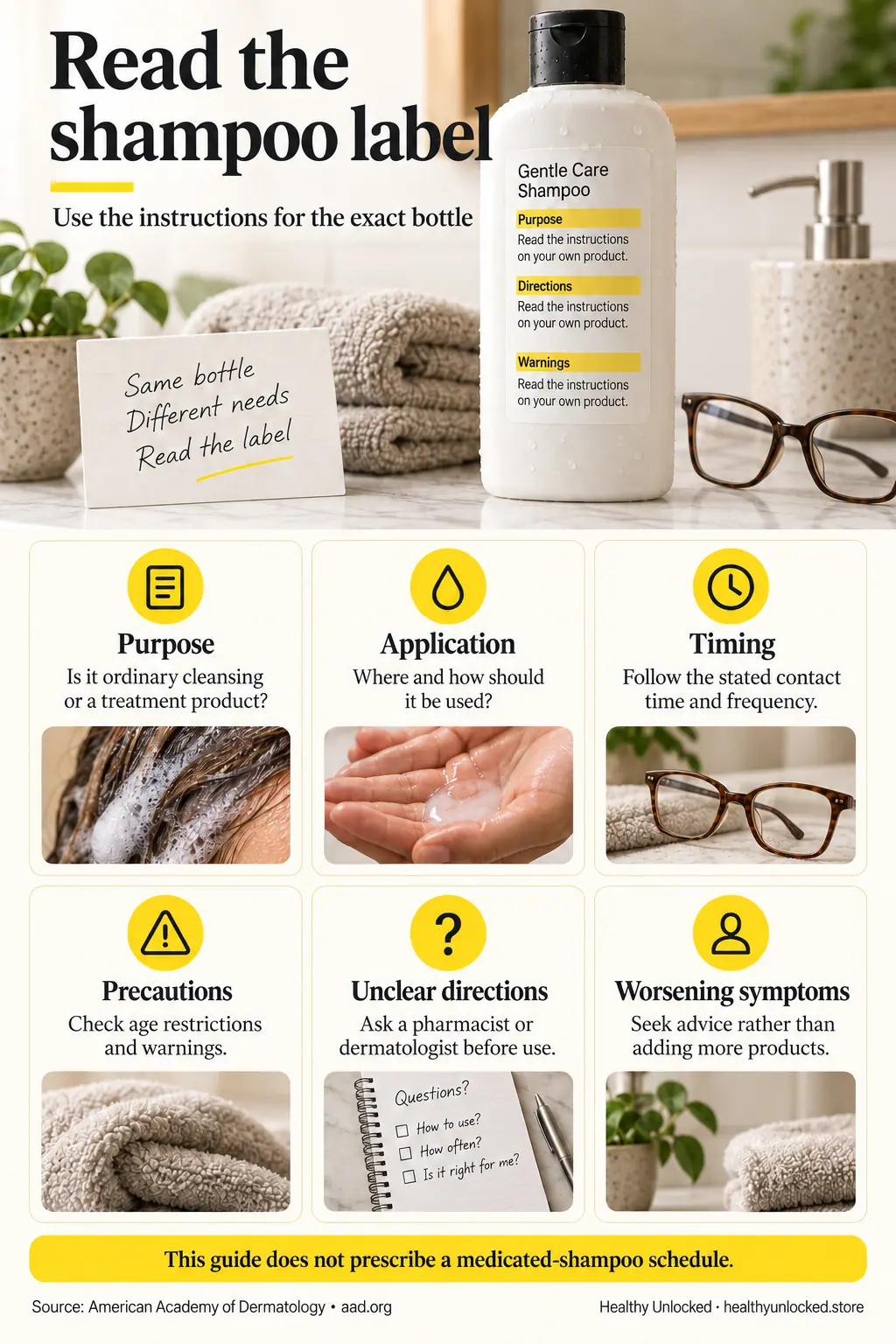
A dandruff shampoo is not interchangeable with every other shampoo on the shelf. Some contain active ingredients with specific directions or precautions. Read the label of the exact product in your hand. If you cannot tell whether it suits you, a pharmacist or dermatologist can help interpret the instructions and the reason for using it.
The AAD dandruff-care guidance discusses anti-dandruff shampoos and following their instructions. This guide does not assign a medicated ingredient, contact time or frequency to your symptoms. Those details depend on the actual product and individual circumstances; copying them from a different bottle can be a mistake.
Look for the product’s purpose, where it should be applied, whether it needs a stated contact time, how it should be rinsed, and what warnings apply. Also check age restrictions, expiry information and any instruction about contacting a professional. A treatment label is more important than the promise printed in large type on the front.
If the label calls for a timed step, use a simple timer rather than guessing or extending the time to make treatment “stronger.” If you are uncertain about instructions, ask before use. The observation planner below does not calculate a treatment schedule because a planner cannot supply product-specific or personal medical advice.
Do not stack multiple medicated shampoos, scalp solutions or medicines because each appears on a separate online list. The combination may be unnecessary or unsuitable. Tell the person advising you about everything you use, including products bought without a prescription and products described as herbal or natural.
| Label item | Question to answer | If unclear |
|---|---|---|
| Purpose and active ingredient | Is this ordinary cleansing or a treatment product? | Ask a pharmacist or clinician |
| Application instructions | Where and how should it be used? | Do not copy directions from another brand |
| Timing and frequency | What does this exact label say? | Do not create a schedule from the planner |
| Warnings and restrictions | Are there precautions relevant to me? | Discuss uncertainties before use |
| Response and follow-up | When does the label advise seeking help? | Seek care for worsening or concerning symptoms |
Natural does not mean reaction-free
An oil, essential oil or homemade mixture can still irritate skin or cause an allergic reaction. Avoid treating an internet recipe as a tested scalp treatment. Do not apply abrasive materials, undiluted essential oils or a mixture that burns, and do not use someone else’s prescription because their flakes looked similar.
The AAD guidance on testing new skin-care products explains cautious introduction of ordinary products. It is not a medical allergy test and does not establish that a product is safe for every part of the body. For a suspected reaction, get appropriate advice rather than performing a home challenge.
What else can cause an itchy or flaky scalp?
Scalp flakes can occur with conditions other than simple dryness or ordinary dandruff. Examples include seborrheic dermatitis, psoriasis, contact dermatitis and fungal infection of the scalp. Listing them is useful because it explains why persistent symptoms need assessment; it does not mean that you should test each possibility yourself.
The AAD overview of seborrheic dermatitis describes a condition that may involve the scalp and other areas. If you already have a diagnosis, ask how to manage the specific sites affected. Do not assume that a product recommended for one area belongs near the eyes or on every patch of irritated skin.
The AAD scalp-psoriasis resource provides a separate explanation of psoriasis on the scalp. Thick scale or discomfort can overlap with other conditions. A dermatologist may use the overall history and examination, not just the appearance of an isolated flake, to distinguish the problem and recommend care.
Contact dermatitis can follow irritation or an allergic response to something touching the skin. The NHS contact-dermatitis guide explains the condition more broadly. Record a new dye, styling product or treatment if relevant. Do not conclude that “chemical-free” marketing solves the issue, or assume that a product used before can never become a problem.
Scalp ringworm is a fungal infection, despite its name. The NHS ringworm resource explains why affected scalp skin may need medical treatment. Patchy hair loss or an unusual scalp change is a reason to seek assessment, not to keep switching cosmetic shampoos. Sharing combs or dismissing a suspected infection as ordinary dandruff can delay appropriate care.
A diagnosis can change the plan
A professional may ask about onset, products, symptoms elsewhere, medicines and previous skin conditions. They may examine the scalp and decide whether any further tests are needed. Do not assume that everyone needs a laboratory test, and do not assume that an examination alone will always answer every question.
If you receive a treatment plan, check that you understand the application steps and the follow-up. Ask what to do if discomfort increases or the expected improvement does not occur. Keep the written plan with the products so that a general routine checklist does not accidentally replace professional instructions.
When should you get professional help?
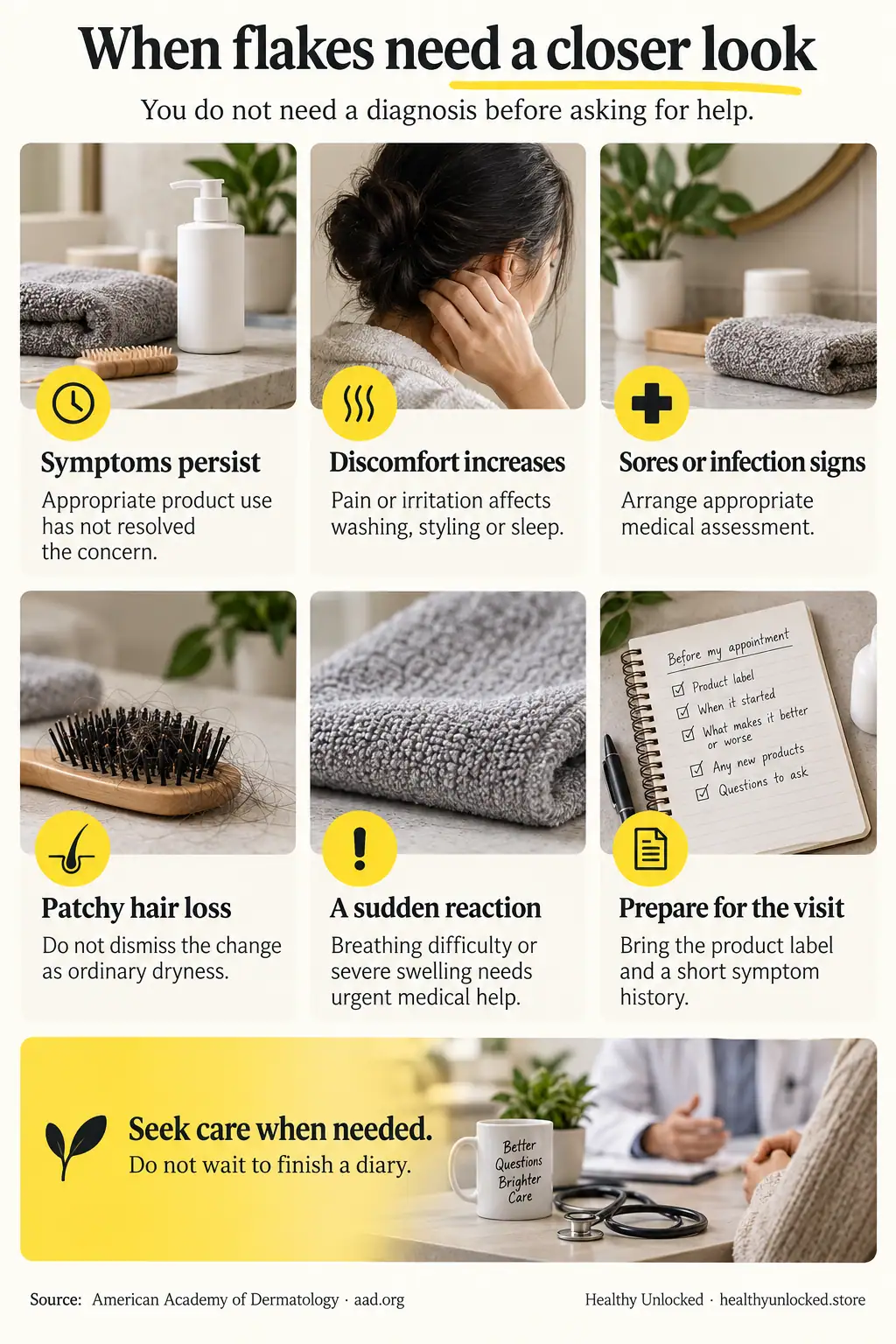
Seek professional advice when symptoms persist despite following appropriate product directions, become severe, or keep returning in a way that affects daily life. Also seek assessment for sores, notable pain, signs of infection or patchy hair loss. You do not need to identify the exact condition before asking for help.
The NHS dandruff guide and AAD treatment guidance explain getting help when ordinary dandruff care is unsuccessful or symptoms are concerning. A pharmacist may help with product instructions; a clinician can assess a diagnosis or a more complicated pattern. The appropriate service depends on the problem and local access.
If you develop difficulty breathing or severe swelling after using a product, seek urgent medical help. Stop treating that as a routine scalp-care problem. For other sudden or worsening reactions, get timely medical advice rather than covering the area with another product. Keep the packaging so you can explain what was used.
Discomfort that disrupts sleep, makes styling painful or leads you to avoid social situations is worth discussing even if the flakes look modest. Describe the impact plainly. The severity of a photograph does not decide whether you deserve help, and shame about visible flakes should not prevent an appointment.
If you are caring for a child, use age-appropriate professional advice rather than this adult routine as a treatment plan. Pregnancy, breastfeeding, other skin conditions and medicines can also affect suitable product choices. Mention relevant circumstances to the person advising you without posting them in a public comment.
Prepare one clear question
A concise opening helps: “I have had flakes and discomfort for this long, I tried this product as its label says, and this is what changed.” Bring the bottle or a readable label photograph. Then ask what the likely causes are, whether examination is needed, and what follow-up should happen if the proposed plan does not help.
Before leaving, repeat the key instructions in your own words. Ask how the plan fits your hair texture and styling practices. If you did not understand a term, request an explanation rather than guessing later. An appointment is more useful when the next step is clear and practical.
What should you record before an appointment?
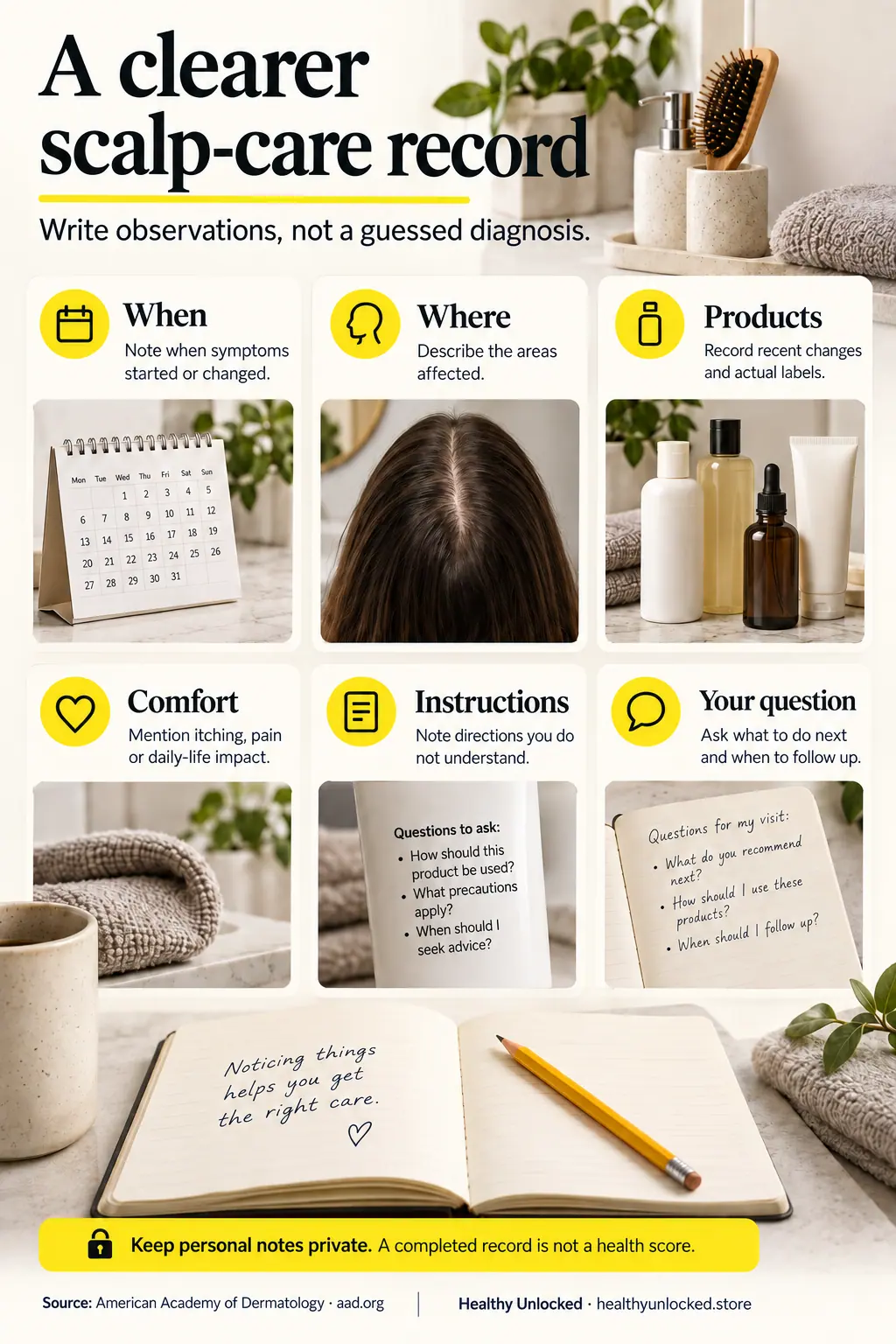
A short observation record can organize details that are easy to forget. Note the date, a relevant symptom or change, the product used, whether you followed its instructions, and what you want to ask. Avoid assigning a disease name unless a professional has diagnosed it. Keep a distinction between “noticed” and “confirmed.”
Use a format you can maintain without turning care into a daily examination project. A few notes around a change may be enough for a conversation. If a clinician asks for a particular record, follow that request. This article does not require a fixed number of days or promise that a complete diary will reveal the cause.
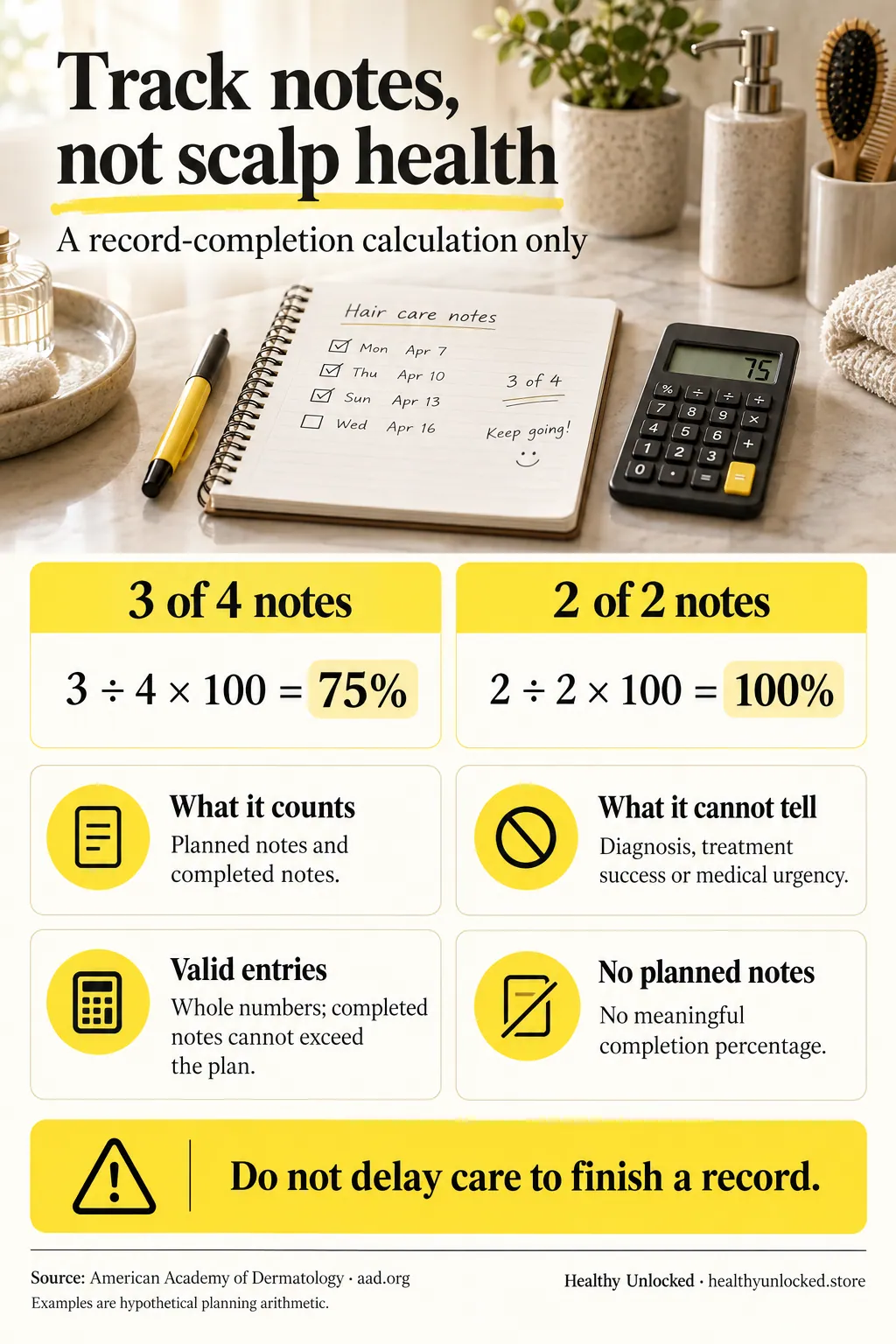
Example one: on Monday, you choose four observation dates during a week. By the end of the week, you have made three notes. Three divided by four, multiplied by 100, equals 75% of the planned notes completed. That percentage describes record completion only. It does not mean the scalp is 75% healthy, or that a treatment is 75% effective.
Example two: you choose two dates before a follow-up and enter a note on both. Two divided by two, multiplied by 100, equals 100% completion. The record could still describe worsening symptoms. Completion and clinical improvement are separate concepts; the planner intentionally avoids converting the former into a health score.
Do not delay care to finish the record. If a concerning symptom develops, seek advice and bring whatever information you already have. A useful note is one that helps the conversation now, not a perfectly completed spreadsheet that keeps you waiting.
| Entry | What was noticed | Useful follow-up question |
|---|---|---|
| Example date 1 | A new product was introduced; scalp felt uncomfortable afterwards | Could the product or its use be relevant? |
| Example date 2 | Washing instructions were checked; one detail was unclear | Can you explain this label instruction? |
| Example date 3 | The same concern continued | Should this be examined rather than changing another product? |
| Private notes | Product name, timing and meaningful change | What is the next step and when should I follow up? |
Keep personal information private
Store notes on paper or on a device you control. Do not include your full name, address, medical record number or scalp photographs in a public comment. If you use an online app, review its permissions, storage and sharing policy before entering health information. A convenient interface is not proof of privacy.
The worksheet download provides a starting structure and space for notes. It does not send the information to an author or clinician. Share a relevant summary through an appropriate care channel if you choose, and avoid assuming that posting a comment creates a private medical consultation.
Try the scalp-care observation planner
The scalp-care observation planner counts planned and completed notes. It helps you organize a brief record before a conversation; it does not recommend medicine, identify a skin condition or judge whether you can safely wait. Choose a number of notes that serves your purpose rather than trying to earn a perfect score.
The calculation is completed notes divided by planned notes, multiplied by 100. Planned notes must be a positive whole number, and completed notes must be a whole number between zero and the planned number. Missing or invalid values should produce an explanation, not a believable-looking percentage. With zero planned notes, there is no meaningful completion percentage.
For a hypothetical plan of five notes and two completed entries, the result is 2 ÷ 5 × 100 = 40%. That is a record-keeping subtotal. The tool does not know whether the symptoms improved, whether a product was used correctly, or whether the person needs urgent care. No clinical thresholds are attached to the result.
Use the result to decide what information you still want to bring, not whether you deserve an appointment. Resetting clears the form on this page. The download includes the observation structure and examples so you can work offline. If you return to the page, do not assume the tool stores a private health history.
The product-label section remains the place to check what questions to ask about a bottle. The professional-help section explains why a concerning change should override a plan to keep observing. A tool makes arithmetic easier; it does not replace the judgment involved in care.
Count prepared scalp notes
3 of 4 = 75%; 2 of 2 = 100%. Note completion only, not diagnosis.
3 of 4 = 75%; 2 of 2 = 100%. Note completion only, not diagnosis.
Calculations use this page’s entries in your browser; they do not save or send them to a Healthy Unlocked server. Keep downloaded files private as needed.

Download and use the worksheet
Open the scalp-care observation worksheet in a spreadsheet program or use its headings on paper. Keep the hypothetical entries separate from your own notes. Enter only details you are comfortable storing, and bring a concise summary to the appointment instead of expecting a clinician to interpret every daily entry.
For ordinary beard care, our journal’s everyday-care articles offers related cleaning and grooming ideas. A beard routine is a separate topic: it should not be used to diagnose a scalp problem or transfer a treatment to a different body area.
Common questions about scalp flakes
These answers summarize the guide. They cannot identify the cause of an individual scalp change or replace product-specific advice.
Can I tell dry scalp from dandruff by looking at flakes?
Not reliably. Flake size, color and oiliness can overlap, and other skin conditions can also cause flaking. Describe what you notice, read product directions, and seek assessment for persistent or concerning symptoms.
Does dandruff mean I am not washing enough?
No. Dandruff is not a measure of cleanliness and can recur despite regular washing. Hair-care habits may matter, but harsh scrubbing or repeated washing is not a universal solution.
Should I use oil on every dry-looking scalp?
No. A dry appearance does not establish the cause, and an oil can irritate skin or be unsuitable for the situation. Ask for advice if you are unsure, especially when the scalp is sore or symptoms persist.
How long should I leave a dandruff shampoo on?
Follow the instructions on the exact product you use or your clinician’s plan. Contact time and frequency differ. This guide and its planner do not create a medicated-shampoo schedule.
When should I see a professional about flakes?
Seek advice for symptoms that persist, become severe or recur with significant discomfort. Sores, notable pain, signs of infection or patchy hair loss also deserve assessment. Breathing difficulty or severe swelling after a reaction needs urgent help.
Does the observation planner diagnose my scalp condition?
No. It calculates the percentage of planned notes you completed. It does not measure scalp health, treatment success or urgency, and you should not delay care to finish the record.
Your next step: describe the change in one sentence, check the products you are already using, and choose an appropriate question for a pharmacist or clinician. A calm, clear record is more useful than guessing from a flake chart.
About this article
By Yashveer Bharani for Healthy Unlocked. This educational guide separates ordinary care, observations and clinical assessment. Links point to dermatology and health-service guidance; no institution is claimed to have reviewed or endorsed this article.
The planner percentages are hypothetical arithmetic for record completion, not diagnostic scores. Visuals explain concepts and do not document examinations, laboratory tests or hands-on product trials. Individual product directions and professional advice take precedence over a general routine.
Sources and further reading
These original references support the guidance and its limits. A link does not mean that the institution reviewed or endorsed this article.
Practical reference
Context and definitions
Safety and care
Evidence and limitations
Further reference
 Healthy Unlocked
Join the conversation
Share a practical idea or ask a question about this guide. Please keep personal medical details private.