
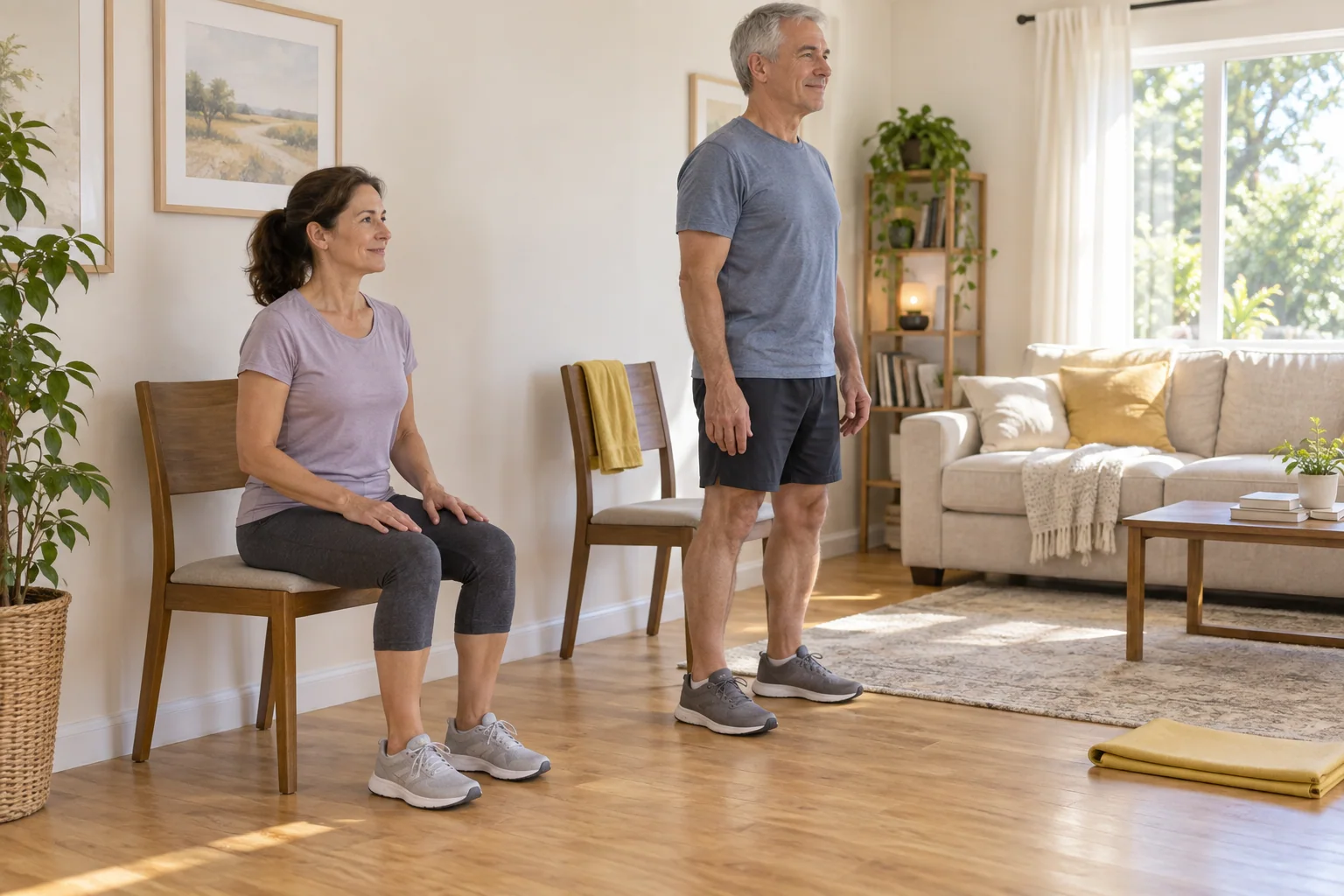
Summary
Strength training at home can begin with bodyweight movements and stable household support. Learn controlled sit-to-stands, wall press-ups and other manageable movements before adding repetitions or difficulty. A short starting routine can help you practice, but it is not automatically a complete program for every major muscle group.
This guide helps you organize a practical start without buying weights. You will find technique notes, five comparison tables, a sample weekly structure and a planner that adds up repetitions. Use the examples to understand planning, rather than treating a larger total as a better workout.
What you’ll understand
- Start with control. Use a comfortable range and steady movement before increasing quantity.
- Check your support. A solid chair and sound wall matter more than improvised equipment.
- Plan recovery. Leave recovery time between harder sessions for the same muscles.
- Separate activity types. Walking and strengthening support different parts of a weekly plan.
- Notice warning signs. Sharp pain, fainting or chest symptoms are not targets to push through.
- Read the total correctly. Repetitions do not measure load, calories or medical suitability.
Start with these steps
- Clear your space and choose stable support.
- Learn a small number of comfortable movements.
- Pick manageable days and include rest.
- Record what you did, then change one part at a time.
This is general education, not rehabilitation or medical clearance. Stop a movement that causes sharp or worsening pain. Chest pain, fainting or severe unusual breathlessness need urgent assessment.
What counts as strength training at home?
Strength training asks muscles to work against resistance. That resistance may come from your bodyweight, a wall, suitable equipment or added weights. For a beginner, the useful question is not whether a room looks like a gym. It is whether the movement is controlled, appropriate to your ability and organized in a way you can repeat.
Public recommendations are a destination to build toward, rather than a demand to copy a demanding workout on your first day. CDC adult activity guidance includes muscle-strengthening work on at least two days a week, alongside aerobic activity. The strengthening component should involve the major muscle groups. A few lower-body movements alone do not meet that whole description.
Bodyweight work is a useful entry point, but “no equipment” does not mean no thought about support. A stable chair can make a sit-to-stand manageable. A sound wall can provide a gentler press-up than a floor variation. You are using ordinary surroundings for controlled movement, not turning loose furniture into exercise equipment.
An exercise can be easy for one person and demanding for another. Previous activity, balance, comfort and health affect your starting point. A repetition count seen online is not a measurement of your readiness. Choose a starting amount you can perform steadily, with a range that feels comfortable, and allow time to learn the movement.
Walking and strengthening are both useful, but they do different jobs. A walk is not automatically a substitute for training all major muscle groups, and a set of wall press-ups does not automatically provide your weekly aerobic activity. You can organize both without making every session long or turning every day into a hard workout.
| Activity | What you organize | What it does not prove |
|---|---|---|
| Strengthening | Controlled resistance for relevant muscle groups | Any repeated movement is a complete whole-body program |
| Aerobic activity | Activity and effort sustained over time | Walking minutes equal strength-training sets |
| Balance practice | Safe support and steadiness appropriate to you | One difficult pose establishes medical readiness |
| Mobility work | Comfortable movement through a suitable range | Stretching treats every cause of pain |
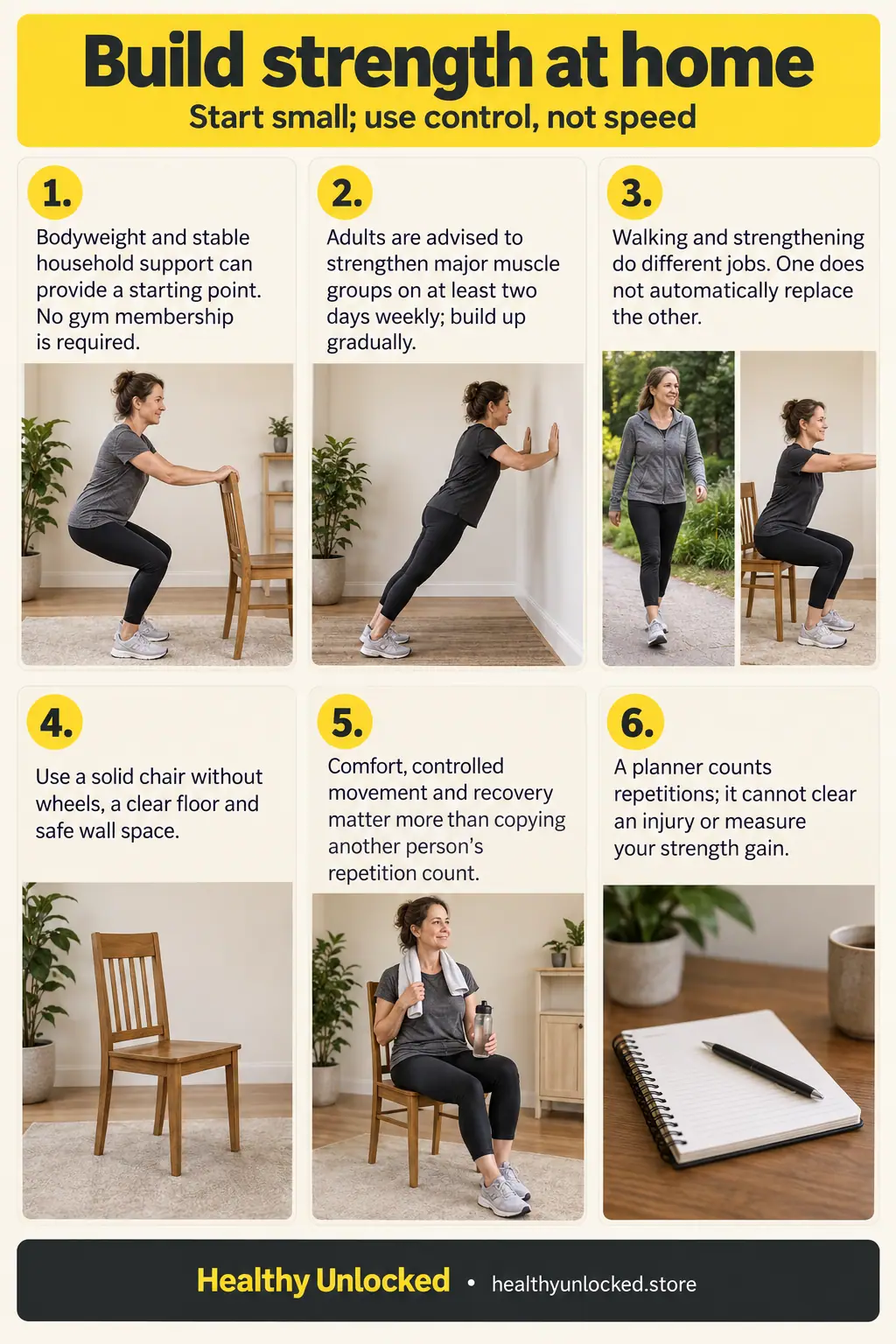
A small start can be useful without being a complete program
The movements below introduce simple patterns and stable support. They are not presented as a full replacement for every form of resistance training. Working the back, shoulders and other areas may need additional appropriate movements or guidance. Do not invent unsafe doorframe pulls or furniture anchors simply to make a routine sound equipment-free.
If you are also beginning ordinary walking, our beginner walking guide explains how to organize manageable minutes. Keep the two records separate: walking time describes duration, while a strength log records movements, sets and repetitions. Neither number by itself establishes exercise intensity or personal medical suitability.
Set up a safer space before you start
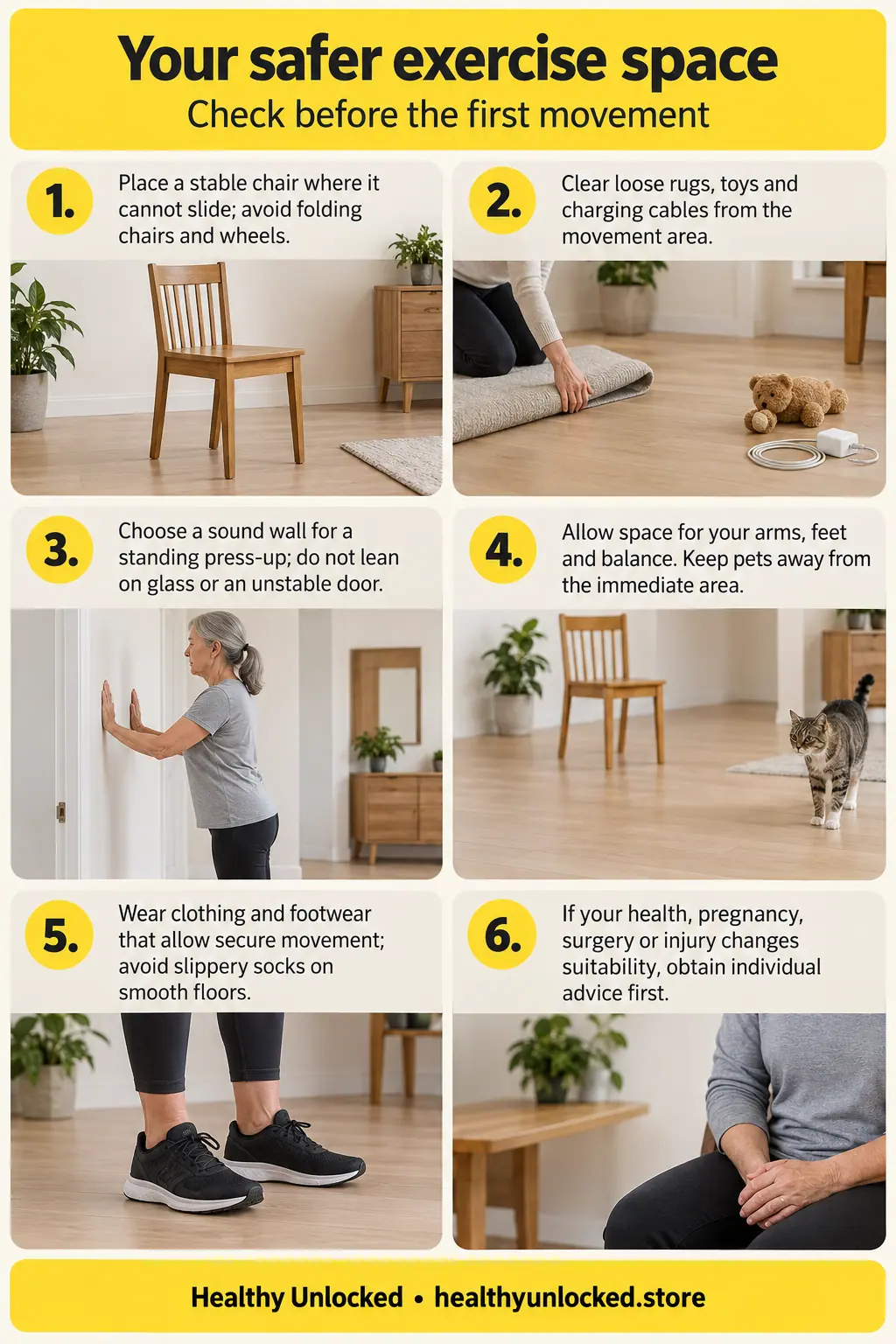
A safer starting space has a clear floor, dependable support and enough room to move without knocking into furniture. Check it before your first repetition. Moving a rug or a charging cable takes little time, but trying to avoid it halfway through a movement can disturb your balance.
Choose a solid chair without wheels. Avoid a folding chair that may close, a lightweight stool that may tilt, or a soft seat that sinks unexpectedly. Position the chair so it cannot slide during the movement. Test the setup gently first rather than assuming that something strong enough for sitting will be stable in every direction.
A wall press-up needs a sound wall and secure footing. Do not lean into glass, a loose partition or a door that could open. Leave enough space for your elbows and feet. Adjust your distance only within a range that lets you remain controlled. A larger lean is not a useful achievement if your position becomes unstable.
Wear clothing that allows movement and footwear appropriate to the surface. Slippery socks on a polished floor are a poor match for an exercise that asks you to control a lean. Clear toys, pets and loose household objects from the immediate area. You should not need to step around surprises while concentrating on technique.
Allow time for preparation, a gentle warm-up, rest and putting things away. A video labeled five minutes may not include those parts. If the available time is short, choose fewer appropriate movements rather than squeezing a rushed circuit into the same window. Keep a drink available if useful, and choose a comfortable, ventilated area.
| Check | A practical choice | Avoid |
|---|---|---|
| Chair | Solid, stable and without wheels | Sliding, folding or tilting support |
| Wall | Sound surface and clear space | Glass, an unstable door or loose partition |
| Floor | Dry surface with obstacles removed | Loose rugs, cables and slippery socks |
| Room | Space for arms, feet and balance | Pets or objects moving through the exercise area |
| Schedule | Preparation and recovery time included | Finishing a target by rushing technique |
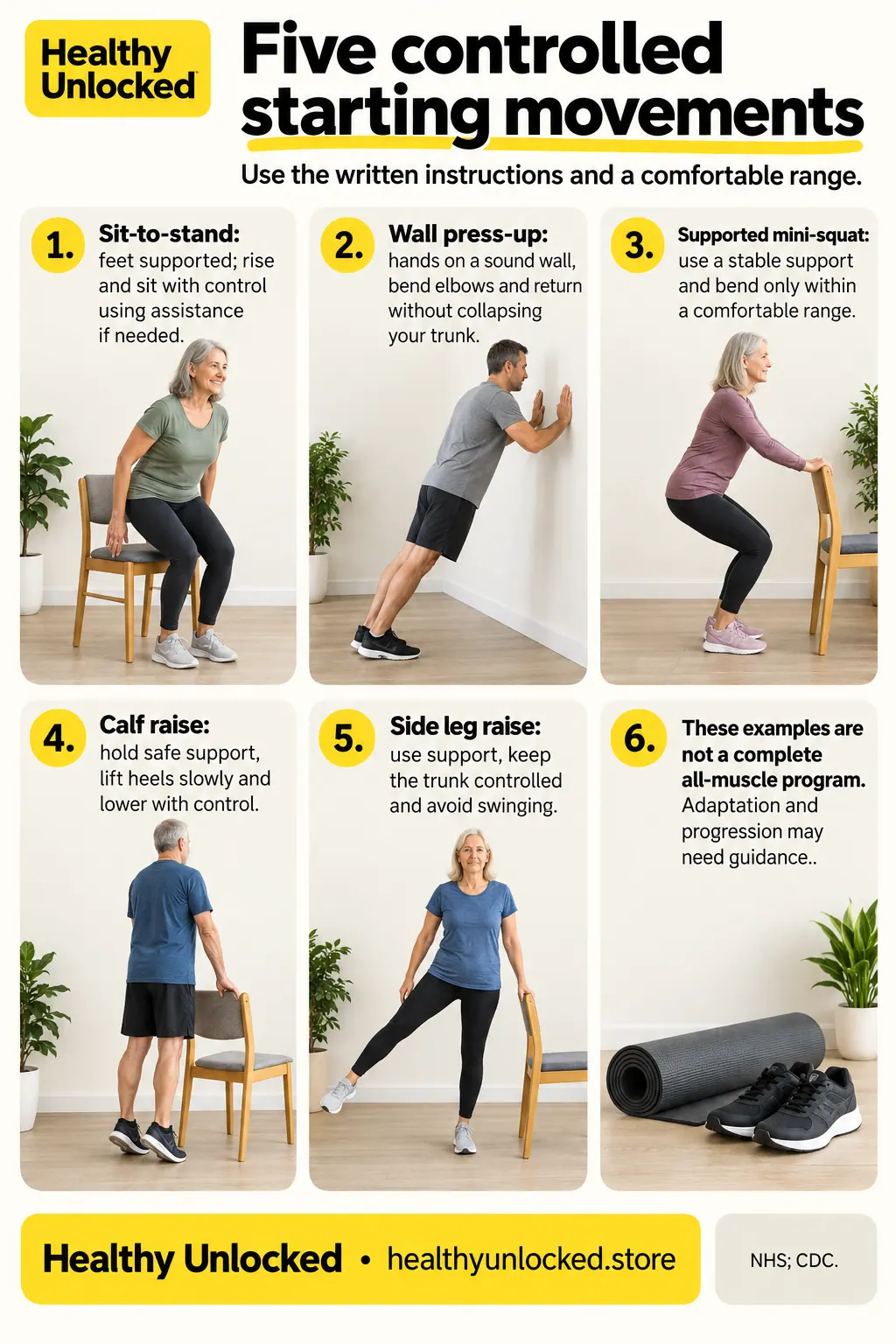
Five controlled movements to learn first
The following movements are described as learning examples. Start with an appropriate number of controlled repetitions, not a competition against the clock. NHS strength exercise guidance provides accessible starting movements and illustrated instructions. Read the whole instruction for a movement; its name alone does not explain how to set it up.
Sit-to-stand. Use a stable chair, place your feet securely and lean slightly forward as appropriate. Rise using your legs, with assistance if needed, then sit back down with control. Avoid dropping into the chair. A comfortable seat height and suitable support matter more than achieving a low seat for the sake of difficulty.
Wall press-up. Place your hands on the wall and choose a stable standing position. Bend your elbows to move toward the wall, then return while keeping your trunk controlled. Do not collapse through the middle or push your body into an unstable lean. A smaller comfortable movement is a sensible learning step.
Supported mini-squat. Hold stable support and bend your knees only as far as is comfortable. Move with control, then return to standing. You do not have to reach a deep position to prove effort. If support moves or the movement produces sharp pain, stop and change the situation rather than continuing the repetition count.
Calf raise. Hold appropriate support, lift your heels slowly and lower them steadily. Avoid bouncing or rushing through a range you cannot control. Keep your surrounding space clear. Balance can be more challenging than the movement first appears, so suitable support is a practical part of the exercise.
Side leg raise. Use stable support, keep your trunk controlled and move a leg to the side without swinging. Return with control. Notice whether you are leaning or using momentum to produce a larger movement. A modest range with steadiness is more useful than a dramatic movement that pulls you off balance.
| Movement | Useful focus | A common problem | Planning limit |
|---|---|---|---|
| Sit-to-stand | Controlled rise and return | Dropping into the seat | Seat height changes difficulty |
| Wall press-up | Steady trunk and secure feet | Leaning on an unstable surface | Distance from wall changes effort |
| Mini-squat | Comfortable range with support | Forcing depth or losing steadiness | Depth is not a universal target |
| Calf raise | Slow lift and lowering | Bouncing or removing needed support | Balance affects suitability |
| Side leg raise | Controlled trunk and return | Swinging to increase the range | State whether counts are per side |
Learn the easier version before making it harder
An easier version is a way to practice a movement, not a lesser category of exercise. Support, range and positioning can make a substantial difference. If you cannot perform a variation steadily, changing it is more useful than performing several uncontrolled repetitions. A qualified professional can help when you are unsure which adjustment suits you.
A photograph or video demonstrates one person, one setup and one moment. It does not examine your balance, joint symptoms or medical history. Watch for the basic idea and the points of control, then keep the movement appropriate to your situation. Do not copy a dramatic range simply because it looks more impressive on a screen.
Build a weekly plan you can repeat
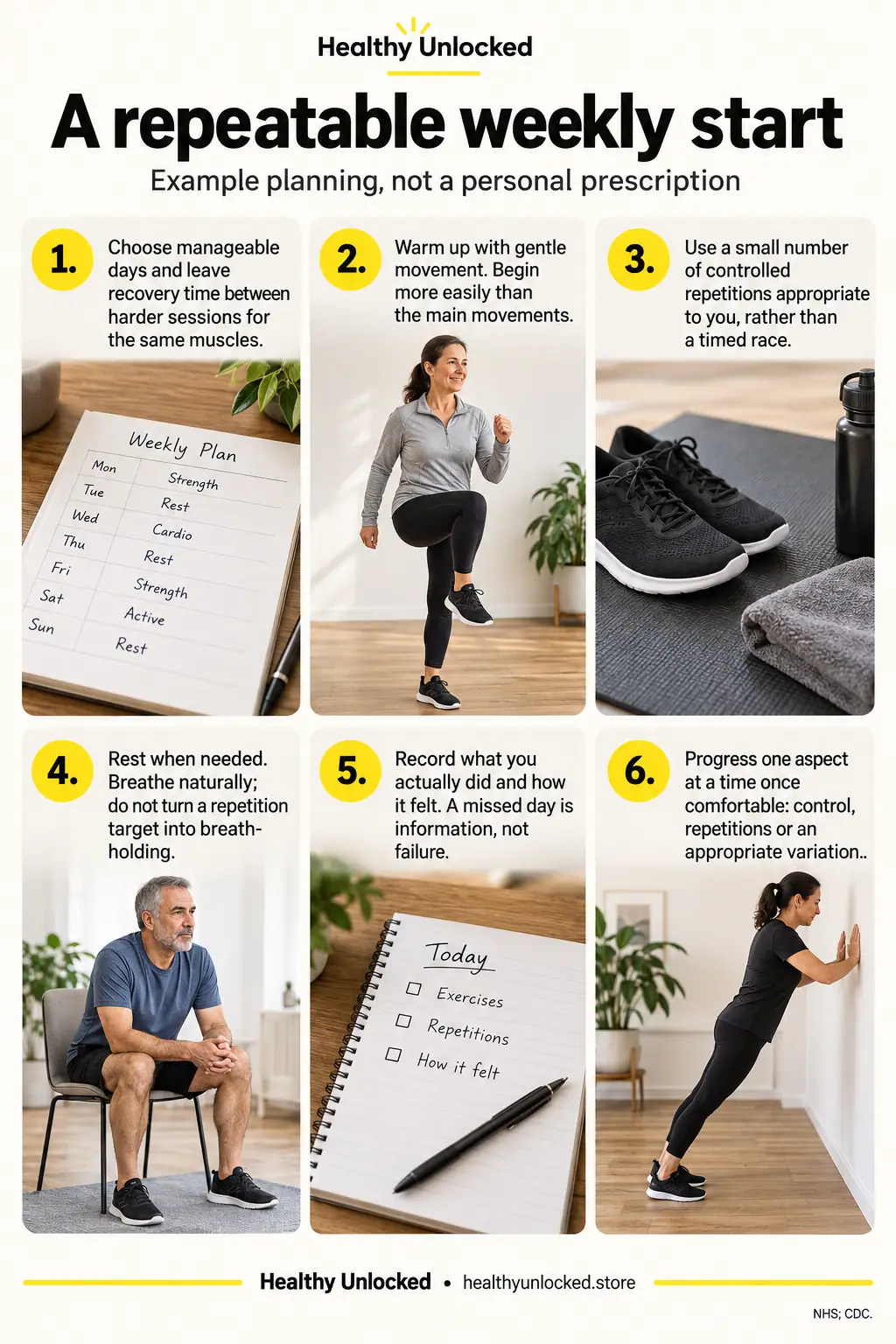
A repeatable plan puts activity into real days with room for recovery. Begin with a manageable amount and build gradually. The Physical Activity Guidelines for Americans explain gradual progression from current activity. A broad weekly recommendation does not set an identical first-session dose for every beginner.
Choose days that fit your schedule and allow recovery between harder work for the same muscles. For example, someone may use two separated days for practice rather than two demanding sessions back to back. This is a way to think about spacing; the exact arrangement depends on the activities, their difficulty and individual circumstances.
Keep the opening session deliberately understandable. Warm up with gentle movement, practice the chosen exercises, rest when needed and finish without rushing. Natural breathing and controlled technique take priority over a target on a worksheet. If you need assistance or a smaller movement range, organize that before beginning.
Use a log that records the actual movement and amount, rather than only checking “workout done.” An entry such as one set of five controlled sit-to-stands is more informative than a vague completion tick. Also note whether you used support and whether anything was uncomfortable. These details help you decide what to repeat or discuss.
A missed day gives information about the plan. Perhaps the time was unrealistic, the space was unavailable or the session was harder than expected. Adjust the next arrangement without trying to repay the missed session with an unusually demanding one. A plan that survives ordinary life is more useful than a perfect-looking timetable you cannot follow.
| Part of the week | Possible planning choice | Important qualification |
|---|---|---|
| First chosen day | Gentle preparation and a small practice session | Select movements and amounts suited to you |
| Between sessions | Ordinary activity and recovery | Walking does not erase a need for muscle recovery |
| Second chosen day | Repeat an appropriate practice session | Avoid copying a harder session just to raise the total |
| End-of-week check | Review comfort, actual sets and practical barriers | A checklist is not a clinical fitness assessment |
| Next week | Repeat or change one manageable aspect | Progress only when control and comfort support it |
Progress without turning exercise into a race
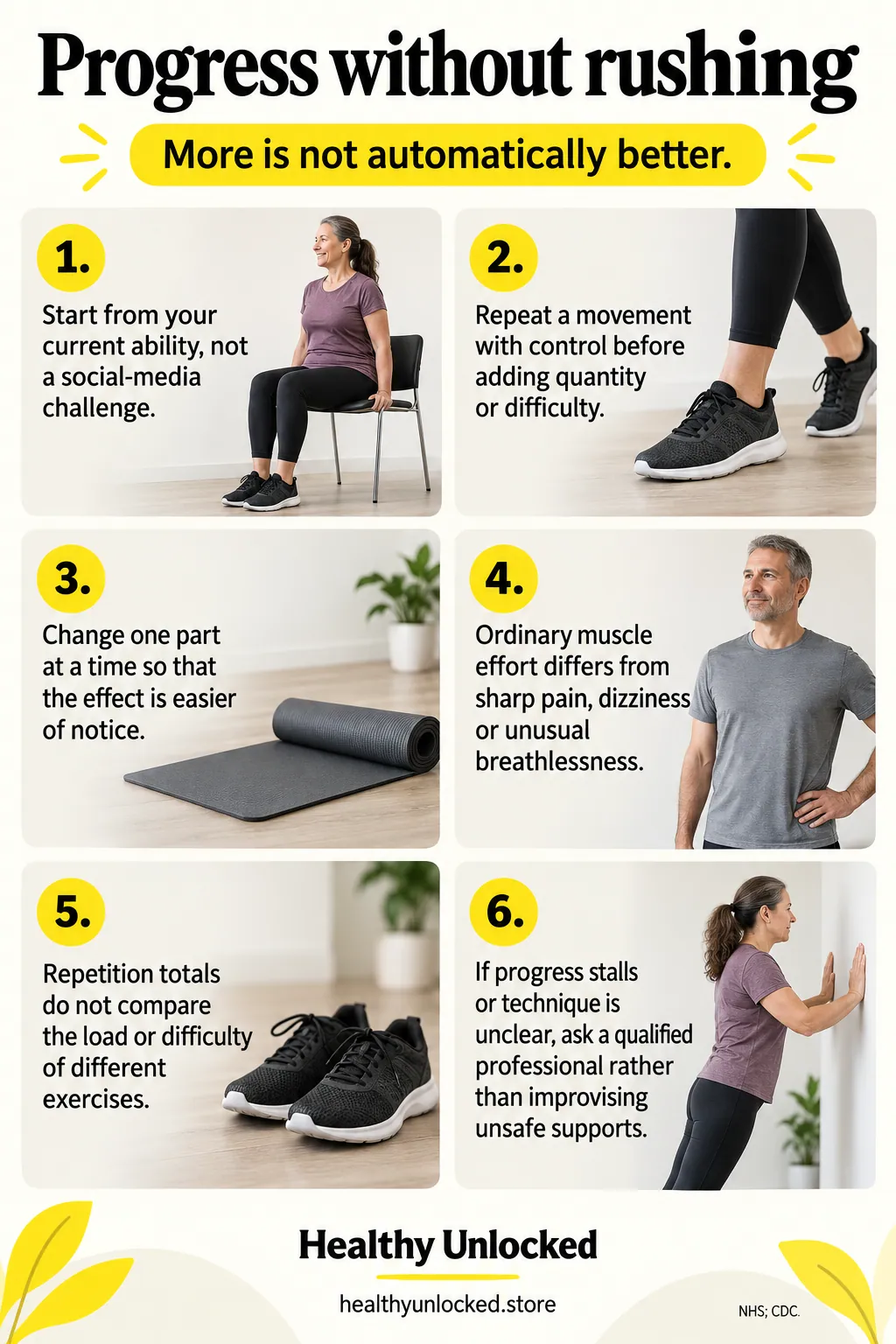
Progress can mean a steadier movement, less unnecessary momentum, a more consistent schedule or an appropriate change in quantity. It does not always mean doubling repetitions. Before making a movement harder, ask whether you can perform your current version with control and whether you recover comfortably afterward.
Change one part at a time. You might practice a movement more smoothly, add an appropriate repetition, or use a suitable variation when ready. Increasing repetitions, sets, range and difficulty together makes it harder to understand which change caused a problem. Small decisions make the next session easier to interpret.
Repetitions describe quantity, not equivalent training load. Five wall press-ups and five sit-to-stands are not interchangeable units of effort. A change in support, range or body position also changes the task. Do not compare two people by adding their totals and declaring the larger number stronger or more disciplined.
The NHS explanation of strength and flexibility work helps distinguish these components. Consider a wider program when appropriate, rather than expecting a handful of starting exercises to cover every need indefinitely. A qualified instructor can help you expand the routine without improvised equipment or poorly understood movements.
If a movement remains uncomfortable or confusing, pause progression and seek guidance. Repeating a problematic motion more often is not necessarily practice that helps. Your log should make a conversation clearer: what you did, which variation you used, what changed and when the discomfort appeared.
Two worked planning examples
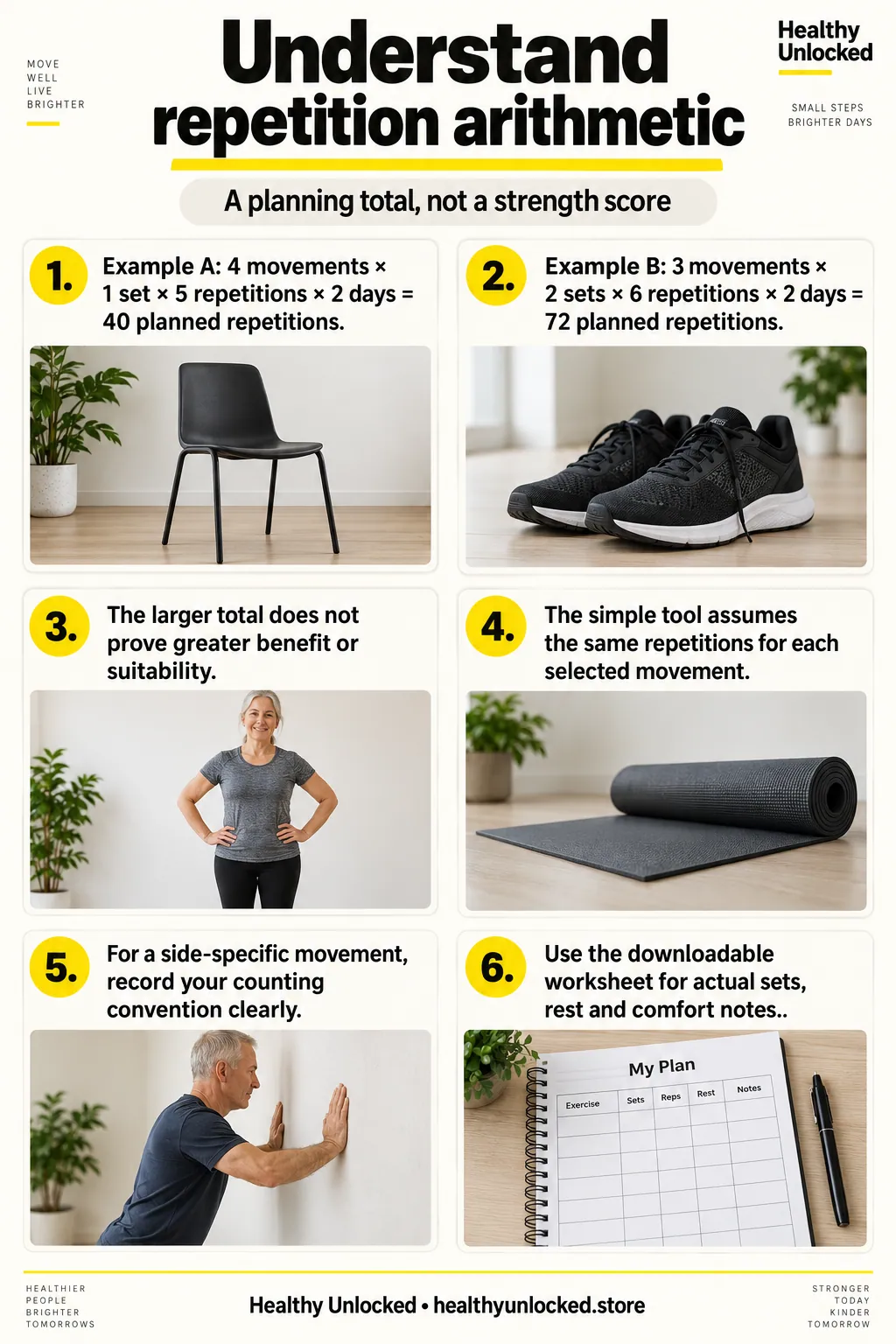
Example A: learning a small routine. Alex selects four appropriate movements, one set of five repetitions for each, on two planned days. The arithmetic is 4 × 1 × 5 × 2 = 40 planned repetitions for the week. This is an example of the planner’s calculation, not a prescription to perform four particular exercises regardless of comfort.
Example B: a different arrangement. Jordan enters three movements, two sets of six repetitions each and two days. The result is 3 × 2 × 6 × 2 = 72 planned repetitions. That larger number does not prove a better workout than Alex’s. The people, exercises, support and effort can differ. Neither total includes preparation, rest or a clinical assessment.
Rest, recovery and ordinary muscle effort
Recovery belongs in the plan from the beginning. Muscles working harder than usual may feel tired or sore afterward, but a general article cannot identify the cause of your pain. Sharp, worsening or concerning symptoms should not be dismissed as proof that a workout is effective.
Keep a simple note of how the session felt and how you felt afterward. Record a relevant discomfort plainly rather than labeling it with a diagnosis. “Pain while lowering into the chair” is more useful than deciding on a medical explanation from a search result. Persistent symptoms deserve appropriate advice.
Daily activity, meals and sleep also form the context around exercise. Our guide to protein and fiber foods explains ordinary meal combinations without turning food into a fixed muscle-building prescription. A workout planner does not calculate your nutrition needs, and a bigger repetition total does not require buying a supplement.
Rest within a session when needed. Keeping good control is more useful than compressing every set into a short time. Avoid holding your breath to finish a count. If you feel dizzy, unusually breathless or unwell, stop rather than trying to turn the interruption into a test of determination.
Look at the week as a whole. Several separate activities can add demand to the same muscles, even if only one is called a strength workout. Carrying heavy objects, an unfamiliar job task or another training session may affect recovery. A timetable is easier to use when it reflects what you actually did, not only the exercise you planned.
When to pause or ask for individual advice
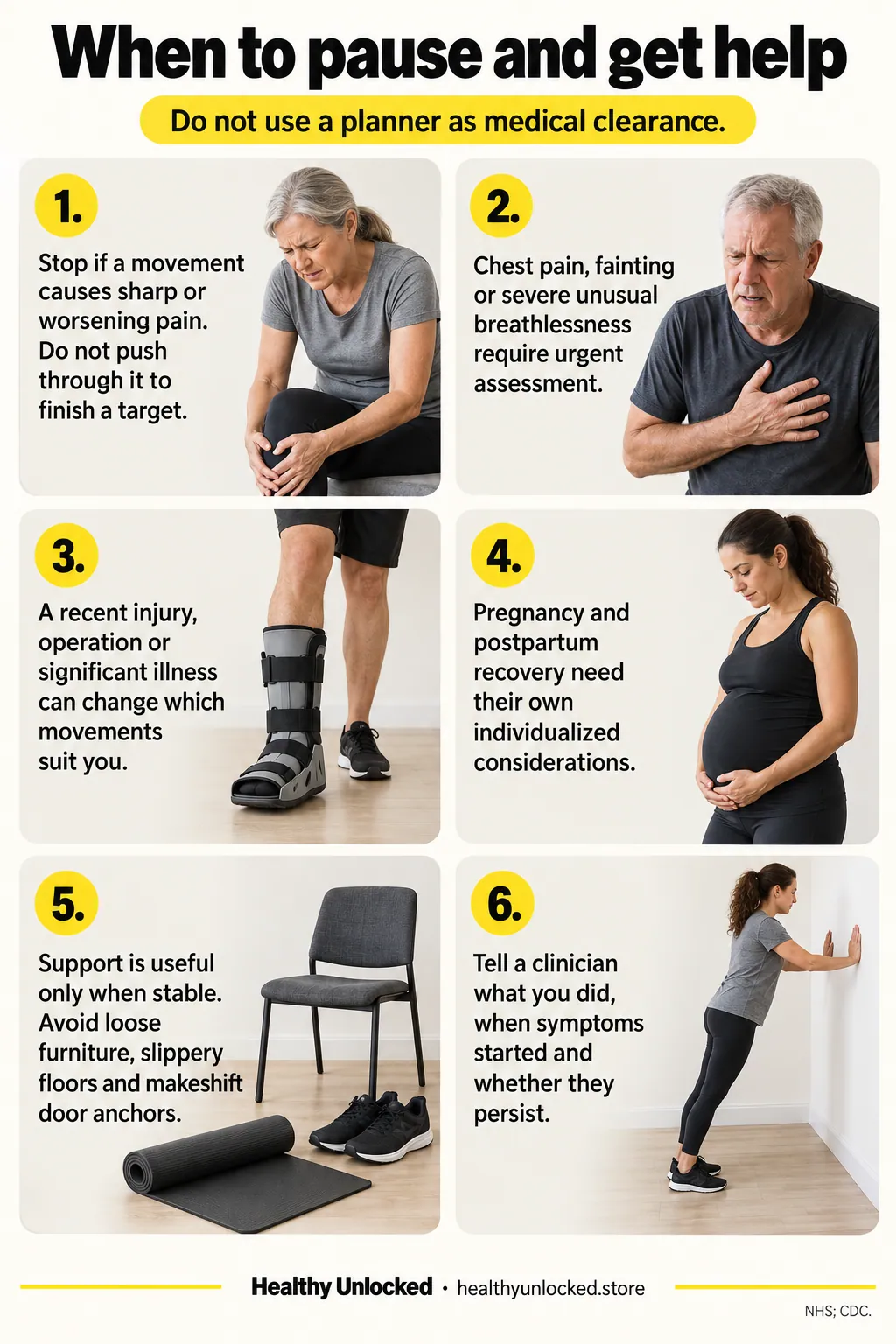
General starting movements are not personal medical clearance. Recent injury or surgery, significant illness, pregnancy, postpartum recovery or a condition that affects balance or exercise tolerance can change what is appropriate. Ask a qualified health professional when you are unsure, rather than relying on a planner to approve your session.
Stop a movement that causes sharp or worsening pain. Chest pain, fainting or severe unusual breathlessness require urgent assessment. Do not continue simply because an application shows repetitions left. The amount you intended to do is less important than responding appropriately to what is happening.
If you already have instructions from a clinician or physiotherapist, follow that individual guidance. A general routine on the internet should not replace a rehabilitation plan or encourage you to ignore a restriction. Bring the proposed exercise and its setup to the professional if you want to discuss whether it fits.
Check support every time the situation changes. A chair can move between sessions, a floor can become wet, and a pet can enter the space. Household familiarity does not establish exercise safety. A brief setup check is an ordinary practical step, not a reason to become anxious about every movement.
When asking for help, describe the activity, your support, the amount you attempted and any symptoms. NHS exercise resources provide broader starting information, while individual advice addresses your circumstances. Neither a video nor a comment section can assess a new symptom properly.
Use the repetition planner and worksheet
The repetition planner multiplies the number of movements, sets, repetitions per set and selected days. It assumes you use the same set and repetition arrangement for every entered movement. This makes a small example easy to calculate, but it does not describe a more complicated workout accurately without additional notes.
The calculation is movements × sets × repetitions × days. It does not include exercise duration, rest, load, intensity, calories, muscle growth or medical suitability. A number such as 40 is a planned repetition count, not a fitness score or a promise of a particular outcome.
For a side-specific movement, state your counting convention. Five repetitions per side differs from five repetitions across both sides. Use the worksheet to record each side clearly where relevant. The simple total cannot decide that convention for you, and it should not hide the difference.
Enter whole numbers within the displayed planning limits. Blank fields or unsupported values need correction before a total is shown. The input limits organize a small example; their existence does not mean every amount inside them is appropriate for everyone. Use comfortable, suitable movements and individual guidance when needed.
You do not need to enter your name, bodyweight or medical symptoms to use the tool. The calculation runs in the page for practical planning. Keep private health information out of public comments. A worksheet can remain on paper or your own device if you prefer not to type information anywhere.
| Example | Inputs and arithmetic | What the result means |
|---|---|---|
| First example | 4 × 1 × 5 × 2 = 40 | Planned movements × sets × repetitions × days; same repetitions assumed for each movement. |
| Second example | 3 × 2 × 6 × 2 = 72 | A larger count does not establish greater benefit. Label per-side counting separately. |
Try the repetition planner
Multiply planned movements, sets, repetitions and days. This does not measure load, calories, strength gains or medical suitability.
Example: 4 movements × 1 set × 5 repetitions × 2 days = 40 planned repetitions. Count each side explicitly when relevant.
Entries stay on this page. The tool does not save or transmit your health information.
Use the same method without JavaScript
If the interactive tool is unavailable, write the four inputs on paper and multiply them. Four movements × one set × five repetitions × two days equals 40. Keep the actual movement names, support and comfort notes beside that calculation so the number does not become detached from what you planned.
Download the home strength-training worksheet to record movements, sets, repetitions, rest and practical notes. The blank worksheet has no diagnoses or automated exercise clearance. Its purpose is to make your plan easier to review and, if useful, easier to discuss with a qualified professional.
Common questions about home strength training
These answers explain general planning. They do not replace individual advice about an injury, a health condition or a movement that causes symptoms.
Can a beginner start strength training at home without weights?
Yes. Appropriate bodyweight movements and stable support can provide a starting point. Learn controlled movements and build gradually. A short set of examples is not automatically a complete program for every major muscle group, and health circumstances may require individual advice.
How many days a week should I plan strengthening?
General adult guidance includes muscle-strengthening activity on at least two days a week. Build toward recommendations from your current ability and leave recovery time between harder work for the same muscles. The recommendation does not set an identical first-session dose for everyone.
Are wall press-ups easier than floor press-ups?
A wall variation can offer a more manageable starting position, but difficulty still depends on your setup and ability. Use a sound wall, secure feet and a controlled trunk. Do not move farther away just to increase effort if control becomes poor.
Does walking replace strength training?
Not automatically. Aerobic activity and muscle-strengthening work address different parts of general adult activity guidance. You can include both in your week. Walking minutes do not establish that all major muscle groups received appropriate resistance work.
Should I keep exercising through pain?
Do not push through sharp or worsening pain to finish a target. Stop and seek appropriate advice when symptoms are concerning or persistent. Chest pain, fainting or severe unusual breathlessness require urgent assessment, regardless of the remaining repetition count.
Does the repetition planner measure workout quality?
No. It multiplies movements, sets, repetitions and days under a simplified assumption. It does not measure load, technique, recovery, calories or medical suitability. A larger total does not establish a better or safer workout.
Your next step: choose a clear space, stable support and a small number of appropriate movements. Practice with control, leave room for recovery and keep a plain record. Progress when the current arrangement is comfortable and understandable, rather than chasing a bigger number.
About this article
By Yashveer Bharani for Healthy Unlocked. This general education article links to public health and NHS guidance. The worked examples and planner make arithmetic transparent; they are not personal exercise prescriptions, rehabilitation plans or measured training results.
Photographs demonstrate illustrative settings. They do not document supervised testing or certify that a movement is appropriate for an individual. Use the original instructions and seek individual advice when your health or symptoms require it.
Sources and further reading
These original references support the guidance and its limits. A link does not mean that the institution reviewed or endorsed this article.
Main guidance
Practical reference
Context and definitions
Safety and care
Evidence and limitations
 Healthy Unlocked
Join the conversation
Share a practical idea or ask a question about this guide. Please keep personal medical details private.