

Summary
There is no single caffeine cutoff time that guarantees good sleep for everyone. The amount you consume, the time you have it and your individual sensitivity all matter. Moving your last caffeinated drink earlier can be a practical habit to review, but a clock cannot tell you how much caffeine remains in your body.
This guide separates research findings from simple scheduling. You will find sources of caffeine, a comparison of timing evidence, practical drink choices and a planner that works backward from your chosen bedtime. Its result is a planning time, not a medically approved threshold.
What you’ll understand
- Count more than coffee. Tea, energy drinks, some foods and medicines can contribute caffeine.
- Read dose with timing. A study using 400 mg does not describe every ordinary cup of tea.
- Keep the day clear. A cutoff calculated before a 01:00 bedtime may fall on the previous day.
- Change one habit. A short diary is easier to interpret than several simultaneous changes.
- Do not chase a daily maximum. An adult amount reference is not a sleep-safe target.
- Look beyond caffeine. Persistent sleep difficulty deserves assessment for other causes.
Start with these steps
- List your usual caffeinated drinks and their serving sizes.
- Choose the bedtime you are actually planning for.
- Try an earlier last drink if appropriate, changing one practical habit.
- Record the pattern and seek help if sleep problems continue.
Do not stop prescribed medicines or use concentrated caffeine powders based on a general article. Chest pain, fainting or severe symptoms require appropriate urgent help, not a cutoff calculation.
How does caffeine timing affect sleep?
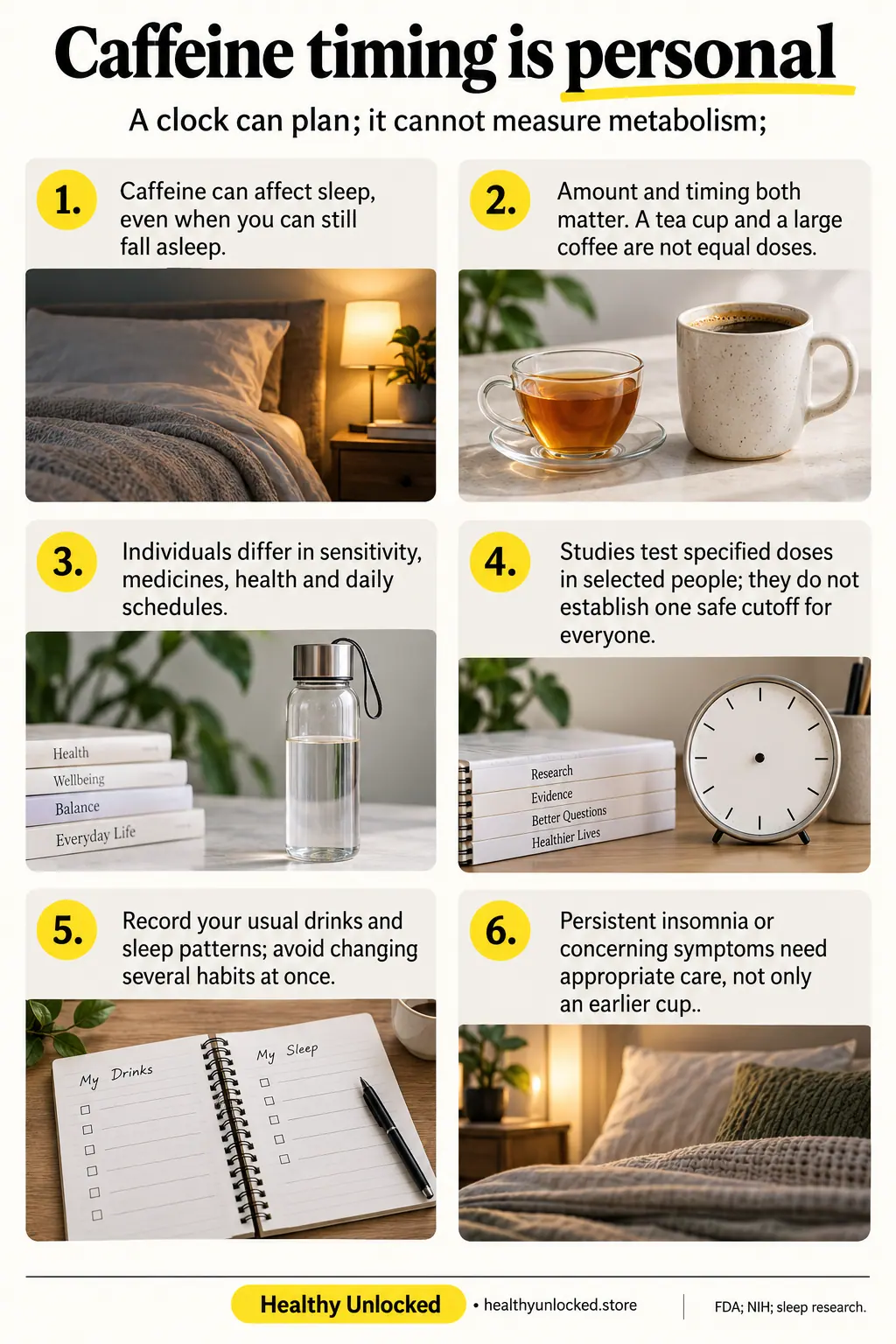
Caffeine can make you feel more alert, but that useful daytime effect can become inconvenient around sleep. Timing is part of the picture; the amount and your response also matter. Falling asleep after a late drink does not, by itself, demonstrate that the drink had no effect on your sleep.
Think of a cutoff as a planning choice to review, rather than a promise that caffeine disappears at a particular hour. Two people can have different responses to the same drink. Health, medicines, usual intake and other circumstances can affect the discussion. A general article cannot calculate your personal metabolism from a bedtime alone.
The NIH information about insomnia explains that caffeine can affect sleep and that sleep problems have several possible causes. Earlier drink timing may be a useful habit to consider, but it is not a complete explanation for every difficult night. Keep the wider pattern in view.
A practical question is: when is my last caffeinated drink, how much is it, and what happens around the same night? That is more useful than asking whether all coffee must stop at the same clock time. Someone sleeping at 09:00 after a night shift has a different schedule from someone planning bed at 23:00.
You do not have to turn ordinary eating and drinking into a complicated experiment. A plain note can show the drink, its size and the time. Add your sleep experience and relevant context. Use that record to organize a sensible conversation, rather than treating one better night as proof that you found a universal rule.
| Question | Useful information | Avoid assuming |
|---|---|---|
| What did I have? | Drink, food or medicine and serving size | All sources are coffee |
| When did I have it? | Actual time and day | An evening cutoff suits every shift |
| How much caffeine? | Reliable label or product information where available | Color or cup count gives an exact dose |
| How did I sleep? | Experience and next-day effect | Falling asleep proves no effect |
| What else changed? | Schedule, illness, stress, naps or medicines | Caffeine explains every symptom |
Alertness and sleep quality answer different questions
Feeling less sleepy after a drink describes an immediate experience. It does not tell you whether your later sleep was long enough or restorative. Likewise, a person may feel they fell asleep normally without noticing every change in the night. These are reasons to avoid confident conclusions from a single feeling.
Keep the plan comfortable and practical. If reviewing drink timing leads you to worry constantly about every minute, a simpler approach may be more useful: record the main habits, make a manageable change and discuss ongoing problems with an appropriate professional. A planner should support your day, not make sleep another performance test.
Find caffeine beyond your coffee cup
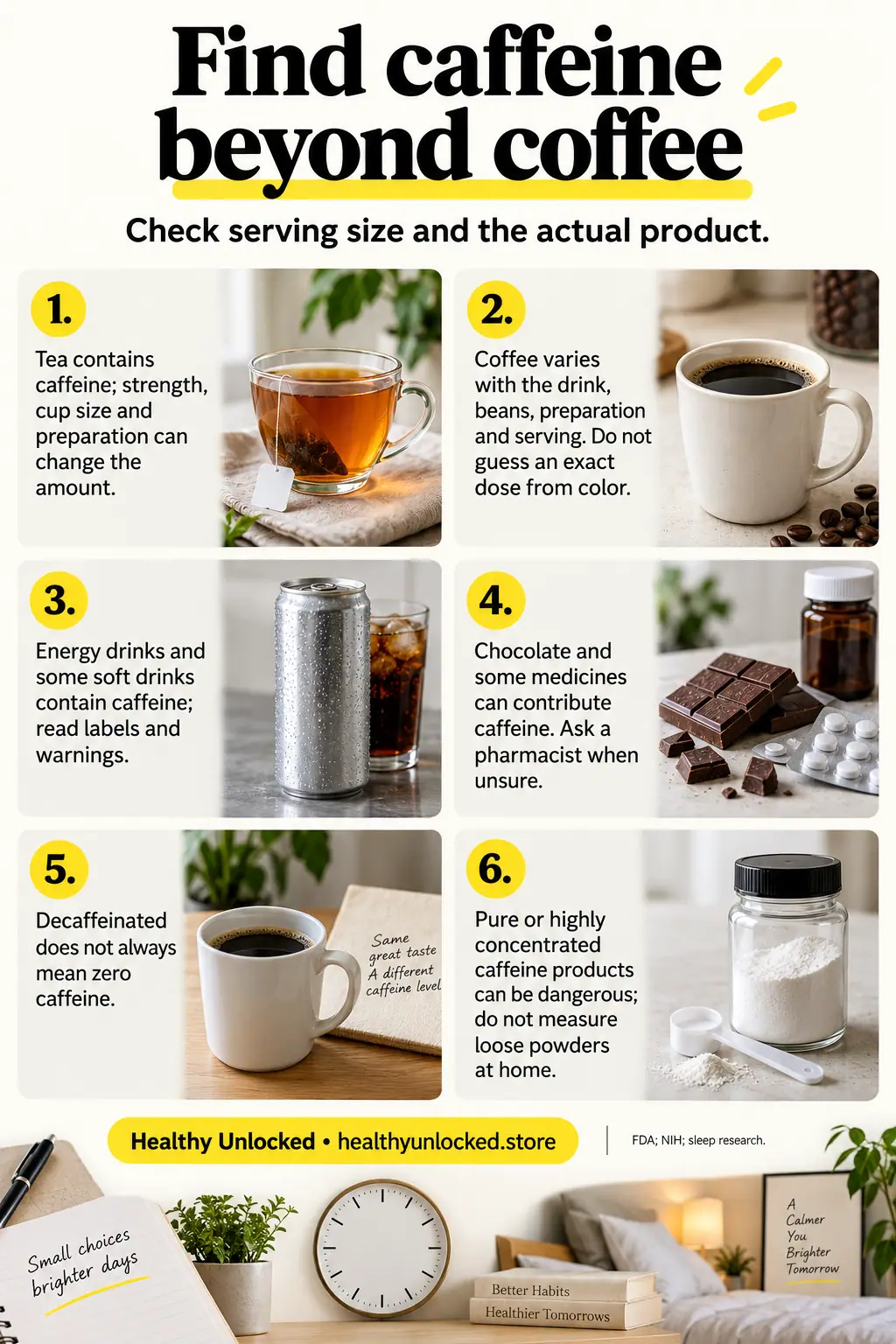
Coffee is the obvious example, but caffeine can also come from tea, some soft drinks, energy drinks, chocolate and certain medicines. A late afternoon drink that does not look like coffee may still matter. Check the actual product and serving rather than relying only on the drink category.
Coffee varies with preparation, product and serving size. A small cup, a large takeaway drink and a concentrated shot are not equivalent descriptions of caffeine. If the retailer or package supplies an amount, read the size associated with it. A figure for one serving should not silently become a figure for every cup you pour.
Tea contains caffeine too. The type of tea, preparation and cup size can change the amount. An exact dose cannot be read from the color alone. In an ordinary diary, writing the tea type, approximate cup size and preparation can still be useful even when a precise milligram figure is unavailable.
Decaffeinated drinks generally contain less caffeine, but the name does not always mean zero. If your aim is a caffeine-free choice, check the actual information. Do not assume that a decaf label or a light-colored drink guarantees the same result for every product.
Energy drinks and energy shots can have warnings and amounts that differ from ordinary drinks. Read labels rather than treating them as a small substitute for an afternoon cup. Some medicines and supplements can also contribute caffeine or interact with it. A pharmacist can help when you are unsure about the product you take.
The FDA information on highly concentrated caffeine products describes a different and serious safety issue. Do not measure loose caffeine powder at home or treat concentrated products as a convenient way to control a drink dose. The timing planner here does not make such products safe.
| Source | What to record | Important qualification |
|---|---|---|
| Coffee | Product, serving and preparation | Amounts vary widely |
| Tea | Type, cup size and preparation | Not automatically caffeine-free |
| Decaf drink | Actual product and information | Lower caffeine is not always zero |
| Energy drink or shot | Serving, label and warnings | A small container can still contain a substantial amount |
| Chocolate or medicine | Product and relevant information | Ask a pharmacist about medicines when unsure |
What do timing studies actually show?
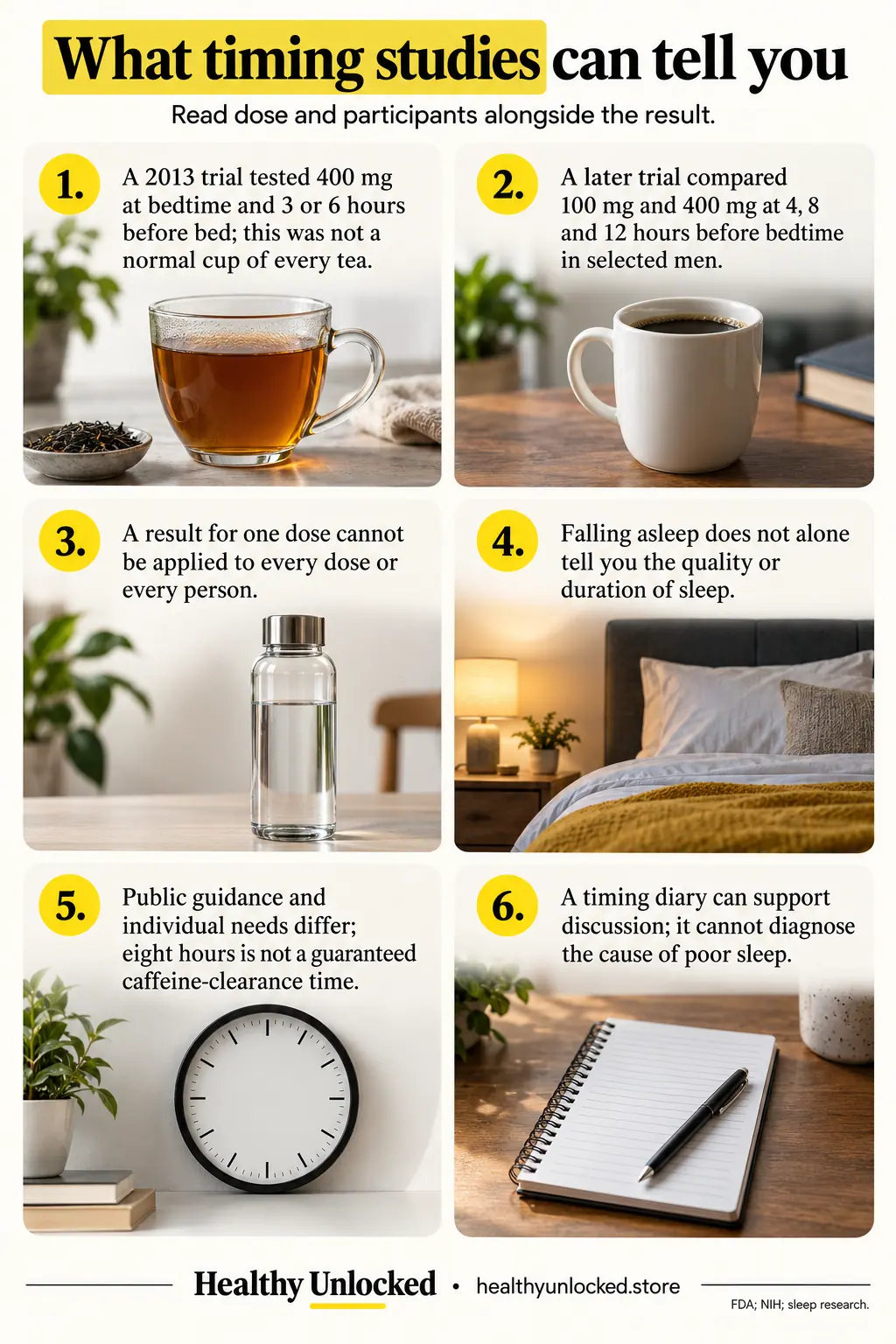
Research is more useful when you read the dose, participants and timing alongside the headline. A study can show an effect under its tested conditions without establishing one safe cutoff for all people. “Six hours before bed” and “twelve hours before bed” are not interchangeable promises detached from the amounts studied.
A 2013 trial of caffeine at different times before bed tested 400 mg at bedtime and three or six hours beforehand. It found sleep disruption under the tested conditions. That amount is not a description of every cup of tea, and the study should not be turned into a guarantee that a different dose is harmless after a specific hour.
A later randomized crossover trial of caffeine dose and timing compared 100 mg and 400 mg at four, eight and twelve hours before bedtime in 23 selected men. Its findings differed by dose and timing. The design helps explain why a simple headline about hours can conceal important differences.
In that later study, the absence of a significant effect for a particular lower-dose condition does not prove that every individual, every health situation or every caffeinated drink is safe at that time. The tested participants and conditions matter. Do not turn the finding into permission to ignore your own sleep difficulties.
Public sleep guidance often recommends avoiding caffeine late in the day or reviewing it around bedtime. That is practical advice, not a laboratory measurement of your clearance time. If a guide uses a number of hours as an example, read its context and limits. An eight-hour planning gap does not mean no caffeine remains after eight hours.
The studies also illustrate a broader reading habit: look at what was actually measured. A subjective impression and an objective sleep measurement answer related but different questions. The diary on this page records your experience; it is not an objective sleep test and cannot establish the physiological cause of a change.
| Evidence | What was examined | What it supports | What it does not establish |
|---|---|---|---|
| 2013 timing trial | 400 mg at bedtime, 3 hours and 6 hours before bed | Timing can matter for sleep at the studied dose | A safe universal cutoff for every drink |
| Later crossover trial | 100 mg and 400 mg at 4, 8 and 12 hours in 23 men | Dose and timing both affect interpretation | Results for every age, health condition or person |
| General sleep guidance | Practical habits around sleep | Review late caffeine and the wider routine | An exact individual metabolism calculation |
| Personal diary | Your drinks, schedule and experience | A clearer pattern for discussion | Diagnosis or proof of causation |
Avoid converting a daily reference into a sleep target
The FDA describes 400 mg a day as an amount not generally associated with negative effects for most healthy adults. That is not a goal to reach, and it does not certify a late-day dose as sleep-safe. Individual sensitivity and other circumstances can change the advice. Younger people and pregnancy are not covered by treating an adult reference as blanket permission.
If you are trying to sleep better, asking how late you can use the largest possible amount is usually less helpful than looking at your current habits. Record what you actually consume and consider a manageable change. Talk with a health professional when medicines, pregnancy or a medical condition make the situation less straightforward.
Choose a planning gap and read the clock
A timing plan begins with the bedtime you actually intend to use. Then choose a gap for your planning example and count backward. The result is a clock time, not a metabolism result. The tool deliberately does not use a half-life formula to pretend it knows your blood caffeine concentration.
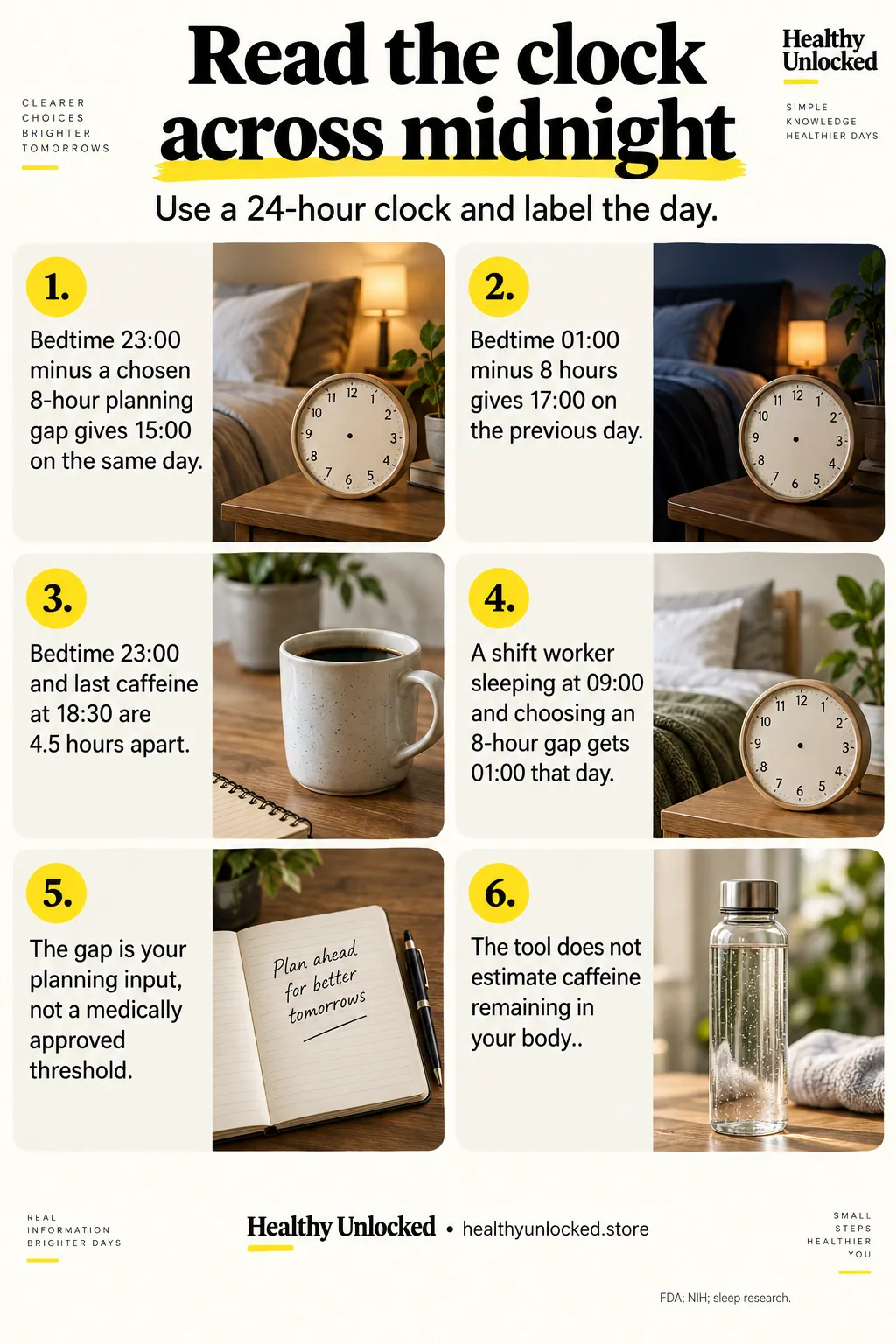
Use a 24-hour clock and keep the day clear. For a planned bedtime of 23:00, subtracting an eight-hour example gap gives 15:00 on the same day. For a bedtime of 01:00, the same subtraction gives 17:00 on the previous day. The mathematical difference is simple, but the day label is essential.
If you work shifts, use the time of the sleep period you are planning. Someone sleeping at 09:00 after work and choosing an eight-hour gap gets 01:00 that day. This is why a fixed rule such as no coffee after 15:00 may not describe every schedule appropriately.
A gap is an input you choose to explore. It is not approved as suitable by the tool. You can use the calculation to organize when to move a drink earlier, then observe the wider pattern. When your bedtime changes, the planning result changes too; the tool does not know whether your actual sleep follows the plan.
Record the last drink separately from the calculated cutoff. A planned time and an actual time are different. If you had a drink later than intended, write that plainly. A diary is useful because it reflects real life, not because every entry exactly matches the plan.
Two worked timing examples
Example A: an ordinary evening. Morgan plans bed at 23:00 and chooses an eight-hour gap to explore. The planner subtracts eight hours and shows 15:00 on the same day. If Morgan’s last caffeinated drink is at 18:30, the time from that drink to the planned bedtime is 4.5 hours. Neither figure shows how much caffeine remains.
Example B: sleep after midnight. Casey plans bed at 01:00 and chooses the same gap. The result is 17:00 on the previous day. If Casey records a last drink at 20:00, the interval to 01:00 the next day is five hours. These fictional examples explain clock arithmetic; they do not establish an eight-hour threshold for either person.
Keep your break while changing the drink
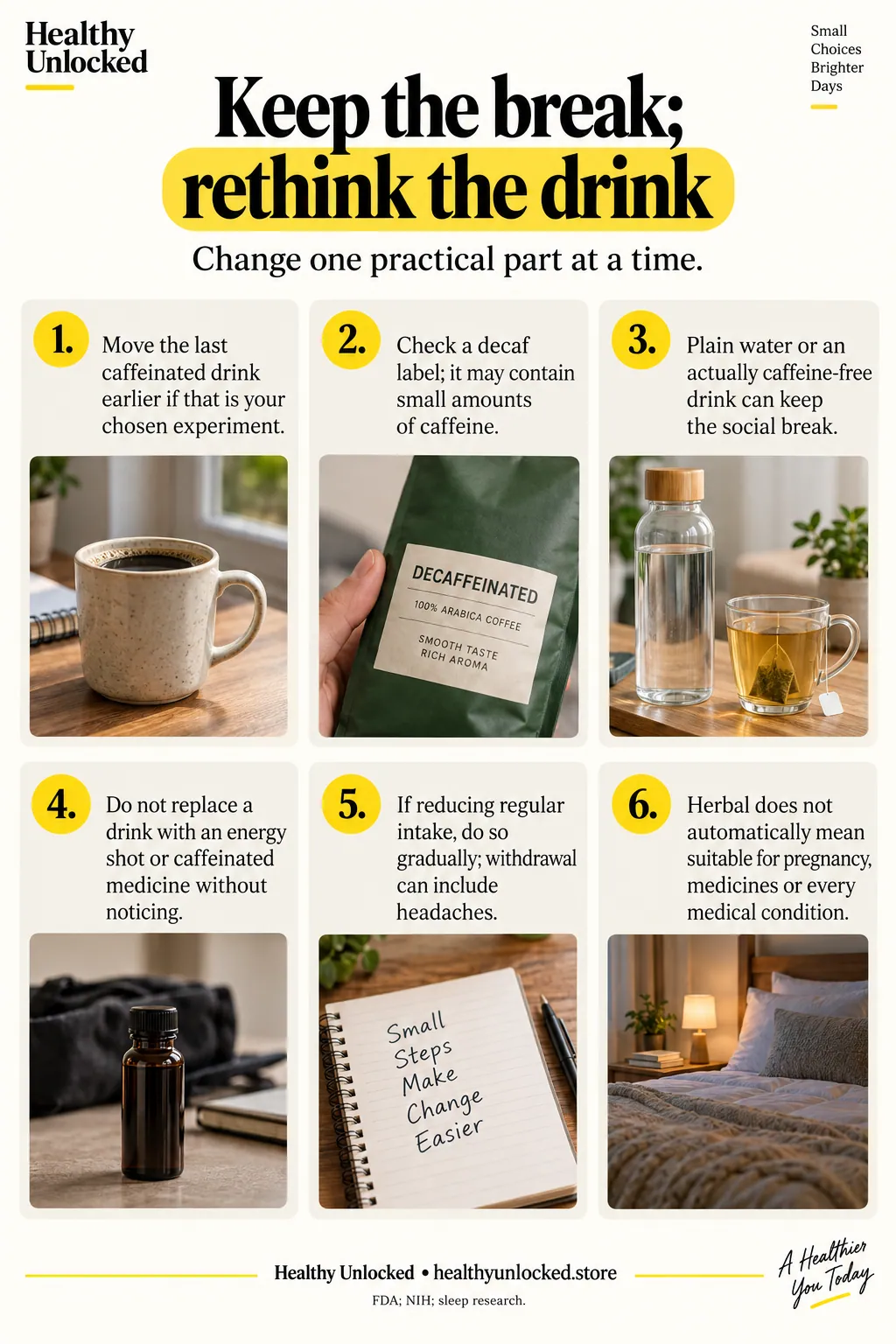
A drink break can be about company, comfort or stepping away from work as much as caffeine. If you want an earlier last caffeinated drink, keep the useful part of the break while reviewing the drink itself. You do not have to abandon a social routine simply because you are changing one ingredient.
Plain water or a genuinely caffeine-free choice may suit some breaks. Decaf can also be a lower-caffeine option, with the earlier qualification that it may not be completely caffeine-free. Choose something appropriate to your circumstances rather than assuming that every herbal drink is suitable for pregnancy or medicines.
If you use caffeine regularly and decide to reduce the amount, gradual reduction may be more comfortable than stopping suddenly. Mayo Clinic information about caffeine and cutting back discusses withdrawal symptoms such as headache. A general article should not prescribe a personal reduction schedule or tell you to stop medicines.
Check that a replacement does not silently add another caffeine source. An energy shot, a caffeinated supplement or a medicine taken during the same break can make the record incomplete. The name of the break does not matter as much as the actual products used.
Change one practical habit where possible. Moving the last cup earlier while also changing bedtime, naps, exercise and medicines makes it harder to interpret a better or worse night. You do not need perfect experimental control; simply keep enough context that you do not give one change more credit than the notes support.
| Possible change | Useful check | Limit |
|---|---|---|
| Move the last drink earlier | Record the actual time and serving | Earlier is not a guaranteed cure |
| Choose decaf | Read actual product information | Decaf may still contain caffeine |
| Choose a caffeine-free break | Check ingredients and personal suitability | Herbal does not automatically mean suitable |
| Reduce usual intake gradually | Notice headaches or other difficulties | A general guide does not set a personal taper |
| Keep a short diary | Change one habit where practical | An observed pattern does not prove causation |
Make a useful caffeine-and-sleep diary
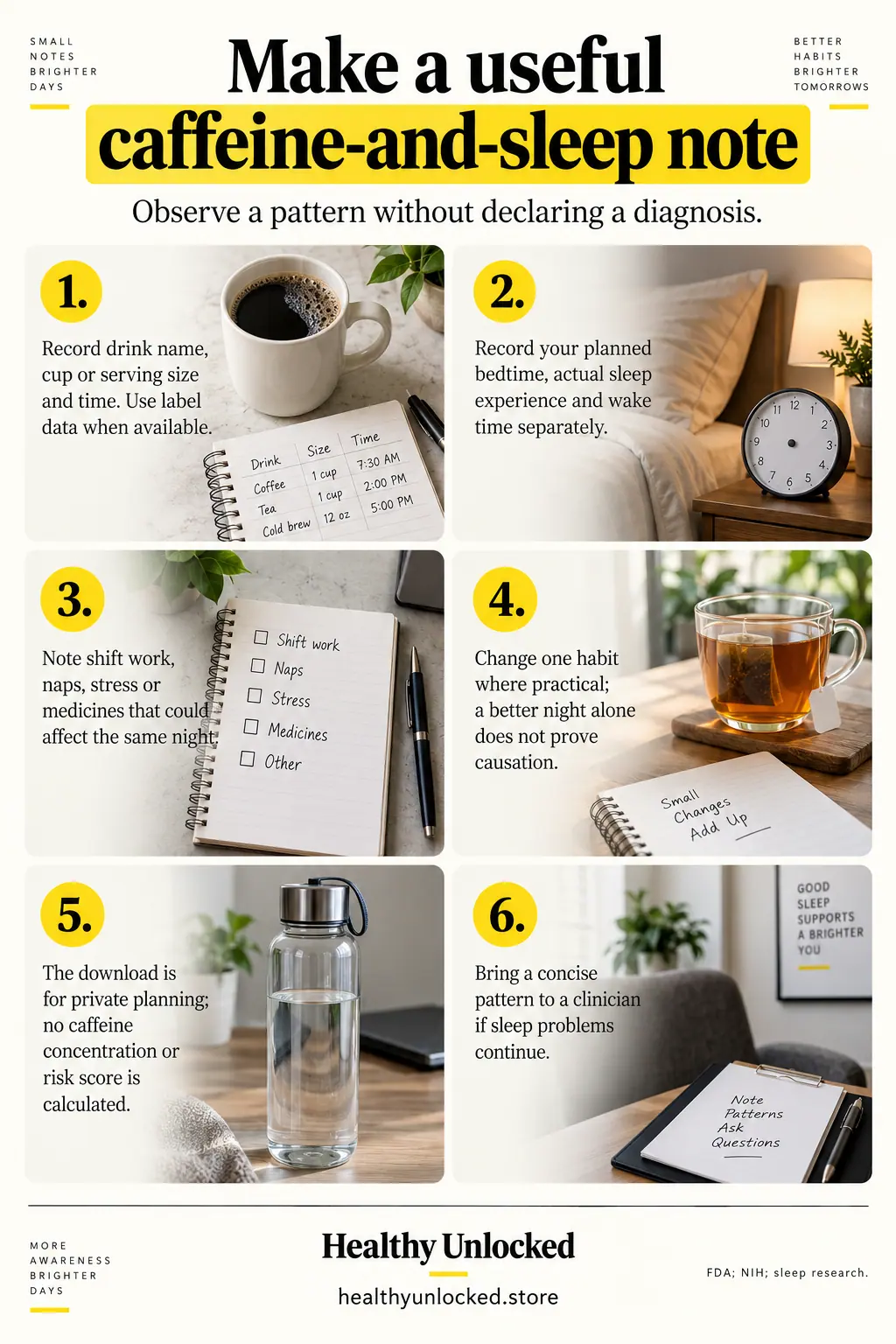
A useful diary can be short. Write the main caffeinated drinks, their approximate serving sizes and the times. Use reliable product amounts if available. If not, keep the uncertainty visible instead of guessing a precise milligram total that looks authoritative but is unsupported.
Write your planned bedtime, your actual sleep experience and your wake time separately. Time in bed is not identical to time asleep. Note whether a difficulty affected the next day, rather than recording only a clock number. A brief statement such as “woke several times and felt tired at work” can help a conversation.
Include relevant context: a shift change, illness, unusual stress, a nap or a new medicine. These do not prove an alternative cause, but they prevent the diary from treating every night as identical. When a pattern is persistent, the full history is more useful than a single caffeine cutoff.
For broader sleep support, read the NHS guide to insomnia.
Do not interpret missing entries as symptom-free nights. Leave them missing or write “not recorded.” A day you did not observe has less information, not proof that everything went well. You can use paper if that makes the record less distracting than another screen near bedtime.
When general timing advice is not enough
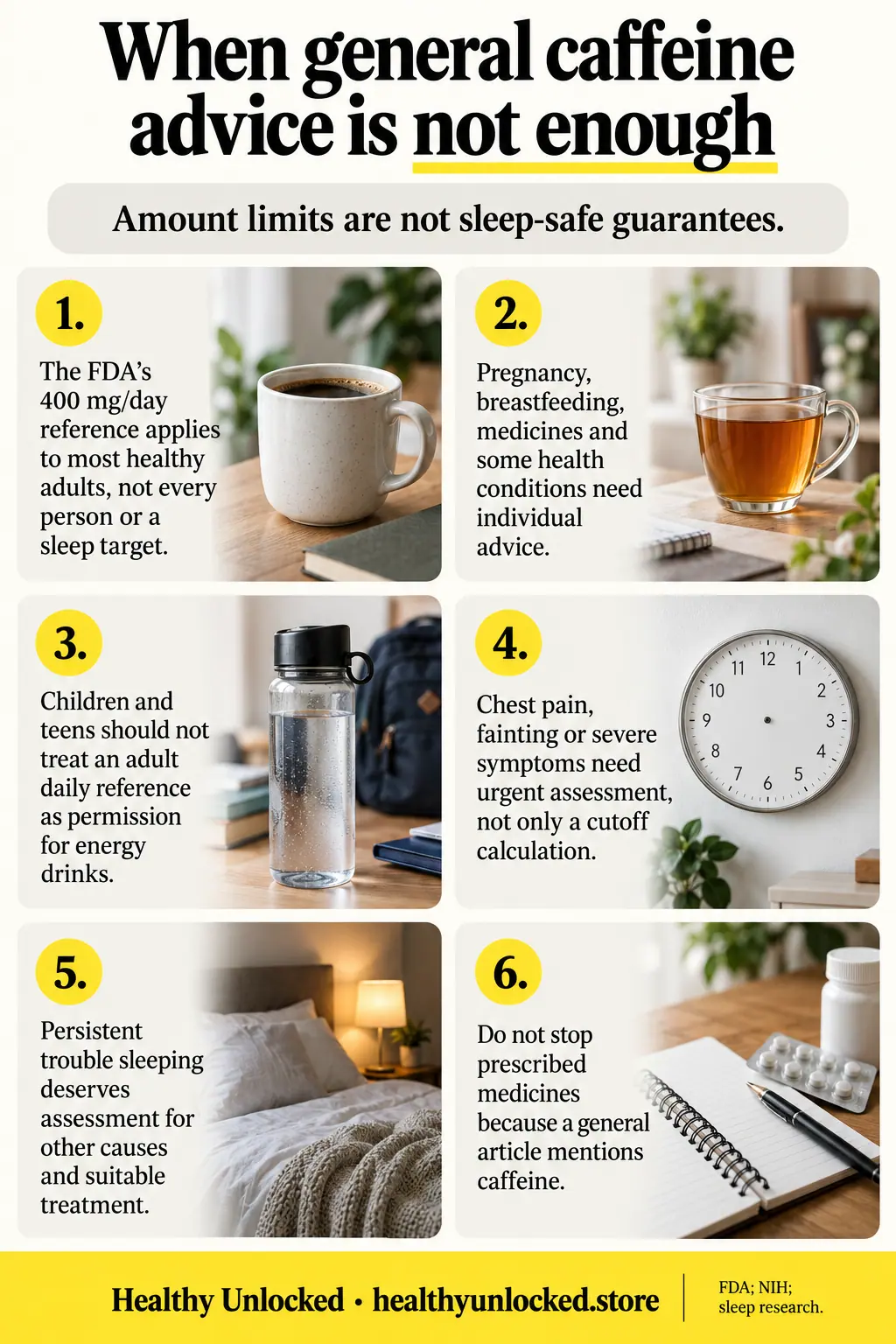
General adult caffeine information does not provide a personal limit for pregnancy, breastfeeding, children, teens or every medical condition. Medicines can also matter. Ask an appropriate health professional about your situation instead of applying an adult daily reference to everyone in the household.
Do not stop prescribed treatment because a general page mentions caffeine. Tell the clinician or pharmacist about your usual drinks and supplements, and ask whether they affect the medicine or your symptoms. A precise product name is more useful than describing everything as a little coffee.
Persistent difficulty falling asleep, staying asleep or functioning during the day deserves attention beyond a cutoff. NHS information about insomnia explains that assessment considers the pattern and other causes. A timing calculator is not a screening test for a sleep disorder or a replacement for evidence-based treatment.
Chest pain, fainting or severe symptoms require appropriate urgent help. If concentrated caffeine or another product may be involved, do not wait for a diary or an online calculation to settle the issue. This page cannot assess poisoning, a heart problem or another acute condition.
Use public comments for general questions, not private medical information. Keep a personal diary private and bring the relevant parts to a clinical conversation. The usefulness of a record comes from clarity and context, not from sharing intimate details with an unknown audience.
Use the caffeine timing planner
The planner accepts a chosen bedtime, a planning gap in hours and the time of your last caffeinated drink. It subtracts the gap from bedtime and calculates the forward interval from the recorded drink to the planned bedtime within a single daily cycle. It makes the previous-day result explicit when subtraction crosses midnight.
For example, 23:00 minus eight hours is 15:00. The interval from 18:30 to 23:00 is 270 minutes, or 4.5 hours. No milligram amount is inferred from those times. The tool does not estimate caffeine half-life, blood concentration, genetic sensitivity or a guaranteed safe interval.
The last-drink interval assumes that the entered drink is the most recent one before the planned sleep period within 24 hours. If the times represent different dates or a longer gap, use a dated paper record instead. The calculation cannot determine the dates from two clock fields alone.
Blank or unsupported inputs need correction. The displayed planning limits keep the example understandable; they do not medically approve every value within them. A result at the selected boundary is still an arithmetic result, not a clinical recommendation.
The tool does not need your name, symptoms or medical history. Keep private notes in your own worksheet. The calculation works in the page and is intended for practical scheduling; it does not decide whether you should consume caffeine or how much.
| Example | Inputs and arithmetic | What the result means |
|---|---|---|
| First example | 23:00 − 8 h = 15:00 | Same-day planning example; eight hours is chosen, not a guaranteed sleep-safe cutoff. |
| Second example | 01:00 − 8 h = 17:00 | The previous day. From 18:30 to 23:00 is 4.5 hours. Neither calculation measures caffeine in the body. |
Try the caffeine timing planner
Use a 24-hour clock and a gap you choose. Eight hours is an example input, not a medically approved cutoff or a metabolism calculation.
Example: 23:00 minus a chosen 8 hours = 15:00 the same day. From 18:30 to 23:00 is 4.5 hours. For 01:00, the planned time is 17:00 the previous day.
Entries stay on this page. The tool does not save or transmit your health information.
Static method and download
Without JavaScript, convert bedtime to minutes, subtract the chosen gap and move back into the 24-hour clock if needed. Then label a result before midnight as the previous day when appropriate. For the drink interval, count forward to the chosen bedtime within the assumed daily cycle. The worked examples above show both situations.
Download the caffeine-and-sleep planning worksheet for drink names, serving sizes, times, sleep experience and context. There is no hidden diagnosis or caffeine concentration calculation in the worksheet. Use it to make a pattern easier to discuss, not to certify a safe intake.
Common questions about caffeine before bed
These answers explain timing and evidence. They do not set a personal caffeine dose or replace care for ongoing sleep problems.
What is the best caffeine cutoff time before bed?
There is no single cutoff that guarantees good sleep for everyone. Dose, timing and individual sensitivity matter. Review your actual drinks and sleep pattern, and consider moving the last caffeinated drink earlier if appropriate. A chosen planning gap is not a metabolism measurement.
Is six hours before bed always enough?
No universal guarantee follows from a six-hour gap. A 2013 trial tested 400 mg at several times, including six hours before bed, and found sleep disruption under those conditions. The finding should be read with the tested dose and participants, not converted into a safe threshold for every drink.
Does tea count as caffeine?
Yes, ordinary caffeinated tea contributes caffeine. Type, preparation and serving size affect the amount. Record the actual drink and cup rather than guessing an exact dose from color. A late drink does not need to be coffee to belong in the diary.
Does decaf mean caffeine-free?
Not always. Decaffeinated drinks generally contain less caffeine but may still contain a small amount. Read the actual product information when you need to distinguish lower caffeine from none. Different products and servings should not be treated as identical.
Can the planner tell me how much caffeine is left in my body?
No. It subtracts a chosen gap from bedtime and calculates an assumed drink-to-bed interval. It does not use your dose, metabolism, medicines or physiology to estimate a concentration. The result is scheduling arithmetic, not an individual sleep-safe limit.
What if I still sleep badly after moving caffeine earlier?
Persistent sleep problems can have several causes and deserve appropriate assessment. Keep a short, factual record of your drinks, schedule and sleep experience. Do not assume that another cutoff calculation will diagnose the problem or replace suitable care.
Your next step: write down your usual last caffeinated drink and the sleep period you are planning. Make one manageable timing change if appropriate and observe the broader pattern. Let the clock organize the plan, while keeping personal health decisions with suitable guidance.
About this article
By Yashveer Bharani for Healthy Unlocked. This article combines original timing research with public sleep and caffeine information. The planner and fictional examples demonstrate clock arithmetic, not measurements of caffeine clearance, diagnoses or personal intake recommendations.
Study doses and participants are stated beside the findings. A personal diary is a practical observation aid, not controlled research. The sources below support further reading and do not imply that their publishers reviewed or endorsed this article.
Sources and further reading
These original references support the guidance and its limits. A link does not mean that the institution reviewed or endorsed this article.
Main guidance
Practical reference
Context and definitions
Safety and care
Evidence and limitations
 Healthy Unlocked
Join the conversation
Share a practical idea or ask a question about this guide. Please keep personal medical details private.