

Summary
Menstrual-cycle tracking can help you describe period dates, bleeding, symptoms and changes at a healthcare visit. Count from one recorded period start to the next, keep uncertainty visible and include the effect on ordinary life. A calendar record does not prove ovulation, diagnose a condition or make unprotected sex safe.
This guide explains what to note, how to distinguish a bleeding duration from a cycle interval, and how to prepare a useful appointment summary. Five tables and a private worksheet support the process. The date calculator counts a completed interval between two dates you enter; it does not predict a future period, fertile days or pregnancy.
What you’ll understand
- Record what happened. Actual dates are different from an app’s prediction.
- Separate two durations. Bleeding days and start-to-start cycle days are not the same.
- Add the daily impact. Pain, heavy bleeding and missed activities matter alongside dates.
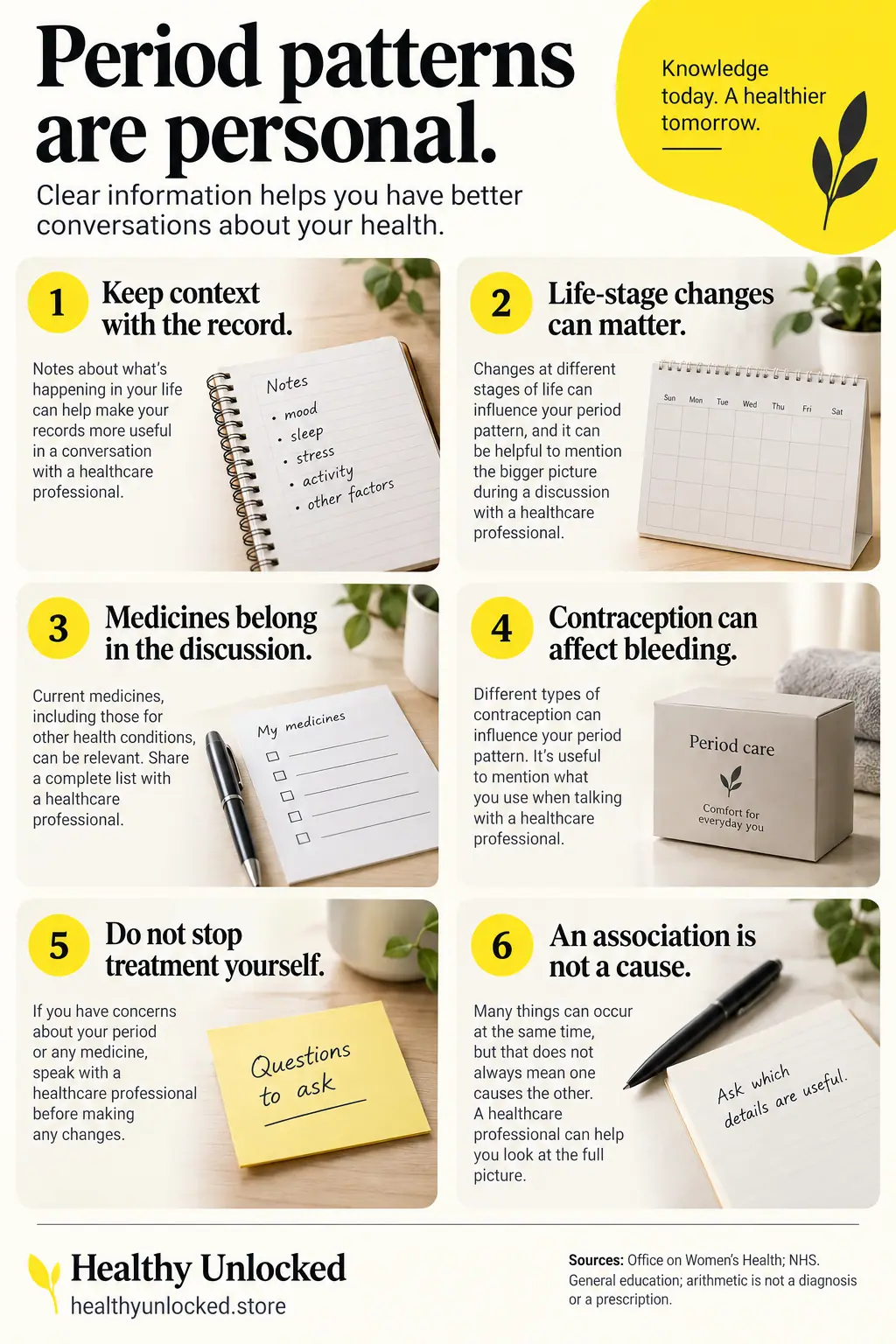
- Keep context visible. Medicines, contraception and life-stage changes can affect the record.
- Protect private details. You can use paper or a local file without a public upload.
- Seek help when needed. Do not wait for more entries when symptoms are concerning.
Start with these steps
- Write the actual start date and label uncertainty.
- Record bleeding and symptoms in your own words.
- Keep medicines and relevant context for the visit.
- Bring the main question and seek earlier help when needed.
General education, not diagnosis, fertility treatment or contraception. Do not use calendar arithmetic to exclude pregnancy, declare safe days or postpone care for severe symptoms.
What can menstrual-cycle tracking tell you?
A menstrual record turns “my periods have changed” into information that can be discussed. Dates, bleeding and daily effects can be easier to explain when written close to the event. The purpose is a clearer conversation, not to make the body match an app’s expected schedule.
The Office on Women’s Health menstrual-cycle overview describes counting a cycle from the first day of one period to the first day of the next. That is different from counting only the days of bleeding. Keeping the two questions separate prevents a simple record from becoming confusing.
A record can show that an interval changed or a symptom occurred on particular days. It cannot establish the cause, prove that an egg was released or confirm a hormonal diagnosis. A healthcare professional may need history, examination and appropriate tests alongside the notes.
Periods can be discussed without treating them as a failure of cleanliness or discipline. The useful information is what happened and how it affected you. There is no need to describe an ordinary variation as a personal fault or promise that a particular food will make the cycle follow a fixed number.
Our protein-and-fiber guide offers general food background. It does not prescribe a menstrual treatment diet. Use food and activity articles for their stated purpose, while a specific bleeding or pain concern receives appropriate assessment.
| Question | Useful information | Important limit |
|---|---|---|
| When did a period begin? | A recorded date with uncertainty labeled | Not a prediction of the next period |
| How long was the start-to-start interval? | The difference between two recorded starts | Not proof of ovulation |
| How did bleeding affect daily life? | Symptoms, product use and missed activities | Not a diagnosis from a number alone |
| What changed around that time? | Medicines or relevant circumstances | Not proof that one change caused the pattern |
| What should I ask at a visit? | A clear concern and readable notes | Not a substitute for assessment |
| Can I avoid pregnancy using this result? | No contraceptive result is provided | Calendar arithmetic is not safe-day advice |
A simple record can be enough
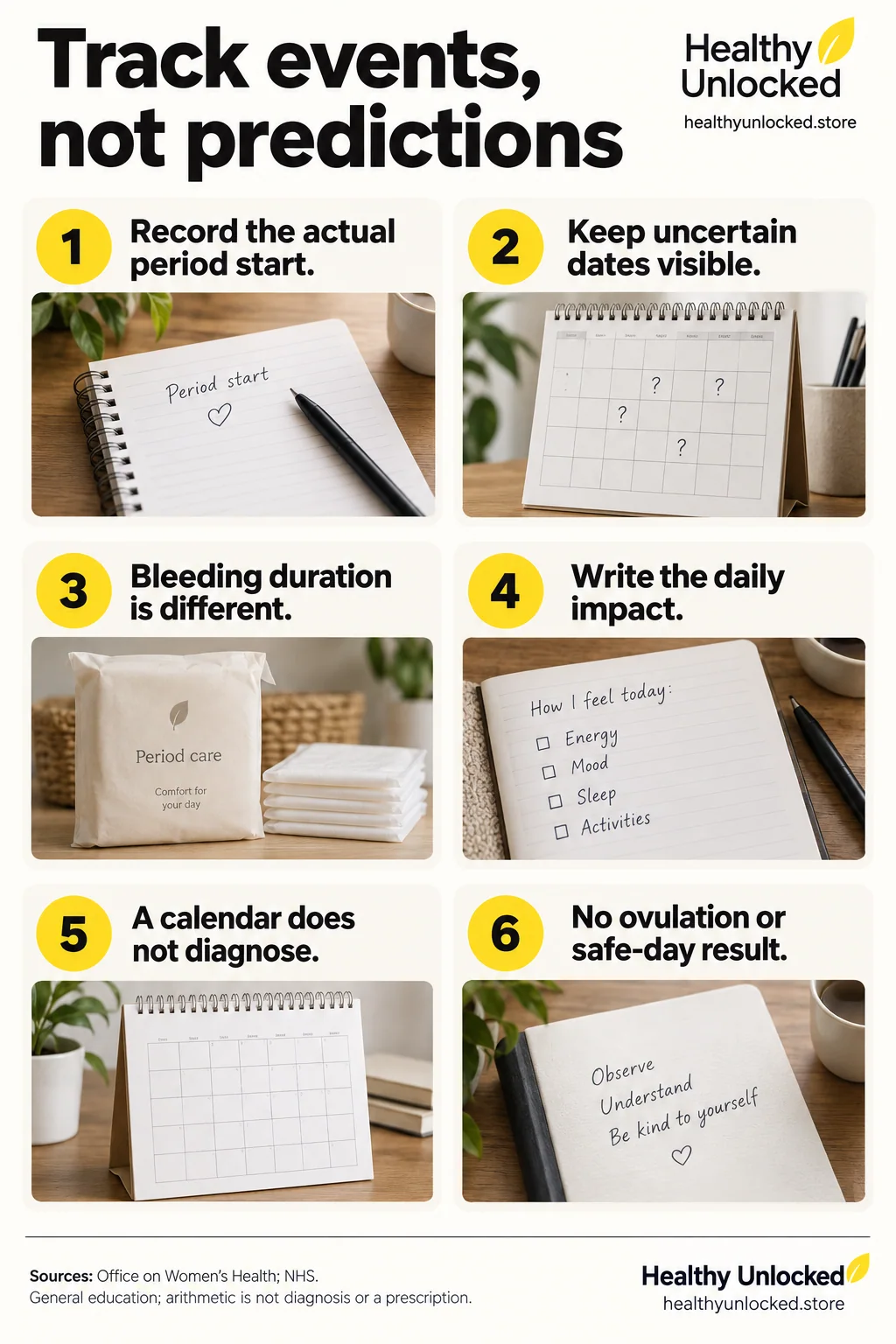
You can start with a calendar, a small notebook or a private file. Choose a format you can maintain without spending the day checking it. If a clinician requests a particular form, use that form rather than assuming this worksheet is a validated clinical instrument.
If tracking increases anxiety, simplify the record and discuss the concern. More columns do not automatically produce more useful information. A short account of a symptom and its effect may matter more than an elaborate chart of predictions.
Record dates, bleeding and the effects that matter
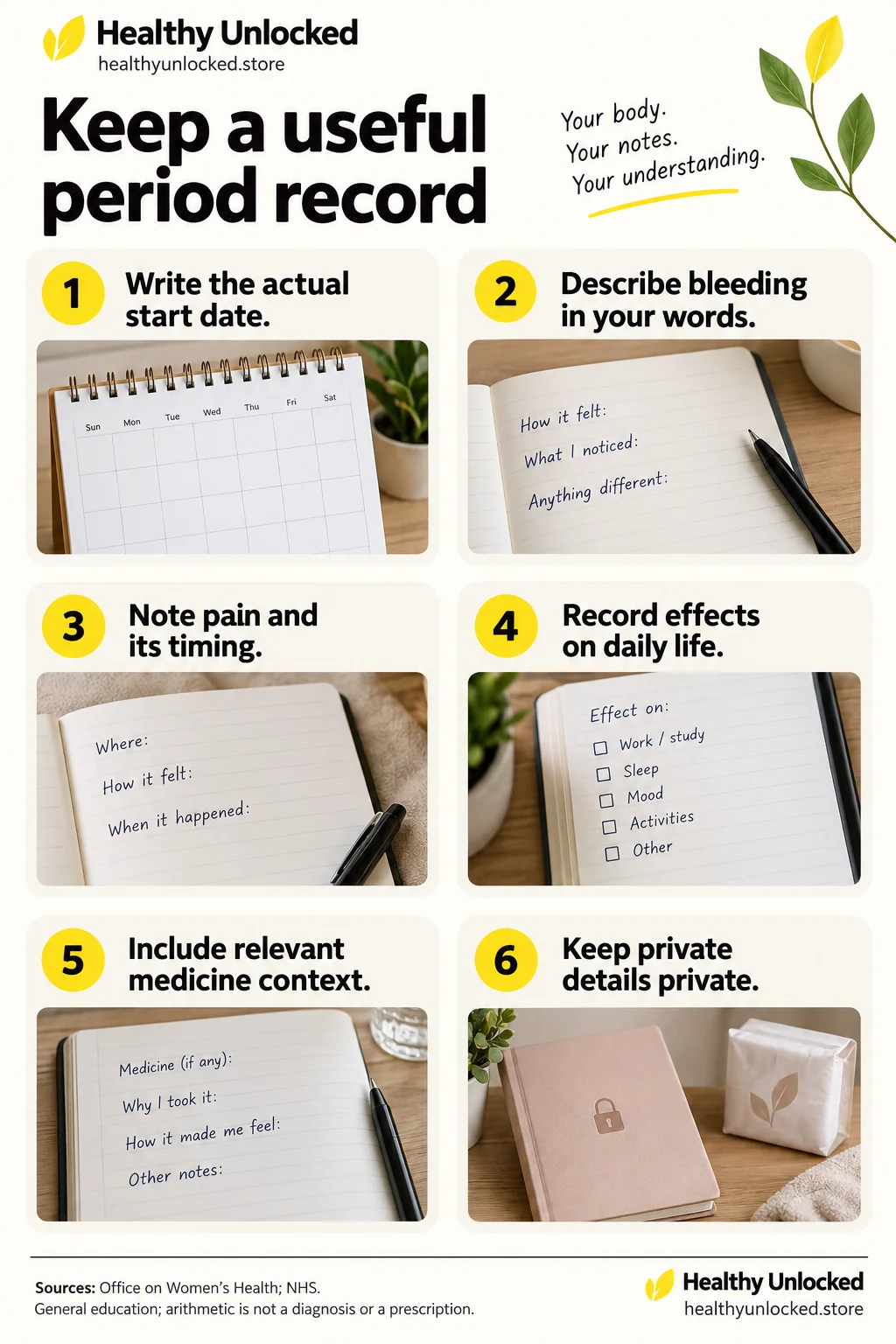
Write the actual date when the period began and keep the date format unambiguous. When you are unsure whether a day was spotting or the start of a period, label that uncertainty. Ask how your clinician wants it recorded instead of forcing an uncertain observation into a precise day-one rule.
Keep bleeding duration separate. You may record the last day of bleeding or describe the approximate number of days. That answers a different question from the interval between period starts. Do not subtract a bleeding duration from a cycle interval to calculate a fertile window.
Note the heaviness in practical terms, including whether it was different from usual, whether products needed changing unusually often, and whether bleeding affected daily activities. Products differ in absorbency and use, so a product count is not a universal measured blood volume.
Write relevant symptoms and their timing in your own words. Pain, dizziness, tiredness or another concern should remain visible even if the date interval looks familiar. A date calculator cannot cancel a symptom simply because its arithmetic is straightforward.
The NHS periods overview provides general background on bleeding and period products. Follow the instructions for the product you use. This article does not give one replacement interval for every product or use a product count to diagnose heavy bleeding.
| Field | How to record it | Keep the limit clear |
|---|---|---|
| Period start | Actual calendar date | Mark uncertainty rather than inventing precision |
| Bleeding duration | Recorded dates or a clear estimate | Not the cycle’s start-to-start interval |
| Bleeding description | Change from usual and practical product information | Not a measured blood volume |
| Symptoms | What happened and when | Not a self-diagnosed cause |
| Daily effect | Missed work, study, sleep or ordinary activities | Relevant even with a familiar interval |
| Context | Medicines, contraception or life-stage details for the visit | Keep sensitive information private |
Dates should describe an event, not an expectation
An app may display a predicted period before it happens. Keep that prediction separate from a recorded start. If a predicted date is copied into the diary as an event, the later interval will look measured when it is not.
If you remember a past start only approximately, write that. A clinician can interpret a record more honestly when its uncertainty is visible. The calculator requires exact dates for arithmetic, so it may be better to leave an uncertain interval uncalculated rather than invent a date.
Count a recorded interval without predicting the next one
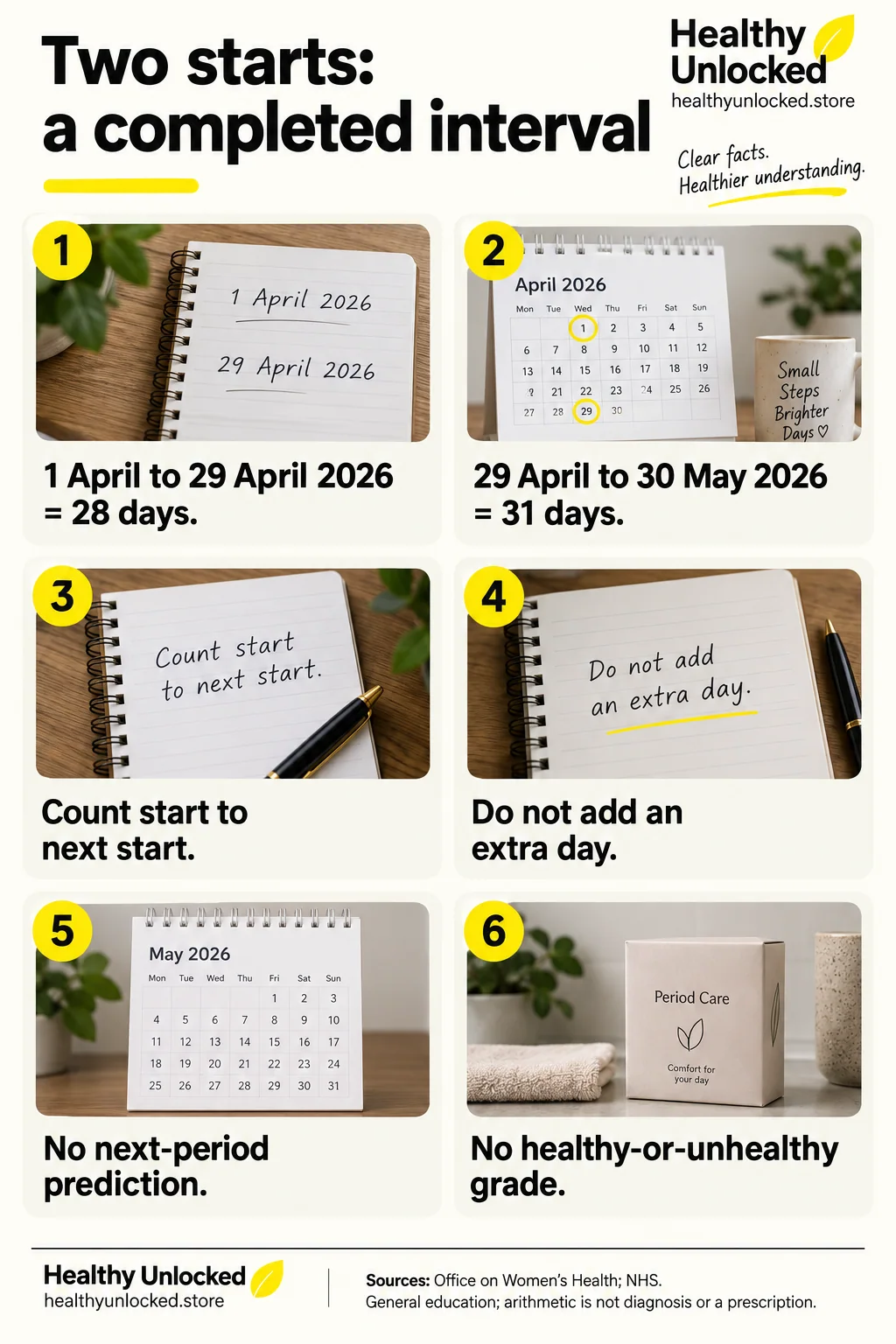
A completed start-to-start interval is the calendar-day difference between one recorded period start and the next. For example, a start on 1 April 2026 followed by a start on 29 April 2026 gives 28 days. The second start begins the next interval; it is not added again as an extra day to the previous one.
Another recorded interval can differ. From 29 April 2026 to 30 May 2026 is 31 days. Those examples show counting, not a judgment that either person has a particular condition or that the following period must repeat the same length.
Public sources do not all display an identical range. The Office on Women’s Health uses 24–38 days in its adult discussion, while the NHS overview describes a 21–35-day range. These references have contexts and definitions; neither is a reason for this calculator to issue a universal “normal” grade.
Age, stage of life, contraception, pregnancy-related circumstances and the reason for tracking can change the assessment. Early years after periods begin and the menopause transition are not the same context as an established adult pattern. A concerning change or symptom still deserves discussion.
Do not convert a completed interval into a future fertile-day calculation. The timing of ovulation is not established by subtracting a fixed number from one cycle length. This article provides no safe-day schedule, pregnancy probability or conception-timing prescription.
| Question | Illustrative answer | Do not confuse it with |
|---|---|---|
| Recorded interval one | 1 April to 29 April 2026 = 28 days | The number of bleeding days |
| Recorded interval two | 29 April to 30 May 2026 = 31 days | A prediction of the next period |
| Bleeding duration | Its own recorded start and end | Proof of ovulation |
| A reference range | A source’s stated population and context | A universal health grade |
| An app prediction | An estimate before the event | An actual period start |
| Pregnancy prevention | Needs an appropriate contraceptive method | A calendar subtraction |
Averages can hide the detail you need
If you later summarize several intervals, keep the original dates available and state which entries were included. A missing or uncertain period start should not be replaced with the app’s prediction to create a tidy average.
This calculator deliberately handles two recorded starts. It does not create an average cycle length or use one to predict the next date. That limited purpose keeps the arithmetic clear and avoids presenting a calendar estimate as a biological measurement.
Keep symptoms and daily impact alongside the dates
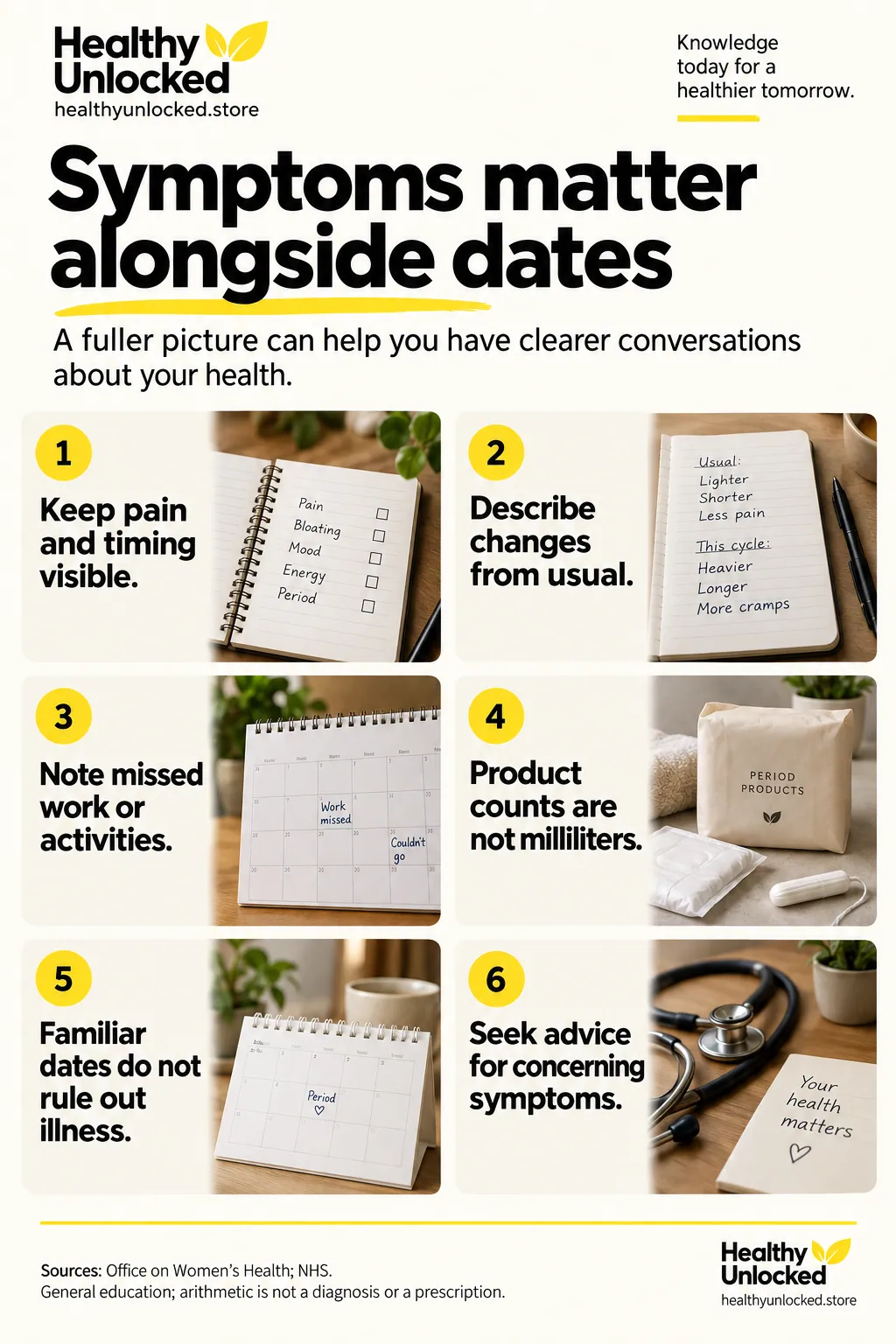
Keep symptoms alongside dates rather than in a separate forgotten note. Describe the pain, bleeding or other effect that brought you to the article. If a symptom prevents ordinary activities, that information matters even when you cannot assign it a precise score.
The NHS heavy-period information discusses practical signs and the effect on daily life. Use those questions to explain the concern at a visit. Do not estimate blood loss from a product picture or claim that every product change represents the same amount.
The NHS period-pain guidance distinguishes ordinary background from symptoms that need advice. A diary can show timing and impact, but the article cannot decide whether a pain is caused by one particular condition or prescribe medication.
You can note mood, headaches or digestive symptoms when they are relevant. An association with period dates may help a conversation, but it does not prove that hormones explain every symptom. A separate condition or another circumstance may also need attention.
If the main concern is tiredness or dizziness alongside heavy bleeding, say so clearly. Do not replace the question with an assumed nutrient deficiency or begin a treatment from an online checklist. A clinician can decide what assessment and follow-up fit the actual situation.
Use words that make the impact understandable
A note such as “missed the afternoon class because of pain” can explain more than a number without context. You do not need to disclose another person’s private information or every detail of the day. Keep the record focused on the question you want help answering.
If you use a scale supplied by a clinician, follow that scale’s instructions. This worksheet does not claim a validated severity score. Do not invent a risk category because the table has space for a symptom description.
Consider medicines and life-stage changes
Medicines and hormonal contraception can change bleeding patterns. Record what you use and any relevant recent change for the consultation. Do not stop a prescribed medicine or change contraception because a diary interval looks different from an article’s example.
Bleeding while using a hormonal method does not necessarily describe the same natural cycle process as a period without that method. Ask how to record it and what changes matter for your particular method. A calendar interval alone cannot confirm ovulation or the effectiveness of contraception.
The NHS irregular-period guidance describes different possible contexts, including life-stage and health factors. A list of possible causes is not a diagnosis. Use it to formulate a question, not to choose a condition that seems to match one detail.
After pregnancy, while breastfeeding, in the early years after periods begin or around the menopause transition, the record may need a different interpretation. Tell the clinician the relevant context rather than applying the same adult reference to every stage.
If pregnancy is possible and a period is late or missed, use appropriate pregnancy-testing and healthcare advice. Do not rely on the interval calculator to exclude pregnancy. A negative or absent calendar prediction is not a biological test.
| Context | What to bring or ask | Avoid |
|---|---|---|
| Hormonal contraception | The method and any recent change | Using a calendar as proof of effectiveness |
| Other medicines | A current list for discussion | Stopping treatment from a date result |
| Early years after periods begin | The history and current concern | Applying one adult range without context |
| Pregnancy or breastfeeding | Relevant dates and advice already received | Assuming a familiar interval excludes pregnancy |
| Menopause transition | Changes and symptoms for assessment | Ignoring unusual bleeding because of age |
| A new persistent pattern | Original entries and the main question | Choosing a diagnosis from one possible cause |
A missed entry is not a missed period
If you did not record a date, mark the information as missing. That is different from a confirmed absence of bleeding. The distinction matters when you show the diary, because a gap in record keeping can otherwise look like a biological change.
If another health condition is part of the question, include the relevant history through a private healthcare route. Do not assume that an internet explanation can decide how a thyroid condition, polycystic ovary syndrome or another issue applies to you.
Choose a private, manageable record
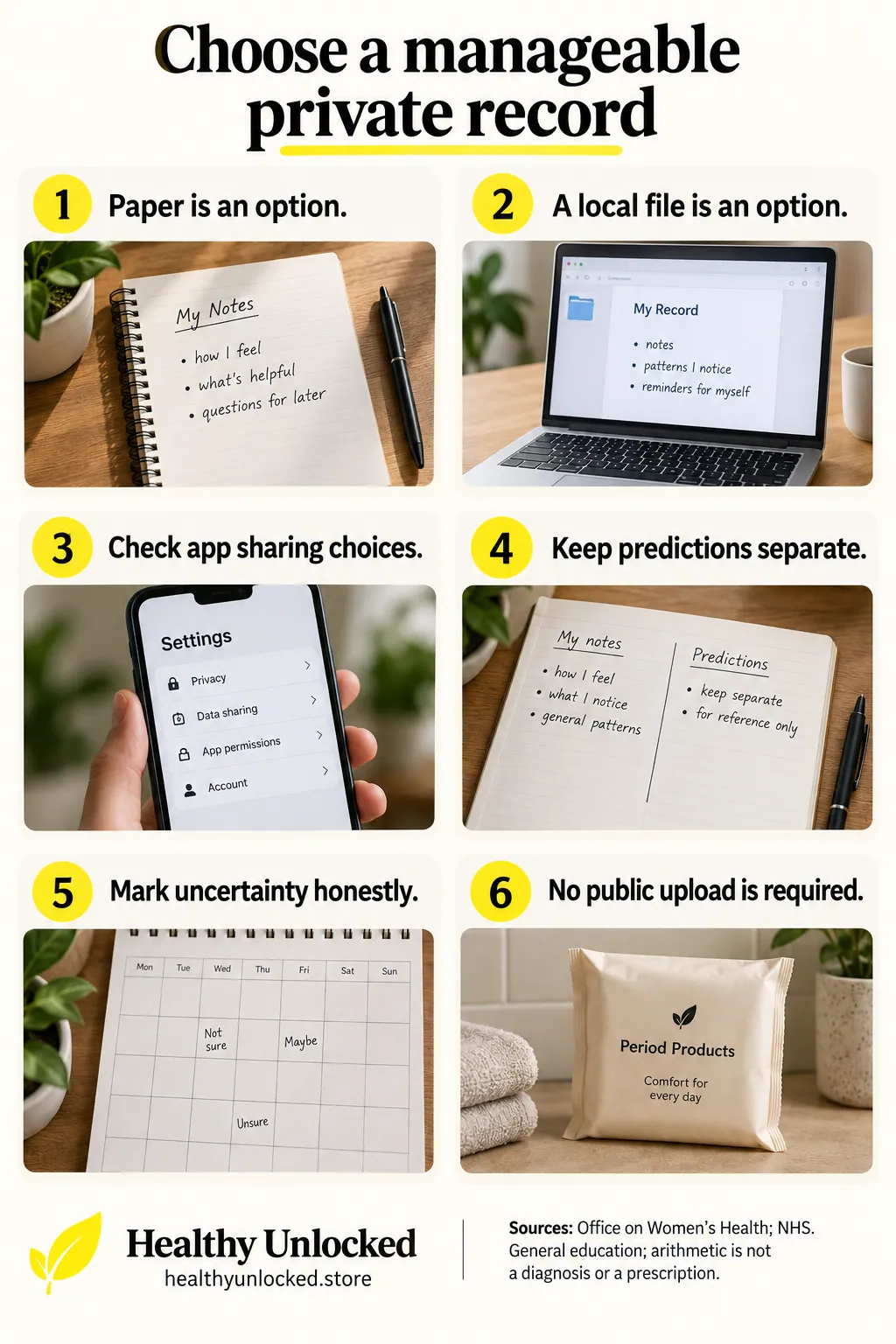
Choose a record you can keep privately. Paper, a locally saved file or a suitable app can have different practical benefits and privacy arrangements. You do not need a public account or a social-media upload to make period dates useful for a consultation.
Before using an app, look at what information it collects, where it is stored, whether an account is required and how deletion works. A convenient interface is not itself a privacy guarantee. Keep optional sensitive details out when they are not needed for your purpose.
The interval tool below uses the dates in the browser to calculate a difference. It does not ask for a name, sexual history or diagnosis. The site is not a healthcare record service, and the broader website services are described in its privacy policy.
If you download a worksheet, decide where the file will be stored and who can access the device. A local file can still be visible on a shared phone or computer. Avoid leaving a detailed personal record in a public folder or attaching it to a public comment.
For a healthcare visit, ask which route the service uses for documents. Share the relevant entries with the intended professional rather than sending a full private record through an unrelated channel. The useful amount of information depends on the question being discussed.
Keep the file understandable without adding identity details
Use clear dates and labels so the record can be read. You can keep a private name or identifier if needed by the healthcare service, but the website does not need it for arithmetic. The downloadable worksheet is a starting format, not a request to submit personal data.
Our Journal contains separate everyday-care topics. A related article can answer a background question without requiring you to reveal personal period information. Reading and using a private worksheet are different from asking the website to provide care.
When should you seek help instead of tracking longer?
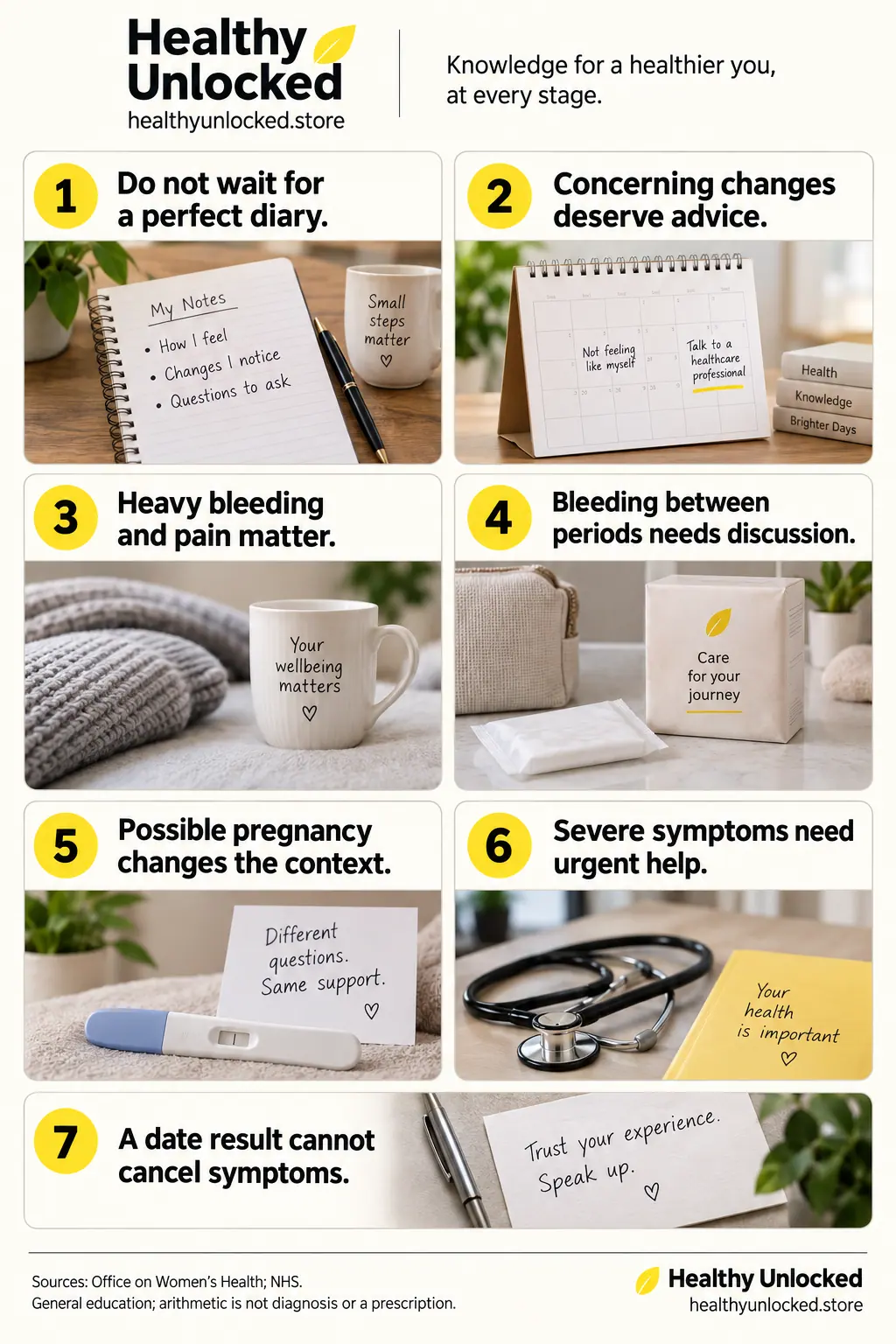
Seek advice for a persistent change, bleeding between periods, bleeding after sex, substantial pain or bleeding that disrupts ordinary life. Do not decide that a familiar date interval makes those symptoms unimportant. The reason for assessment is the whole situation, not one calendar value.
The NHS information on bleeding between periods or after sex explains why unusual bleeding deserves checking. A tracking worksheet can support the conversation, but it cannot identify the cause or safely dismiss the symptom.
Heavy bleeding with faintness, severe weakness, breathlessness, chest pain or a rapidly worsening situation can need urgent care. Severe sudden pelvic or abdominal pain also needs appropriate assessment. Do not wait to complete another cycle or calculate a new interval.
If pregnancy is possible, pain or unusual bleeding can need prompt advice. The NHS ectopic-pregnancy symptom information explains concerning features. A calendar cannot exclude this problem, and a severe or sudden situation needs appropriate urgent services.
For a non-urgent visit, bring the original dates, symptom effects, relevant medicines and your main question. Ask what happens next, whether tests are needed and which changes should prompt earlier contact. A useful record supports a plan rather than trying to replace the clinician’s assessment.
You do not have to earn an appointment with enough data
There is no requirement in this article to track several months before seeking help. If you are concerned, start the conversation with the information you have. A clinician can decide whether further recording is useful and what format fits the question.
A person who finds the topic difficult to discuss can prepare one sentence about the main concern. Plain language is enough. You should not have to use a technical diagnosis or present a polished chart to explain that bleeding or pain is affecting daily life.
Try the recorded-period interval calculator
The recorded-period calculator asks for two actual start dates: the earlier recorded start and the next recorded start. The second must be later than the first, and neither should be a future prediction. The result is the number of calendar days between them.
The calculation treats each entered calendar date as a date in a consistent arithmetic model, so clock changes do not create part-days. It subtracts the first date from the second and divides by one calendar-day unit. It does not add an extra day for the second period start.
Example one: 1 April 2026 to 29 April 2026 gives 28 days. Example two: 29 April 2026 to 30 May 2026 gives 31 days. These are completed intervals chosen to demonstrate counting. The examples do not predict a next period or classify a person’s cycle.
Invalid dates, a reversed order, identical starts, blank entries or future predicted dates should not produce a result. The tool clears a previous answer when the new input is invalid. That prevents an old interval appearing to describe a changed pair of dates.
The result has no normality grade, ovulation date, fertile window, pregnancy probability or safe-day advice. Use it only to explain the recorded interval. If you need fertility or contraceptive advice, use an appropriate healthcare source and method rather than this calendar arithmetic.
| Condition | Handling | Meaning |
|---|---|---|
| Two recorded starts | Use valid calendar dates | Actual events, not app predictions |
| Second date after the first | Calculate the date difference | No extra inclusive day is added |
| Same or reversed dates | Clear the result and ask for correction | Not a completed interval |
| Impossible or blank date | No result | A tidy number must not hide bad input |
| Future predicted start | No recorded-interval result | Prediction is a different question |
| Displayed interval | A whole number of calendar days | No diagnosis, fertility or contraceptive conclusion |
Count a recorded start-to-start interval
1 April to 29 April 2026 = 28 days. Actual past dates only; no prediction, ovulation, safe days or health grade.
1 April to 29 April 2026 = 28 days. Actual past dates only; no prediction, ovulation, safe days or health grade.
Calculations use this page’s entries in your browser; they do not save or send them to a Healthy Unlocked server. Keep downloaded files private as needed.

Use the worksheet as a record, not a forecast
The downloadable worksheet includes recorded dates, uncertainty, bleeding descriptions, symptoms and questions for the appointment. It contains the two arithmetic examples and source links. It is an original editorial worksheet, not a validated clinical instrument or a dataset of patients.
Keep a copy only if it is useful and store it privately. Follow a clinician’s requested form when you have one. The practical outcome is a clearer account of what happened and what you want help understanding.
Common questions about menstrual-cycle tracking
Is a cycle length the same as bleeding duration?
No. A cycle interval is counted from one recorded period start to the next. Bleeding duration describes the days of bleeding and should be recorded separately.
Does everyone need a 28-day cycle?
No. Patterns and context differ, and public resources use different reference ranges. This calculator does not grade an interval as normal or abnormal.
Can the calculator tell when I ovulated?
No. A difference between dates does not prove ovulation or locate a fertile window. The tool provides no conception-timing or safe-day advice.
Can I use the result to avoid pregnancy?
No. Calendar arithmetic in this tool is not contraception and cannot make unprotected sex safe. Seek appropriate advice on a suitable method.
Should I wait for several months of records before asking for help?
No. Seek advice when you are concerned, and do not delay assessment for severe pain, heavy bleeding, faintness or other concerning symptoms to finish a diary.
How should I keep the record private?
Use a suitable private format, check app data practices and store downloads carefully on shared devices. The website does not need your name or personal health history to calculate an interval.
Your next entry: write the actual date, keep the daily effect visible and mark what is uncertain. Bring a question to the visit rather than a diagnosis or a future prediction.
About this article
By Yashveer Bharani for Healthy Unlocked. Public reproductive-health and health-service sources inform this article, alongside original editorial tables and worksheets. No independent gynecologist review, clinical examination or validated questionnaire is claimed.
The calculator measures only the difference between two recorded dates. It does not predict ovulation, diagnose a condition, exclude pregnancy or provide contraception. Images explain the record-keeping topic rather than documenting clinical outcomes.
Sources and further reading
These original references support the guidance and its limits. A link does not mean that the institution reviewed or endorsed this article.
Main guidance
Practical reference
Context and definitions
Safety and care
Evidence and limitations
 Healthy Unlocked
Join the conversation
Share a practical idea or ask a question about this guide. Please keep personal medical details private.