

Summary
A healthy grocery list on a budget starts with the food you already have, a few meals you can realistically make, and the amount you will use. Compare similar products by a clear weight or volume, consider the usable portion, and leave room for preferences, allergies and safe storage. An expensive label is not a requirement for a varied meal.
This guide turns shopping into a practical decision: what is missing, how much is useful, and what the final price buys. It includes a flexible meal-based list, five comparison tables and a usable-food price calculator. The prices in the worked examples are hypothetical rupee amounts, not current market quotes or promises of savings.
What you’ll understand
- Plan before buying. Check cupboards and write a few meals that fit the week.
- Compare like with like. Pack sizes, dry foods and cooked foods need clear units.
- Count the usable amount. A lower pack price can hide more waste or less food.
- Read the label. Ingredients, allergens, dates and storage matter alongside nutrition.
- Use flexible swaps. Choose food you enjoy and can prepare, rather than a fixed menu.
- Keep the calculation in its place. A price per 100 g does not measure nutrition or food safety.
Start with these steps
- Check what needs using first.
- Choose a few workable meals and alternatives.
- Compare similar items using one unit.
- Buy an amount you can store and use safely.
General food education, not a prescribed diet, a guaranteed saving or a food-safety assessment. Do not buy an unsuitable food because its calculated unit price is lower.
What makes a budget grocery list useful?
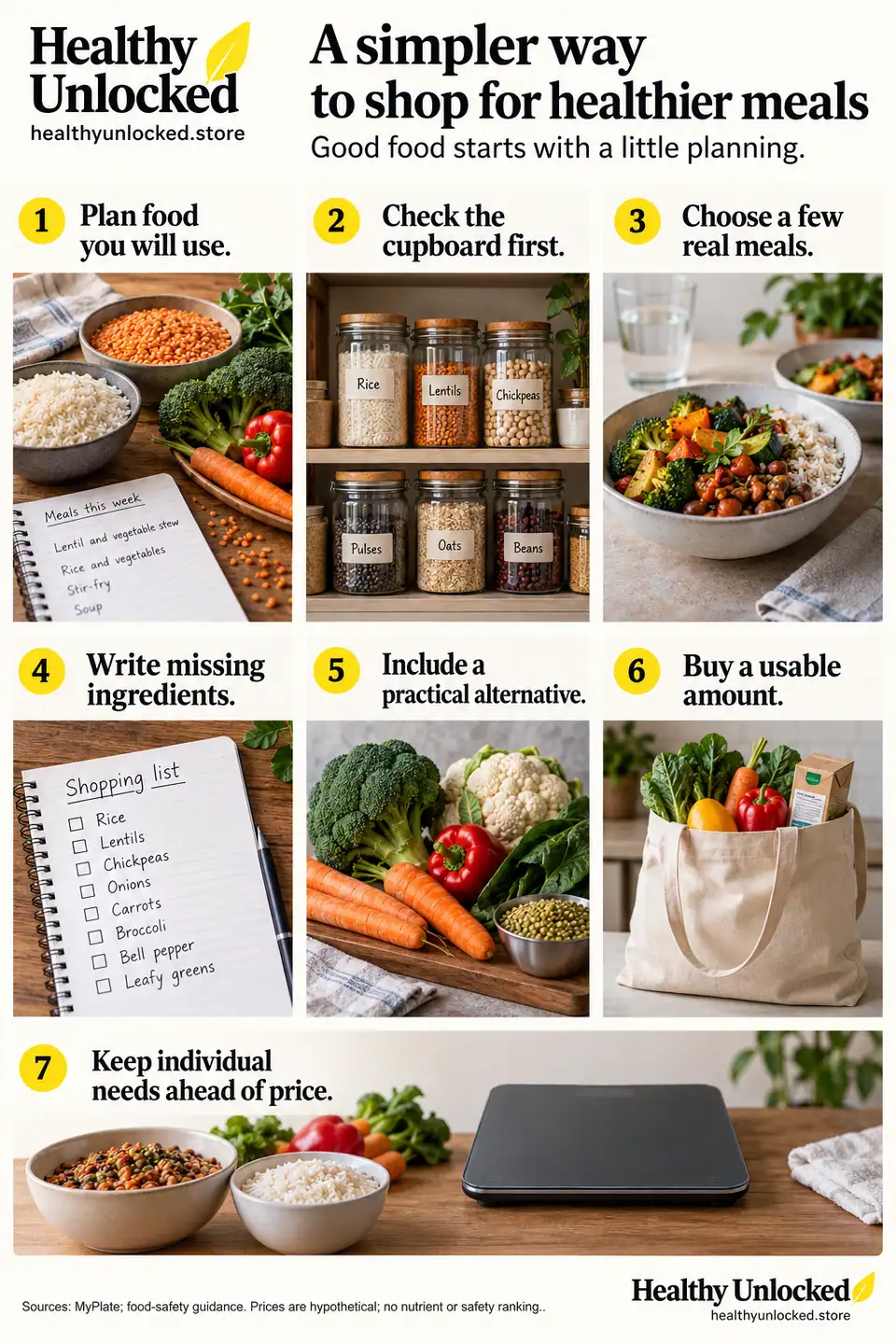
A useful list is a bridge between your cupboard and the meals you expect to eat. It should answer a few ordinary questions: what is missing, how much do you need, and when will you use it? A long list of foods called “healthy” is less helpful if it ignores the stove, refrigerator, money and time available at home.
The MyPlate budget-planning resources suggest organizing purchases around meals and comparing similar products. The planning principles can be useful across kitchens, but the linked resource is from the United States. Its shop offers, assistance programs and dollar examples are not Indian market prices or local eligibility advice.
For a familiar meal, begin with its ingredients rather than inventing a new eating identity. A dal-and-rice meal might need a pulse, grain, vegetables and the ingredients that make it enjoyable. A household eating eggs, fish or dairy may make a different list. The point is to cover the actual meals, not to make every family buy the same food.
Budget also includes what you cannot use. A large bag that spoils, a vegetable nobody will eat and a product that requires equipment you do not have can all cost more in practice than the shelf price suggests. The lowest number is useful only when the product fits the need you are trying to meet.
Our protein-and-fiber guide explains how food combinations can bring different nutrients to a meal. Use that background to build variety, then use this article to plan purchases. The shopping calculator does not convert the nutrient discussion into a “best food” score.
| Decision | Example of a useful note | Why it helps |
|---|---|---|
| Meals to cover | Three dinners at home and two packed lunches | Connects purchases to real use |
| Food already available | Rice, one pulse and frozen vegetables | Avoids buying the same staples again |
| Fresh food needed | Enough vegetables for the planned meals | Makes the quantity explainable |
| Alternative | Another familiar pulse if the first is unavailable | Keeps the list flexible |
| Storage limit | One shelf of refrigerator space | Prevents a bulk purchase that does not fit |
| Individual need | An allergy or a clinician-advised restriction | Stops a cheap unsuitable item becoming the default |
A list can be useful without being perfect
You do not have to predict every meal. Start with the meals you know about and leave a small amount of flexibility for changed plans. A list that is easy to adjust is more practical than one that treats a missed dinner as a failure.
If money is very tight, separate essentials for the next few days from optional extras. This article cannot decide the household budget or guarantee that a particular food is affordable. It can help make the decision visible, so that a promotion does not replace the priorities you had before entering the shop.
Start with food you already have
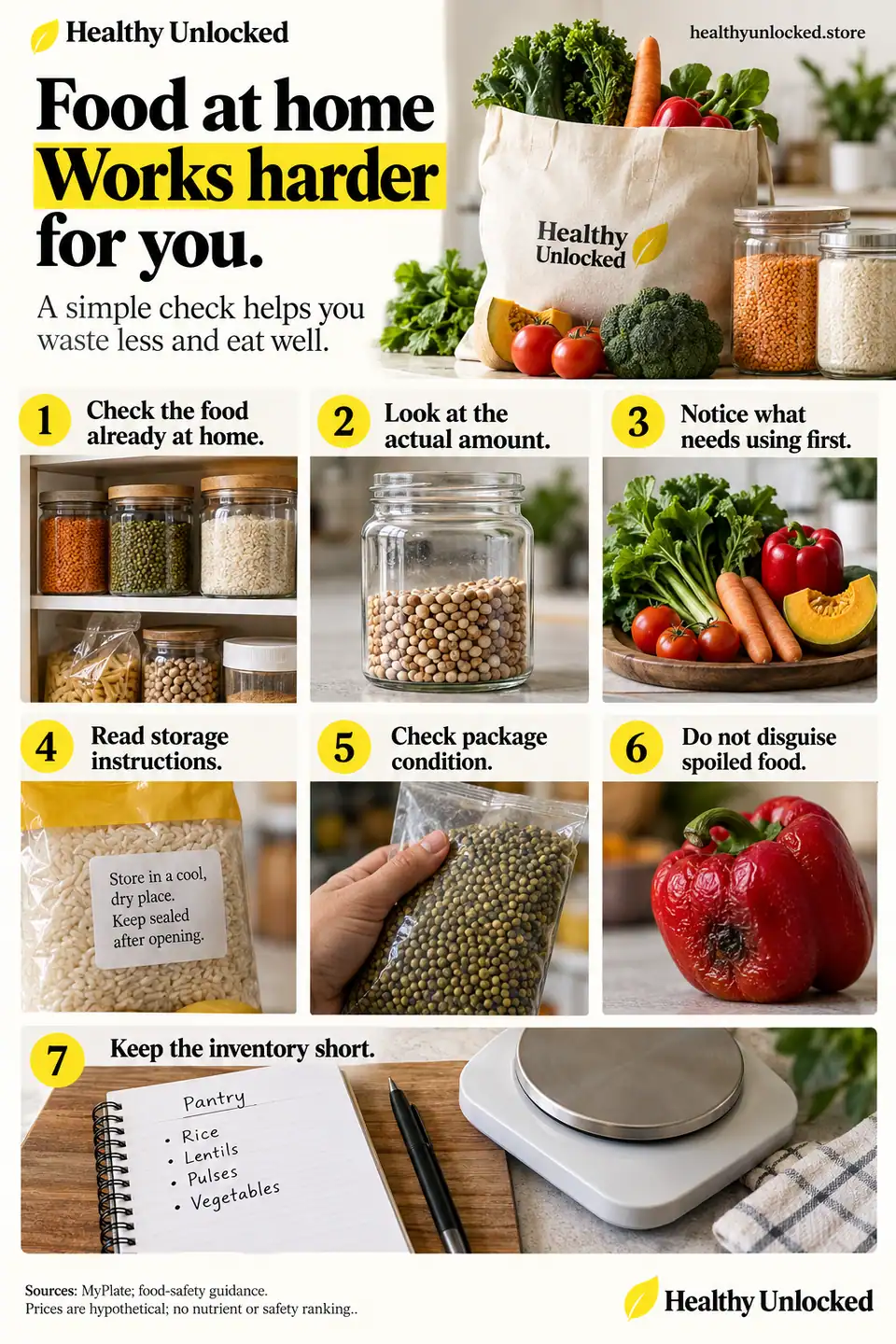
Before opening a shopping app or visiting the market, look at the food already available. Check cupboards, the refrigerator and any freezer space you use. Write a short “use first” note for ingredients that need attention, then build a meal around them when they remain suitable and safe.
Check the actual amount, not only the container. A nearly empty rice jar and a full one lead to different purchases. If measuring every staple is too much work, use a simple note such as “enough for two meals” and make clear that it is an estimate. Precision matters most when it changes the buying decision.
Read storage instructions and the relevant date information on packaged food. Do not treat a planning list as permission to eat a questionable product. A damaged package, an uncertain storage history or signs of spoilage need a safety decision, not a creative recipe intended to avoid waste at any cost.
Avoid assuming that “leftover” means a product can wait indefinitely. The FoodSafety.gov storage chart gives category-specific background. Follow the actual product instructions and appropriate local advice; different foods and storage conditions have different limits.
Keep the inventory short enough to use. A few lines for staples, fresh food and items needing attention will often be enough. The purpose is to reduce forgotten duplicates and connect the next purchase to a meal, not to create a second job managing a spreadsheet.
| Area | What to check | Next action |
|---|---|---|
| Dry staples | Amount, package condition and storage instructions | Write only what is missing |
| Fresh produce | Condition and a realistic plan to use it | Choose a meal or an appropriate alternative |
| Refrigerated food | Date, storage history and product instructions | Use safely or make the appropriate disposal decision |
| Frozen food | What is present and whether storage remained appropriate | Plan use without assuming freezing fixes every problem |
| Opened packets | Name, opening date when useful and instructions | Avoid buying a duplicate without checking |
| Cooking basics | The ingredients needed for the planned meals | Keep the list specific rather than adding every spice |
Turn an ingredient into a meal before adding more
If you have a pulse and a grain, you may need vegetables or another familiar accompaniment rather than another large pack of the same staple. Look at the combination on the plate. Food variety can come from small changes across meals, not only from filling the trolley with many separate products.
When more than one person shops for the household, share a short list and agree how to mark an item as bought. A simple duplicate purchase can undo careful price comparisons. Keep private health details out of a shared list unless the household needs that information and you are comfortable sharing it.
Build a flexible list around real meals
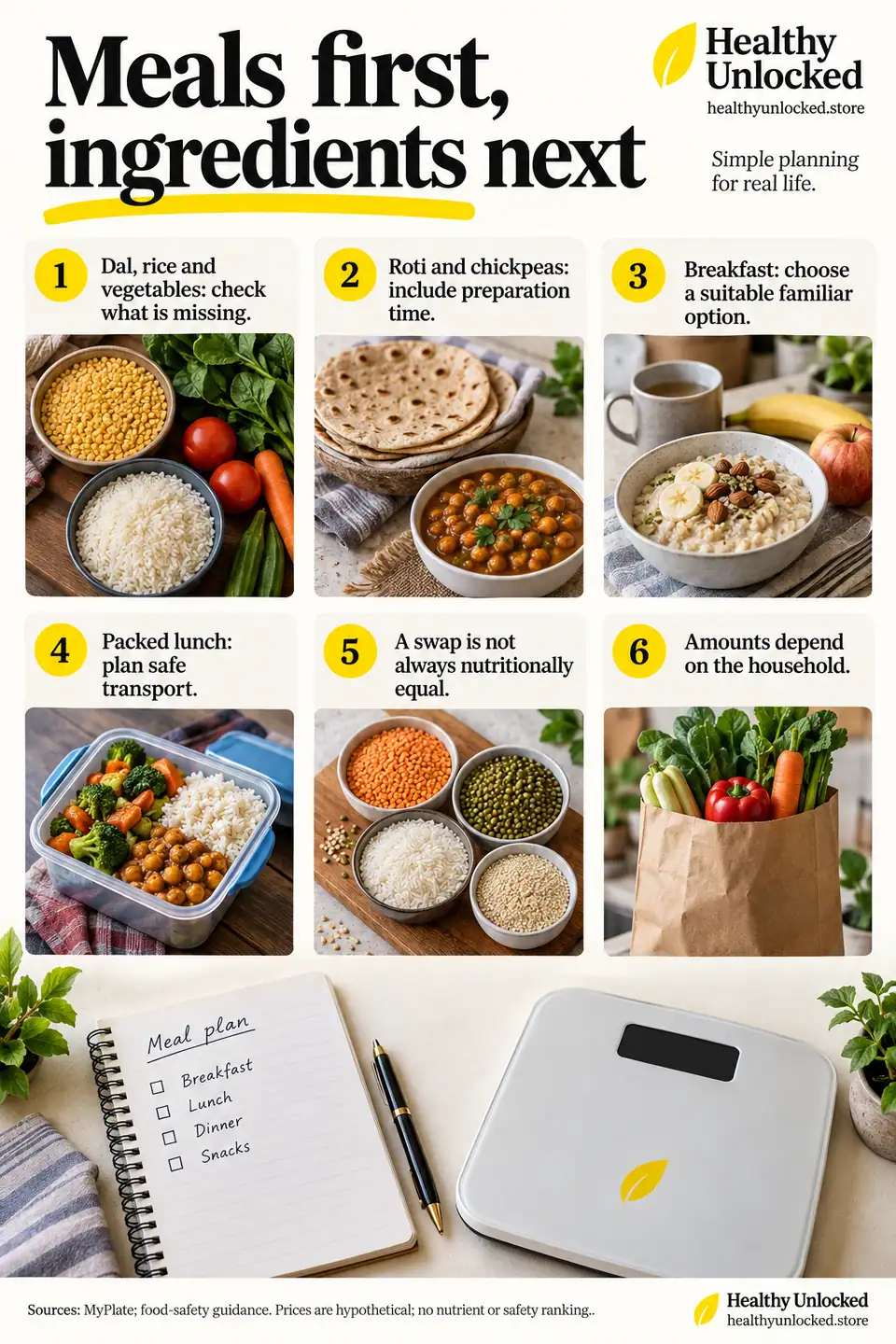
Write meal ideas first, then turn them into ingredients. Choose examples you can actually prepare on the busiest day, not only recipes that suit a free weekend. A plan might include a pulse-based meal, a vegetable-and-grain meal and a simple breakfast, with alternatives for a changed schedule.
Use categories to make the list easier to scan: grains or other staples, pulses or other protein foods, vegetables and fruit, and any dairy or other items your household uses. These are shopping categories, not a prescribed portion formula. The required amounts depend on who is eating and what else is in the meal.
Include preparation details when they matter. Dry chickpeas need a different plan from a ready-to-use product. A cheaper dry item may fit one kitchen well and be impractical in another. Time, water, fuel and equipment are real constraints; comparing only the packet price can hide them.
Build in a small number of sensible alternatives. “Any familiar seasonal vegetable suitable for this dish” can work better than insisting on one expensive item. An alternative should fit the meal and the household’s needs. It is not automatically equal in nutrients, allergens or cooking requirements.
You can also plan how an ingredient appears in more than one meal. A vegetable may work in dinner and the next day’s lunch. That can simplify shopping, but prepare and store food safely rather than assuming that a reuse plan overrides storage limits. A flexible list is useful only when the food remains suitable.
| Meal idea | Check at home | Buy if needed | Practical alternative |
|---|---|---|---|
| Dal, rice and vegetables | Pulse, rice and cooking basics | Vegetables and missing staples | Another familiar pulse or grain |
| Roti, chickpeas and vegetables | Flour and prepared or dry chickpeas | Missing ingredients for the planned amount | A familiar bean dish with a workable preparation plan |
| Plain yogurt with fruit and oats | Yogurt storage and available oats | An amount of fruit you will use | Another suitable breakfast your household enjoys |
| Eggs with a grain and vegetables | Eggs, bread or another grain | Missing vegetables or staples | A suitable pulse-based meal if preferred |
| Packed lunch from planned ingredients | Container, storage and reheating arrangements | Only the missing parts | A simpler meal that fits safe transport |
Use an amount that fits the people eating
The worksheet deliberately does not assign the same portion to every reader. Household size, appetite, other meals and individual advice change the amount needed. If you already use a suitable household measure, write that measure and the number of meals instead of copying a serving from an unrelated chart.
Our Journal includes broader everyday-care reading. Use a related guide when it answers a real question, but do not add products to the list merely because an article mentions them. The shopping plan should stay connected to the meals you chose.
Compare prices without confusing quantities
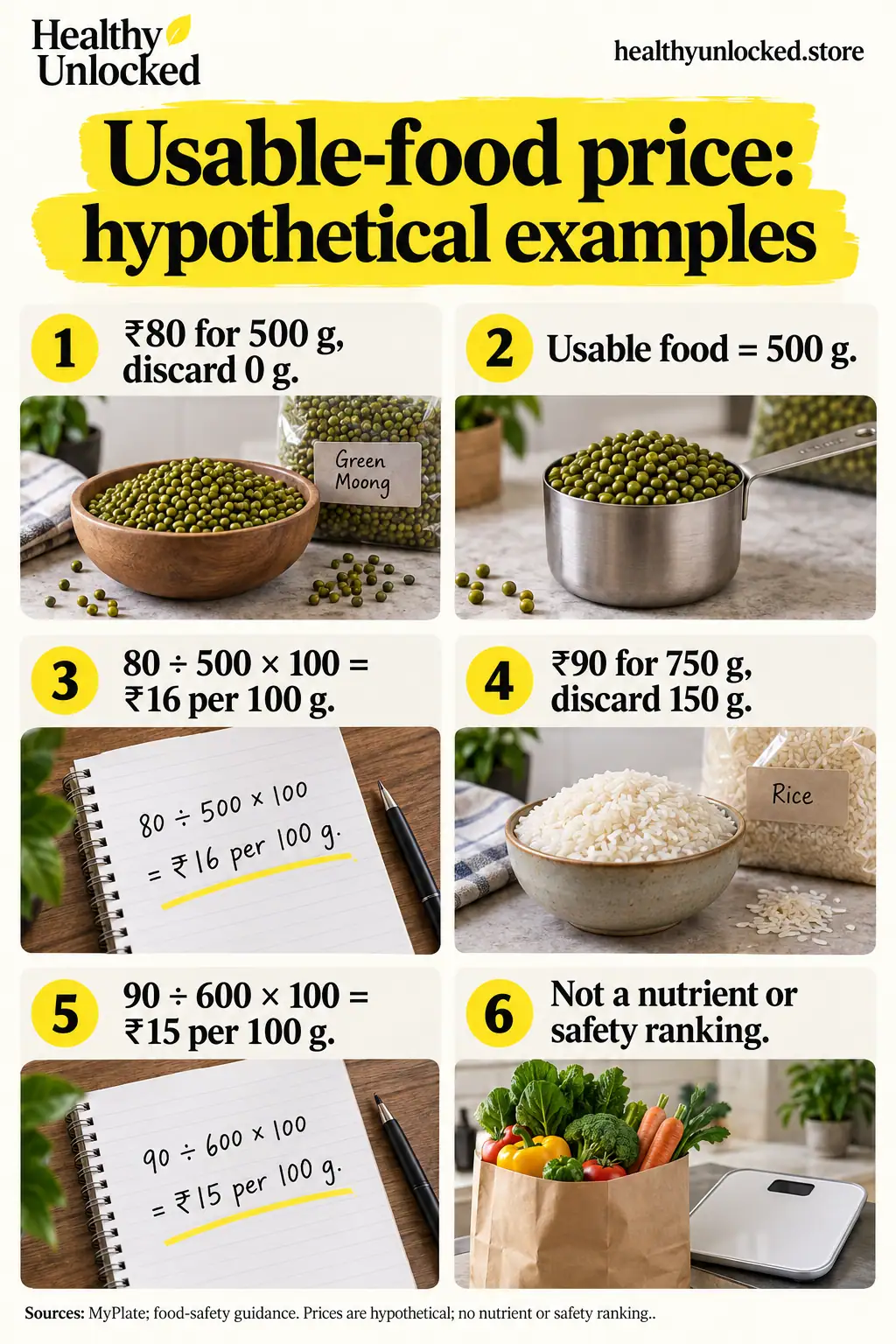
A pack price answers what you pay for that pack. A unit price answers what the same amount costs. They are different questions. To compare two similar dry products, choose one unit, such as price per 100 grams, and use the net food weight stated on the package rather than the weight of the packaging.
The MyPlate budget-shopping tip sheet illustrates comparing similar products by unit price. Our examples use hypothetical rupee amounts so the arithmetic is familiar. They are not a survey of shops, a current price list or a claim that a particular brand is cheapest.
For some foods, the usable portion changes the comparison. A weight that includes parts you will discard can exaggerate how much food reaches the kitchen. Estimate the discarded amount honestly, subtract it from the net food weight, and label the result as an estimate. Do not make up a precise yield from appearance alone.
Do not compare dry and cooked weights as if they were the same product state. Cooking can change weight through water absorption or loss. A price per 100 grams of dry food and a price per 100 grams of cooked food answer different questions. Keep the preparation state visible before drawing a conclusion.
A lower unit price does not establish equal nutrition, equal taste or equal safety. Compare like categories where possible, then consider whether the food fits the meal. The calculator cannot decide that peanuts and almonds, for example, are interchangeable for somebody with an allergy or that equal weights contain equal nutrients.
| Input or result | Example A | Example B |
|---|---|---|
| Purchase price | ₹80 | ₹90 |
| Net food weight | 500 g | 750 g |
| Estimated discarded part | 0 g | 150 g |
| Estimated usable food | 500 g | 600 g |
| Price per 100 g of usable food | 80 ÷ 500 × 100 = ₹16 | 90 ÷ 600 × 100 = ₹15 |
| What the result means | Cost of the entered usable weight | Not a nutrient, quality or safety ranking |
A promotion can change the amount you buy
Check whether a multi-buy offer requires more food than you will use. The unit price may be lower while the total spend is higher. That can be a sensible choice for a staple that stores safely, but it may be a poor fit for a perishable product or a limited budget today.
Include any actual additional costs in the purchase price when they belong to the comparison, and make the basis consistent. A shop price and an online price with delivery charges are not the same transaction. This worksheet does not calculate shipping, fuel or discounts automatically; enter a clearly chosen final amount.
Read the details behind a front-of-pack claim
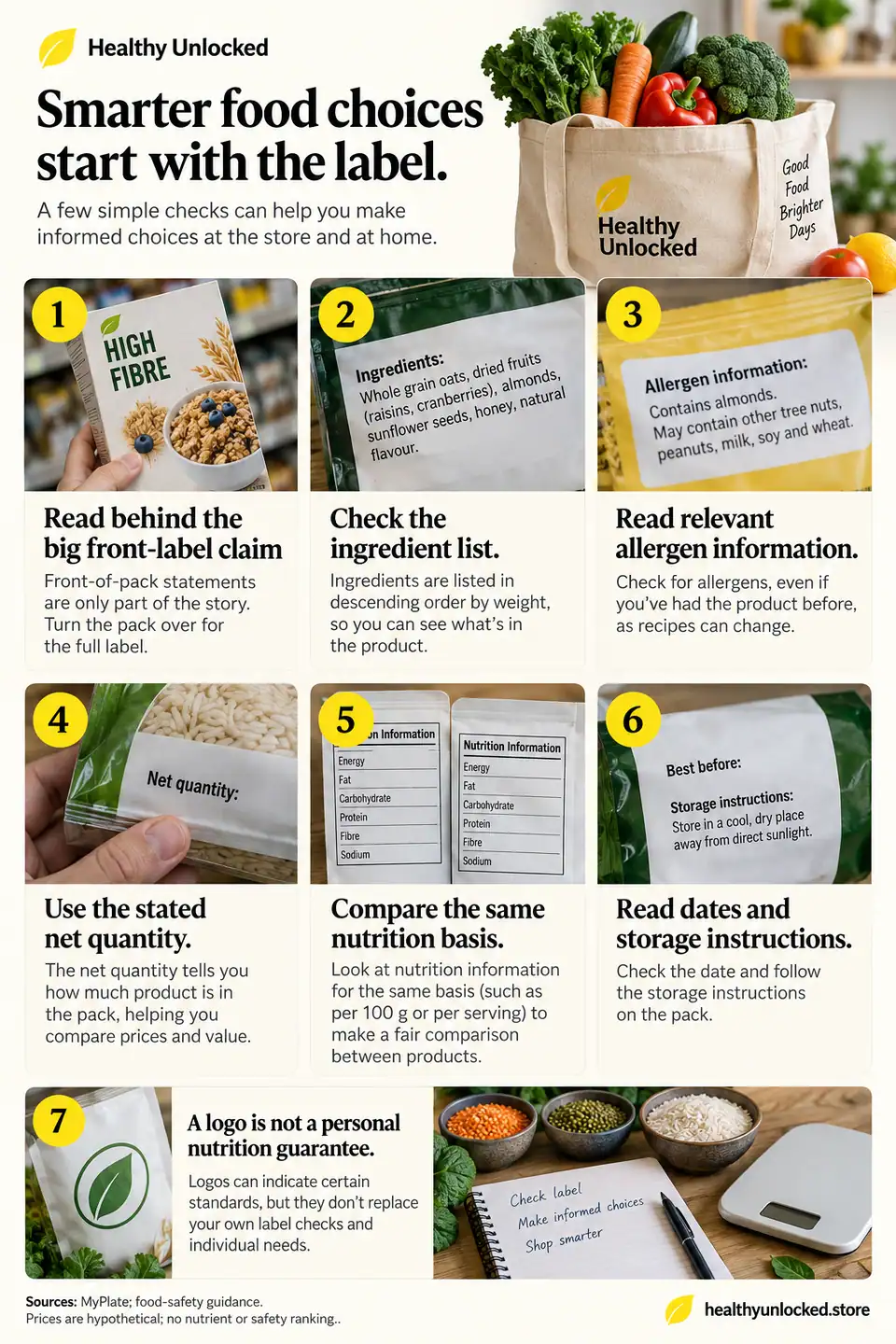
A front-of-pack phrase can attract attention without answering the questions that matter for your meal. Turn the package around and read the ingredient list, allergen information, net quantity, nutrition information, date and storage instructions. Different parts of the label serve different purposes.
Nutrition amounts may be listed per 100 grams, per serving or using another stated basis. Compare the same basis when possible and check what the serving means. A small declared serving does not mean that eating a larger amount leaves the nutrient total unchanged. The price calculator does not calculate those nutrients for you.
An ingredient or an allergen that is unsuitable for your household remains unsuitable even when the price is attractive. Read the relevant warning rather than relying on the product name or a picture. If you have medical dietary advice, use that advice when it differs from an ordinary shopping example.
The FSSAI consumer information hub provides an Indian route to food-safety information and consumer services. Official registration or a logo does not mean that a product is the right nutritional choice for every person. It also does not replace checking the actual package and storage conditions.
Keep claims in proportion. Words such as “natural,” “high protein” or “superfood” should not replace a reading of the product details. A familiar ordinary food may fit your meal well, while a heavily promoted product may add cost without answering the need on your list. The decision depends on the food, amount and context.
An unclear label is a reason to ask, not guess
If the net quantity, storage requirement or allergen information is unclear, ask the seller or manufacturer for appropriate information. Do not invent an answer because the calculator needs a number. The tool is optional; a shopping decision should not depend on filling every field.
For unpackaged produce, use the actual purchased weight and your own clearly labeled estimate of the usable amount. Do not claim the same accuracy as a verified package declaration. The comparison is a practical estimate, and uncertainty should remain visible in the note you save.
Buy only what you can store and use safely
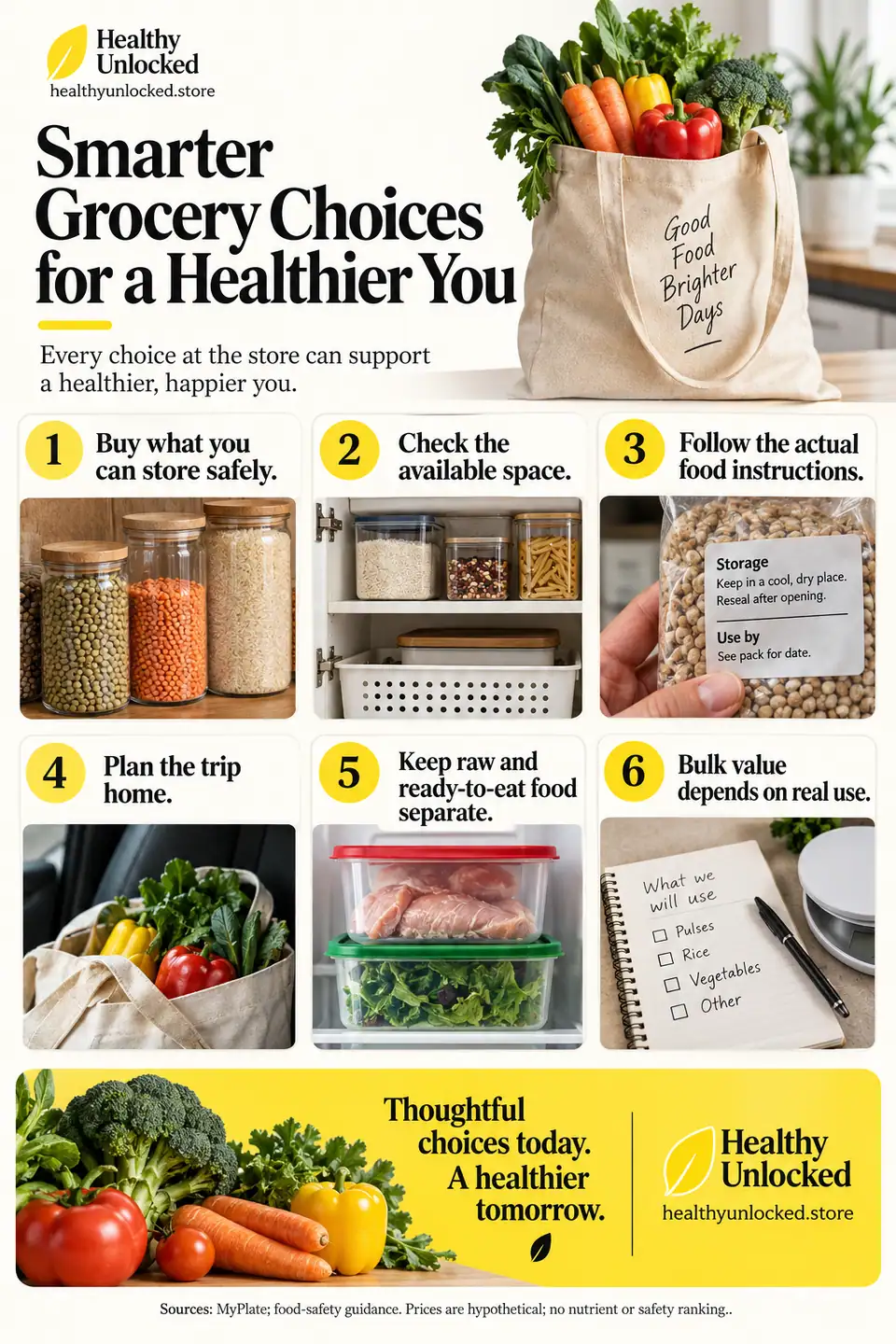
Before buying a large pack, decide where it will go and how it will be used. A cupboard staple, refrigerated food and frozen food have different requirements. Storage space is not an afterthought: it helps determine whether the amount you plan to buy is workable.
Plan the trip home and any packed-lunch transport when temperature-sensitive foods are involved. Do not assume that a lower price compensates for unsuitable storage. The FoodSafety.gov food-safety overview separates cleaning, separation, cooking and chilling as distinct responsibilities.
Keep raw foods and ready-to-eat foods appropriately separated. A shopping bag and a refrigerator shelf can both matter. Follow the product instructions and suitable food-safety guidance, especially when food is being prepared for somebody with greater vulnerability to foodborne illness.
Buy an amount that fits the expected use. A larger pack is not automatically the more economical option if much of it will be discarded. If sharing or freezing is part of the plan, check that it is appropriate for that food and storage arrangement rather than treating every product as suitable for the same method.
Waste prevention should stay compatible with safety. Using a suitable ingredient in another meal is practical; disguising spoiled food or ignoring an uncertain cold-storage history is not. The calculator describes the price of the amount entered and cannot inspect food or decide whether it is safe.
Make the next use easy to remember
A brief note on the list can say which ingredient belongs to which meal. If a product has specific instructions after opening, keep those instructions available. Clear labeling can prevent a forgotten item becoming a second purchase or a guess about how long it has been stored.
For a shared kitchen, agree who will use the food and when. A bargain can become waste when everybody assumes somebody else has a plan for it. A small coordinated purchase may be more useful than a larger pack bought without that conversation.
Choose swaps that fit your kitchen and needs
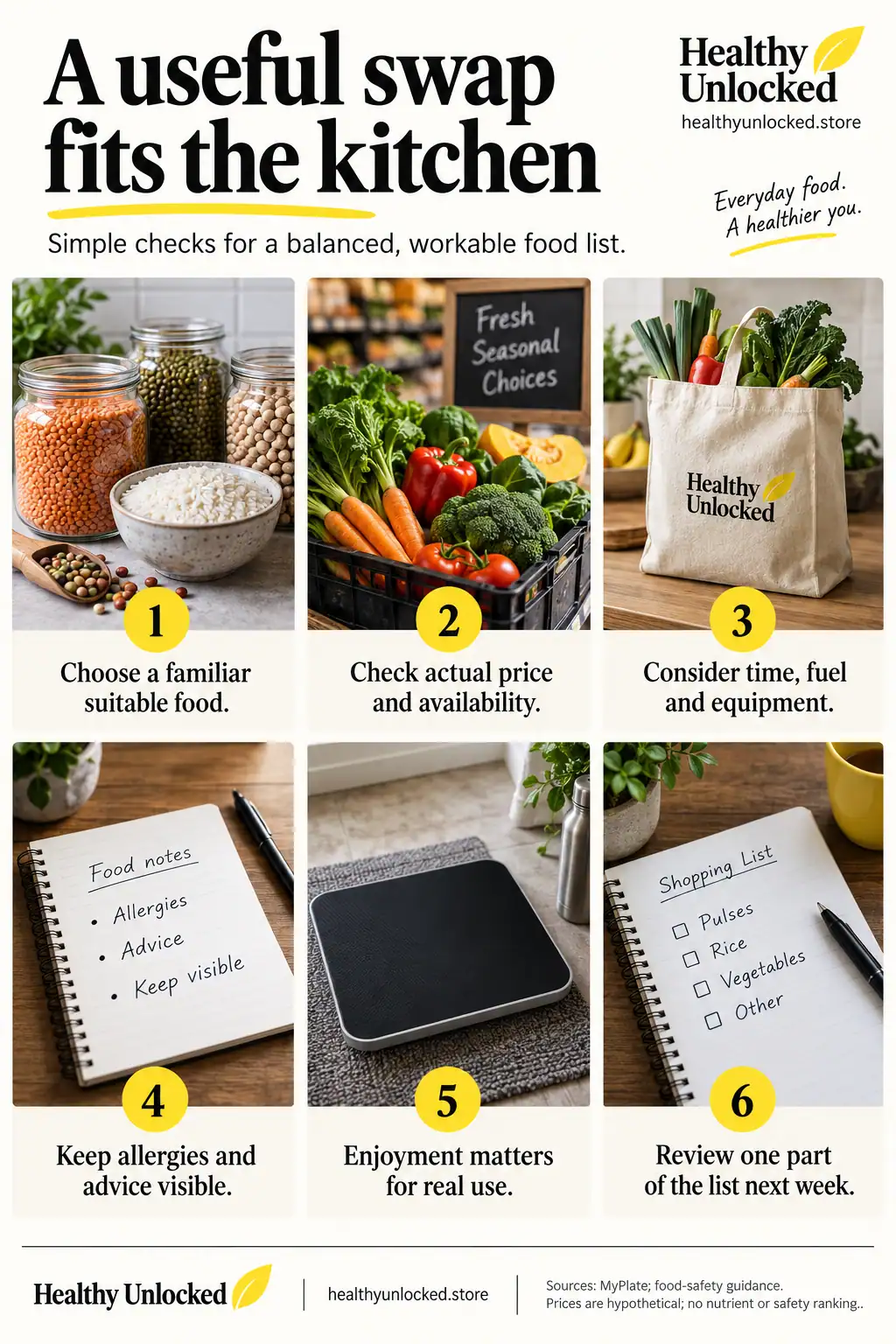
A useful swap solves a practical problem while still fitting the meal. It may be another familiar vegetable, pulse or grain that is available and suitable. Do not assume every swap is equal in nutrients, allergens, preparation time or flavour. The worksheet is a planning aid, not a nutrient-equivalence chart.
Seasonal or locally available produce can be worth considering, but price and availability vary by place and day. There is no universal list that is always cheapest. Compare what is actually available, consider the edible amount and choose something you expect to use.
Convenience can have value. A ready-to-use product may cost more per gram but fit a day when preparation time or equipment is limited. A dry staple may be more suitable when you can prepare and store it safely. Make the trade-off explicit rather than judging the household by one type of purchase.
For someone with an allergy, a digestive difficulty or a medical dietary restriction, a common budget recommendation may not fit. Use the relevant individual advice and ask for suitable alternatives. Do not use a lower unit price as a reason to challenge an established restriction.
Keep enjoyment in the plan. A food that nobody wants to eat is unlikely to become useful simply because it is inexpensive. Familiar cooking styles, manageable preparation and a few flexible options can make a budget list more durable than a strict menu copied from another household.
A useful weekly review is brief
After the week, ask which purchases were used, which were duplicated and which were impractical. Change one part of the next list. You do not need to calculate a perfect household efficiency score or blame yourself for a changed work schedule.
If a planned meal was skipped, consider whether the remaining food is still suitable and how it can be used safely. Sometimes the right change is a smaller amount next time. The lesson is a clearer plan, not a promise that every week can be predicted.
Try the usable-food price comparison
The tool compares the purchase price with the estimated usable food weight. Enter a price in rupees, the net food weight in grams, and the estimated grams you will not use. Use the same preparation state and a genuinely comparable food category when comparing results.
The formula is: usable weight = net food weight minus discarded weight. Price per 100 grams of usable food = purchase price divided by usable weight, multiplied by 100. The calculation includes only the values you enter; it does not retrieve market prices, measure nutrient content or estimate cooking fuel.
Example one: a hypothetical ₹80 purchase contains 500 grams of food, all entered as usable. The calculation is 80 ÷ 500 × 100, giving ₹16 per 100 grams. Example two: a hypothetical ₹90 purchase weighs 750 grams, with 150 grams entered as discarded. The usable amount is 600 grams and the calculation gives ₹15 per 100 grams.
The second result describes a lower price for the entered usable weight, not proof that the food is a healthier or safer choice. An estimated yield can change, and the example does not compare actual products. Keep the raw numbers in the saved note so somebody else can understand the result.
The calculation happens in your browser and does not ask for a name, medical history or household income. The site is not a personal shopping-record service. Save your own result if needed, and read the site privacy policy for the services used by the website.
| Field or condition | Handling | Meaning |
|---|---|---|
| Purchase price | A finite amount greater than zero | A paid purchase, not a current price fetched by the site |
| Net food weight | A finite number greater than zero | Food weight in grams, excluding the package |
| Discarded weight | Zero or more, smaller than net food weight | Your estimate, not an automatic yield measurement |
| All food discarded | No result | A price per usable gram is undefined |
| Blank, negative or non-finite input | Clear the previous result and show a correction | An invalid entry must not leave a misleading answer |
| Displayed amount | Rounded to two decimal places after calculation | No nutrient or safety ranking is produced |
Compare usable-food unit price
₹80 ÷ 500 g × 100 = ₹16 per usable 100 g. Hypothetical prices; not equal nutrition, market quotes or safety.
₹80 ÷ 500 g × 100 = ₹16 per usable 100 g. Hypothetical prices; not equal nutrition, market quotes or safety.
Calculations use this page’s entries in your browser; they do not save or send them to a Healthy Unlocked server. Keep downloaded files private as needed.
Use the worksheet to explain the decision
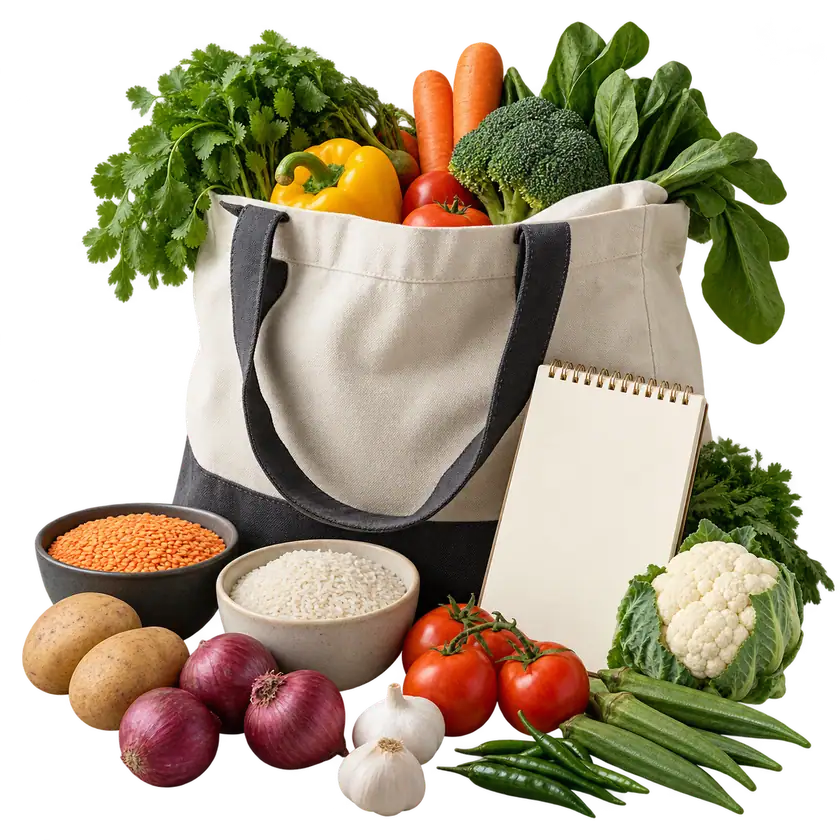
The downloadable worksheet records the meal idea, actual purchase details, chosen weight basis and calculation. Leave fields blank when you do not know them, and label an estimate. The file is an editorial worksheet, not a published market-price dataset or a source of medical advice.
Compare the result with the practical questions from the beginning: will you eat it, can you prepare it, can you store it, and does it fit your household? The calculation is one part of that decision. It should make the choice clearer rather than replace the rest of the information.
Common questions about budget food shopping
Is a larger pack always better value?
No. A lower unit price can be useful, but the total spend, storage requirements and amount you will actually use also matter. Compare similar products and avoid buying more simply to qualify for a promotion.
Can I compare dry and cooked food by the same weight?
Not without keeping the preparation state clear. Cooking changes weight through water absorption or loss. A price per 100 grams of dry food and a price per 100 grams of cooked food describe different states.
Does a lower price per 100 grams mean a healthier food?
No. The calculator measures the cost of the entered usable weight. It does not compare nutrients, allergens, food safety, taste or individual dietary needs.
Are the rupee examples current local prices?
No. They are hypothetical amounts chosen to demonstrate the formula. Enter your actual purchase price and clearly label any estimate of the usable weight.
What should I do when I cannot estimate the discarded part?
Do not invent a precise yield. Use a clearly labeled estimate if it is reasonable, or compare the declared net weight and keep the uncertainty visible. The tool is optional.
Can the worksheet tell whether food is safe to eat?
No. Follow appropriate food-safety guidance and product storage instructions. Do not eat questionable food or buy an unsuitable item because a calculation makes its price look attractive.
Your next shopping trip: check one cupboard, choose a few meals, and write only the missing ingredients. Compare a sensible amount you can use, then keep safety and individual needs alongside the price.
About this article
By Yashveer Bharani for Healthy Unlocked. This article combines public food-planning and food-safety resources with original editorial worksheets. The prices are hypothetical and the usable amounts are user estimates; no market survey, recipe testing or independent dietitian review is claimed.
The calculator applies the formula printed above. Photographs and infographics support the explanation; they do not document tested meals or establish nutritional equivalence. This is general education, not personal dietary advice.
Sources and further reading
These original references support the guidance and its limits. A link does not mean that the institution reviewed or endorsed this article.
Main guidance
Practical reference
Context and definitions
Safety and care
Evidence and limitations
 Healthy Unlocked
Join the conversation
Share a practical idea or ask a question about this guide. Please keep personal medical details private.