
Summary
A beginner beard-care routine needs gentle cleaning, a moisturizing product your skin tolerates, and careful grooming. Care for the skin underneath the beard as well as the hair. A longer beard does not automatically need more products, and beard oil is not a proven treatment for growing new hair.
This guide helps you organize ordinary care without building a crowded bathroom shelf. Compare the jobs of common products, follow practical cleaning and trimming checks, and use a checklist that separates essential care from optional styling.
What you’ll understand
- Clean the skin too. Work gently through the beard and rinse well; vigorous scrubbing is unnecessary.
- Choose for comfort. Skin sensitivity and product tolerance matter more than scent or shine.
- Go slowly with trimming. Check the manual, start conservatively and reassess before taking more hair off.
- Keep tools personal. Clean and store them as instructed; do not share razors.
- Check problems separately. Persistent rash, painful bumps or sudden hair loss need assessment.
- Use a short checklist. The planner counts selected tasks, not skin health or treatment success.
Start with these steps
- Check which suitable cleanser, moisturizer and clean tools you already have.
- Choose one comfortable cleaning-and-moisture sequence.
- Add combing or trimming only when relevant to your beard.
- Review comfort and seek appropriate care for persistent or concerning changes.
General grooming education, not diagnosis or a prescription. Seek urgent help for severe swelling or breathing difficulty after using a product.
What does a beginner beard-care routine need?
A beard-care routine is the repeated care of facial hair and the skin beneath it. Start with the jobs that need doing: remove everyday buildup gently, keep skin comfortable, and manage the hair in a way you prefer. Styling products come after those jobs, rather than replacing them.
The American Academy of Dermatology’s beard-care guidance describes a simple cleaning, moisturizing and grooming approach. Treat that as a practical foundation. Your beard length, the way products feel on your skin, and whether you shave any edges determine the details.
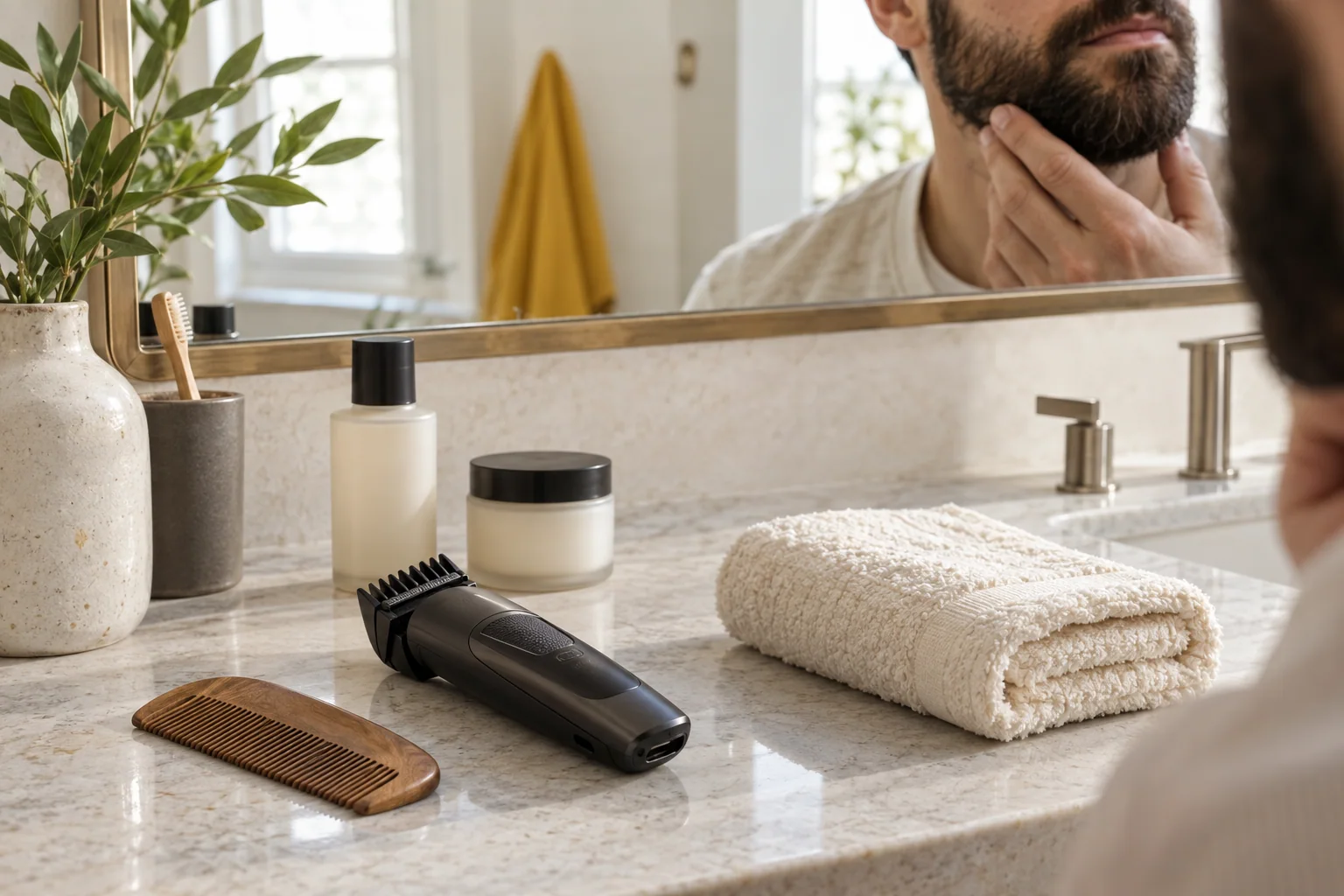
Begin by looking at your bathroom shelf. A suitable facial cleanser may already do the cleaning job. A tolerated moisturizer may already suit exposed skin. You may already own a clean comb and a guarded trimmer. Buying a separate bottle for every possible step can make it harder to notice what helps or causes irritation.
Think of hair appearance and skin comfort as two related but different checks. Hair can look shiny while the skin underneath feels tight. A freshly shaped beard can still hide a sore bump. Look beyond the surface: is the routine comfortable, manageable, and easy to repeat without pulling or stinging?
You do not need to grow the fullest beard in the room to care for it well. Different growth patterns suit different styles. A practical goal is clean, comfortable hair and skin, with a shape you like. Avoid turning ordinary variation into a problem that every new product promises to fix.
| Care job | A practical starting point | What it does not prove |
|---|---|---|
| Cleaning | Gentle cleanser, thorough rinsing and a clean towel | That stronger scrubbing is better |
| Moisture | One suitable product applied as directed | That every beard needs oil and balm together |
| Grooming | Gentle detangling and controlled trimming if wanted | That shorter or fuller hair is healthier |
| Observation | Notice comfort and meaningful changes | A diagnosis from appearance alone |
Keep a routine different from a treatment plan
Ordinary cleaning and grooming are not the same as treating acne, dermatitis or an infection. If a routine starts to include medicated products, growth medicines, or repeated attempts to hide a rash, pause and ask an appropriate clinician what the actual problem is. Do not combine treatments because separate online lists recommend each one.
For the rest of the face, our beginner skin-care guide explains cleansing, moisture and sun protection. Keep the beard routine compatible with the facial routine you already tolerate, rather than adding two overlapping sets of products.
How should you clean your beard and the skin beneath?
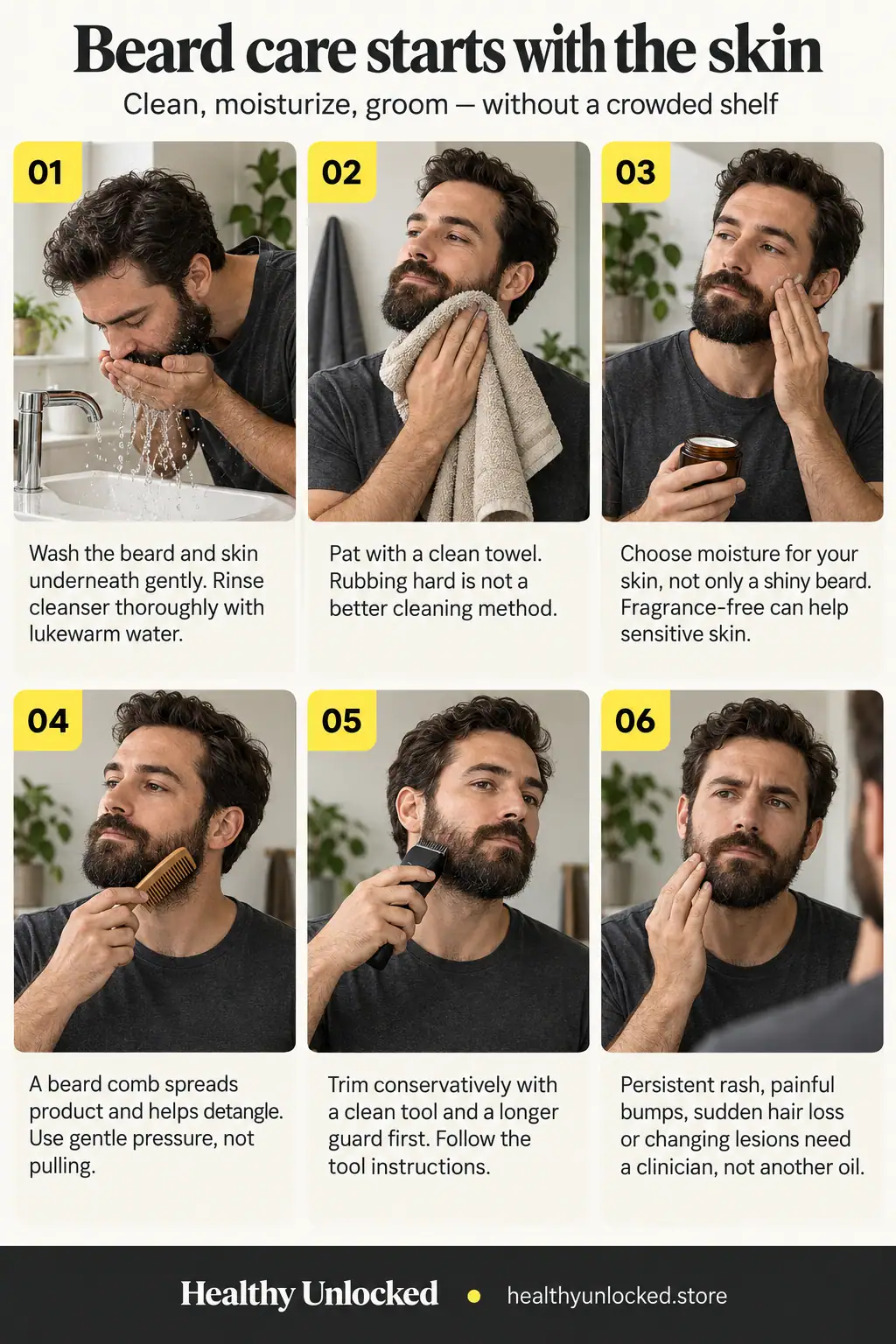
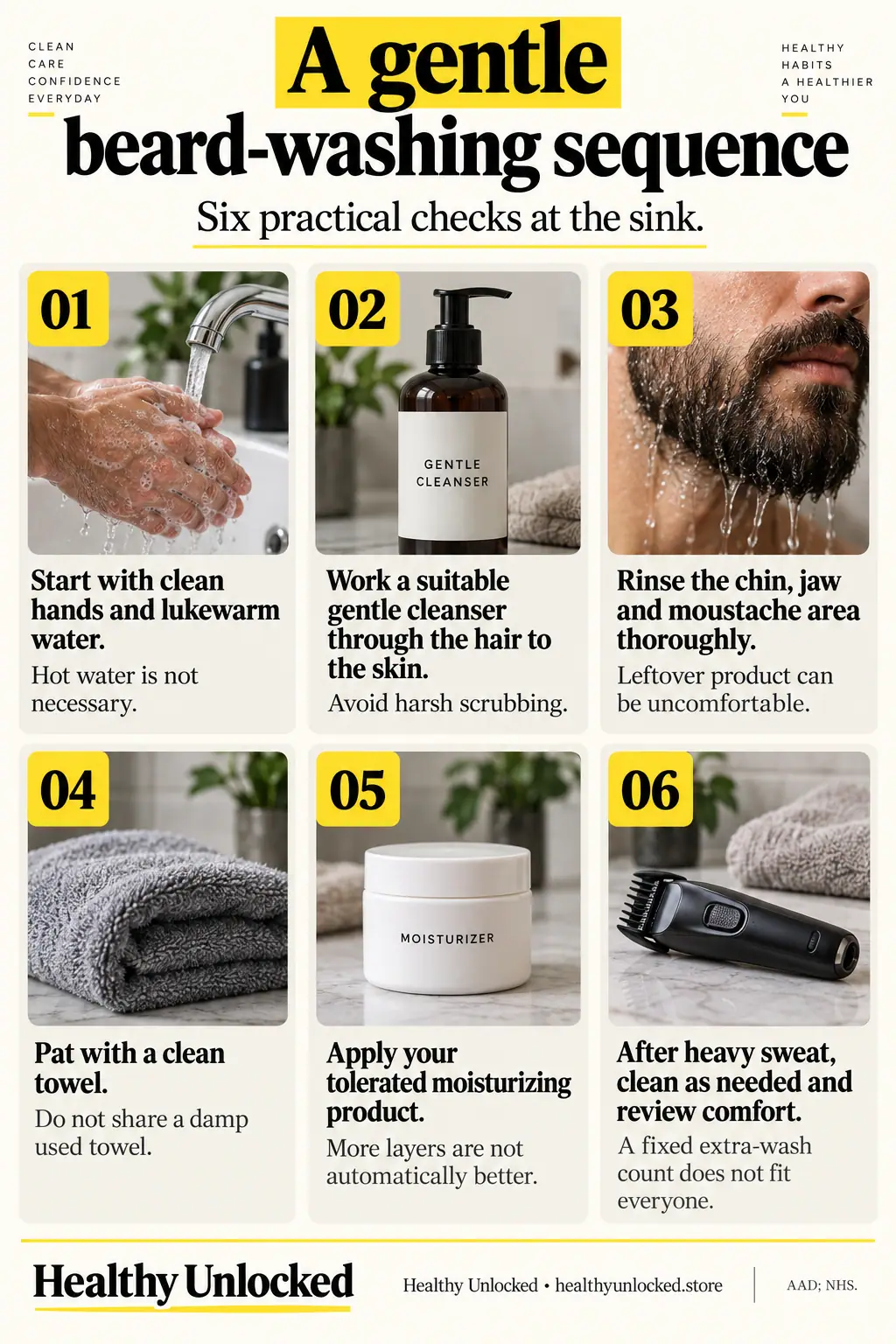
Clean a beard by gently reaching the skin under the hair, then rinsing thoroughly and patting with a clean towel. The aim is a comfortable, repeatable clean. A harsh scrub, very hot water or a strong fragrance is not evidence that the washing step is working better.
The AAD face-washing guide is useful for understanding gentle technique. At the sink, start with clean hands and water that feels comfortable. Work carefully around the chin, jaw and moustache, where product can be easy to leave behind.
If the beard is longer, move the hair gently with your fingertips so you can reach the skin. Do not scratch at the roots with fingernails or force a brush through wet tangles. A little patience at this stage is more useful than adding a second cleanser because the first one did not reach underneath.
Rinse in the places you actually cleaned. Check the underside of the chin and the area close to the lips. Keep products away from your eyes and mouth as their labels instruct. Then use a clean towel with light patting. A towel that has stayed damp beside the sink is a storage problem, not an extra skincare step.
A workable wash routine also needs a realistic location. If you share a bathroom, keep your own towel and tools in a clear place. Make the cleanser easy to find and the clean towel easy to reach. The routine should not require searching through six bottles when you are already late for work.
| Step | What to check | Avoid |
|---|---|---|
| Before washing | Clean hands, suitable cleanser and a clean towel | Starting with a dirty grooming tool |
| Through the beard | Gentle contact reaches the skin | Scratching or aggressive brushing |
| Rinsing | Cleanser is removed around jaw and chin | Leaving residue under dense hair |
| Drying | Light patting with your own clean towel | Hard rubbing or a shared damp towel |
| Afterwards | Apply your tolerated moisture step as directed | Adding products only because the shelf looks incomplete |
Sweat, dust and a changed day
A quiet desk day and a sweaty outdoor day do not feel the same. After heavy sweating or obvious dirt, consider the cleaning your skin actually needs. The AAD guidance on men’s skin care offers broader context. Avoid treating an extra wash as a competition to remove every trace of natural oil.
If repeated washing leaves your skin uncomfortable, review the product and technique before buying another scrub. Notice the conditions: more washing, a new bottle, a rough towel, or longer time under hot water. These observations can help a professional understand what changed, but they cannot identify a skin condition by themselves.
Which moisturizer fits your beard and skin?
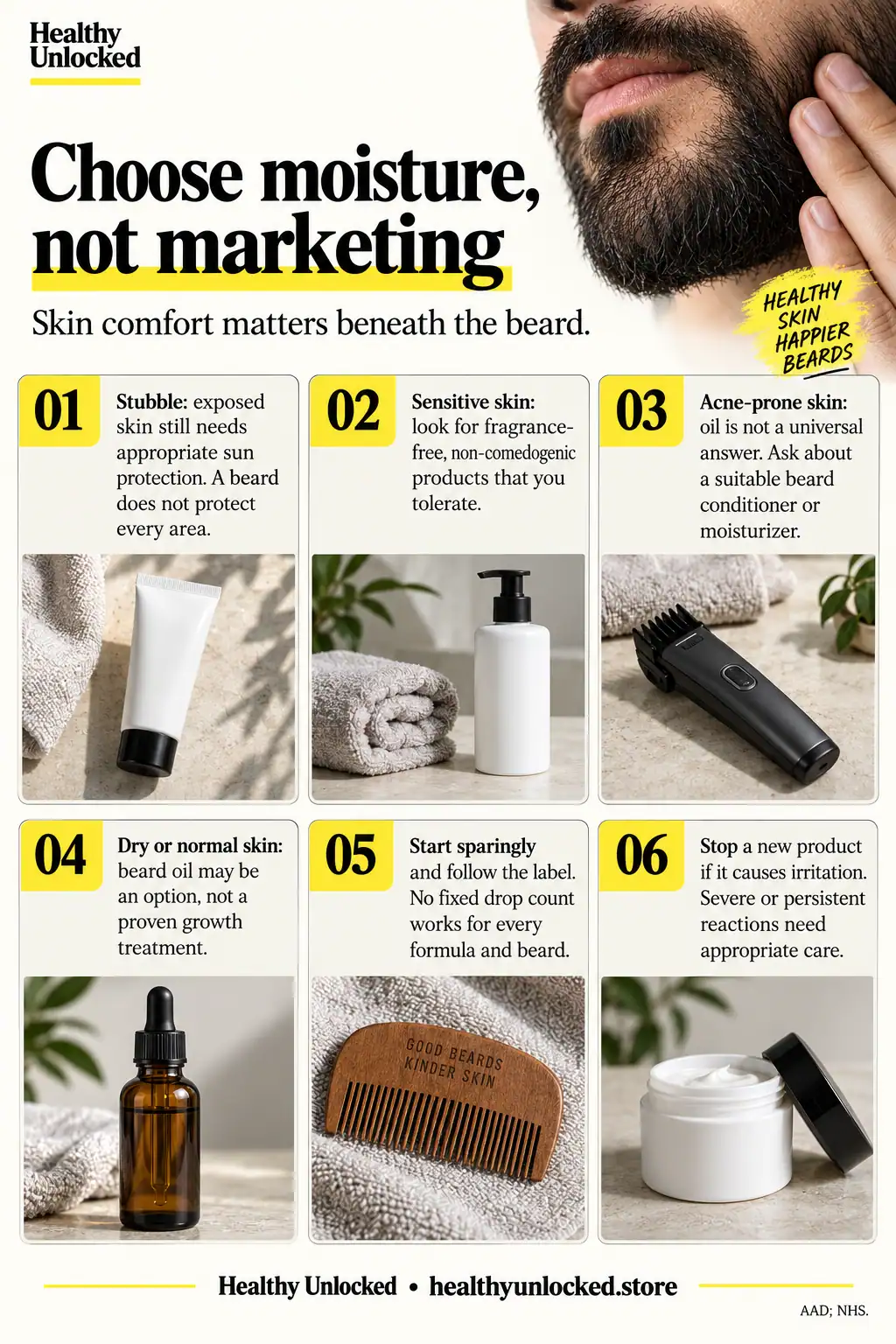
The right beard moisturizer is one that suits the skin beneath the beard and can be used as directed without irritation. Beard oil, conditioner and facial moisturizer have different formulas and purposes. Compare their actual labels and how they feel, rather than assuming that a product named “beard” fits everyone.
For people with sensitive skin, the AAD advice on dry-skin care explains why gentle product choices matter. “Fragrance-free” and “unscented” are not interchangeable shopping terms. Read the label and ingredient list rather than choosing only by the smell at the shop.
A beard oil can make grooming feel easier for some people, but oil is not a universal answer. If your skin develops breakouts, do not assume that a thicker oil will improve the situation. The dermatology beard guide discusses different moisturizing options by skin type; ask for advice if the choice remains unclear.
Apply a suitable product sparingly as directed, working where the skin needs attention rather than coating only the outer hair. Formulas, bottle openings and beard density differ, so a fixed number of drops is a poor universal instruction. Start with the label. Avoid combining a new oil, balm and serum on the same day.
Shine is an appearance preference, not a medical endpoint. If the beard looks polished but your skin stings, the routine deserves review. Likewise, a less glossy beard can still be clean and comfortable. Photographs in advertisements cannot tell you how the same formula will feel on your own skin.
| Option | Why someone might consider it | Important limit |
|---|---|---|
| Facial moisturizer | A suitable existing option for skin comfort | Check tolerance and instructions; not every formula fits every skin |
| Beard conditioner | Hair softness and grooming where appropriate | Product name alone does not make it non-irritating |
| Beard oil | A possible grooming option for some skin and hair | Not a proven new-hair growth treatment |
| Beard balm or wax | Optional styling hold | Hold does not replace cleaning or skin assessment |
| Sun-protection product | Protection of exposed skin as part of sun-safe care | A beard does not cover every area or replace other protection |
Protect the skin that remains exposed
A beard leaves areas such as the upper cheeks, forehead, ears and parts of the neck exposed. Follow appropriate sun-protection guidance for those areas, alongside shade and clothing. Do not assume that facial hair gives complete protection or that growing a beard removes the need to think about the sun.
If sunscreen gathers at the hairline, review application carefully rather than abandoning protection. The AAD application guide can help with technique. A convenient routine is one you can carry out correctly, not merely one with the shortest list of products.
How can you comb and trim with more control?
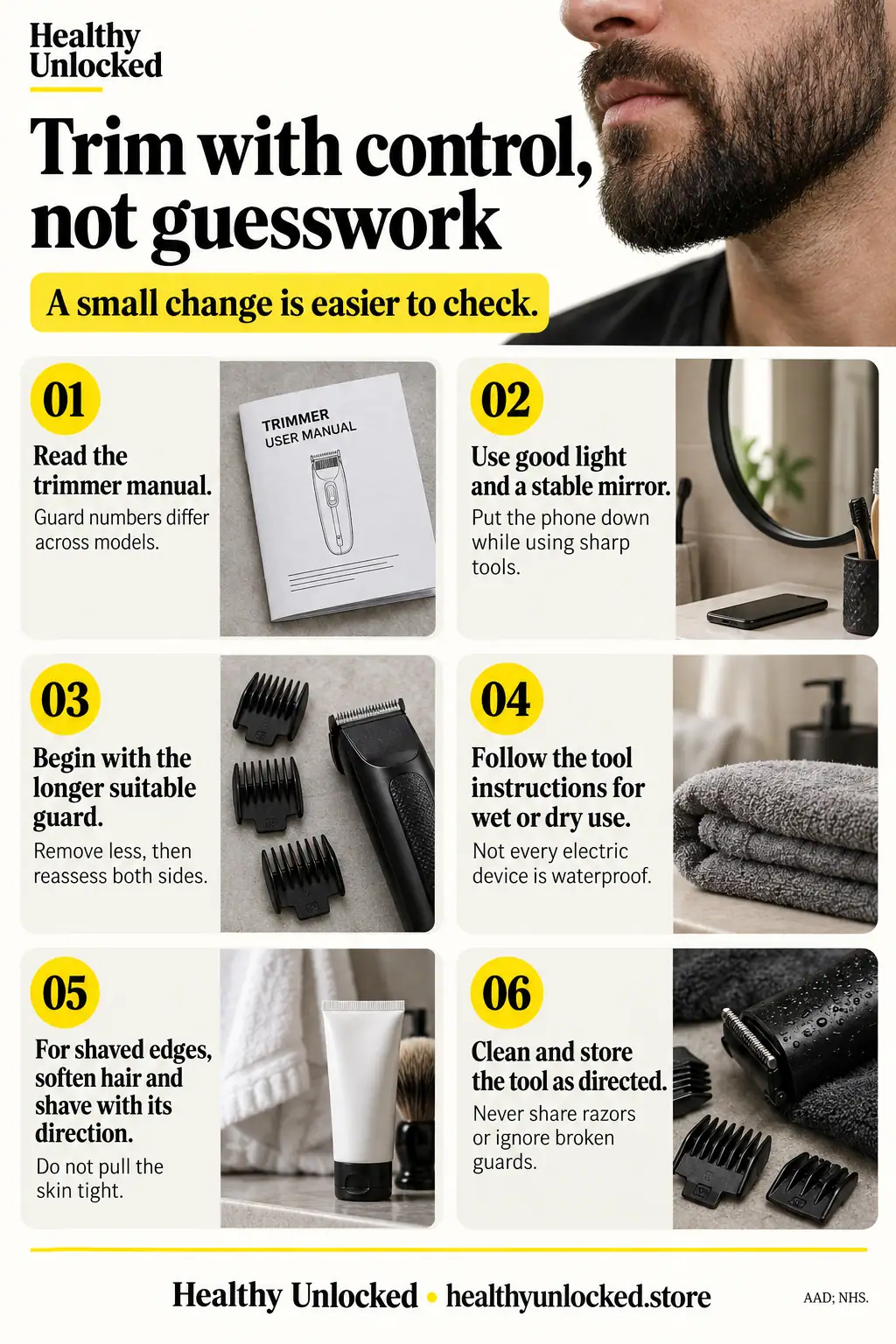
Comb and trim a beard with gentle pressure, good visibility and a clear plan. Use a clean, suitable tool, read its instructions, and make a conservative change before reassessing. A guard number is not a universal millimeter measurement across every device, and a hurried second pass can remove more than intended.
First decide what you want to change: a stray edge, hair near the lip, overall length, or an area that tangles. Those are different tasks. Looking at a photograph for inspiration is reasonable, but copying its shape exactly may not suit your growth pattern or available tools.
Use a stable mirror and good light. Put down the phone while working with a sharp tool. Check that guards and attachments are secure. Follow the manufacturer’s instructions about dry or wet use, charging, cleaning and damaged components. A device that rinses under water is not automatically intended for every wet-use situation.
For length changes, a longer suitable guard gives you room to reassess. Take a small amount, pause, and compare both sides without chasing every tiny difference. Your face is not a perfectly symmetrical template. Repeatedly cutting one side to match the other can leave you with a much shorter beard than you planned.
When shaving an edge, technique matters as well as the blade. The AAD shaving guide and razor-bump guidance explain useful precautions. If trimming or shaving repeatedly causes painful bumps, changing the shape alone may not resolve the underlying problem.
A comb is a tool, not a test of toughness
A comb should move through the beard without a contest. Work patiently on a tangle instead of pulling hard. Check for rough or broken teeth, and clean the comb as appropriate for its material. An expensive brush does not make aggressive pressure safer.
Longer facial hair may need more detangling attention, but more attention does not have to mean more product layers. Separate the grooming job from the shopping job: if a clean comb and your current tolerated product work comfortably, there is no missing step simply because an advertisement lists a larger kit.
What belongs in a simple beard-care kit?
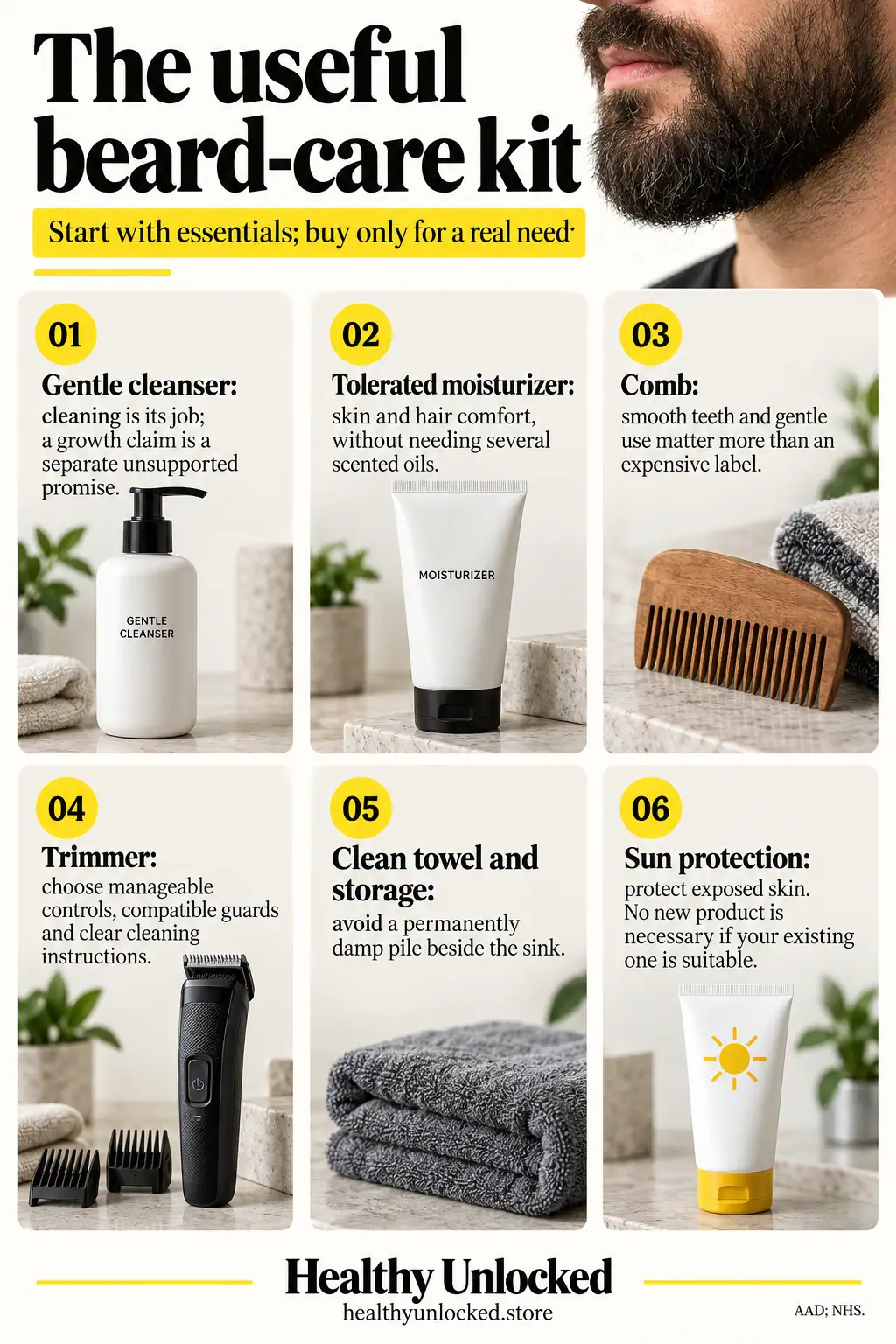
A simple beard-care kit can start with a gentle cleanser, a suitable moisturizing product, a clean towel, and the grooming tools you actually use. Add optional products for a clearly identified job. A cupboard full of overlapping formulas makes a routine longer without necessarily making it more useful.
Shop by the problem you are trying to solve. Is the current comb rough? Is the trimmer difficult to control? Does the cleanser sting? Is the towel always damp because it has nowhere to dry? Those questions point to practical changes. “I do not own a beard serum” does not identify a problem on its own.
Compare product instructions before price or fragrance. Look for a readable ingredient list, clear use directions and manageable storage. If a bottle promises a medical result such as treating infection or growing new hair, that is a different claim from helping a beard look neat. Ask what evidence supports the specific promise.
A travel kit should preserve function rather than reproduce your entire shelf. Pack suitable labeled containers, a clean towel if needed, and the tools you can safely store. Do not put an unlabeled liquid in a shared bottle and later guess whether it is cleanser or conditioner.
For electrical tools, keep the actual manual accessible. Cleaning directions can differ between removable attachments and the device itself. Do not use a cleaning liquid or method simply because it worked for someone else’s model. The manufacturer’s support information is one example of where device-specific instructions belong.
| Question | A useful answer | A reason to pause |
|---|---|---|
| What job will it do? | A specific cleaning, moisture or grooming job | A vague promise to transform every beard |
| Do I already have a suitable option? | An existing tolerated product meets the need | Buying duplicates without a reason |
| Can I follow the instructions? | Clear use, storage and cleaning directions | Unclear labeling or a damaged accessory |
| What if it irritates? | Know how to stop and seek help when needed | A claim that burning proves it is working |
| Is it treating a medical problem? | Discuss that problem with a clinician | Using a styling product as a treatment substitute |
“Natural” is not a safety certificate
Natural, herbal and homemade describe a product or marketing approach; they do not establish that it suits your skin. A fragrance or plant ingredient can still cause a reaction. The NHS contact-dermatitis information explains why irritation and allergy need to be taken seriously.
Choose new products cautiously and avoid adding several at once. The AAD guide to introducing skincare products describes a home tolerance check, which is not the same as clinical allergy testing. Do not call a small home check proof that a product can never cause a reaction.
What if your beard feels itchy or develops bumps?
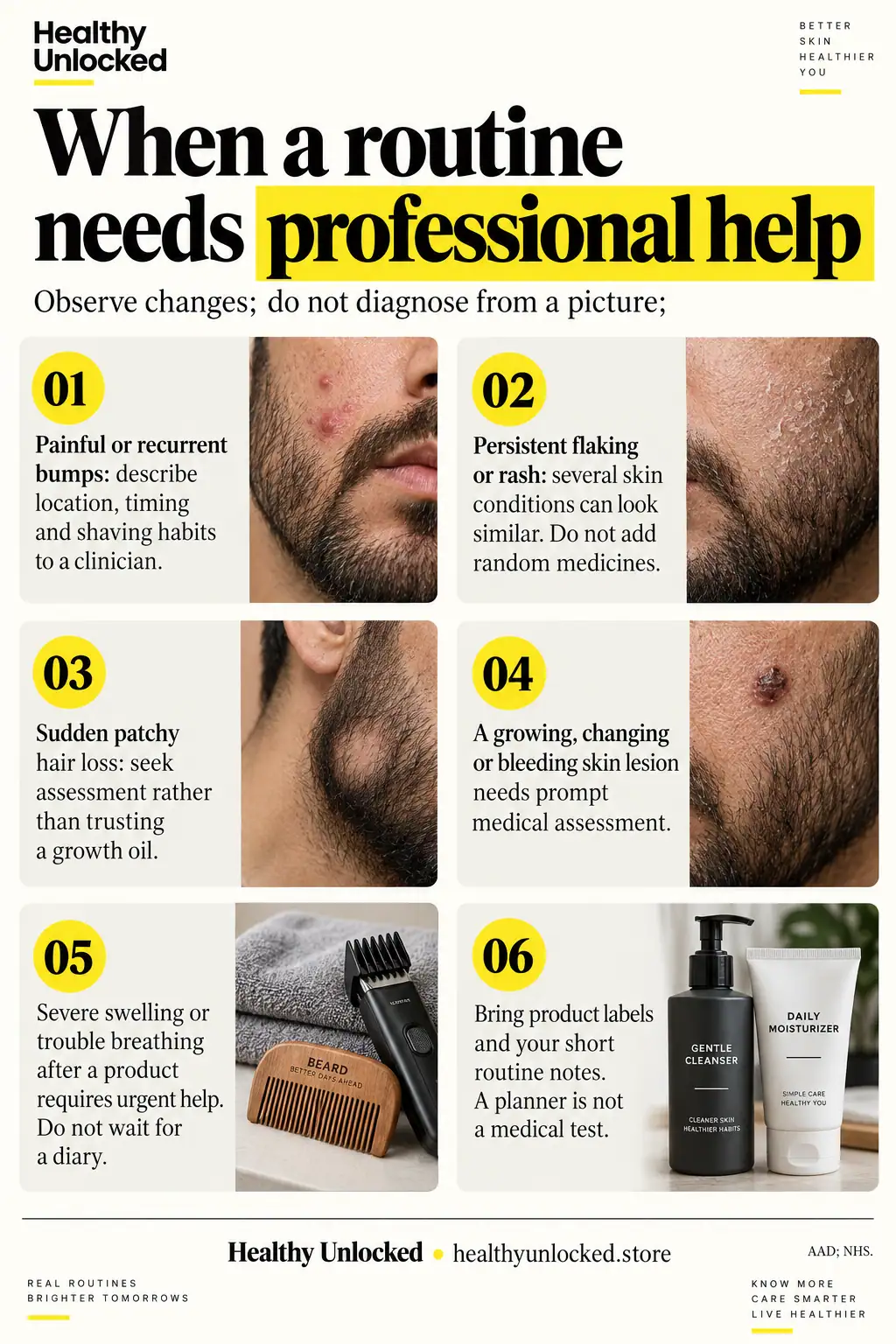
An itchy beard or a patch of bumps can have more than one cause. Review recent changes and seek appropriate assessment when symptoms persist, hurt, spread or worry you. Do not diagnose from a picture or stack medicated products onto a grooming routine without knowing what you are treating.
The AAD page on common beard problems shows why beard symptoms deserve more thought than “add oil.” Dryness, shaving-related bumps and other skin conditions may look similar to a beginner. The article here helps organize observations, rather than assigning a diagnosis.
Write down the part of the face affected, when you first noticed the change, and what was different beforehand. A new cleanser, closer trim, longer time in a helmet, or repeated rubbing may be relevant context. Include product names and labels when asking for help. Keep private medical details out of public comments.
Pause a newly introduced product that causes irritation and get advice appropriate to the symptoms. Severe swelling or trouble breathing is an urgent problem, not a reason to finish a tracking worksheet. If a skin lesion is growing, changing or bleeding, arrange prompt medical assessment rather than covering it with beard hair.
Sudden hair loss also deserves assessment. Oils marketed for growth are not a reliable way to identify why hair has disappeared. The AAD overview of hair-loss causes gives broader context. You can bring a short account of timing and changes without needing to supply a perfect explanation.
What to take to a care appointment
Bring the bottles or clear photographs of their labels, your trimming or shaving pattern, and a short description of the change. If you have already used a treatment, list it accurately. A clinician needs the actual routine, not an ideal version copied from a guide.
Ask simple questions: what might need checking, which routine steps should continue, which should stop, and when should you return if the problem does not improve? The NHS information on folliculitis can be background reading where available, but information pages do not replace your assessment.
How can you build a routine you will repeat?
Build a beard-care routine around a repeatable sequence and an occasional grooming check. Start with what your skin already tolerates, then change one practical issue at a time. A checklist can help you remember tasks; it should not make you feel that every optional product is essential.
Choose a convenient point in the day rather than an impressive schedule. The cleanser and towel can stay where you wash. The comb can stay in a clean place near the mirror. Put the trimmer away when you finish, so the next session begins with checking the tool instead of finding a damaged guard.
A routine can also respect personal and cultural choices about cutting hair. If you do not trim, remove trimming from your checklist. Keep cleaning, comfortable moisture and gentle detangling where useful. The planning tool counts the selected tasks; leaving out a task that does not suit your choice is not a failure.
Look at comfort over a reasonable period without inventing a medical trial. Ordinary notes such as “new cleanser on Monday; stung immediately” can help a discussion. They are not controlled test results. Do not change three products and then claim that the last bottle deserves credit for every improvement.
If care becomes complicated, simplify the decisions. Write the task first, then the suitable product or tool. For example: “wash gently,” rather than “use all four bottles.” This approach keeps the routine understandable when you are traveling, sharing a bathroom or handing the checklist to someone helping you.
| Example | Inputs and arithmetic | What the result means |
|---|---|---|
| First example | 4 ÷ 5 × 100 = 80% | Four of five selected tasks completed; not a health score. |
| Second example | 2 ÷ 3 × 100 ≈ 66.7% | Only included tasks count; a missed task is a reminder, not a diagnosis. |
Plan your beard-care checklist
Select suitable tasks, then mark what you completed. The percentage describes this checklist only—not healthy skin or beard growth.
Example: 4 of 5 selected tasks completed = 80%. An unselected task is not counted. This is a planning reminder.
Entries stay on this page. The tool does not save or transmit your health information.
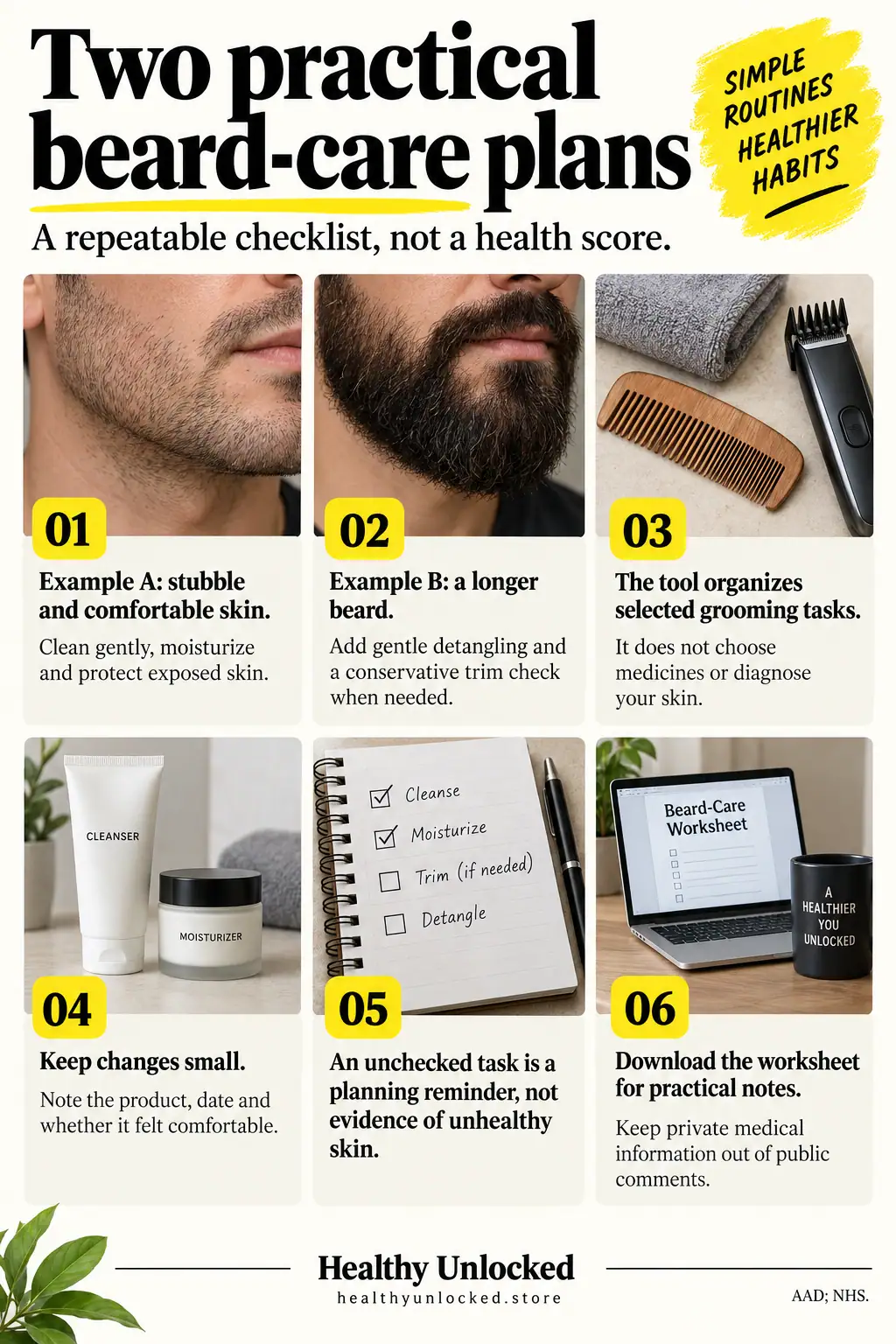
Worked example A: a short beard and a modest routine
This is an illustrative planning example, not a recommendation for every skin type. A person with stubble selects three tasks: gentle cleaning, the tolerated moisture step, and checking sun protection for exposed skin. The task count is 1 + 1 + 1 = 3. It says nothing about how healthy the skin is.
The person leaves trimming unchecked because no length change is wanted. That is a legitimate choice, not a missing treatment. If a product causes discomfort, the routine needs review even when all three boxes have ticks. Completion measures whether selected tasks were noted, not whether symptoms will improve.
Worked example B: a longer beard with an occasional trim
A second illustrative plan selects cleaning, moisture, gentle detangling and a tool-cleaning check: four tasks. On a day when a conservative trim is wanted, the optional trim check makes five selected tasks. Four everyday tasks plus one occasional task equals five; it does not mean five products must be purchased.
The longer beard does not automatically need a medicated shampoo or a growth serum. The person first checks whether the existing products remain comfortable and whether the comb and trimmer suit the job. If a painful bump develops, the plan changes from “add another step” to “seek appropriate advice.”
How to use the planner and download
The beard-care planner is a local checklist that counts the tasks you select and organizes a reminder. It does not analyze a photograph, diagnose a condition, recommend medication, or store a health record. Its result is planning arithmetic: one selected task counts as one task.
Use the controls to choose the jobs you want to include. Review the resulting reminder before applying it to your day. A blank selection should ask you to choose a task rather than leaving an old result on screen. Changing a selection should update the count and text immediately.
You can use the same method without JavaScript: write your chosen tasks on paper and count them. The worked examples above demonstrate that process. Download the beard-care worksheet for an editable list of the article’s comparison and planning rows. It is a learning resource, not a validated clinical scale.
The generated visuals illustrate grooming objects and example routines. They do not document hands-on product testing or a medical outcome. The HTML tables hold the practical information in readable text, and the source library lets you inspect the underlying guidance independently.
Your checklist choices stay in the page. Avoid putting diagnoses, photographs of a rash or other private health information into comments. For how sources and corrections are handled, read our editorial standards. A useful guide should let you distinguish sourced guidance, ordinary planning examples and remaining uncertainty.
Common beard-care questions
These answers cover ordinary grooming questions. Symptoms that persist or concern you deserve an individual discussion rather than another online routine.
Do I need a separate beard wash?
Not necessarily. Start by checking whether your existing gentle facial cleanser is suitable for your skin and reaches the skin beneath the beard. A product named “beard wash” is not automatically gentler or more effective. Follow its label and review comfort rather than buying another bottle only to complete a kit.
Is beard oil essential for beginners?
No. Beard oil is one possible grooming option, and it does not suit every skin. A suitable moisturizer or beard conditioner may fit a particular routine better. Compare the actual formula, instructions and tolerance. Oil should not be presented as a proven treatment for new hair growth or a substitute for assessing persistent symptoms.
Should I trim my beard every day?
There is no universal daily trimming schedule. Frequency depends on your preferred style, growth and whether you want to cut hair at all. Inspect a clean tool, follow its manual and make conservative changes. If close trimming repeatedly causes discomfort or bumps, discuss the problem instead of chasing a tidier edge.
Can I use the same towel and razor as someone else?
Keep razors personal and use your own clean towel. Follow the cleaning and storage instructions for grooming tools. A shared bathroom does not require shared equipment, and a damp towel left beside the sink is not ready simply because it looks clean. Replace or safely address damaged accessories before use.
Does itching mean my beard is growing well?
Itching is not proof of healthy growth. Review recent products, washing and grooming, and get appropriate assessment if itching persists, worsens or comes with painful bumps, rash or hair loss. Different conditions can look similar. Do not add random medicated products or dismiss discomfort as something every beard must endure.
Does the planner tell me which treatment to use?
No. The planner counts selected grooming tasks and produces a practical reminder. It does not diagnose your skin, score health or recommend medicines. Its worksheet and examples can help you organize a routine or a care conversation. Urgent or concerning symptoms should be addressed directly, without waiting to complete the checklist.
Your next step: choose one simple cleaning-and-moisture sequence, check the tools you actually need, and keep the routine comfortable enough to repeat. More products are useful only when they serve a real, suitable purpose.
About this article
By Yashveer Bharani for Healthy Unlocked. This guide combines cited dermatology information with practical product-function comparisons and an original task-counting checklist. It does not claim clinical testing, verified brand comparisons or independent dermatology review.
Sources were checked during draft preparation on 7 October 2026. Planning examples are clearly labeled and do not measure treatment success. You can inspect the sources below and use the contact page to report a factual correction.
Sources and further reading
These original references support the guidance and its limits. A link does not mean that the institution reviewed or endorsed this article.
Practical reference
Context and definitions
Safety and care
Evidence and limitations
 Healthy Unlocked
Join the conversation
Share a practical idea or ask a question about this guide. Please keep personal medical details private.