
Summary
A breakfast without eggs can include useful protein from suitable yogurt, milk, tofu, chickpeas, nuts or other foods you enjoy. Start with a protein anchor, add a fiber-rich partner, and check the actual portion and product. Egg-free does not automatically mean vegan, dairy-free, allergen-free or nutritionally complete. One breakfast also does not determine your whole day’s nutrition.
This guide compares six clearly identified foods, offers sweet and savory ideas, and includes a two-food subtotal calculator. The numbers come from linked USDA FoodData Central records and stated weights. They are estimates, not laboratory results from these photographed meals. Use them to understand combinations, rather than treating the examples as required portions or a personal protein prescription.
What you’ll understand
- Protein sources. Compare the food, preparation and stated weight together.
- Simple bowls. Yogurt or a suitable alternative can pair with oats and fruit.
- Savory choices. Tofu and chickpeas offer alternatives to eggs.
- Label checks. Serving size, ingredients and allergens have different jobs.
- Practical swaps. Similar-looking foods do not always have similar nutrients.
- Auditable calculations. Learn what the calculator includes and leaves out.
Four useful breakfast decisions
- Choose an anchor. Use an appropriate protein-containing food.
- Add a partner. Include suitable fruit, vegetables or whole grains.
- Read the portion. Check grams, preparation and the product label.
- Respect your needs. Consider allergies, storage and personal advice.
Keep the scope clear. These examples are not weight-loss plans, individualized targets or treatment for a medical condition. Egg allergy requires more than removing a visible egg; follow your own allergy plan and seek urgent help for severe reactions.
Which foods provide protein for breakfast without eggs?
Suitable yogurt, milk, tofu, chickpeas and peanuts can provide protein without an egg. Their amounts vary by food, brand, preparation and portion. Oats contribute some protein and fiber too. A useful comparison states all those details; the food’s name alone does not tell you what a serving supplies. USDA FoodData Central provides the records used here.
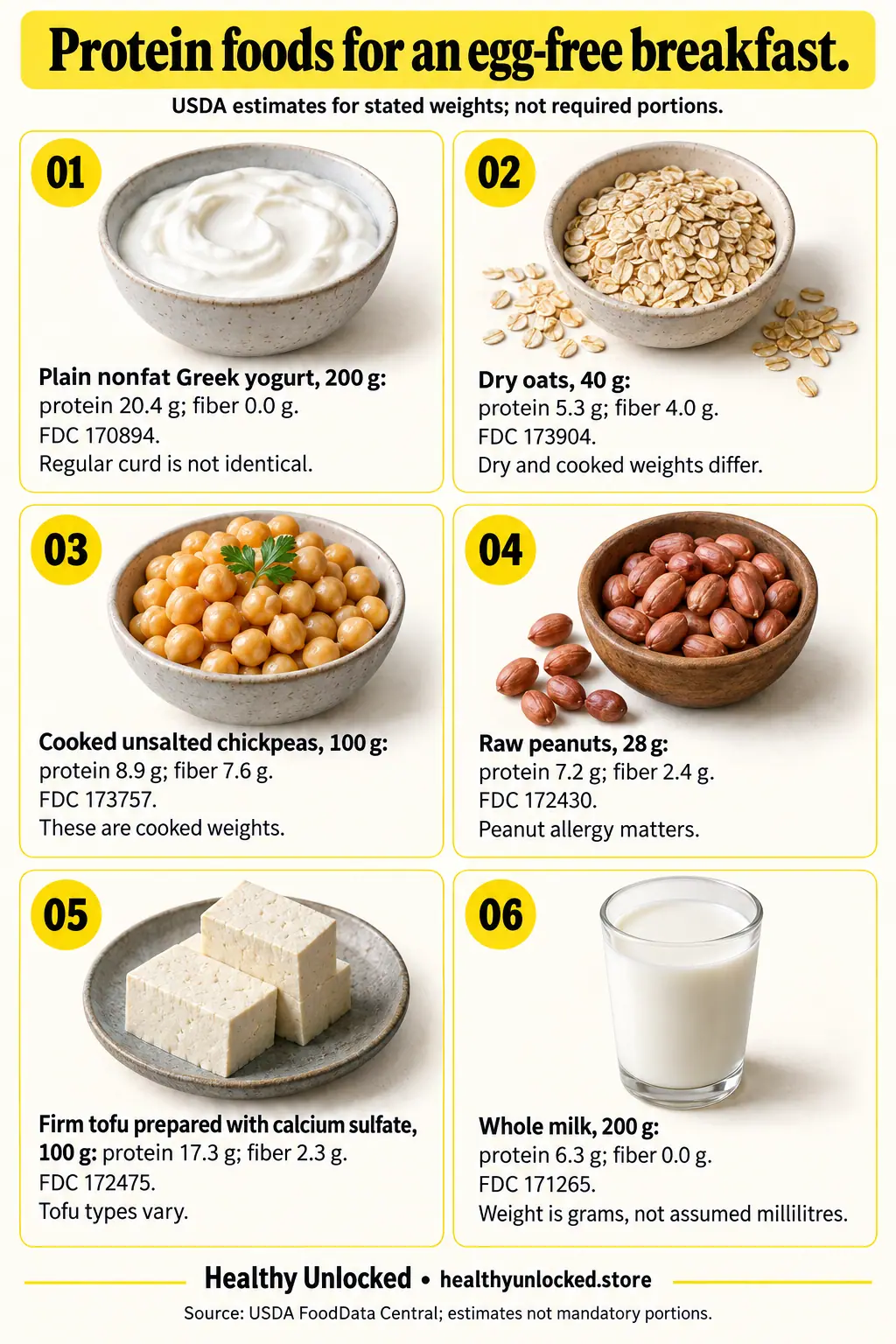
The chart uses six SR Legacy records accessed on October 6, 2026. The serving weights are illustrative choices, not recommended amounts for every reader. Plain nonfat Greek yogurt is a particular product type, not a substitute name for all yogurt. Firm tofu prepared with calcium sulfate is not identical to every tofu. The whole-milk row is weighed in grams rather than silently treating grams as milliliters.
| Food and source | Preparation and weight | Protein | Fiber | Comparison limit |
|---|---|---|---|---|
| Plain nonfat Greek yogurt, FDC 170894 | 200 g | 20.4 g | 0.0 g | Other yogurts differ |
| Regular or quick oats, FDC 173904 | 40 g dry, unfortified | 5.3 g | 4.0 g | Dry weight, not cooked bowl weight |
| Chickpeas, FDC 173757 | 100 g cooked, without salt | 8.9 g | 7.6 g | Not 100 g dry chickpeas |
| Peanuts, FDC 172430 | 28 g raw | 7.2 g | 2.4 g | Peanut allergy matters |
| Firm tofu, FDC 172475 | 100 g, prepared with calcium sulfate | 17.3 g | 2.3 g | Different tofu types vary |
| Whole milk, FDC 171265 | 200 g, 3.25% milkfat, added vitamin D | 6.3 g | 0.0 g | Grams, not assumed milliliters |
The rows are different portions, not a universal ranking
A 200 g yogurt portion and 28 g of peanuts are different amounts of food. The table does not rank equal weights, calories, prices or personal suitability. More protein in one row does not establish that it is the best breakfast for you. A product you cannot tolerate or afford is not improved by a larger number in a generic chart.
The protein and fiber columns also describe different nutrients. Milk and yogurt can provide useful protein without dietary fiber. Chickpeas provide both in the stated preparation. Adding fruit or a suitable whole grain can bring fiber to a dairy-based breakfast. Our protein and fiber food guide explores those combinations in more detail.
How much protein does breakfast need?
There is no single breakfast protein target that this article can prescribe to every reader. Daily needs depend on factors including age, health and activity, and a personal plan may have additional considerations. Harvard’s protein guide explains general protein context. A social-media target for one meal should not automatically become your own prescription.
Instead, identify what is already in your breakfast and what you want to add. A bowl of oats is not a bad food because it provides less protein than the stated yogurt portion. It can be one part of a meal. Compare the whole pattern, appetite and practical needs, without treating the largest number as the only worthwhile choice.
How can you build a simple sweet breakfast bowl?
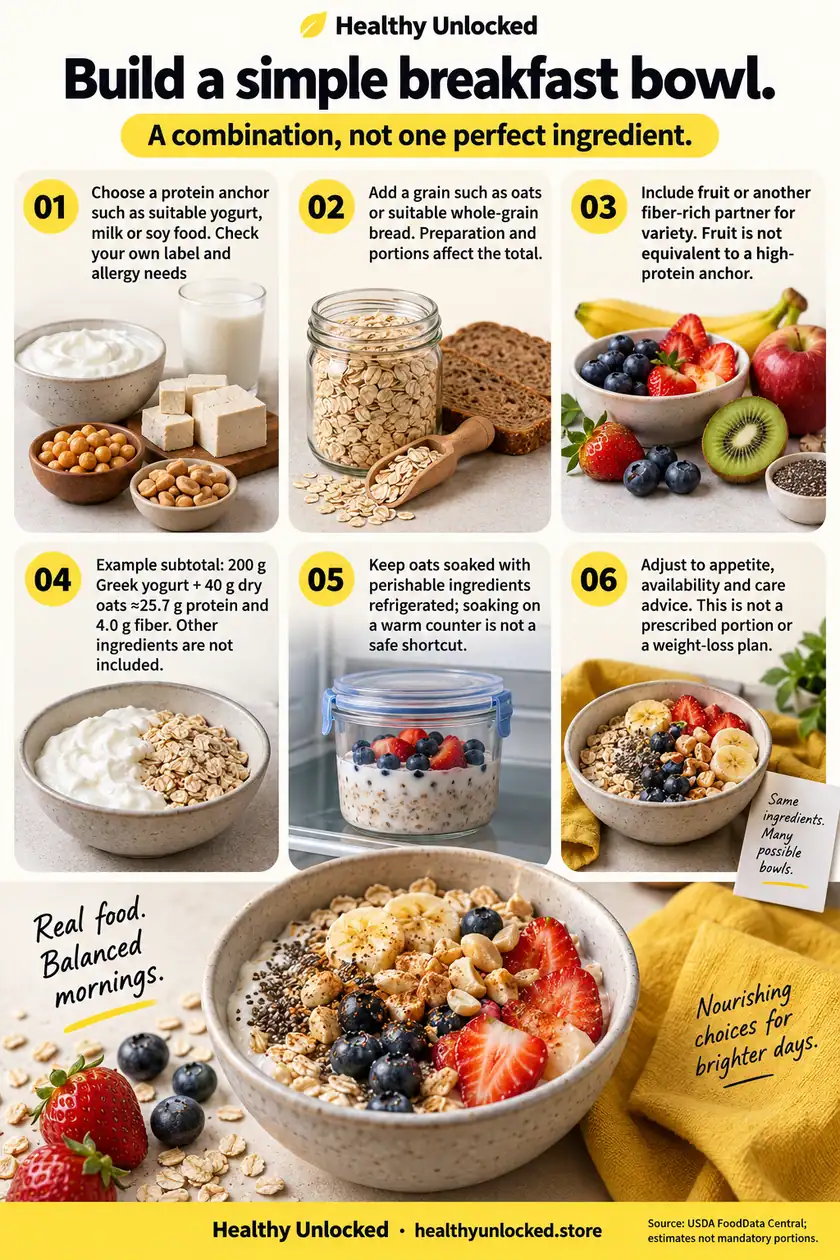
Choose a suitable yogurt or another appropriate base, add oats or a compatible grain, and include fruit and flavor you enjoy. Read the base’s label rather than assuming all yogurts or plant alternatives contain the same protein. The calculated example below covers only its two stated ingredients; fruit, toppings and other foods remain outside that subtotal.
A plain nonfat Greek yogurt bowl can be convenient when you have appropriate refrigeration. You might add oats and fruit, then adjust the amount and texture to your preference. This is a flexible assembly idea, not a tested recipe promising a particular outcome. USDA MyPlate’s dairy information explains the broader food-group context.
Worked example: yogurt and dry oats
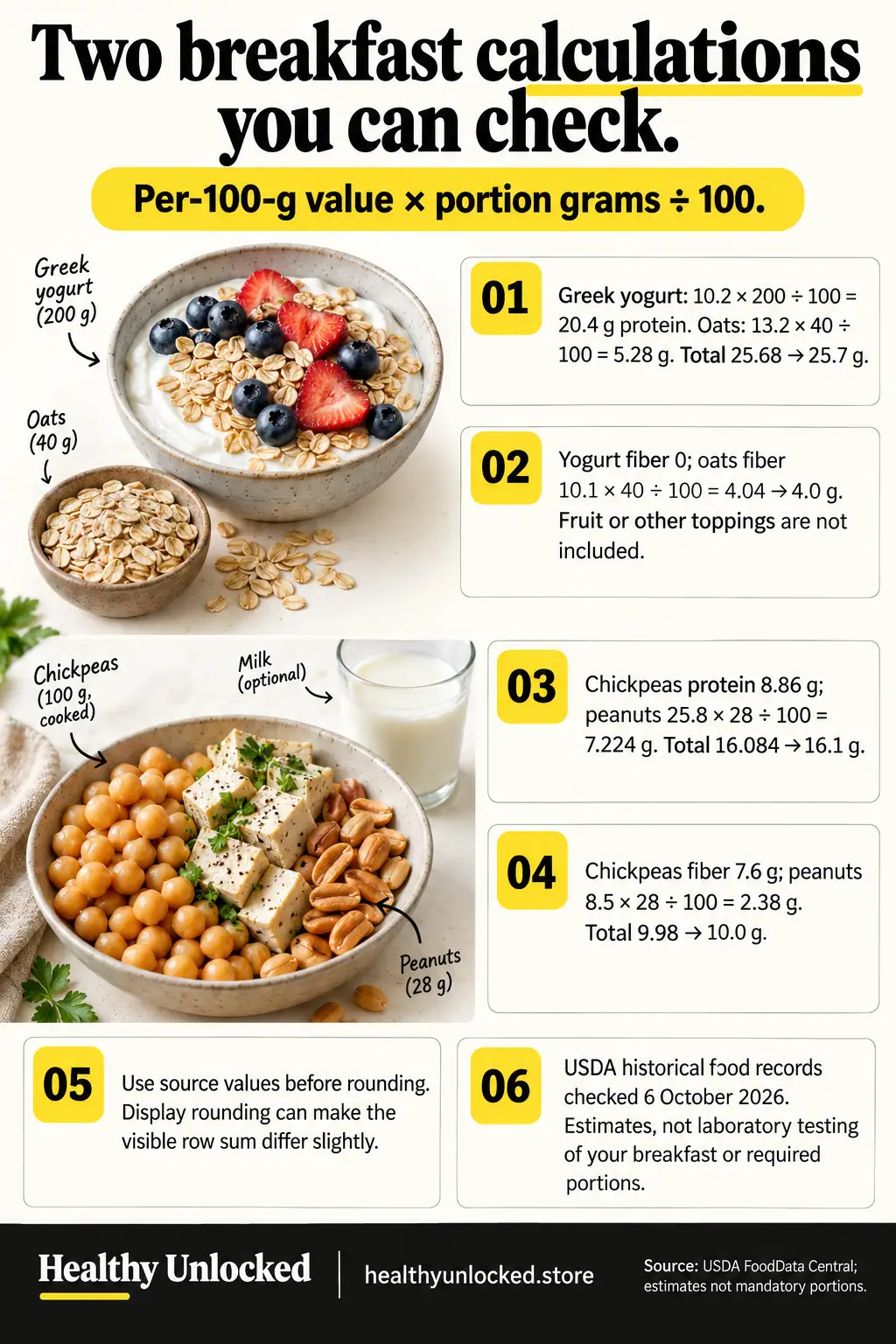
The chart’s 200 g plain nonfat Greek yogurt provides 20.4 g protein. The 40 g dry oats provide 5.28 g before rounding. Together, those two portions provide about 25.7 g protein and 4.0 g fiber. The figures use FDC 170894 and 173904. They are not the total for a photographed bowl with fruit or a different yogurt.
When oats absorb liquid, their cooked weight increases. If you measured 40 g dry oats before preparation, you use the dry-oat amount in this example. Do not substitute 40 g of cooked oatmeal and expect the same subtotal. Check the relevant food record and preparation when you want to calculate a different version.
Plant-based yogurt requires its own check
A plant-based product can be useful, but its protein, fortification and ingredients vary. A coconut-based alternative and a soy-based alternative are not nutritionally interchangeable simply because both sit in the yogurt aisle. FDA’s comparison of milk and plant-based alternatives illustrates why labels matter for substitutions.
If you avoid dairy because of allergy, lactose intolerance or preference, the reason changes the checks you need. Lactose-free dairy is not automatically suitable for milk allergy. A product described as plant-based may have other allergens or cross-contact concerns. Use the ingredient and allergen information alongside your own care plan.
A bowl should fit the rest of breakfast
Texture, appetite, time and enough food matter. A small protein subtotal is not a complete assessment of whether a meal is satisfying. Add suitable food rather than trying to solve every need with one powder. It is also fine to choose a savory breakfast; convenience does not require a sweet bowl or a trend-driven ingredient.
What savory egg-free breakfasts are practical?
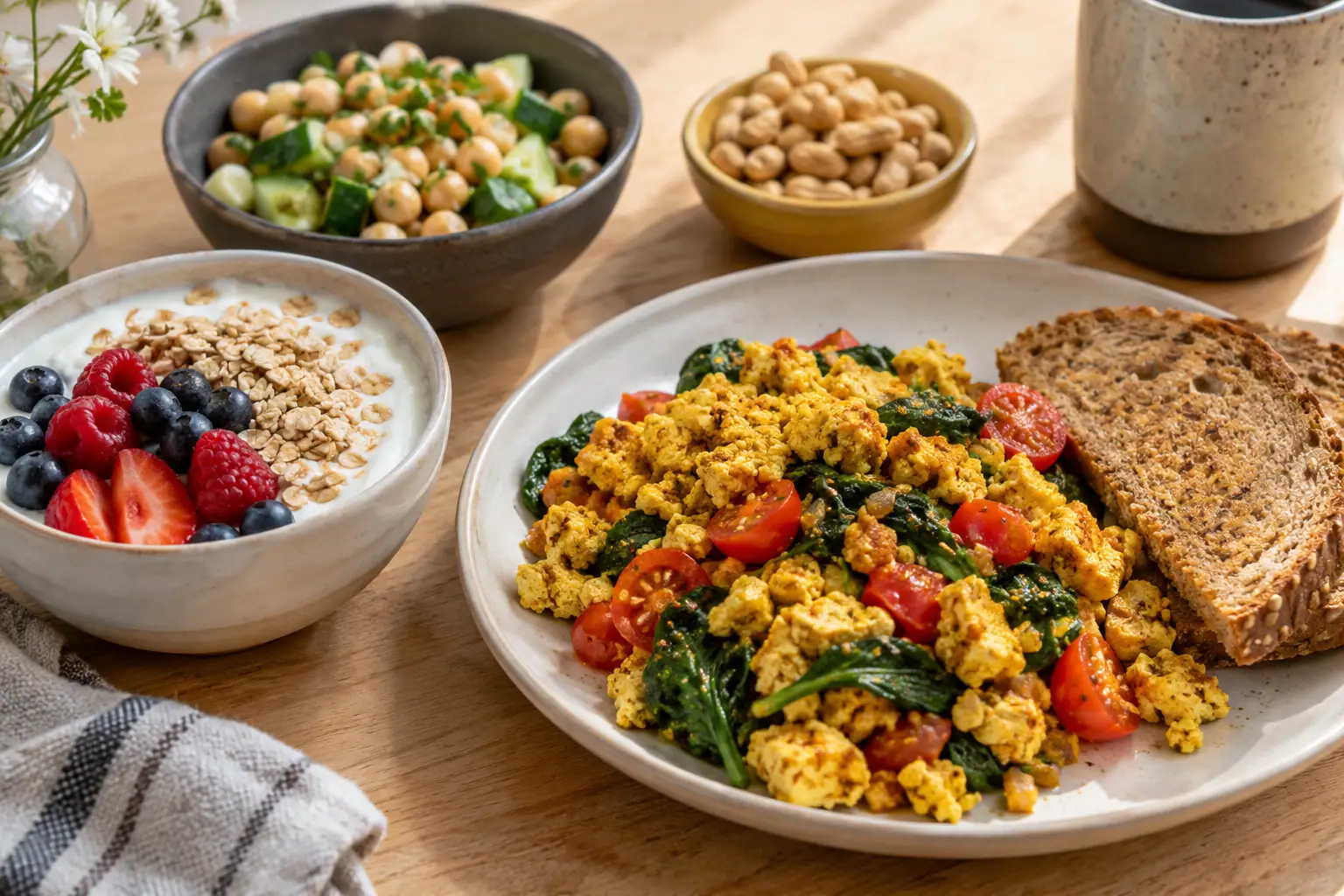
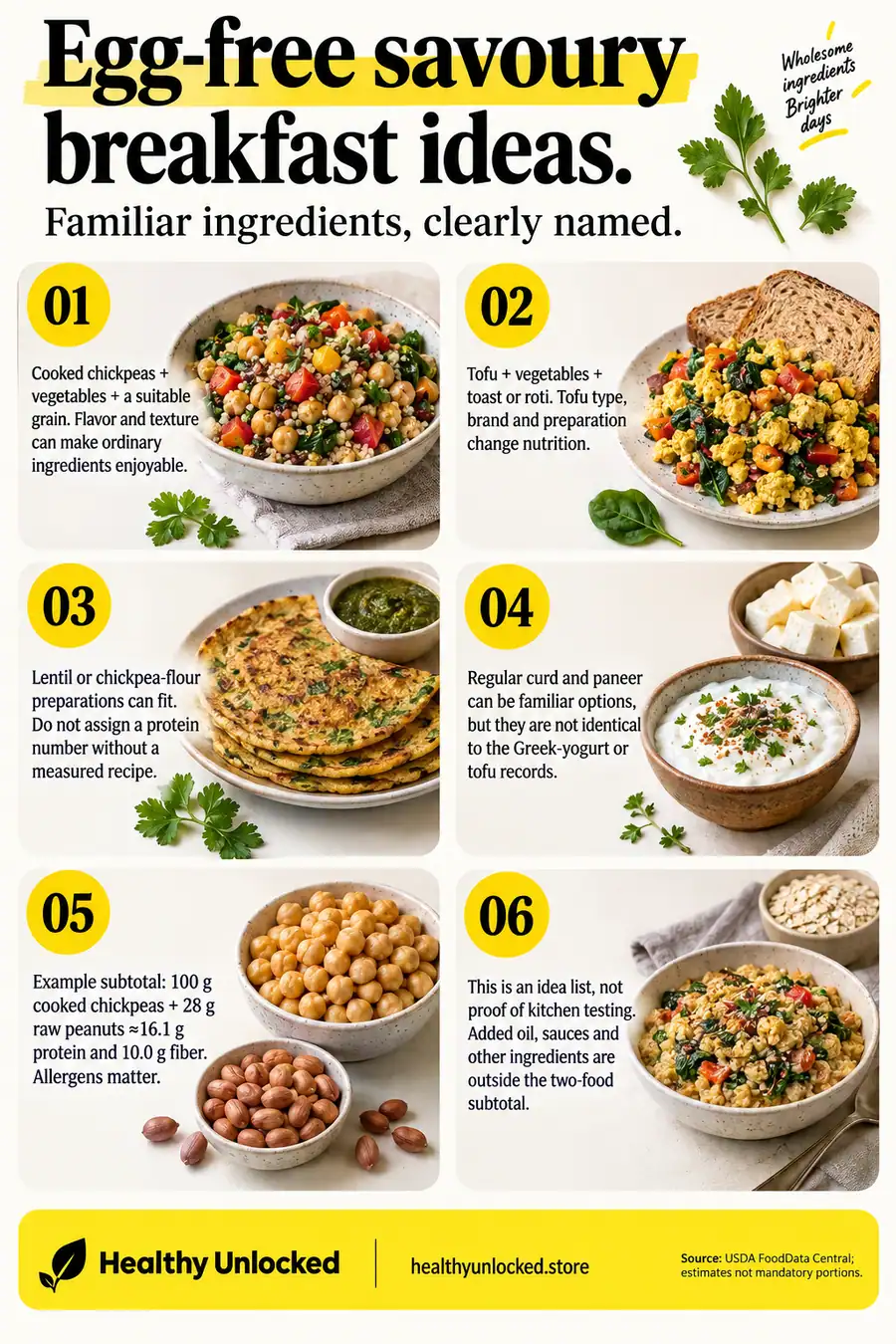
Tofu with vegetables, cooked chickpeas with suitable sides, and bean-based breakfast ideas can provide alternatives to eggs. The preparation and portions determine the nutrients. A tofu scramble may resemble scrambled eggs, but it has its own ingredients and label. Egg-free recipes also need checking for hidden egg in breads, sauces or packaged components.
For tofu, choose a texture you enjoy and follow storage and cooking instructions. The table uses a specific firm tofu record; silken or other varieties need their own numbers. Harvard’s soy information provides background. A soy allergy is a reason to choose a suitable different option, not to rely on a generic plant-food recommendation.
| Idea | Possible protein anchor | Useful partner | What to verify |
|---|---|---|---|
| Yogurt bowl | Appropriate yogurt | Oats and fruit | Yogurt type, ingredients and refrigeration |
| Tofu with vegetables | Suitable tofu | Vegetables and appropriate bread or grain | Soy, bread ingredients and tofu type |
| Chickpea breakfast bowl | Cooked chickpeas | Vegetables and a suitable side | Cooked weight, storage and seasonings |
| Milk and oat combination | Milk or a checked alternative | Oats and fruit | Allergens, product protein and preparation |
| Nut or seed addition | Suitable nuts or seeds as part of a meal | Other breakfast ingredients | Allergies, portion and the rest of the meal |
Worked example: chickpeas and peanuts
For the stated records, 100 g cooked unsalted chickpeas provide 8.86 g protein and 7.6 g fiber. Raw peanuts at 28 g provide 7.224 g protein and 2.38 g fiber. The two-food subtotal is about 16.1 g protein and 10.0 g fiber. It is an illustrative combination, not a recommended portion or a complete prepared-meal calculation.
Someone with peanut allergy should not use this combination. Removing the peanuts changes both the food and the number. Do not keep the same calculated total after a substitution. A chickpea dish with oil, vegetables or bread has additional ingredients; calculate those separately if a complete analysis is needed.
Familiar breakfasts do not need invented numbers
Besan pancakes, lentil-based dishes, paneer preparations and other familiar foods can be relevant options. Their protein depends on the recipe, ingredients, cooking yield and portion. This chart does not supply a verified value for every home preparation. It is better to offer a useful idea without a fabricated macro total than to attach a precise number to an unspecified recipe.
Use a measured recipe and appropriate data if you want a fuller estimate. Record dry ingredients, final yield and number of portions. Store-bought versions require their own label. A dish name used by many families is not one standardized nutritional product. Small changes in preparation can make a meaningful difference to a calculation.
What should you check on an egg-free product label?
Read serving size, ingredients and allergen information separately. The nutrient panel usually refers to a stated serving or weight; the ingredient list identifies what is included; allergen information addresses different risks. A large protein claim on the front does not replace those checks. FDA’s Nutrition Facts guide explains the U.S. label format.
| Label area | Useful question | Example of a mistake | Better check |
|---|---|---|---|
| Serving size | Which amount do the numbers describe? | Reading one serving as the whole package | Compare your amount with the stated serving |
| Ingredient list | What is actually in the product? | Assuming bread or sauce has no egg | Read the complete current list |
| Allergen information | Does this suit my allergy plan? | Equating egg-free with allergen-free | Check relevant allergens and cross-contact advice |
| Product type | Does it match the comparison? | Using Greek-yogurt values for every yogurt | Use the actual product label or appropriate record |
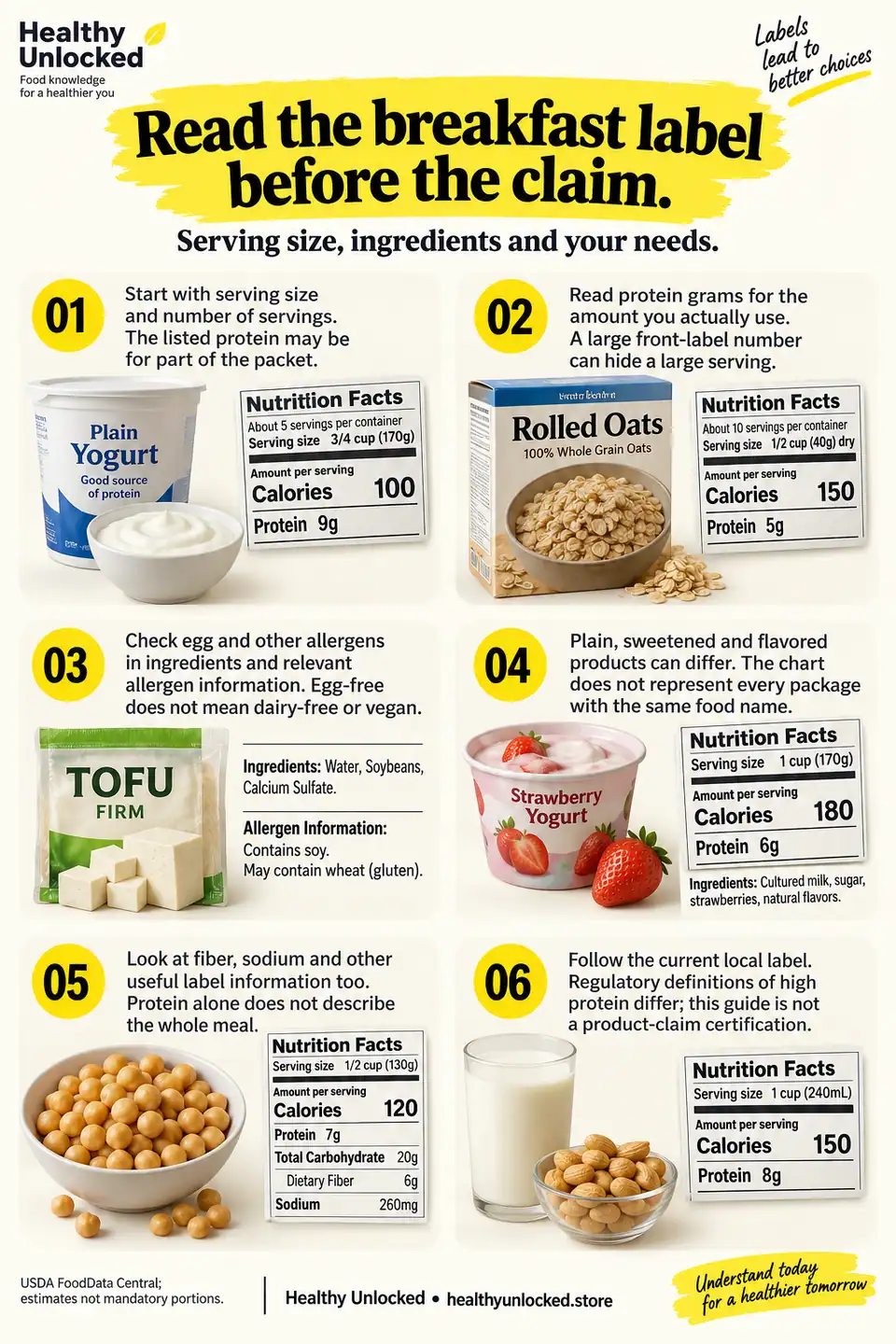
Egg-free, vegan and dairy-free mean different things
An egg-free breakfast may contain milk or yogurt. A vegan breakfast avoids animal-derived ingredients, but that does not establish suitability for every allergy. Dairy-free does not automatically mean soy-free or nut-free. FARE’s egg-allergy information explains why avoidance requires more than removing a visible egg.
Packaging can change. Recheck a familiar product rather than relying on an old photograph of its label. For a diagnosed allergy, follow your clinician’s advice about ingredients, advisory statements and eating outside the home. Severe reactions need urgent action according to your emergency plan; a food blog is not an emergency treatment guide.
Protein-rich wording is descriptive here
This guide uses protein-containing foods to answer an everyday breakfast question. It does not certify that a prepared recipe satisfies a regulated “high protein” labeling claim. Those claims have specific requirements that differ from a casual description. The numbers, food identity and limits are more useful than a powerful phrase without a defined basis.
How can you make swaps that fit budget and dietary needs?
Choose swaps by their job in the meal, then check nutrients, price, storage and suitability. A cheaper ingredient can be useful without being identical to the original. Yogurt, tofu, legumes and nuts have different textures and nutrient patterns. Reusing the old total after changing a food is the main calculation mistake to avoid.
| Situation | Possible direction | Recheck | Important limit |
|---|---|---|---|
| Greek yogurt costs more | Suitable plain yogurt or another anchor | Actual protein and serving | Do not retain Greek-yogurt numbers |
| Avoiding milk | Suitable soy food or another option | Allergens, label and fortification | Plant-based is not automatically equivalent |
| Peanuts unsuitable | Another safe ingredient or a different meal | Allergy plan and new subtotal | Do not assume another nut is safe |
| Little morning time | Safe earlier preparation or simple assembly | Storage and actual ingredients | Convenience is not a safety exemption |
| Different portion | Use the measured amount | Weight and preparation | Dry and cooked weights differ |
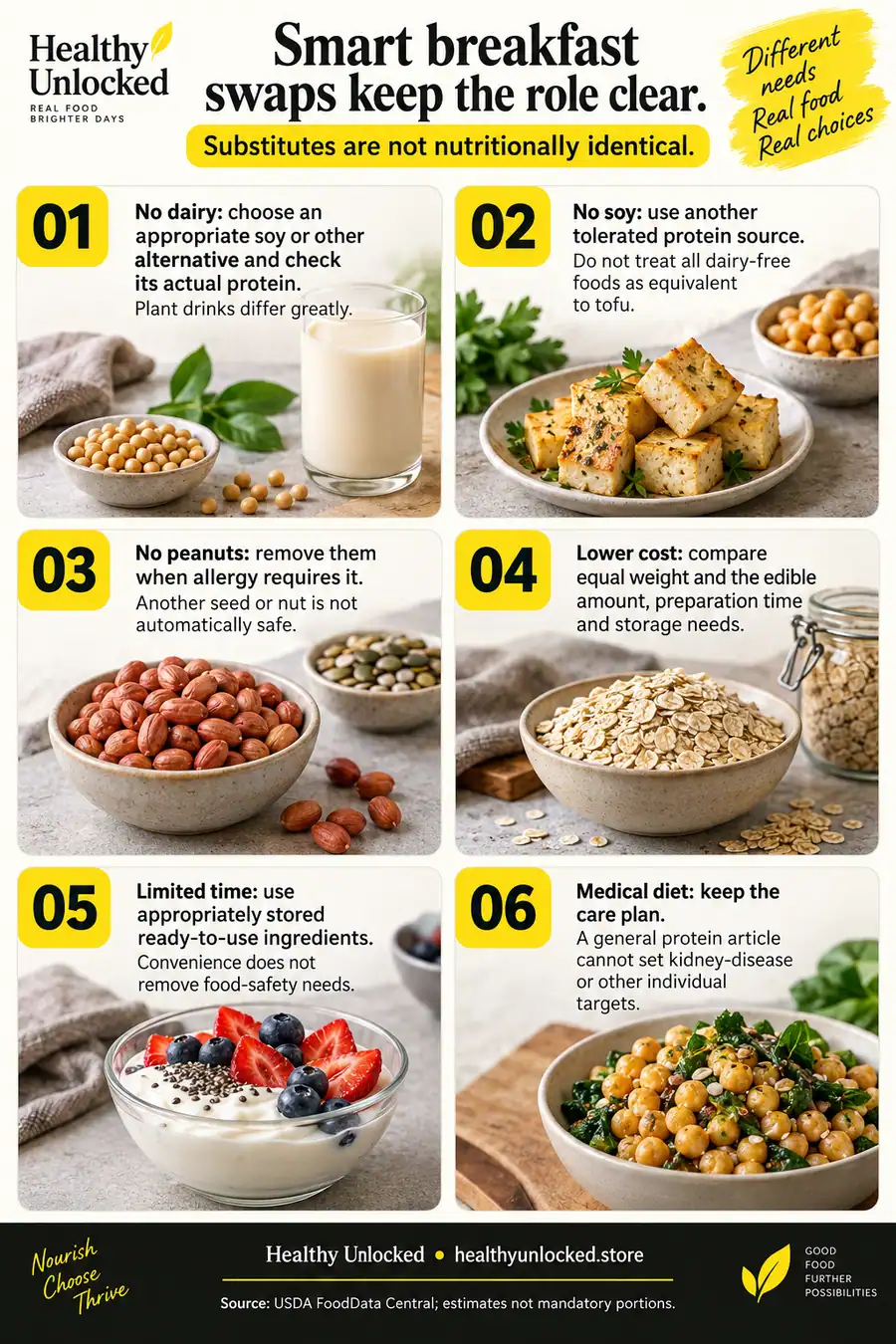
Compare price in a way that fits real use
Price per 100 g can make package sizes easier to compare. Price per usable serving can answer a different practical question. Neither proves that a food suits your allergy needs or provides the same protein. A larger package may cost less per gram but create waste if you cannot use or store it safely.
Include preparation time and storage in the decision. A food that needs overnight preparation may be easy for one household and awkward for another. No breakfast style is universally superior. MyPlate’s budget guidance offers broader planning ideas without making a particular product mandatory.
Keep cultural and personal preferences in the plan
You can use familiar savory food rather than copying a photographed bowl. The useful question is what each component contributes and whether the combination suits your circumstances. Our weekly routine review helps connect a small practical change with the problem it is intended to solve. A good breakfast plan should work in your kitchen, not only in an image.
What preparation, storage and allergy precautions matter?
Egg-free food still needs safe handling and appropriate storage. Dairy, cooked foods and mixed meals do not become shelf-stable because they contain no egg. Follow product directions, use clean preparation practices, and consider cross-contact when allergy is relevant. A generic meal idea cannot assess your particular kitchen or medical situation.
FoodSafety.gov’s four food-safety steps explains cleaning, separating, cooking and chilling. Use the guidance relevant to your food and conditions. This article does not assign one storage time to every mixed breakfast. A bowl with yogurt and a dry packet of oats have different requirements.
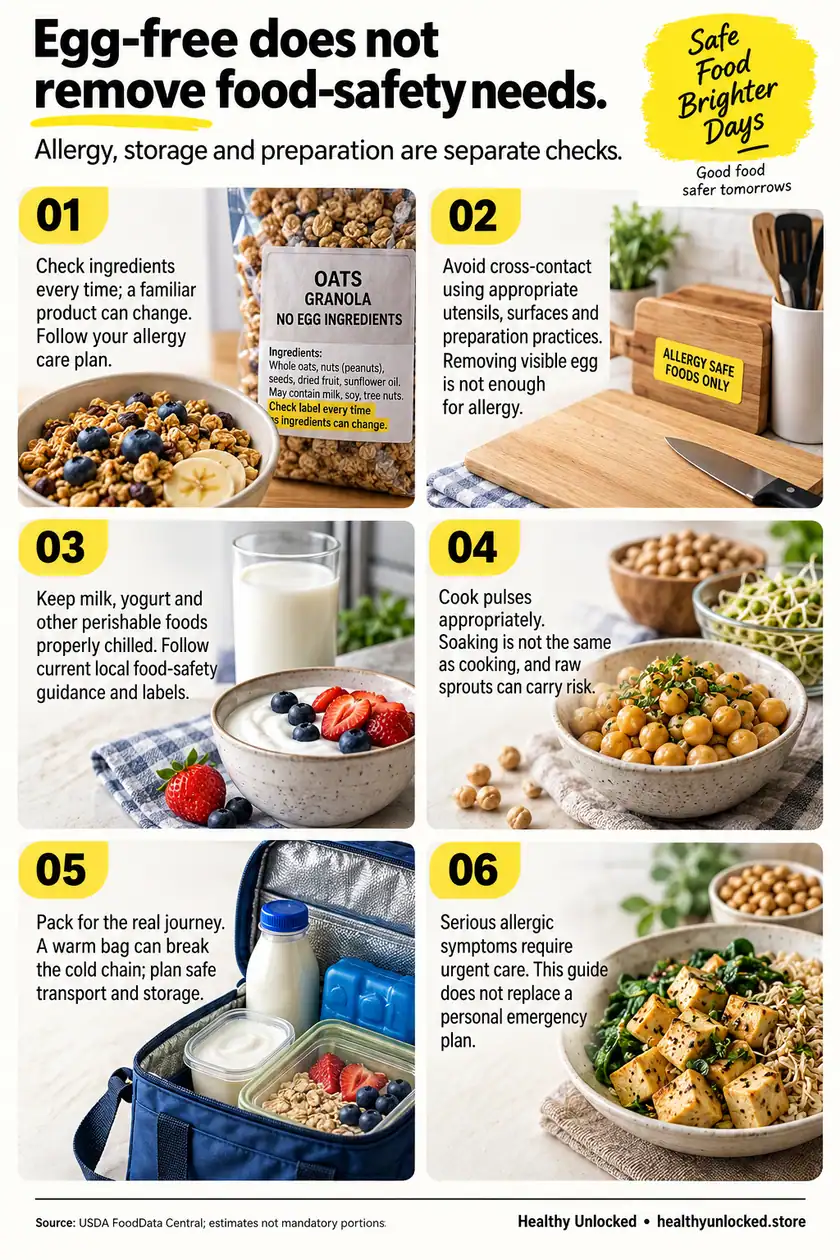
Allergy avoidance includes preparation surfaces
Shared utensils, spreads, cooking surfaces and packaged ingredients can matter when egg allergy is diagnosed. FARE’s cross-contact information explains the distinction from ordinary ingredient choice. Washing or removing a visible ingredient does not automatically make every preparation suitable. Follow the advice appropriate to your own allergy plan.
Do not test a known allergen simply because a recipe looks appealing. A substitution needs checking for its own allergens too. If you eat away from home, the person preparing food needs accurate information about the relevant restriction. A general list of “safe breakfasts” cannot replace that communication.
More fiber is not always the most comfortable change
Chickpeas and oats can add dietary fiber, but a large sudden increase may be uncomfortable for some people. Adapt gradually where suitable, and seek advice for persistent digestive symptoms. The chart’s fiber figure is a nutrient estimate, not a recommendation to maximize it at every meal. Individual medical restrictions may require a different approach.
The general guidance here also cannot decide dietary needs for kidney disease, swallowing problems, pregnancy, children or other specific circumstances. A health condition does not mean you cannot enjoy breakfast; it means an individual plan matters. Use your care team’s instructions when they differ from a general food guide.
How does the two-food breakfast calculator work?
The calculator adds protein and fiber for two stated portions from the six-food chart. It uses the source-based values before final rounding. It does not include unselected fruit, bread, oil, toppings or drinks. Choosing the same food twice means two of that stated portion, not one portion counted once.
Try the two-food breakfast builder
Choose two stated portions. The result adds only protein and fiber before other ingredients; it does not assess a complete breakfast or your needs.
Example: 200 g plain nonfat Greek yogurt + 40 g dry oats = about 25.7 g protein and 4.0 g fiber. Same food selected twice means two stated portions.
Your selections stay in this page. No personal health data is stored or sent by this tool.
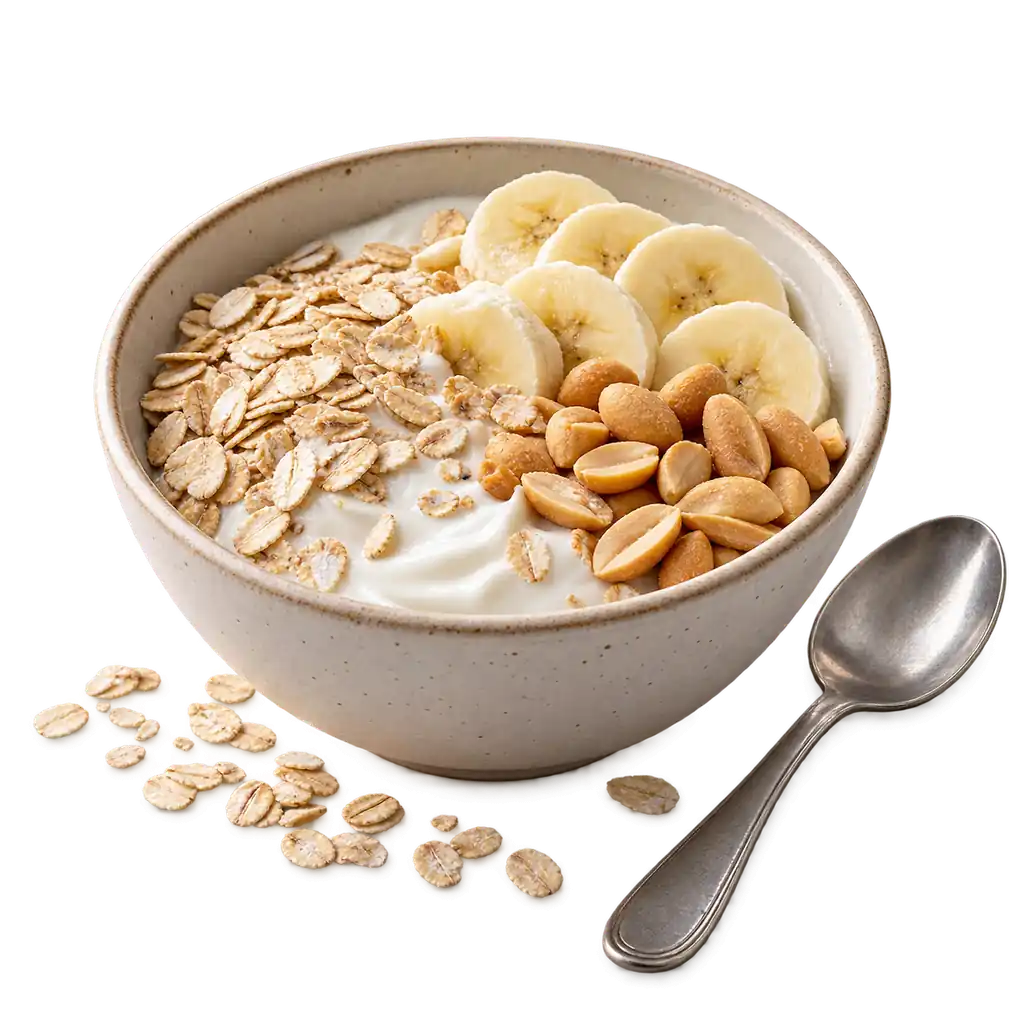
A subtotal is not a whole meal analysis
If the result says yogurt plus oats provides about 25.7 g protein, it means the two specific portions in the dataset. Changing yogurt type or oat weight changes the answer. The image of a bowl is not used to measure nutrients. There is no visual recognition of your food and no personal target hidden behind the calculation.
The tool does not estimate every nutrient, calorie need or allergy risk. A meal with a clear protein subtotal can still need other components or a different portion. The purpose is to show a traceable arithmetic step, not to declare the breakfast complete. Keep the ingredient list, appetite and individual needs alongside the result.
No personal information is needed
You do not need to enter your weight, age, diagnosis or contact details. The inputs stay in the page’s calculation; this tool does not build a personal health profile. The visible examples remain useful if JavaScript is unavailable. A browser result is an educational estimate, not a clinical recommendation.
How were the nutrient totals calculated?
For each nutrient, the formula is the source value per 100 g multiplied by the stated weight, divided by 100. Add the unrounded portion values, then round the final subtotal to one decimal place. The downloaded data identifies food records, preparation and weights. This makes the estimates inspectable without claiming precision that a variable food cannot provide.
| Combination | Protein calculation | Fiber calculation | Final two-food subtotal |
|---|---|---|---|
| Greek yogurt 200 g + dry oats 40 g | 10.2 × 200 ÷ 100 + 13.2 × 40 ÷ 100 = 25.68 g | 0 × 200 ÷ 100 + 10.1 × 40 ÷ 100 = 4.04 g | 25.7 g protein; 4.0 g fiber |
| Cooked chickpeas 100 g + raw peanuts 28 g | 8.86 × 100 ÷ 100 + 25.8 × 28 ÷ 100 = 16.084 g | 7.6 × 100 ÷ 100 + 8.5 × 28 ÷ 100 = 9.98 g | 16.1 g protein; 10.0 g fiber |
Download the source-based comparison
Download the breakfast protein and fiber dataset. It covers the six stated foods, not every possible breakfast. Reader-facing food links open the USDA nutrient pages rather than raw JSON. Source records are historical SR Legacy data; a current product label may differ. An access date describes when the records were checked, not when the foods were laboratory tested here.
Numbers rounded in the food table may not sum to exactly the same last decimal as unrounded calculations. That is why the method and final rounding rule are visible. A changing product, different preparation or altered portion needs a new calculation. Do not silently keep an old total because the dish has the same name.
What the evidence does and does not establish
Primary nutrition, safety and allergy resources support the explanations. Worked examples provide original arithmetic from identified data. Photographs illustrate food combinations; they do not document recipe testing or nutrition analysis in this kitchen. No independent dietitian review or individual suitability is claimed.
Our guide to evaluating a wellbeing resource explains how to check authorship, evidence and limits. Useful detail should make a decision clearer. More links or a longer article cannot turn a generic estimate into personalized medical advice.
Common questions about breakfast without eggs
Can you get useful breakfast protein without eggs?
Yes. Suitable yogurt, milk, tofu, legumes and nuts can contribute protein. The amount depends on the actual food, preparation and portion. Choose a combination that fits your needs; the chart is not a personal protein target.
Does egg-free mean vegan or allergen-free?
No. An egg-free meal can contain dairy, soy, nuts or other allergens. Vegan and dairy-free describe different restrictions. For diagnosed egg allergy, check ingredients and cross-contact according to your own care plan.
Can regular yogurt use Greek-yogurt numbers?
Not automatically. The chart uses plain nonfat Greek yogurt from a specific USDA record. Regular yogurt, flavored products and plant alternatives can differ. Use the actual label or an appropriate source record.
Are dry and cooked oat weights interchangeable?
No. Oats absorb liquid during preparation. The example uses 40 g dry oats, not 40 g cooked oatmeal. Keep the preparation state and weight together when calculating nutrients.
Is the calculator a complete breakfast analysis?
No. It adds protein and fiber for two stated portions. Other ingredients and nutrients are outside that subtotal. Choosing the same food twice represents two portions. It does not diagnose needs or certify a meal as complete.
Do you need protein powder for an egg-free breakfast?
Not automatically. Ordinary foods can contribute protein. A supplement has its own suitability, ingredient and quality questions. Individual medical or dietary needs may require professional advice; this article does not prescribe supplements.
Your next breakfast: choose a suitable protein anchor, add a fiber-rich partner and read the actual portion. Keep the combination practical and enjoyable. A clear source and a modest calculation are more useful than an impressive number with hidden assumptions.
About this article
By Yashveer Bharani for Healthy Unlocked. This guide combines linked nutrition, allergy and food-safety resources with original calculations from six identified USDA records. Illustrative weights are not required portions. Photographs do not document recipe testing. The content provides general education, not an individualized nutrition plan, clinical review or guaranteed result.
Sources and further reading
These original sources support the guidance and clarify its limits. Calculators use the stated assumptions, not personal health measurements. Some references are in English. A link does not mean that the institution reviewed or endorsed this article.
Core guidance
Practical reading
Preparation and labels
Safety and care
Related evidence
Reference resources
 Healthy Unlocked
Join the conversation
Share a practical idea or ask a question about this guide. Please keep personal medical details private.