

Summary
A perimenopause symptom tracker is useful when it records changes clearly for a clinical conversation. Note period and bleeding changes, sleep, hot flushes, mood and other concerns that affect your day. A diary cannot confirm menopause, rule out other causes, score your health or choose hormone treatment.
This guide helps you keep short factual notes and prepare questions for a clinician. You will find five comparison tables, example entries, appointment priorities and a planner that counts completed diary days. The completion percentage describes record keeping only; it says nothing about symptom severity.
What you’ll understand
- Keep notes factual. Record what happened, when and how it affected you.
- Separate frequency and impact. A frequent symptom and a disruptive symptom are different descriptions.
- Do not dismiss bleeding. Bleeding after menopause needs assessment, even if light or once.
- Add context. Medicines, contraception, surgery and other changes help interpretation.
- Prepare priorities. Bring your most important concerns and a small set of questions.
- Avoid a diagnostic score. Completing more diary entries does not prove a diagnosis or better health.
Start with these steps
- Write the main change in your own words.
- Add dates, context and the effect on daily life.
- Choose one or two priorities for the appointment.
- Ask about assessment, options and follow-up.
Do not wait to complete a diary when bleeding or other symptoms are concerning. Severe bleeding with faintness, severe distress or feeling unsafe can require urgent help. This is general education, not diagnosis or personalized treatment.
What can a perimenopause tracker help you understand?
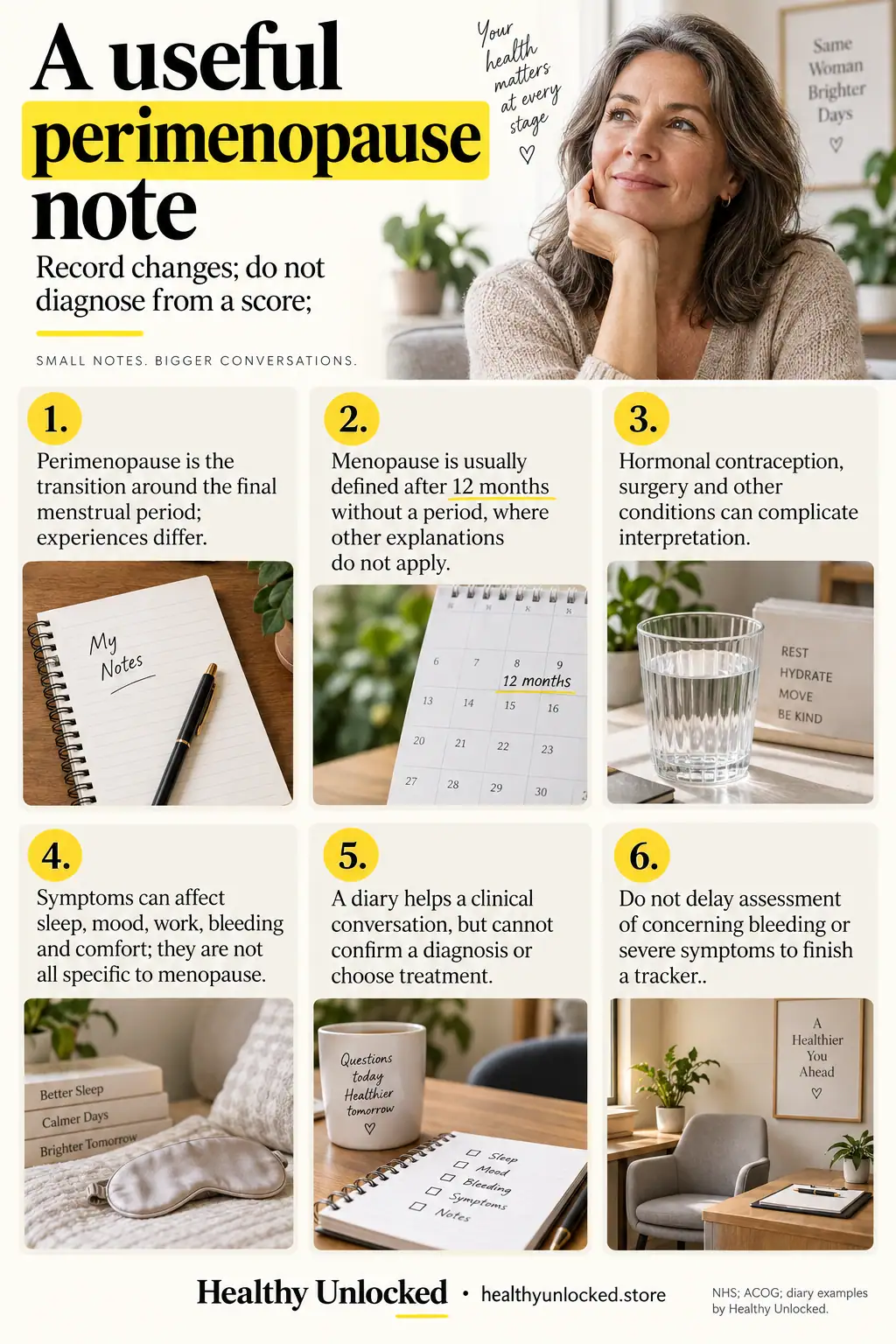
A tracker helps you remember and explain changes. It is a communication aid, not a test that declares you are in perimenopause. The most useful record often describes an ordinary experience plainly: when a period changed, whether a hot flush interrupted work or how a difficult night affected the next morning.
Perimenopause is the transition around the final menstrual period. Menopause is commonly defined after twelve months without a period when other explanations do not apply. NHS information about menopause and perimenopause explains the broader transition. Hormonal contraception, surgery and other circumstances can complicate interpretation, so a calendar alone does not settle every situation.
Experiences differ. Some people notice several changes, some notice few, and the effect on daily life varies. A symptom list should not make you feel that you must experience every item. It should also not suggest that a symptom is unimportant because it does not match someone else’s story.
Sleep changes, mood, concentration, hot flushes, vaginal discomfort and urinary concerns may belong in the discussion when relevant. These experiences are not all specific to menopause. A diary should preserve the observation without deciding the cause before assessment. Write what happened rather than assigning every new problem to hormones.
You do not need an elaborate application or a long daily essay. A notebook, a short worksheet or a private document can work. Choose a format you can use comfortably and access at the appointment. The purpose is a clearer conversation, not a perfect record that becomes another daily obligation.
| Diary task | Useful purpose | Limit |
|---|---|---|
| Dates and patterns | Help you recall when changes occurred | Do not establish a diagnosis alone |
| Daily impact | Show what interrupted sleep, work or comfort | Does not create a severity score across unrelated symptoms |
| Medicine and contraception notes | Provide context for assessment | Does not tell you to change treatment |
| Appointment questions | Organize priorities | Does not replace a clinician’s evaluation |
| Completion count | Show which days were recorded | Missing days are not symptom-free days |
Use your own words before medical labels
“I woke twice feeling very hot” gives a different kind of information from “my hormones are definitely low.” The first is an observation you can discuss. The second is an explanation that may not be established. Keeping that difference clear makes the record more useful without making your experience less real.
If a familiar term helps, you can use it alongside the description. You might write hot flush, night sweat or vaginal dryness, then explain what you noticed. A clinician can ask further questions and consider other explanations. You do not need to learn an entire medical vocabulary before seeking help.
Choose a short set of useful diary fields
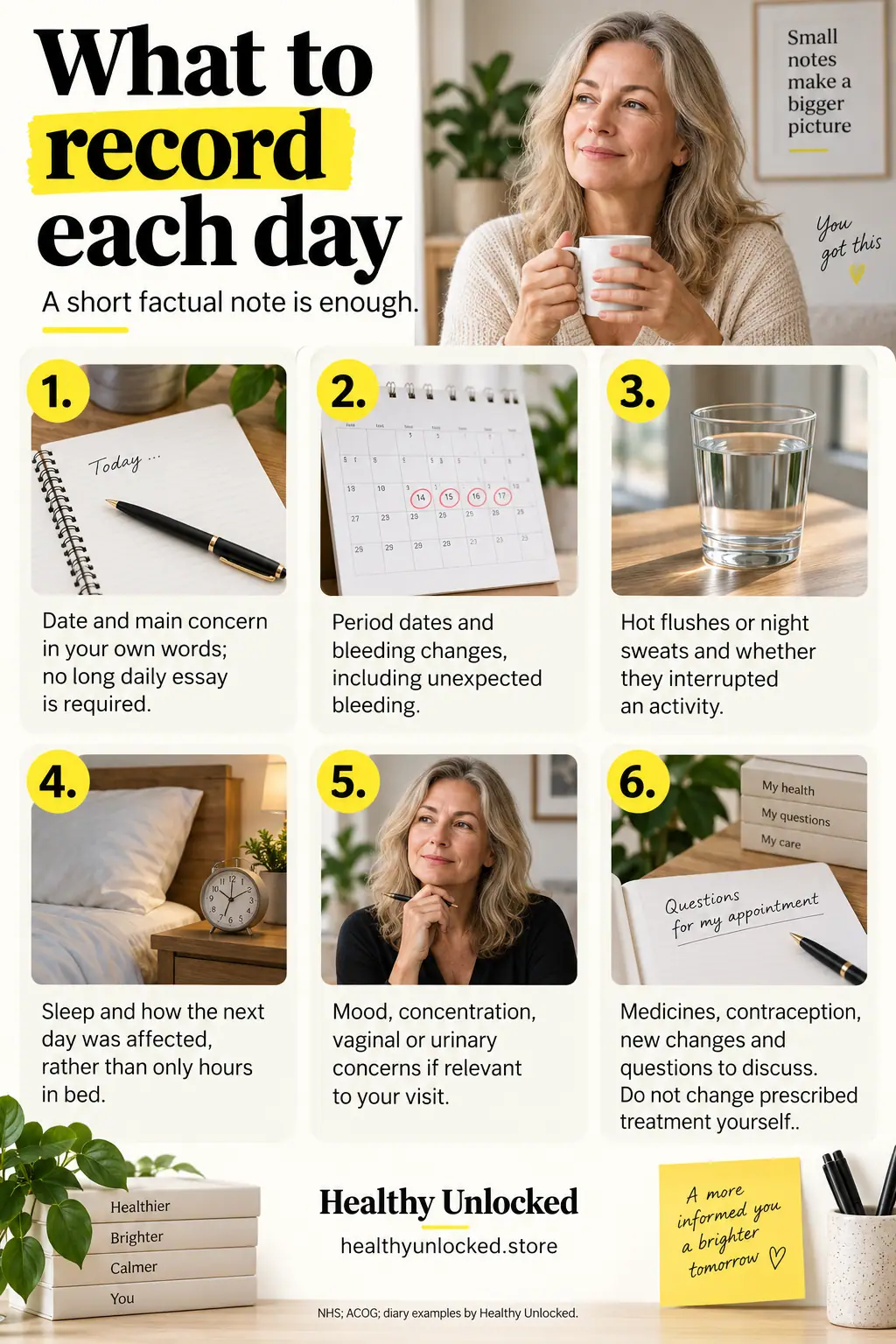
Begin with a small set of fields: date, main change, relevant timing and daily impact. Add period or bleeding information when it applies, along with a brief note about medicines or other circumstances. Too many fields can make the record harder to keep without adding useful detail.
For sleep, distinguish time in bed from your actual experience. You might note difficulty falling asleep, waking with sweating or feeling tired the next day. An exact hour total can be uncertain. It is better to leave that uncertainty clear than to supply a precise number you do not know.
For hot flushes or night sweats, note when they happened and whether they disturbed an activity. Frequency and disruption are different. Several brief episodes that you could manage and one episode that interrupted a meeting should not be collapsed into a pretend medical score.
For mood or concentration, describe the effect without self-diagnosis. “Could not focus on a familiar task” or “felt unusually low and withdrew from a usual activity” can start a conversation. Severe distress or thoughts of self-harm need immediate support rather than waiting for a longer pattern.
Vaginal discomfort, painful sex or urinary symptoms can be important even when they feel difficult to mention. You can write a short phrase privately and bring it to the appointment. A clinician can help clarify it. A generic diary cannot distinguish every cause of urinary pain, infection or discomfort.
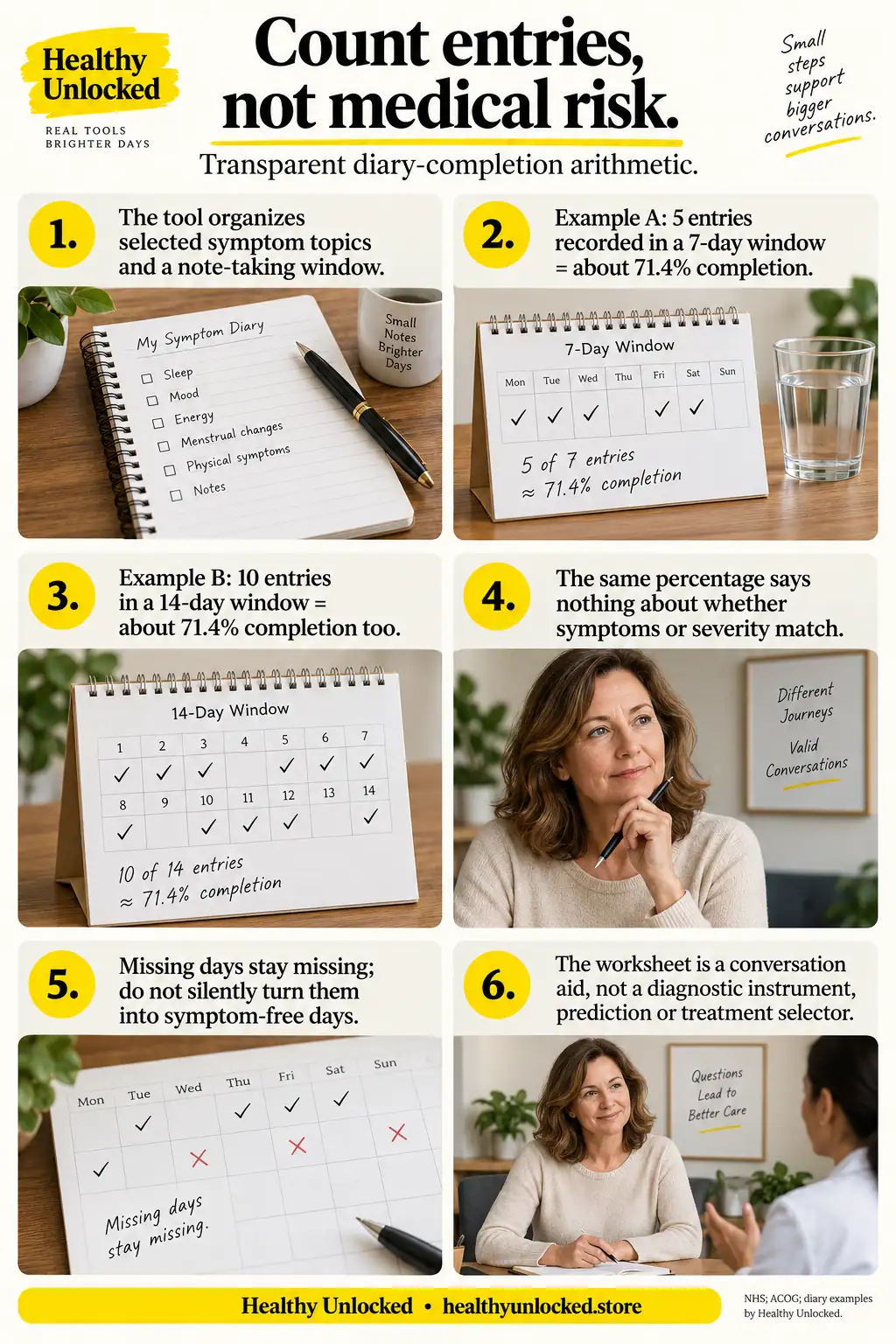
Keep missing entries missing. If you did not record a day, write not recorded or leave it blank. Do not turn an empty row into no symptoms. A diary with some gaps can still be useful when you explain its limits honestly.
| Field | Example note | What to avoid |
|---|---|---|
| Date and main change | Tuesday: woke twice feeling hot | A long essay you cannot sustain |
| Bleeding | Start and end dates; different from usual | Calling all changes normal without assessment |
| Sleep | Waking pattern and next-day effect | Treating time in bed as exact sleep duration |
| Mood or concentration | Familiar task felt harder to focus on | Declaring a diagnosis from one entry |
| Comfort or urinary concern | New dryness or burning, if relevant | Assuming every symptom is menopause |
| Context | New medicine, shift change or illness | Leaving an important change out of the history |
Record bleeding changes without dismissing them
Bleeding changes deserve a clear description and appropriate assessment. A transition can involve period changes, but that does not mean every bleeding pattern should be dismissed as expected. Record the start and end dates, how it differs from your usual pattern and any other relevant symptoms.
Include bleeding between periods or after sex when present. Bring that information to a clinician instead of deciding the cause from a tracker. ACOG information about perimenopausal bleeding and bleeding after menopause explains why the context matters and why changes sometimes need investigation.
Any vaginal bleeding after menopause needs medical assessment, even if it is light or happens only once. NHS guidance on postmenopausal bleeding makes this point clear. A low count in a diary does not remove the need to check it, and you should not wait for several repeat episodes to make the record look complete.
Very heavy bleeding with faintness, marked weakness or other severe symptoms may need urgent help. If you feel acutely unwell, a worksheet is not the next step. Seek appropriate care and provide the relevant information when you can. The tool on this page is not an emergency assessment.
Contraception, hormone treatment and surgery can affect bleeding patterns. Note those circumstances for the appointment. Do not change prescribed treatment because a diary or general article seems to label the bleeding. Assessment considers the history and the actual situation.
| Observation | Record if possible | Important action |
|---|---|---|
| Changed period pattern | Dates and difference from usual | Discuss relevant changes with a clinician |
| Bleeding between periods or after sex | Timing and associated symptoms | Seek appropriate assessment; do not assume the cause |
| Bleeding after menopause | Even light or one-off bleeding | Arrange medical assessment |
| Very heavy bleeding with severe symptoms | What happened and how you feel | Seek urgent help rather than finishing a diary |
| Bleeding with contraception or treatment | Product, history and changes | Do not adjust treatment from a general tracker |

A record should support care, not become a waiting period
You do not need to complete seven days, fourteen days or any other diary window before contacting a clinician. Those windows are planning examples for keeping notes. When a symptom is concerning, the decision to seek help is separate from whether you have filled the worksheet.
A single well-described event can be useful information. Write what you remember, including uncertainty, and seek the appropriate help. Do not delay because you lack an exact count, a photograph or a complete cycle history. A clinician can ask further questions.
Describe the effect on your ordinary day
Daily impact helps a clinician understand what matters to you. It might involve disrupted sleep, difficulty working, discomfort during a usual activity or changes in relationships. This does not mean you must prove that a symptom is severe enough to deserve attention. Your concern is a reasonable starting point for discussion.
Use an ordinary example. “I woke twice and was tired during the morning meeting” is more informative than a number with no explanation. “I stopped an activity because of discomfort” describes a practical effect. Keep the example brief enough that you can identify it at the appointment.
A frequency count and an impact description should remain separate. The number of hot flushes is not the same as the effect on work. Adding scores for bleeding, mood, sleep and pain into one total can create false precision unless you are using an appropriate validated instrument under suitable guidance. This page does not do that.
Look at your own notes over time rather than comparing totals with another person. Symptoms, circumstances and recording habits differ. Someone who records more often can have a higher entry count without a worse condition. A diary-completion percentage describes documentation, not the seriousness of the experience.
If work is affected, consider what practical conversation you want to have. You may want to discuss adjustments, breaks or a more comfortable setting. What you share and with whom is your choice. A private symptom diary does not need to become a document for everyone at work.

Keep privacy as part of the plan
Choose where the record will live and how you will bring it to the appointment. A paper sheet can be simple, while a private device may be convenient for someone else. Avoid shared accounts or a public comments section for intimate symptoms. The usefulness of the record does not depend on posting it online.
A partner or family member can help if you want that support. Ask them to help with remembering or organizing, rather than deciding what your symptoms mean. You may also prefer to speak to the clinician alone. Both arrangements can be discussed when you book the visit.
Add medicines, contraception and relevant history
Bring relevant context beside the symptoms. A medicine change, hormonal contraception, pregnancy possibility, surgery or another illness can affect the discussion. A clinician needs this information to interpret the pattern rather than relying only on the symptom list.
List prescribed medicines, nonprescription products and supplements accurately. Names, doses as prescribed and recent changes can be useful to the clinician, but do not enter private medicine details in this page’s public comments. The planner does not ask for them and does not calculate medicine interactions.
Contraception deserves a separate question if you are uncertain. A changed or absent period while using hormonal contraception does not automatically establish menopause, and a tracker does not decide when contraception is no longer needed. Discuss the situation with an appropriate professional.
Prior surgery can matter. An operation involving the uterus or ovaries changes how a bleeding history should be understood. You do not need to decide its medical meaning yourself. Bring the relevant history and ask how it affects assessment and the information you should track.
Stress, shift work, another illness or a change in ordinary routine can affect the same period of life. Including those notes does not dismiss your symptoms. It gives the clinician a fuller picture and prevents the diary from presenting every day as medically identical.
Do not turn an internet list into a test order
A clinician may discuss assessment or investigations based on age, symptoms, history and other circumstances. A general tracker cannot decide which tests you need. Ask what a proposed test would clarify and what its limits are, rather than requesting every test named on an internet page.
Likewise, a result from a test should be interpreted with the full situation. This article does not diagnose a hormone level, select a treatment or declare a result normal. The diary can help you explain the change that prompted the discussion.
Turn your notes into a clearer appointment
Before the visit, choose the one or two concerns that most affect your day. You can bring additional notes, but a short priority statement makes the opening clearer. For example: “My sleep has changed and I have unexpected bleeding that I want assessed.” The clinician can then ask more detailed questions.
Bring the relevant diary, period history and list of medicines or contraception. You do not need to rewrite every entry into a long report. A short summary of when the changes began and what has affected you most is often easier to discuss than many pages of unorganized notes.
Ask which other explanations should be considered and whether further assessment is appropriate. Symptoms can have more than one possible cause. This is a question about careful evaluation, not a claim that your experience is imagined or that menopause cannot be involved.
If treatment options are discussed, ask about benefits, risks, alternatives and how they fit your history and preferences. ACOG information about hormone therapy for menopause offers background for questions. It does not let this article choose a hormone product, dose or route for you.
Ask about options beyond medication when relevant, and what evidence supports them. NHS information about menopause treatment discusses a range of approaches. A video about cognitive behavioral therapy can help explain a topic to ask about, but it is not a substitute for individualized care or a course of therapy.
Finish by clarifying follow-up. What should you record next, when should you return and which symptoms mean you should contact someone earlier? Write the agreed plan in your own words. If something is unclear, ask again rather than leaving with a guess about what to do.
| Question | Why it helps | What the diary cannot decide |
|---|---|---|
| What might explain these changes? | Supports a full assessment | A diagnosis from an online symptom total |
| Does this bleeding need investigation? | Keeps bleeding concerns visible | Whether a pattern can safely be ignored |
| What information or tests would be useful? | Clarifies the purpose and limits | A universal test list for everyone |
| Which options fit my history and preferences? | Supports shared treatment decisions | A hormone product or dose |
| What should I monitor and when should I return? | Creates a follow-up plan | A reason to wait through concerning symptoms |
| What support or adjustments may help? | Connects care with ordinary daily life | Guaranteed benefit from a single lifestyle change |

Know when a diary should not delay care
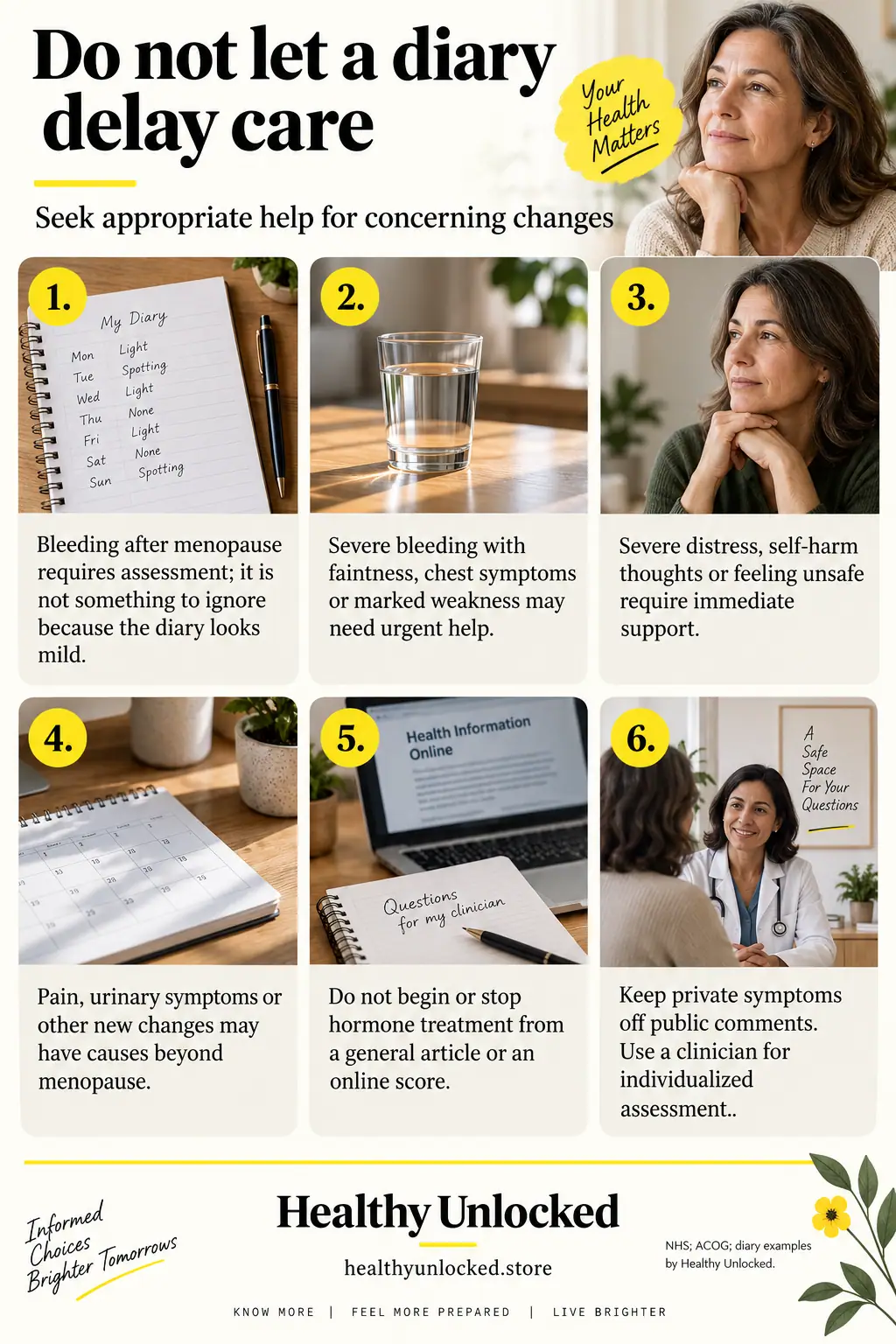
A diary should never become a reason to delay care. Bleeding after menopause needs medical assessment, including light or one-off bleeding. Very heavy bleeding with faintness or other severe symptoms may need urgent help. The number of completed rows does not change those points.
Severe distress, thoughts of self-harm or feeling unsafe require immediate support. Contact appropriate local emergency or crisis services when needed. A symptom tracker cannot assess immediate mental-health risk, and you do not need to collect more entries before asking for help.
Pain, urinary symptoms and other new changes may have explanations beyond menopause. Do not dismiss a persistent or concerning problem because it appears on a menopause symptom list. A clinician can consider the full history and decide what assessment is appropriate.
Do not start or stop hormone treatment from an online score, a general article or someone else’s experience. Medicines, health history and preferences matter. A diary can prepare you for that discussion, but it cannot provide prescribing advice or replace monitoring agreed with a clinician.
Keep the distinction between information and approval clear. This page helps organize observations and questions. It does not claim that a clinician reviewed your notes, approved a plan or diagnosed you. A private review-ready record is useful because it supports actual care, not because it imitates a medical report.
Use the diary planner and download
The diary planner organizes a note-taking window and selected discussion topics. Enter the number of days in your chosen window and the number of days you recorded. The result is recorded days divided by planned days, multiplied by 100. It tells you about diary completion only.
Worked example A: five recorded days in a seven-day window gives 5 ÷ 7 × 100, about 71.4%. There are two unrecorded days. They are missing information, not confirmed symptom-free days. No diagnosis or severity is calculated from the percentage.
Worked example B: ten recorded days in a fourteen-day window also gives about 71.4%. The two people can have completely different symptoms and impacts despite the same percentage. The calculation does not compare their health or recommend the same care.
The tool does not ask you to enter detailed symptoms, intimate notes or medicine names. Topic selections act as reminders for the discussion. They are not weighted into a diagnostic score. A selected topic is not confirmation that the symptom is present or caused by menopause.
Blank values, negative values or more recorded days than the selected window need correction. The planning limits keep the arithmetic coherent; they do not require you to wait that many days for an appointment. Zero recorded days is a zero completion count, not a statement about symptoms.
| Example | Inputs and arithmetic | What the result means |
|---|---|---|
| First example | 5 ÷ 7 × 100 ≈ 71.4% | Diary completion for a chosen seven-day window, not symptom severity or medical risk. |
| Second example | 10 ÷ 14 × 100 ≈ 71.4% | Same percentage in a different window. Missing days are unknown, not symptom-free. Do not delay care. |
Prepare your appointment notes
Count recorded days and select discussion topics. The result is diary completion only; it never diagnoses menopause or rates medical risk. Do not wait to finish a diary before seeking care.
Example: 5 recorded days ÷ 7 chosen days × 100 = 71.4% completion; 10 ÷ 14 gives the same percentage. Neither result says how severe symptoms are. Missing days stay missing.
Entries stay on this page. The tool does not save or transmit your health information.
A worksheet that works without the interactive tool
Without JavaScript, write the chosen days and recorded days on paper. Divide recorded days by chosen days and multiply by 100 if you want a completion percentage. You can also skip the percentage entirely and use the diary fields and appointment questions directly.
Download the private symptom diary and appointment worksheet to record dates, observations, impact, context and questions. Keep the file private. It contains a blank organizing format and examples, not a validated diagnostic questionnaire, a prediction model or treatment recommendations.
Common questions about symptom tracking
These answers describe a communication tool. Concerning symptoms and individual treatment decisions need appropriate professional assessment.
Can a symptom tracker confirm perimenopause?
No. A diary helps you describe changes, timing and daily impact. A clinician considers the full history and other possible explanations. A symptom list or completion percentage cannot confirm a diagnosis, rule out another cause or select treatment.
What should I record for an appointment?
Record dates, period or bleeding changes, relevant symptoms and their effect on ordinary life. Add medicines, contraception, surgery or other context where appropriate. Short factual notes are useful; a long daily essay or an invented severity total is not required.
Should I wait until I have two weeks of notes?
No diary window is a required waiting period before seeking care. The seven- and fourteen-day examples only explain record-keeping arithmetic. Concerning bleeding or severe symptoms should be assessed appropriately without waiting to complete the worksheet.
Does light bleeding after menopause need checking?
Yes. Vaginal bleeding after menopause needs medical assessment even when it is light or occurs only once. A low diary count does not establish that it is safe to ignore. Seek suitable care rather than using the tracker to decide the cause.
Does the completion percentage measure symptom severity?
No. It is recorded days divided by planned days, multiplied by 100. Five of seven days gives about 71.4%, regardless of the symptoms recorded. Missing days remain missing information, and the percentage does not compare health between people.
Can I choose hormone treatment from the diary?
No. Treatment decisions require a discussion of symptoms, history, medicines, benefits, risks and preferences with a qualified clinician. The worksheet helps prepare questions and follow-up, but it does not choose a hormone product, dose or route.
Your next step: write one clear observation and how it affected your day. Bring the relevant dates and context to a clinical conversation. Let the diary support your voice, while leaving diagnosis and treatment decisions to an appropriate assessment.
About this article
By Yashveer Bharani for Healthy Unlocked. This is general educational information about recording changes and preparing for a clinical conversation. The sources below support the guidance; no personalized diagnosis, treatment approval or independent clinical review is claimed.
The planner calculates diary completion only. Its examples are fictional arithmetic, not validated symptom scores or measured clinical outcomes. Illustrative photographs do not document examinations. Seek appropriate care when symptoms or bleeding need assessment.
Sources and further reading
These original references support the guidance and its limits. A link does not mean that the institution reviewed or endorsed this article.
Main guidance
Practical reference
Context and definitions
Safety and care
Evidence and limitations
 Healthy Unlocked
Join the conversation
Share a practical idea or ask a question about this guide. Please keep personal medical details private.