

Summary
A sleep hygiene checklist helps you organize everyday habits that support sleep: enough opportunity, a reasonably consistent schedule, suitable daytime activity, thoughtful caffeine timing, a quieter evening and a comfortable bedroom. These habits can be useful, but they are not a stand-alone treatment for chronic insomnia or a guarantee that every night will go well.
This guide turns the checklist into practical decisions, explains when symptoms deserve assessment and includes a bedtime-opportunity planner. The planner works backward from a chosen wake time; it does not measure sleep, diagnose a disorder or prescribe sleep restriction. A short diary helps you discuss patterns without turning sleep into a performance score.
What you’ll understand
- Opportunity versus sleep. Hours in bed are not necessarily hours asleep.
- A realistic schedule. Work and caring responsibilities belong in the plan.
- Daytime influences. Light, activity, caffeine and naps can affect the night.
- A simpler evening. Choose a few repeatable steps rather than an elaborate ritual.
- Bedroom comfort. Adjust light, noise and temperature without a shopping requirement.
- The boundary of self-help. Persistent problems, breathing pauses and marked sleepiness need care.
Four useful starting checks
- Check your opportunity. Does your schedule leave enough time for sleep?
- Choose one manageable change. Adjust a practical barrier first.
- Keep a brief record. Note patterns without constant clock watching.
- Respect symptoms. Seek advice when habits are not enough.
Keep the scope clear. Do not drive when sleepy or change medicines from this checklist. Shift work, pregnancy, health conditions and persistent insomnia can need tailored advice. General adult guidance should not be substituted for a child’s or teenager’s sleep needs.
What is sleep hygiene, and what can it actually do?
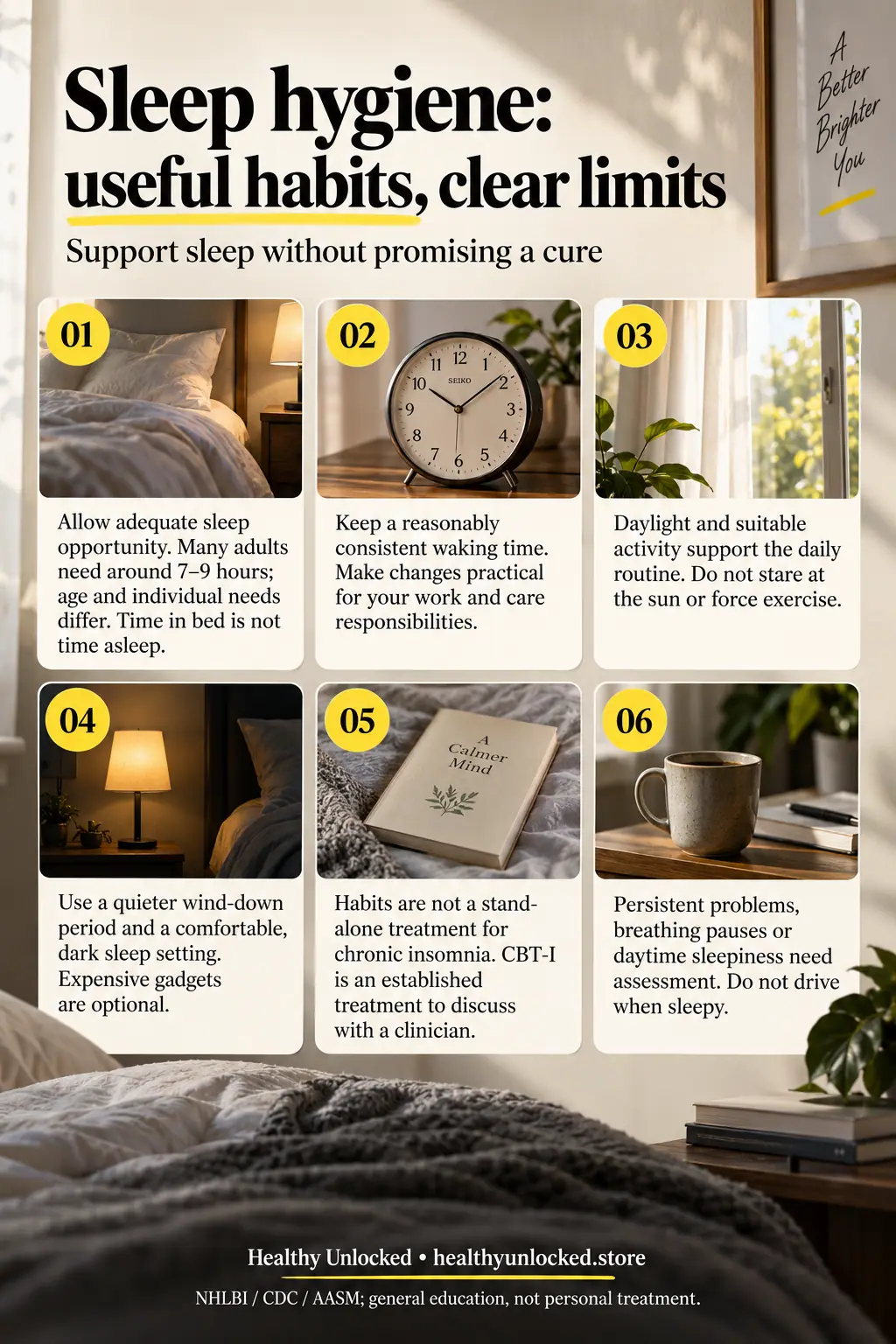
Sleep hygiene means everyday habits and surroundings that support sleep. It covers the schedule, daytime choices, evening activities and bedroom setting. It is a practical starting framework, not a diagnosis or a promise that one checklist can fix every sleep problem. The NHLBI’s healthy-sleep guidance explains these general habits.
The word hygiene does not mean a difficult night is a sign of being careless or unclean. Sleep can be affected by medical conditions, stress, medicines, work and responsibilities outside your control. A useful checklist identifies changes you can reasonably make. It should not create a new standard of perfection or make you feel responsible for symptoms that need assessment.
Separate supportive habits from treatment
For chronic insomnia, cognitive behavioral therapy for insomnia, or CBT-I, is an established treatment to discuss with a clinician. NHLBI’s treatment information explains how it differs from general habit advice. This article does not provide a sleep-restriction program, medication plan or a substitute for that care.
| Area | Useful check | Practical action | Important limit |
|---|---|---|---|
| Opportunity | Enough time available for sleep? | Review work, travel and bedtime tasks | Time in bed is not measured sleep |
| Timing | A reasonably consistent routine? | Choose a feasible wake-time anchor | Shift work may need a different plan |
| Daytime | Light, activity, caffeine and naps? | Observe patterns and adjust thoughtfully | No single cutoff suits every person |
| Evening | A transition from tasks to rest? | Choose a few quieter activities | No guaranteed falling-asleep time |
| Symptoms | Persistent difficulty or safety concerns? | Seek an appropriate assessment | Habits do not rule out a sleep disorder |
Start with the barrier you can change
If bedtime is crowded with practical tasks, preparing tomorrow’s essentials earlier may be more useful than buying a sleep gadget. If noise is the main issue, a conversation about the household routine may matter more than another relaxation app. Our weekly routine review uses this approach of connecting a manageable change with the problem it is meant to solve.
How much sleep opportunity should your schedule allow?
Many adults need roughly seven to nine hours of sleep, although needs differ by age and individual circumstances. The NHLBI sleep-duration guidance explains age-related recommendations. A period set aside for sleep is an opportunity, not proof of how long you slept. Awake periods and difficulty falling asleep can reduce actual sleep within that window.
Work backward from a feasible wake time
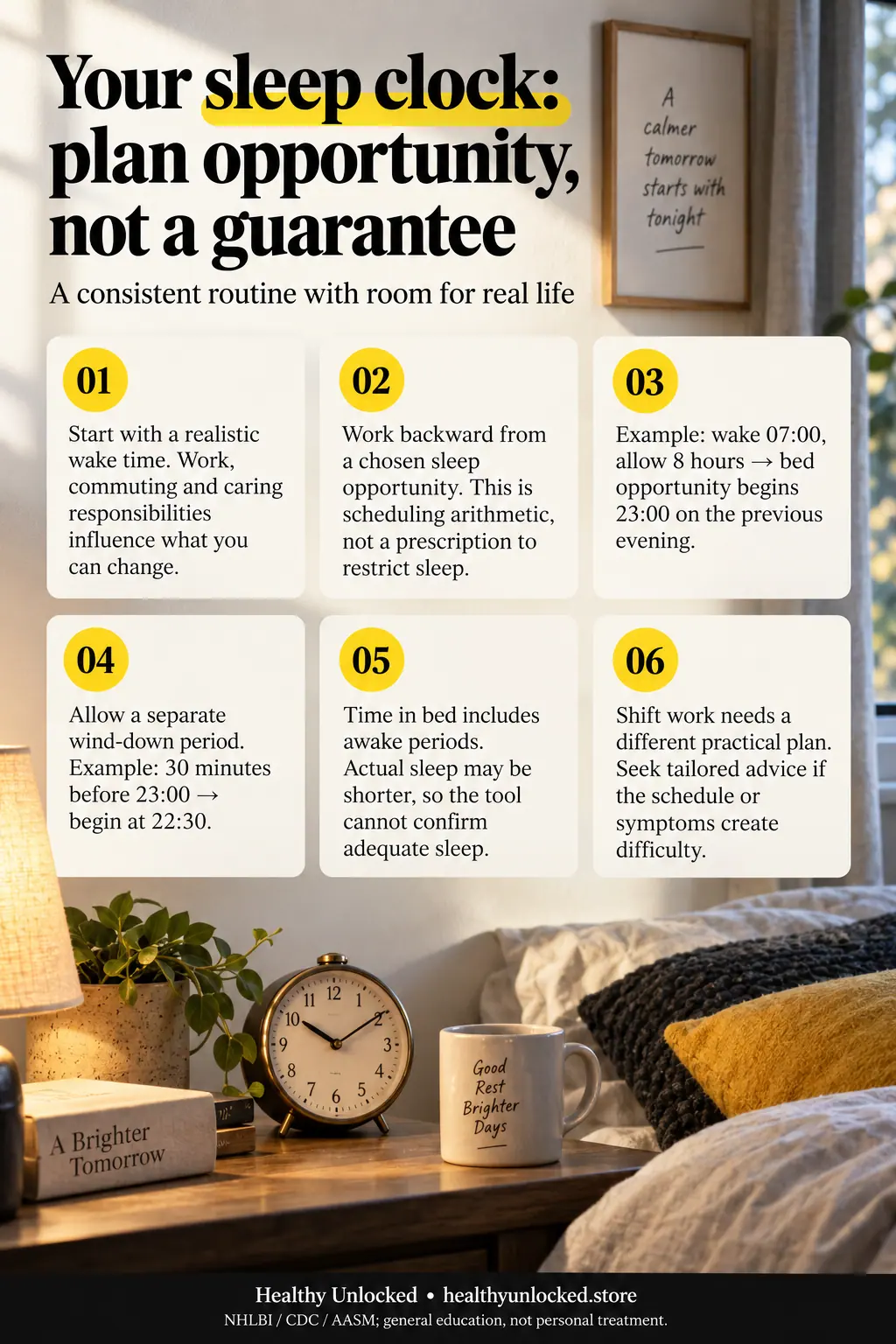
Choose a wake time that fits your real responsibilities, then consider what would leave enough opportunity before it. This makes practical conflicts visible. If a commute requires an early start while evening chores continue late, a planner cannot remove that conflict. It can help you identify which task, timing or support arrangement needs attention.
Keep the routine reasonably consistent when feasible, including days off. Consistency is a direction, not a demand that every day be identical. Caring for a child, shift work or illness can limit control over timing. A general article should acknowledge those limits instead of presenting an exact clock hour as the right bedtime for everyone.
| Question | What to record | What you might adjust | Boundary |
|---|---|---|---|
| When must I wake? | Workday and day-off requirements | A feasible timing anchor | Do not ignore work or caring needs |
| What delays bedtime? | Tasks, travel and stimulation | Move one task earlier where possible | Not every delay is a personal choice |
| How much time is available? | Bed-to-wake opportunity | A more realistic schedule | Not equivalent to actual sleep |
| Do symptoms persist? | Difficulty and daytime impact | Discuss a short diary with a clinician | The planner cannot diagnose insomnia |
Do not turn arithmetic into sleep restriction
The tool below subtracts a chosen opportunity from a wake time. It does not tell you how little time you should spend in bed or how to reduce sleep to treat insomnia. Those treatment decisions are separate. Entering a number makes a schedule calculation, not an individual recommendation. If the plan seems unrealistic or symptoms persist, seek appropriate guidance rather than making the window increasingly strict.
How do daylight, activity, caffeine and naps affect the night?
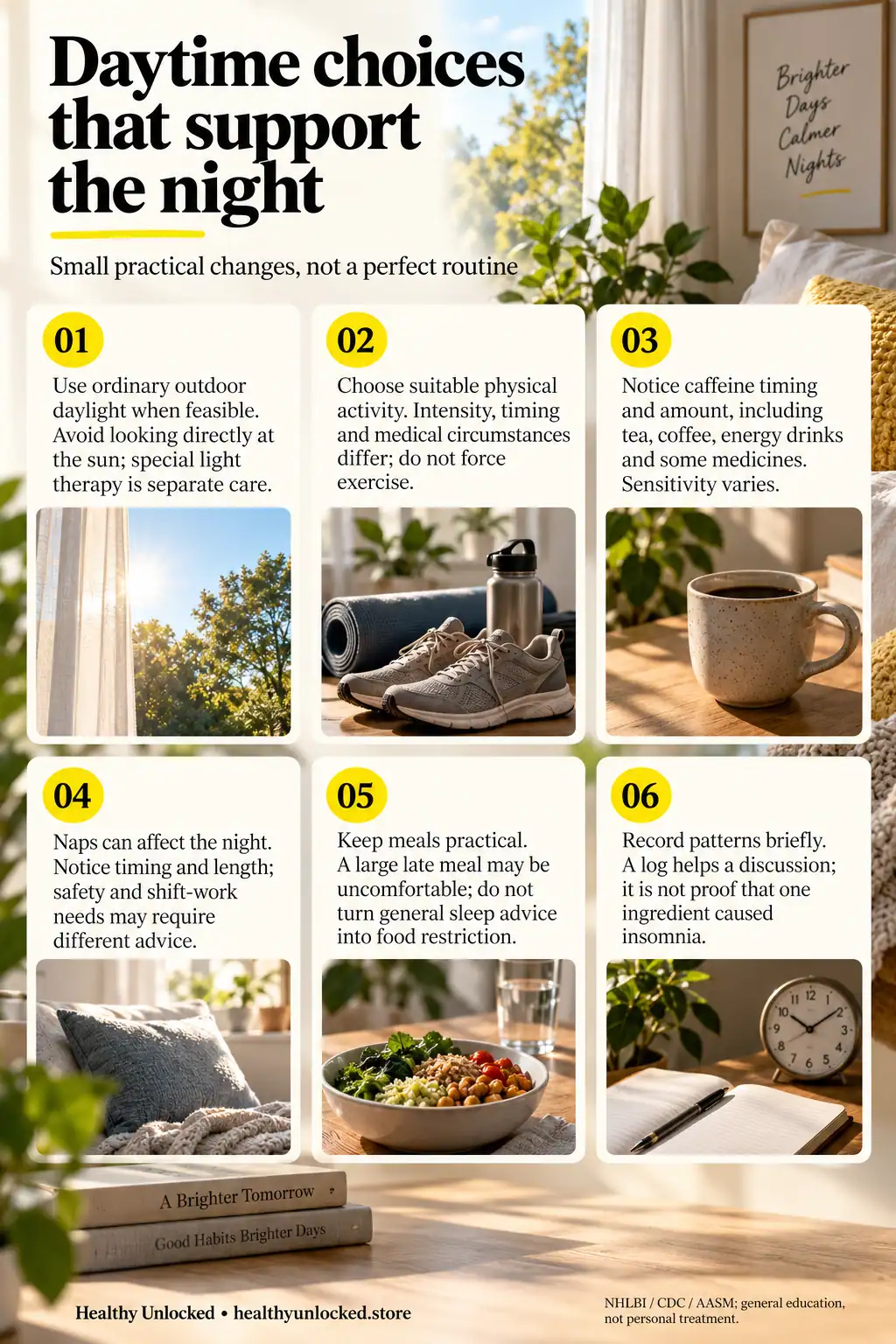
Daytime habits are part of the sleep routine. Ordinary daylight, suitable activity and thoughtful use of caffeine can help structure the day. Their timing and effect vary. Begin by noticing what you actually do rather than adopting a long list of rules that does not fit your work, health or household circumstances.
Use ordinary daylight safely
Spend time outside in ordinary daylight when practical, while keeping appropriate sun protection and safety. Do not stare at the sun. This general habit is different from prescribed bright-light therapy for a circadian condition. The NHLBI explanation of the sleep-wake cycle helps explain why light and timing belong in the discussion.
Suitable physical activity can support everyday wellbeing and the routine around sleep. Avoid making evening exercise an absolute ban or a cure. Effort, timing and personal response vary, and a medical condition can change what is appropriate. If a demanding session near bedtime seems to leave you alert, note the pattern and consider a practical change rather than forcing a universal rule.
Look beyond the coffee cup
Caffeine occurs in tea, coffee, some energy drinks and certain medicines. Check labels and note timing as well as amount. The FDA’s caffeine explanation describes variability and important cautions. A general intake reference is not a bedtime target, and a person’s sensitivity can differ from an average figure.
The useful question is whether your use fits your sleep and health needs, not whether you can find a numerical allowance to justify another late drink. Pregnancy, medicines and some health conditions can change the discussion. Do not stop or alter a medicine independently because caffeine appears in its ingredients; ask the appropriate professional about timing or alternatives.
Observe naps without creating another rigid rule
Naps can affect night sleep, depending on timing and length. Some people, including shift workers, may have different practical needs. Notice whether a late or long nap is part of a difficult pattern. This checklist does not prescribe an exact nap schedule for everyone or suggest that sleepiness should be ignored to protect a perfect bedtime.
Keep safety first. Marked daytime sleepiness can affect driving and work, and needs attention. A planned nap or coffee is not a guarantee that driving becomes safe. If you are sleepy, do not drive. Persistent sleepiness deserves assessment instead of repeated attempts to work around it with a beverage or a stricter habit list.
What makes an evening routine calmer and easier to use?
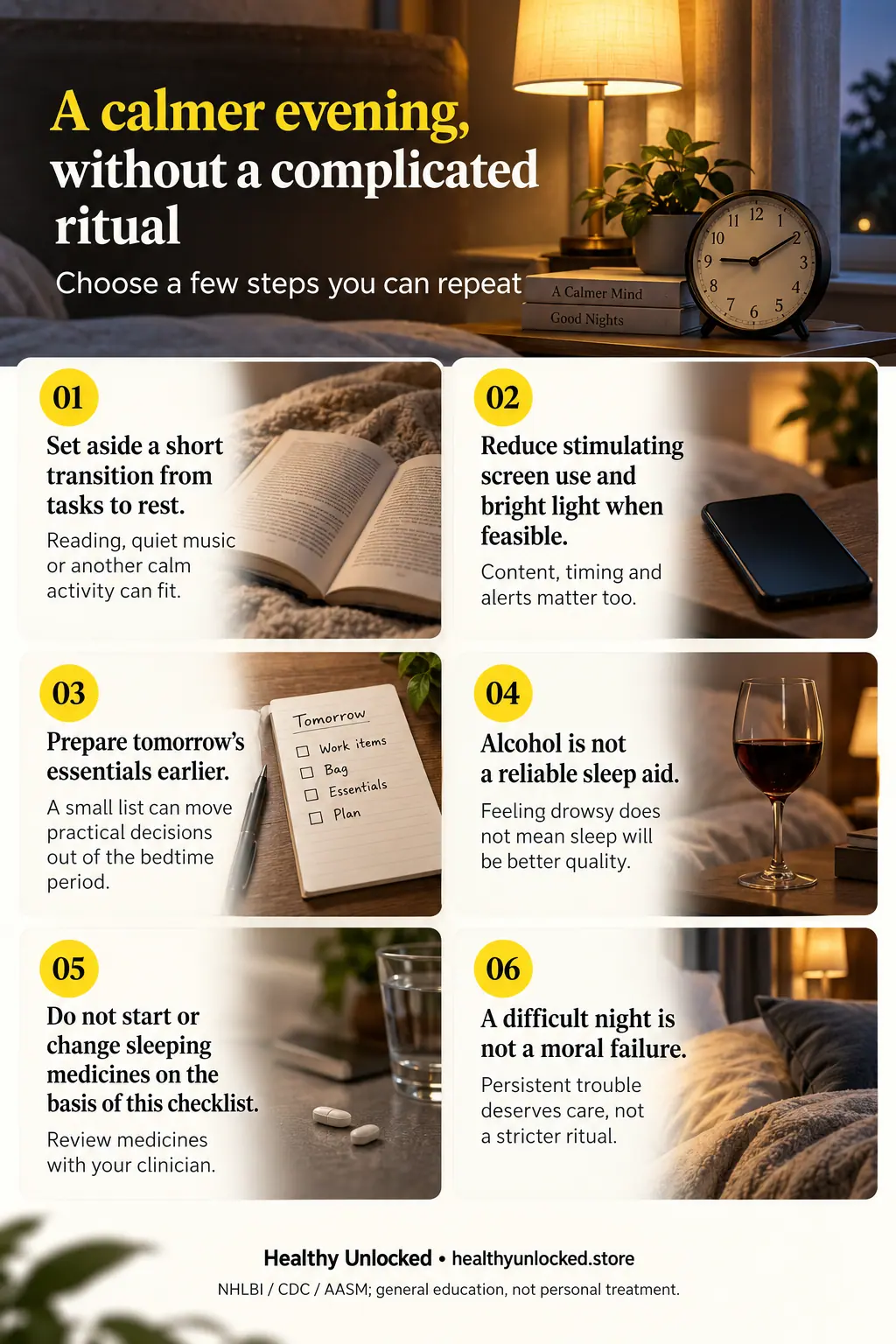
Allow a transition from active tasks to rest. A quieter activity, reduced unnecessary alerts and a small amount of preparation for tomorrow can be useful. The aim is a routine you can repeat, not a long ritual that becomes another job. There is no requirement to buy a special tea, app, supplement or light to make an evening count.
Choose a few ordinary steps
Reading, quiet music or another calm activity may fit your evening. Prepare a short list of tomorrow’s essentials earlier if practical. That can move ordinary decisions away from bedtime. If an activity creates frustration or pressure to perform relaxation correctly, choose a simpler option. The routine should make the transition easier rather than make sleep feel like an exam.
| Choice | Purpose | Simple version | Limit |
|---|---|---|---|
| Prepare essentials | Reduce late practical decisions | Set out what you need tomorrow | Not every household task can move |
| Quieter activity | Transition away from demanding tasks | Read or listen to something calm | No guaranteed time to fall asleep |
| Screen/alert review | Reduce stimulation and interruptions | Adjust unnecessary notifications | Emergency and caring needs remain |
| Alcohol review | Avoid treating drowsiness as quality sleep | Do not use alcohol as a sleep aid | Not a medication or withdrawal plan |
Screens are more than a light setting
Bright light, stimulating content, time spent scrolling and notifications can all be relevant. A blue-light filter alone does not make an intense late conversation or an extra hour of scrolling disappear. Adjust what you can: a quieter task, fewer unnecessary alerts or a practical end point. Avoid using the phone to repeatedly calculate how badly the night is going.
If a device is needed for work, accessibility or caring, plan around that need. Sleep advice should not imply that everyone can remove every screen from the evening. Think about the specific source of disruption. A modest change to content or notifications may fit better than a rule you cannot follow.
Alcohol and sleep medicines need clear boundaries
Feeling drowsy after alcohol does not mean sleep quality will be better. General sleep guidance advises against treating it as a sleep aid. Do not start, stop or change sleeping medicines from a checklist. Medicines and supplements have individual benefits, risks and interactions that require an appropriate discussion.
The NCCIH melatonin resource explains why a familiar supplement still needs careful consideration. Melatonin is not an automatic beginner step or proof that a product is suitable because it is advertised as natural. This article intentionally does not provide doses or instructions for changing treatment.
How can you make the bedroom more comfortable?
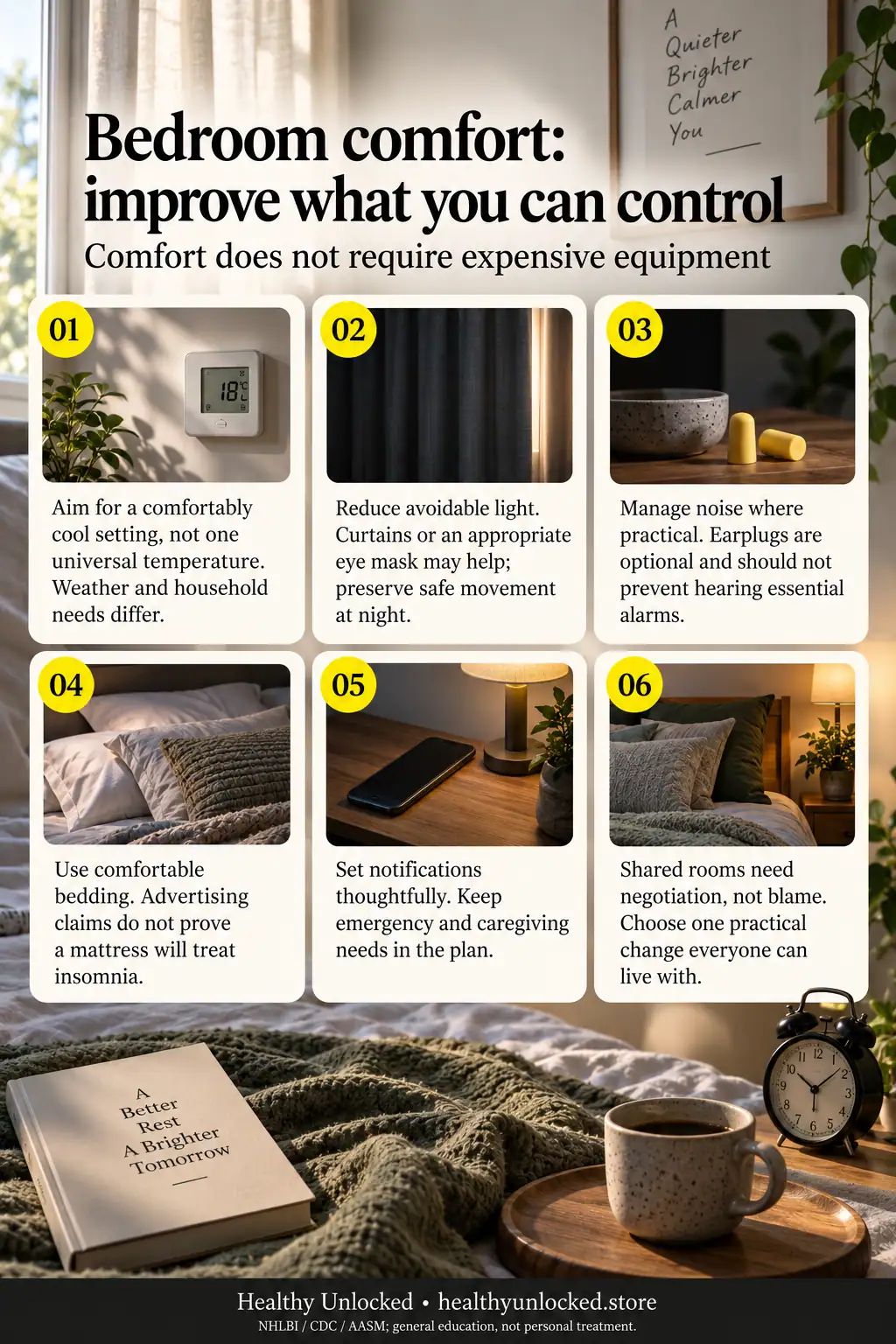
A comfortable, reasonably quiet and dark setting can support sleep. Adjust the parts you can control: unnecessary light, avoidable noise, bedding comfort and room temperature. There is no single temperature or shopping list that suits every home. Climate, personal comfort, shared rooms and safety needs affect the practical choice.
Improve comfort without a gadget requirement
Curtains or a suitable eye mask may help with light, but keep safe movement at night in mind. Noise reduction can be useful where practical; earplugs are optional and should not prevent you hearing essential alarms or caring responsibilities. A fan or ventilation may improve comfort in some settings, but the exact setup should fit the household.
A mattress advertisement cannot establish that a purchase will treat insomnia. Comfortable bedding is a reasonable consideration, separate from a clinical treatment claim. Before spending, identify what problem the item is meant to solve. If the main issue is repeated breathing pauses or persistent insomnia, changing a pillow does not replace an assessment.
Shared rooms need a conversation
People sharing a space may need different light, noise and temperature arrangements. Discuss a small change that respects those needs rather than treating the room as a contest over who follows the best routine. Work schedules and caregiving can create real limits. The checklist should help identify a workable compromise, not assign blame.
Keep essential notifications and emergency access in the plan. Silencing every sound is not useful if you need to hear an alarm or respond to someone’s care. A practical sleep setting balances comfort and responsibility. Try one manageable adjustment and review whether it helped the specific barrier you identified.
When are better habits not enough?
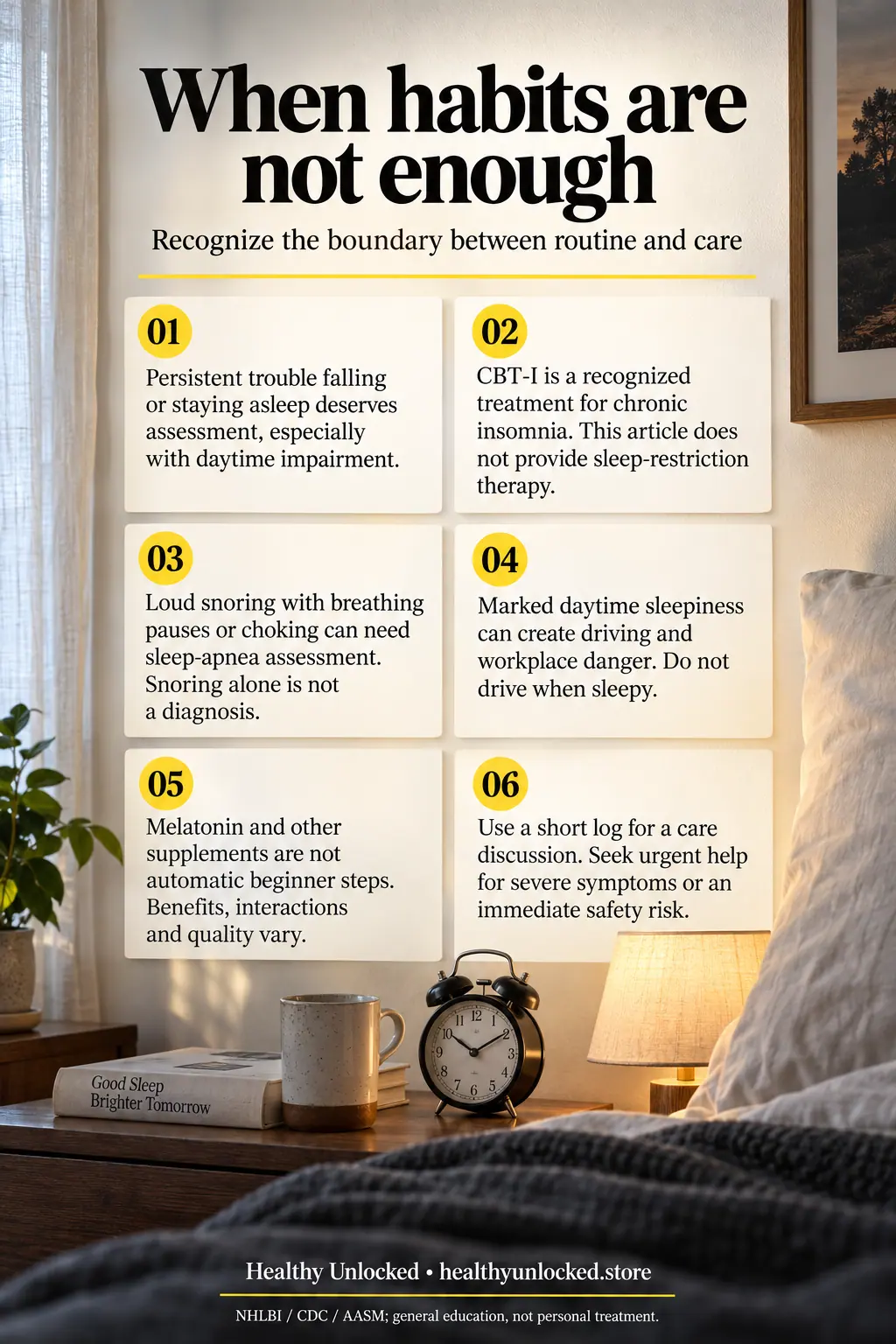
Persistent trouble falling asleep, staying asleep or feeling restored deserves an appropriate discussion, especially when daytime functioning is affected. Sleep problems can have several causes. A checklist cannot confirm that the cause is stress, a screen or caffeine, and good habits cannot rule out a sleep disorder.
| Pattern | Useful next step | Information to bring | Avoid assuming |
|---|---|---|---|
| Persistent sleep difficulty | Discuss assessment and suitable treatment | Brief timing and daytime-impact notes | That stricter habits alone will cure it |
| Breathing pauses or choking | Ask about sleep-apnea assessment | Observed symptoms and sleepiness | That snoring alone proves a diagnosis |
| Marked daytime sleepiness | Address safety and seek advice | When it occurs and its impact | That coffee makes driving safe |
| Medication-related concern | Review with the appropriate professional | Medicine names and current instructions | That an article authorizes a dose change |
Understand what CBT-I means
CBT-I is a structured treatment for insomnia, not simply another name for a sleep-hygiene list. It can include several components, delivered with suitable guidance. The NHLBI treatment page provides an overview. Do not copy treatment components, particularly sleep restriction, into an unsupervised planner merely because the name sounds familiar.
Snoring and sleepiness need context
Loud snoring with breathing pauses or choking can warrant sleep-apnea assessment. Snoring alone is not a diagnosis. The NHLBI symptom information explains the broader picture. If a partner notices a pattern, record it for a care discussion rather than using a consumer recording or app to declare a diagnosis.
Do not drive when sleepy. Severe symptoms or an immediate safety risk require appropriate urgent help. The routine planner cannot assess alertness or decide that you are safe for driving or hazardous work. These limits remain even if every checkbox in the article is selected.
Try the bedtime-opportunity planner
Choose your wake time, the sleep opportunity you want to plan and a wind-down period. The tool subtracts those choices and shows clock times using a 24-hour format. A bedtime later than the wake clock time belongs to the previous evening. The output is a schedule illustration, not a predicted time asleep.
Try the sleep-opportunity planner
Work backwards from a wake time. This is scheduling arithmetic, not a sleep measurement or sleep-restriction treatment. All times use a 24-hour clock.
Example: wake 07:00 − 8 hours = 23:00 on the previous evening; 30 minutes of wind-down begins at 22:30. Actual sleep can be shorter.
Your selections stay in this page. No personal health data is stored or sent by this tool.
Download the sleep routine and observation log. It separates planned timing from actual sleep observations and has space for questions. Keep it privately or print it. You do not need to send personal sleep data to this website to use the tool.
Use the result as a practical conversation starter
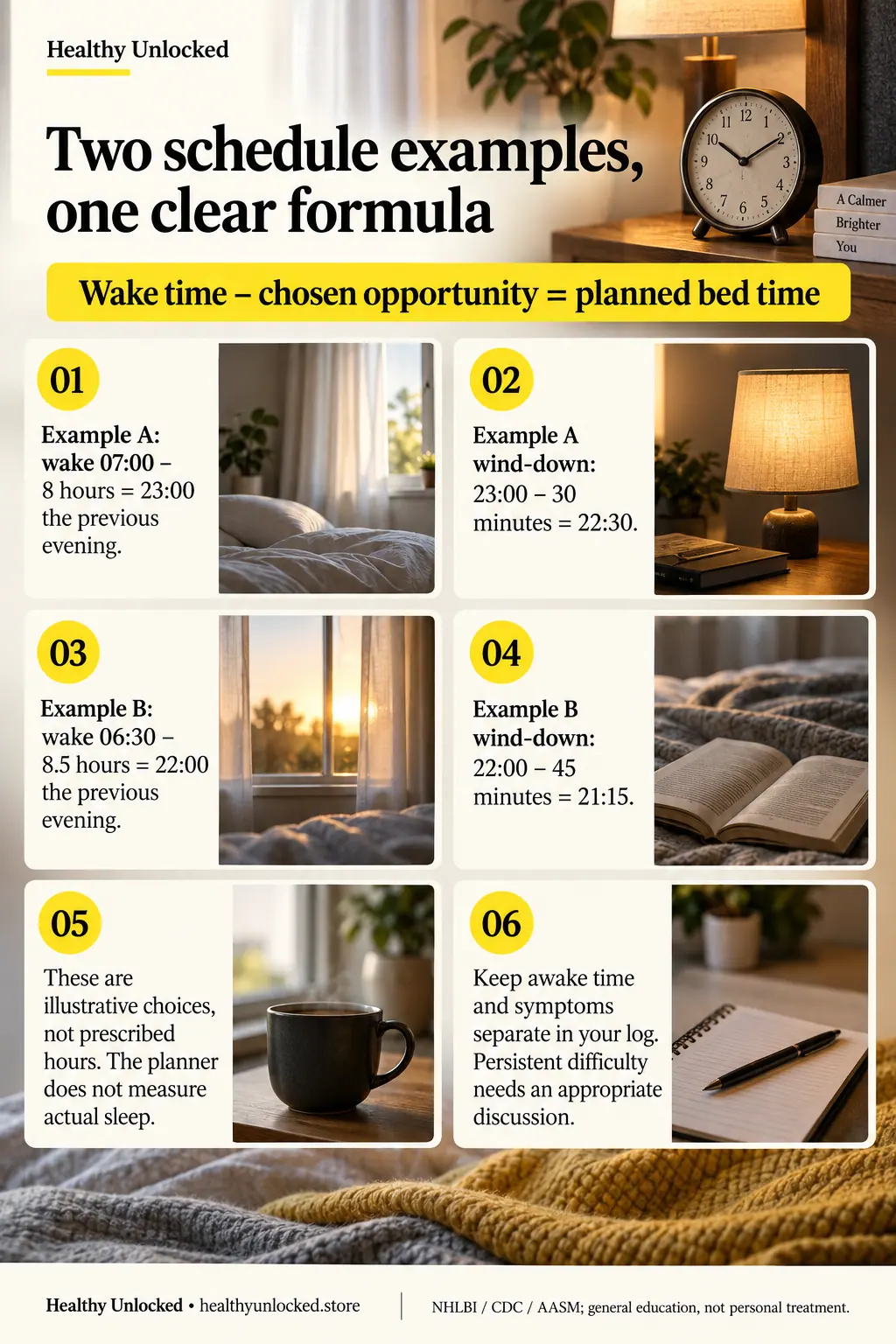
A wake time of 07:00 with eight hours of planned opportunity gives 23:00 on the previous evening. A 30-minute wind-down period begins at 22:30. If tasks make that impossible, review the tasks or support needs. Do not treat the calculated time as a command or assume that getting into bed then guarantees eight hours asleep.
A brief diary can help show timing and symptoms over several days. Avoid constantly checking the clock to calculate a running score. The AASM sleep-diary resource explains its use in a care discussion. A diary is information for assessment, not a device that proves one habit caused a disorder.
How do the two examples work?
The first calculation subtracts chosen opportunity from wake time. The second subtracts the wind-down period from the resulting bedtime. Times wrap across midnight. Both examples use illustrative choices; neither is a prescribed sleep duration, documented patient case or treatment outcome.
| Example | Wake time and opportunity | Planned bedtime | Wind-down calculation |
|---|---|---|---|
| A | 07:00; 8 hours | 07:00 − 8:00 = 23:00 previous evening | 23:00 − 0:30 = 22:30 |
| B | 06:30; 8.5 hours | 06:30 − 8:30 = 22:00 previous evening | 22:00 − 0:45 = 21:15 |
What the numbers do not tell you
They do not measure time asleep, awakenings, sleep stages, alertness or a health outcome. They also do not identify the right treatment for insomnia. A more detailed-looking calculation would not fix those missing observations. The tool is kept limited so its output means what the inputs can actually calculate.
How sources and examples are separated
Public health and sleep-medicine sources support general habit and symptom guidance. The timing examples are original arithmetic illustrations. Photographs show everyday settings and objects, not a sleep study. Our guide to evaluating wellbeing resources explains how to check claims and their limits.
If an individual treatment plan differs from this general guide, follow the advice from your care team. Our purpose-first approach to everyday routines is about keeping ordinary steps usable; it does not make a routine article a clinical treatment. A useful next step can be asking a clearer question rather than adding another product.
Common questions about sleep hygiene
Can sleep hygiene alone cure chronic insomnia?
It should not be presented as a stand-alone cure. Supportive habits can be useful, but chronic insomnia may need assessment and treatment such as CBT-I. This article does not provide sleep-restriction therapy or a medication plan. Persistent problems deserve appropriate care rather than a stricter checklist.
Does eight hours in bed mean eight hours asleep?
No. Time in bed includes periods awake and time needed to fall asleep. The planner calculates opportunity only. It cannot measure actual sleep, stages or alertness. Keep those observations separate in a short diary when discussing symptoms with a clinician.
Is there one best bedtime for everyone?
No universal clock hour fits all adults. Work, caring responsibilities, sleep needs and shift schedules differ. A feasible, reasonably consistent routine is a useful direction. A timing calculation does not decide your individual sleep need or guarantee when you will fall asleep.
Do you need melatonin to begin?
It is not an automatic beginner step. Supplements have variable benefits, risks, interactions and quality. Do not start or change treatment from this checklist. Discuss an appropriate option with a professional when needed, especially if health conditions, pregnancy or medicines affect the decision.
Do snoring and sleepiness always mean sleep apnea?
No, a generic article cannot make that diagnosis. Loud snoring with breathing pauses or choking and marked sleepiness can warrant assessment. Record relevant observations and seek appropriate advice. Do not assume an app, photograph or checklist can confirm or exclude the condition.
What if you are too sleepy to drive?
Do not drive when sleepy. A planned bedtime, coffee or a checked habit list does not certify safe alertness. Address the immediate safety situation and seek appropriate advice for persistent sleepiness. The planner cannot assess driving or workplace safety.
Tonight’s useful step: choose one practical barrier, make a manageable adjustment and keep the result in perspective. A difficult night is not a moral failure. If problems persist or safety is affected, the next step is appropriate care, not a longer ritual.
About this article
By Yashveer Bharani for Healthy Unlocked. This guide combines linked sleep-health sources with original schedule illustrations and an opportunity planner. It does not document sleep testing or provide individualized treatment. Images illustrate ordinary settings; the calculations are planning aids, not measurements of sleep.
Sources and further reading
These original sources support the guidance and clarify its limits. Calculators use the stated assumptions, not personal health measurements. Some references are in English. A link does not mean that the institution reviewed or endorsed this article.
Core guidance
Practical reading
Preparation and labels
Safety and care
Related evidence
Reference resources
 Healthy Unlocked
Join the conversation
Share a practical idea or ask a question about this guide. Please keep personal medical details private.